See Spot Print
We’re not fans of Spotify, for reasons we won’t go into, but in a positive development, thanks to a collaboration with Bookshop.org, you can now buy physical books via Spotify. Says Engadget:
Rather than positioning audiobooks as the hard copy-killer, Spotify is encouraging you to see them as complimentary [sic] to one another. First announced back in February, the new partnership with Bookshop.org appears to be an acknowledgement from Spotify that physical still reigns supreme in the book world. Bookshop is a digital marketplace that enables indie booksellers to take their businesses online, and Spotify says any purchase made through its app will "directly support those bookshops and the authors who brought the story to life."
Whilst viewing an audiobook on Spotify, users will see a “Get a copy for your bookshelf” link (if a physical edition is available) that redirects them to Bookshop.org, which then handles the purchasing and fulfillment processes.
And this is an interesting feature:
Key to this partnership is the new Page Match feature that Spotify launched in February, which allows readers to sync their progress between audiobooks and physical or ebooks so they can jump between formats seamlessly. When reading a paperback, you can use your phone camera to scan the page you reach and continue from that point in the audiobook. It also allows you to scan ereader pages so you can pick up when you left off in the audiobook, and vice versa.
All right, so that’s a point in Spotify’s favor.
How Swede Tt Is
Via Undark, schools in Sweden, after a long pivot away from printed learning materials toward tablets and other digital media, are now reintroducing printed books. And not only printed books, but writing on paper by hand with pencil or pen. The Swedish government also intends to make schools cellphone-free. And they’re ponying up the cash for it.
Last year alone, the education ministry allocated $83 million to purchase textbooks and teachers’ guides. In a country with about 11 million people, the aim is for every student to have a physical textbook for each subject. The government also put $54 million towards the purchase of fiction and non-fiction books for students.
So…why?
Between 2000 and 2012, Swedish students’ scores on standardized tests steadily declined in reading, math, and science. Though they recovered ground between 2012 and 2018, those scores had dropped again by 2022.
Granted, it’s not entirely clear how much of this was due to digital media, but:
there is some evidence that analog teaching materials for reading may be superior to screen learning. However, this applies to expository as opposed to narrative texts. Narrative texts tell a story, whether fiction or non-fiction, while expository texts are designed to inform, describe, or explain a topic in a logical, factual manner.
Mind you, they’re not going full Luddite.
Swedish officials emphasize that digital technology isn’t being removed from schools altogether. Rather, digital aids “should only be introduced in teaching at an age when they encourage, rather than hinder, pupils’ learning.” Achieving digital competence remains an important objective, particularly in higher grades.
Bleak House
Tough times demand tough fonts, and, via Print magazine, the typeface for our dystopian present has now been designed. Called Dickens (who ably chronicled his own dystopian times), it is
a font family that feels less like it was designed and more like it clocked in for a shift. The current mood demands letterforms with a backbone and Dickens has that energy. Not futuristic optimism. Not tech-bro minimalism. More like rolled-up sleeves, ready to get to work energy.

Released by Finnish type foundry Fenotype, and designed by Emil Karl Bertell, Erik Jarl Bertell, and Teo Tuominen‘, Dickens is a serif typeface with quirks, unevenness, and a relatable personality. It works equally well for a natural cosmetics brand, an AI start-up, or a microbrewery in Portland that only serves beer with names like Fermented Anxiety, Late Stage Lager, and Austerity Amber.
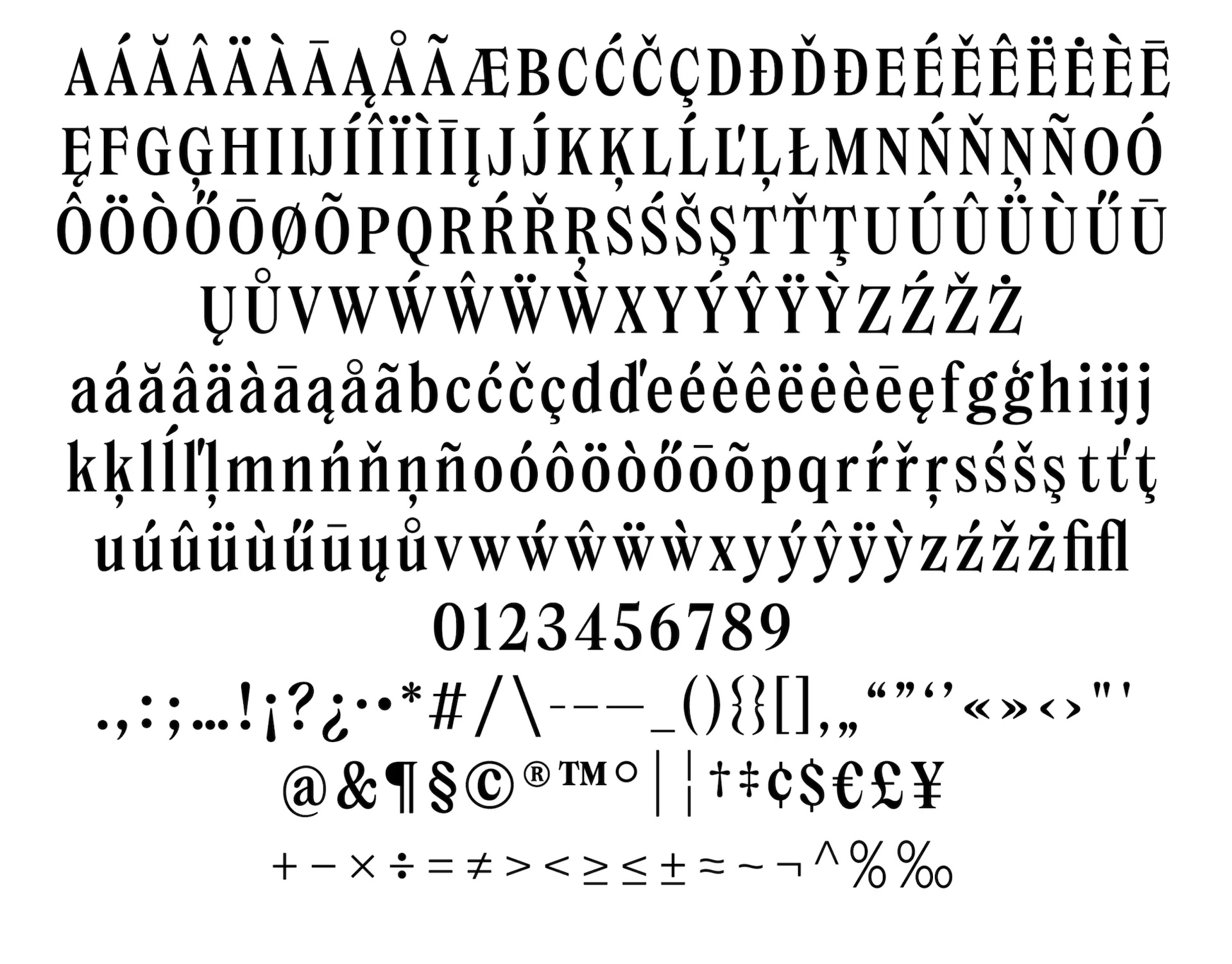
Weights run from thin to very thick, so you can choose your level of existential dread accordingly. Light if you’re feeling optimistic, bold if you’ve read the comments section, extra bold if you’ve gone down a social media rabbit hole. Everything has italics too, because even in hard times we deserve a little drama.
Accept Cookies
Have you ever watched the Great British Bake Off? No, nor have we, although we applaud the idea. We bring this up because a legacy Atlas Obscura story we came across points out that “The ‘Great British Bake Off’ of the 1600s would have been all alphabet cookies.” And for a logical reason: at that time, literacy was still very low, and women would demonstrate “their domestic and scholarly prowess by baking perfect pastry letters.”
Edible letters, Wendy Wall argues in Recipes for Thought Knowledge and Taste in the Early Modern English Kitchen, were a part of a 17th-century “kitchen literacy” that created opportunities for women to practice and perfect reading and writing. This craft extended from decorative swirls, similar to what might adorn cursive handwriting, to actual pastries formed in the shape of letters.
They even turned up in a 17th-century still life by German painter Peter Binoit:
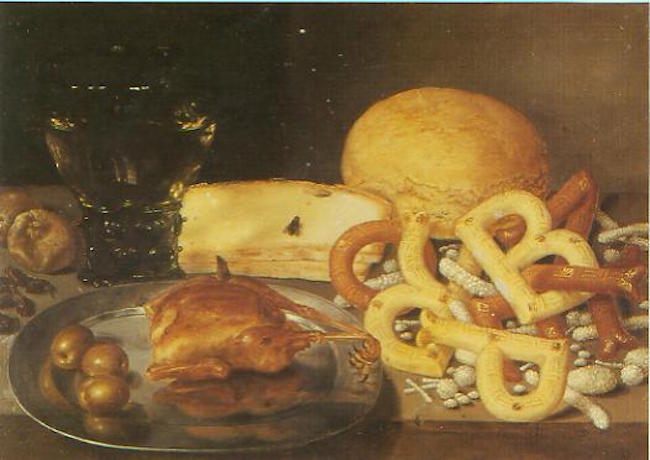
This would be a great promotional strategy (and may actually be) for type foundries, to create accurate edible letterforms, although one needs to be careful not to cut one’s mouth on a serif.
@ Bat
Back in the 1970s, when we first started using typewriters, were always curious about some of the characters. For example, if you typed shift-2, you would get “@”? What did that mean? Half of Princess Leia’s hair? Today, the @ symbol is everywhere. But where did it come from?
Via Laughing Squid, Simple Things – Surprising Histories traces the history of the @ sign all the way back to its use by Renaissance merchants. In 1536, a Florentine merchant was writing a letter about some cargo that was coming in from the Americas, and needed to indicate the price of wine. Wine at the time was transported in a large jar called an amphora. So this merchant abbreviated the word “amphora” with the letter “a” with a tail that curved back over it. For whatever reason, it caught on throughout Europe and eventually began to be used as shorthand for “at the price of”—i.e., “10 apples @ 5¢ each.” The @ symbol eventually made its way onto typewriters primarily for bookkeepers. It fell out of use over the course of the 20th century—until 1971, when email was invented.
Check out the rest of the video here.
By the way, the symbol because so ubiquitous that in 2004 @ was added to Morse code—the first addition to Morse code since World War II. If you need it, the Morse code for @ is • – – • – • (dot-dash-dash-dot-dash-dot). You’re welcome.
WYSIWYG
At least in terms of snacking and…in Japan. In 1962, Japan passed the Act Against Unjustifiable Premiums and Misleading Representations, a consumer protection law intended to stop deceptive advertising and packaging. Via Boing Boing:
Companies can’t exaggerate what’s inside, especially when it comes to size, appearance, or quality. If companies break this rule, they risk fines and public warnings.

Granted, it’s not always a 100% perfect match, but is eerily accurate. How accurate? Check out this Instagram video to see how closely Japanese brands follow this policy.
Slice and Dice
How long do think dice have been around? Surely before the founding of Las Vegas, right? It had long been held that dice—not the six-sided variety we are familiar with, the exotic 20-sided dice known to D&Ders, or the tacky fuzzy dice suspended from 1970s rear-vier mirrors, but more akin to “throw sticks”—were invented in Egypt about 5,200 years ago.
Now, archaeologists have recently found that Native Americans, specifically those in what are now Wyoming, Colorado, and New Mexico, were using dice to play games more than 12,000 years ago. Says Popular Mechanics:
A new study published in the journal American Antiquity by Colorado State University researcher and Ph.D student, Robert Madden, reveals that people living at the end of the Ice Age in North America produced the oldest-known examples of dice in the world. The dice offer an unprecedented look at human interactions with randomness centuries before Europe’s first mathematical models of probability were inspired by questions about dice games.
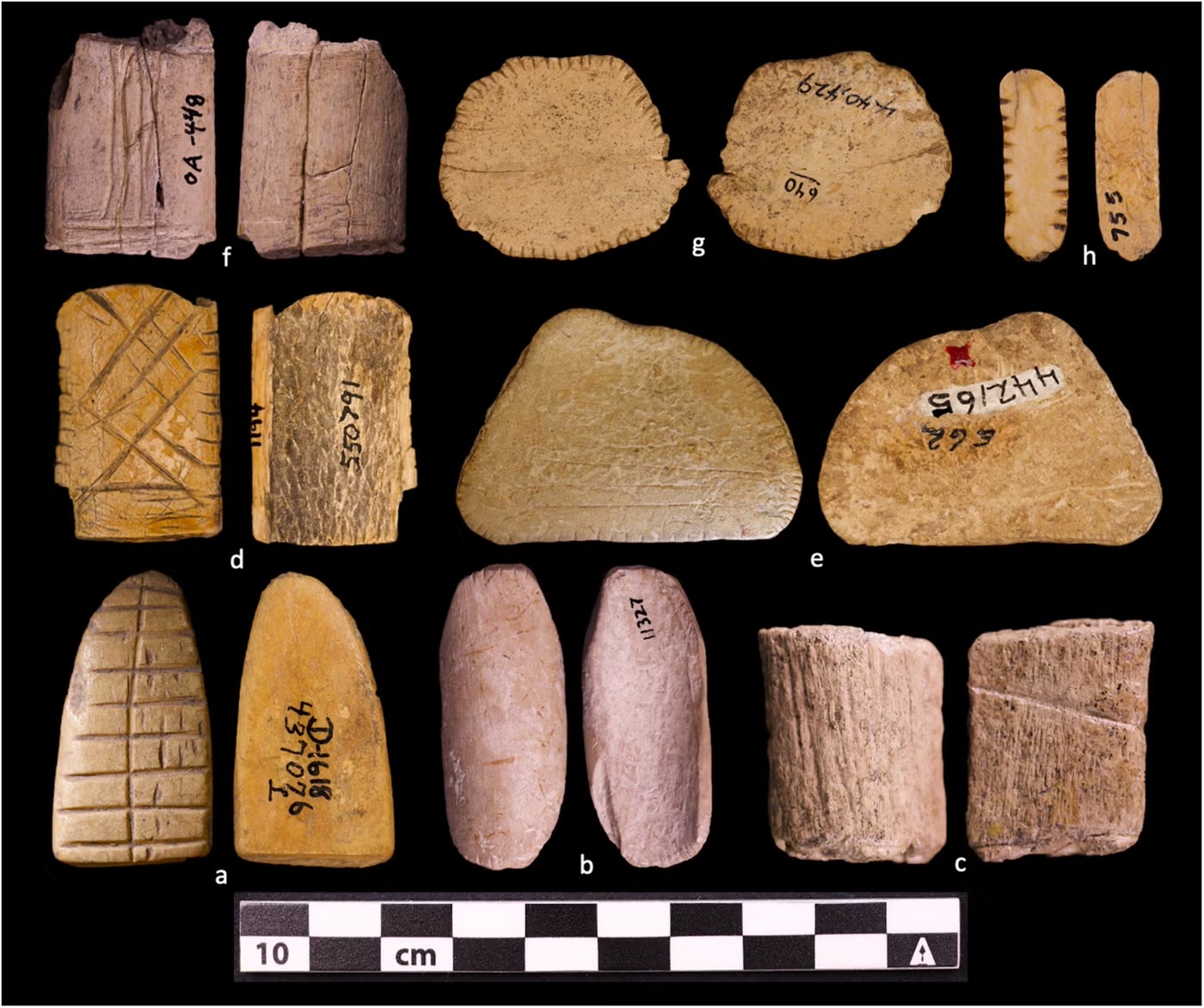
The ancient dice aren’t modern six-sided cubes we’re familiar with, but instead prehistoric pieces of bone, typically with two sides. Reminiscent of flipping a coin, the world’s first dice were made of flat or slightly rounded bone—commonly in oval or rectangular shapes—and these “binary lots” were small enough to hold in a hand so they could be tossed onto a playing surface. Human-made markings on the surfaces, either inscribed or colored, give each pair of dice a unique style.
Madden also estimated that use of the dice was 70% women. What are the odds?
Graphene Charges
Was it a good week for graphene news? It’s always a good week for graphene news! Doubling the energy density of a six-minute charging graphene aluminum-ion battery. From (who else?) Graphene-News, Graphene Manufacturing Group (GMG) has been developing its Graphene Aluminium-Ion Battery technology (“G+A CELLS”) in conjunction with the University of Queensland.
The GMG G+A CELLS have reportedly demonstrated superior performance characteristics when compared to a representative market leading ultra-fast charging batteries, the Lithium Titanate Oxide (“LTO”) batteries, which can be sold at a premium price of up to US$1200/kWh.
Now, GMG (which is not to be confused with the color management software company) has developed “a completely new hybrid electrolyte that is chloride free and non-corrosive, unlike common aluminium battery electrolytes, along with a complex cathode and anode technology that enables very stable fast charging over hundreds of cycles.”
You say “aluminium,” we say “aluminum,” but let’s not call the whole thing off.
GMG management believes that the G+A CELLS can eventually achieve over 160 Wh/kg when charged in 1 hour, and over 80 Wh/kg when charged in 6 minutes with further development of the cathode, anode, electrolyte and component weights.
Head Spinning
Sometimes, we have nothing in particular to say about a story (only sometimes?) but often the headline is amusing, sometimes intentionally, sometimes not. For example, we were bemused by a France24 headline that read “Engineers are imitating beavers to prevent flooding.” Now, it’s a perfectly sensible story, but the headline conjured up some bizarre images of engineers sporting oversized teeth and prancing through the woods. It could just be us.
Then the (Schenectady) Gazette had the headline, “Man in cow costume charged with attempted assault in Rensselaerville.” Honestly, the story raised more questions than it answered, especially since no one could adequately explain why he was in a cow costume.
Machine-Fed Meals
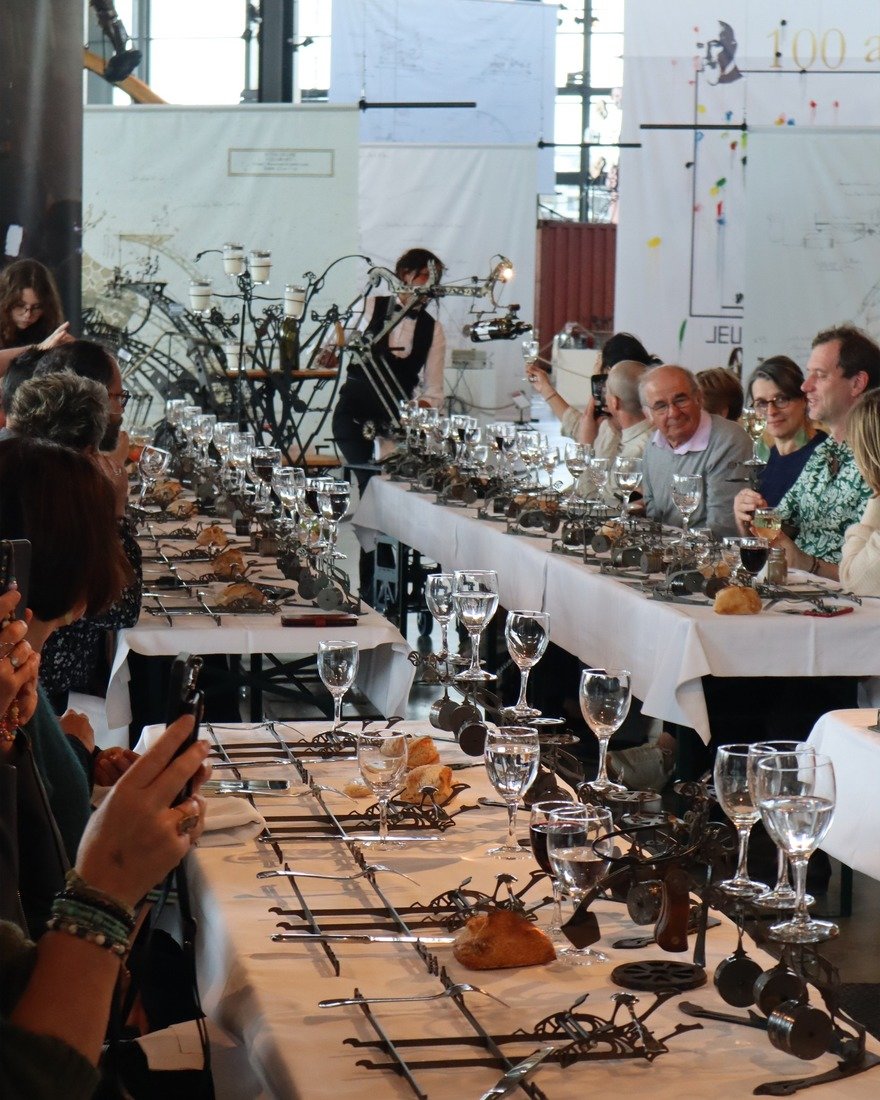
Steampunk meets haute cuisine in a weird performance art/culinary event in France. Via Core77:
Toulouse-based Compagnie La Machine is, strangely, a street-theatre company with an internal design-build firm. They create kinetic machines in their workshop, and incorporate them into their performances.
For example, their Halle de la Machine exhibition space features a café in which they serve a Lunch of Small Mechanicals on weekends.
Diners are served by performers using steampunk-like contraptions to serve the food: Bread is fired by catapults, serving carts are replaced by giant wheels, the fresh pepper is delivered Tom-Cruise-Mission: Impossible-style, and the dessert descends on chandeliers.
Sounds like your average college freshman dining hall.
Kind of reminds us of the “feeding machine” sequence in Charlie Chaplin’s classic Modern Times.
If you find yourself in Toulouse, lunch is served from 12pm–3pm on Saturdays and Sundays, through May 3. A steal at €65 (USD $76).
The Doors of Misperception
(Optional musical accompaniment to this item.)
Remember when life used to be simple? For example, if you wanted to park your car in your garage, you pressed a button on the garage door opener remote and the door would open. Few things could be more convenient.
Well, naturally, in this age of ensh***ification, that’s no way for a company to squeeze as much money out of you as possible. So what do they do? Yes: “garage door opener as a service,” because we are truly living in a dystopian hell. Says Boing Boing:
Honda has taken a feature that used to be a single dumb button press: open garage, go inside, live your life, and turned it into an app, a login, a piece of hardware, and a subscription, because apparently even arriving home now needs a payment plan.
Yes, Honda’s new Passport requires a subscription for garage door access, and it costs $129–$179 for 3–5 years, plus equipment and setup.
NO!!! WE ARE NOT SUBSCRIBING TO A FKING GARAGE DOOR!!!! We’ll get out and open it manually if necessary.
Jeez, these people…
Getting the Pint
In one of those “You got your chocolate in my peanut butter/No, you got your peanut butter in my chocolate” kind of moments (by the way, has that ever happened in the entire history of snacking?), virologist Chris Buck has created an experimental “vaccine beer”—yes, using beer to deliver antigens that target polyomaviruses. Via (who else?), Food & Wine:
Buck’s vaccine beer is designed to work against polyomaviruses, small viruses that typically cause asymptomatic infections in the general population but can lead to serious health issues in people with weakened immune systems. He’s self-published a series of research articles about his work, including studies conducted on mice and on himself.
We’re not opposed to eliminating the jab from the vaccine experience (getting a flu and COVID vaccine simultaneously made us feel like we were in a Velvet Underground song), but there are concerns.
Buck wrote in a Medium article that his search for a vaccine to prevent polyomavirus infections has faced numerous hurdles, including licensing and regulatory issues, making his work somewhat controversial in the medical community. But he’s pushed on. Here’s the backstory on vaccine beer, plus why many infectious disease doctors are wary of it.
There are not injectable vaccines available for polyomaviruses, so Buck sought an effective delivery system. As a beer aficionado (and home brewer), that seemed like the perfect solution.
So, Buck engineered commercial brewer’s yeast to deliver a polyomavirus antigen to anyone who ingests it. The concept behind this is similar to being injected with an antigen in any other vaccine: It enters your body, which then mounts an immune response.
We applaud the idea, but not being of the “do our own research” crowd, we’re more concerned with what actual infectious disease experts say about it.
“What Dr. Buck is trying to do is a very bad idea,” said William Schaffner, MD, an infectious disease specialist and professor at the Vanderbilt University School of Medicine. While Schaffner said Buck’s work is “exciting,” he also stressed the importance of following proper regulatory channels. “The investigator is trying to evade the conventional route to the assessment and development of vaccines,” he said. “He thinks he can do this much more quickly without doing the elaborate studies that are usually required to get a vaccine assessed in regard to effectiveness and safety. That would be terrible.”
Still, we’re open to the idea of an orally administered vaccine. The beer would just be a plus.
This Week in Printing, Publishing, and Media History
April 13
1742: George Frideric Handel’s oratorio Messiah makes its world-premiere in Dublin, Ireland.
1743: American lawyer and politician, 3rd President of the United States Thomas Jefferson born.
1860: English-Belgian painter James Ensor born.
1870: The New York City Metropolitan Museum of Art is founded.
1899: American architect, game designer, and creator of Scrabble Alfred Mosher Butts born.
1901: French psychiatrist and academic Jacques Lacan born.
1923: Would you believe... American actor and director Don Adams born.
1906: Irish novelist, poet, and playwright, Nobel Prize laureate Samuel Beckett born.
1960: The United States launches Transit 1-B, the world’s first satellite navigation system.
1974: Western Union (in cooperation with NASA and Hughes Aircraft) launches the United States’ first commercial geosynchronous communications satellite, Westar 1.
April 14
1629: Dutch mathematician, astronomer, and physicist Christiaan Huygens born.
1828: Noah Webster copyrights the first edition of his dictionary.
1894: The first ever commercial motion picture house opened in New York City using 10 Kinetoscopes, a device for peep-show viewing of films.
1939: The Grapes of Wrath, by American author John Steinbeck is first published by the Viking Press.
April 15
1452: Italian painter, sculptor, and architect Leonardo da Vinci born.
1755: Samuel Johnson’s A Dictionary of the English Language is published in London.
1888: English poet and critic Matthew Arnold dies (b. 1822).
1924: Rand McNally publishes its first road atlas.
1980: French philosopher and author, Nobel Prize laureate Jean-Paul Sartre dies (b. 1905).
April 16
1844: French journalist, novelist, and poet, Nobel Prize laureate Anatole France born.
1871: Irish author, poet, and playwright John Millington Synge born.
1889: English actor, director, producer, screenwriter, and composer Charlie Chaplin born.
1947: Scottish singer-songwriter Gerry Rafferty born.
1994: American novelist and critic Ralph Ellison dies (b. 1913).
2012: The Pulitzer Prize winners were announced, it was the first time since 1977 that no book won the Fiction Prize.
April 17
1397: Geoffrey Chaucer tells The Canterbury Tales for the first time at the court of Richard II. Chaucer scholars have also identified this date (in 1387) as the start of the book’s pilgrimage to Canterbury.
1524: Giovanni da Verrazzano reaches New York harbor. (“If only there were a bridge here,” he is thought have remarked.)
1790: American inventor, publisher, and politician, 6th President of Pennsylvania, Benjamin Franklin dies (b. 1706).
1897: American novelist and playwright Thornton Wilder born.
1955: English singer-songwriter and guitarist Pete Shelley born.
1957: English novelist, essayist, lyricist, and screenwriter Nick Hornby born.
2014: Colombian journalist and author, Nobel Prize laureate Gabriel García Márquez dies (b. 1927).
April 18
1918: American publisher, creator of CliffsNotes Clifton Hillegass born.
1930: The British Broadcasting Corporation announced that “there is no news” in their evening report.
2020: Europe surpasses 100,000 COVID-19 deaths.
April 19
1824: English-Scottish poet and playwright Lord Byron dies (b. 1788).
1927: Mae West is sentenced to 10 days in jail for obscenity for her play Sex.
1971: Launch of Salyut 1, the first space station.
1987: The Simpsons first appear as a series of shorts on The Tracey Ullman Show.
2013: American journalist, author, and publisher, founder of USA Today, Al Neuharth dies (b. 1924).