Start the Presses!
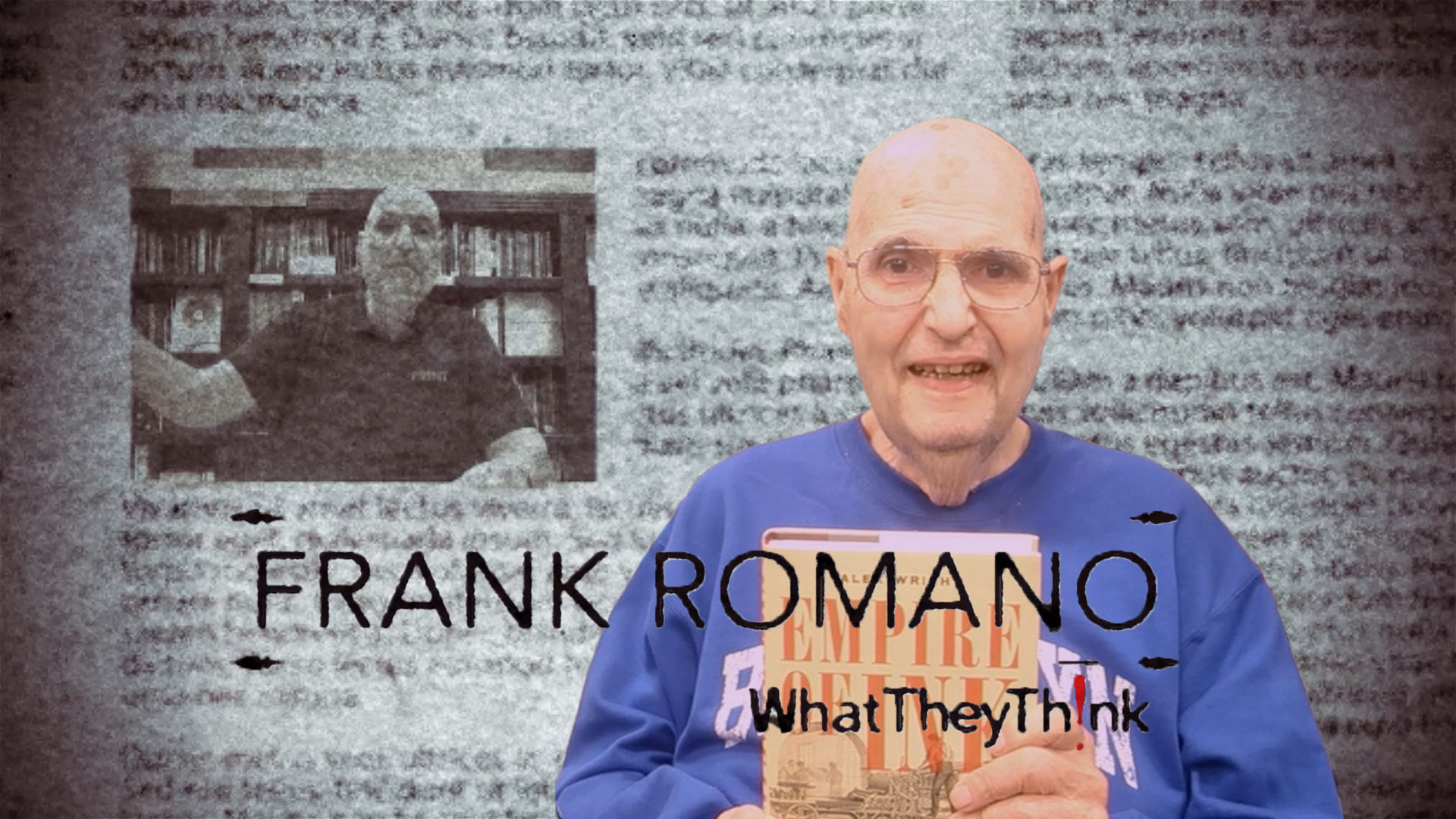
In his weekly videos, Frank Romano has often bemoaned the loss of newspapers, and while you can argue whether what has replaced the newspaper is any better or worse (TikTok…really?), the fact remains that the press was “the heart of the body politic, and right or wrong, whatever was recorded in print was going to impact the nation individually and as a whole.”
Via Print magazine, Alex Wright, who has written a number of books on communication, recently published Empire of Ink, a look at the history and mythology of the American newspaper.
His perspective views the burgeoning wave of local papers that covered a range of news, gossip and scandal—fake and real—while setting the bar for freedom of the press, in short, as the book’s subtitle goes, “The Printers, Rogues and Radicals Who Invented the American Newspaper.”
Steven Heller spoke with Wright:
I was drawn to the metaphor [printer’s devil] because it also suggests the moral and ethical dilemmas that are inherent to the printing trade. While today we celebrate the press as a vehicle for free expression and a safeguard of personal liberty, the rapid expansion of the printed word has also had its share of unintended consequences on society at large. Elizabeth Eisenstein famously argued that the advent of the printing press was deeply bound up with the Protestant Reformation and the violence that followed. In a similar vein, the industrialization of printing in the nineteenth century also triggered a kind of information explosion that left a lot of damage in its wake: fake news, scandals, and occasional bouts of violence. Debates have always swirled about the limits of free expression and the threat of information overload. The book argues that these tensions have been around since Gutenberg, if not well before.
More info and links to purchase the book here.
Bright Idea
Do you live in an area that has really gone to town (or gone ham) banning books? Do you wish you had access to banned books that you thought were important? There are many online bookstores that could easily sort you out, but why not take advantage of…a hacked smart lightbulb. Sure, why not. Says Boing Boing:
Connect to an open WiFi network, and a captive portal opens a shelf of banned ebooks. The access point is a smart light bulb. Rick Osgood reflashed the ESP32 chip inside with custom firmware, rewrote the partition table to carve out 2MB of the 4MB flash for storage, and built a web server that runs entirely off the bulb's power.
We’re not sure we understand that. Can Osgood clear it up?
The idea was that if you lived somewhere that banned books you thought were important, you could theoretically stick a digital copy of the book on one of these light bulbs. Then you could go install it somewhere in your community. As long as the light bulb is switched on, then anyone in the vicinity can still access the banned material assuming they have an electronic device with WiFi. Since the device is a light bulb, it would be difficult to detect and likely to go unnoticed. A cyberpunk digital dead drop. These devices are also fairly inexpensive, so leaving them around town as is hopefully not very cost prohibitive.
Sneaky. We love it. We’d never buy a smart lightbulb in a million years, but kudos to Osgood.
Reunited
Over the course of his life, Leonardo da Vinci filled reams of notebooks with anatomical studies, sketches of flying machines, landscapes, and various random musings. There was no organization to them, which experts think was the way Leonardo’s mind worked.
Via Discover magazine, after Leonardo’s death in 1519, the notebooks were bequeathed to Francesco Melzi, his last student. The notebooks ended up with Italian sculptor Pompeo Leoni—who, suffering a severe case of OCD, apparently felt that the notebook pages needed to be organized. So—and you can imagine the collective gasp of historians worldwide—Leoni cut the pages apart and sorted them into two volumes: one for science and engineering and one for art.
The system was tidy, but Leonardo had likely never intended to separate art from science in the first place. A single page might hold a machine, a horse, and a poem, and Leoni severed connections the artist had made on purpose.
The science and engineering volume was a 1,119-sheet tome that came to be known as the Codex Atlanticus, while the art volume weighed in at 550 sheets. It was inevitable that the two would become separated, and the Codex Atlanticus ended up at Milan’s Veneranda Biblioteca Ambrosiana in 1637, while the art volume wound up in England in the 1620s, likely as a gift to Charles II, and thus was added to the Royal Collection.
Now, historians are able to stitch the two volumes back together, and in the way that Leonardo had originally created them.
On June 8, 2026, Museo Galileo in Florence, together with the Italian Ministry of Culture and the Embassy of Italy in London, launched Leonardotheka, a free online platform that reunites roughly 3,500 pages of Leonardo's manuscripts for the first time since the late 16th century, undoing one of the century’s most consequential cut-and-paste jobs.
It was the result of a 10-year effort, as da Vinci scholars worked with Royal Collection Trust, the Ambrosiana, and the Biblioteca Leonardiana in Vinci.
The team matched watermarks, sheet dimensions, and ink to determine which fragments had once belonged together.
The digital archive went live on June 8 and you can check it out at teche.museogalileo.it/leonardo.
Italian Graffiti
Leonardo isn’t the only Teenage Mutant Ninja Turtle Renaissance artist we’re looking at this week. Via Atlas Obscura, Michelangelo (full name Michelangelo di Lodovico Buonarroti Simoni) was forced into hiding in 1530 after he had joined a band of Florentines who were trying to oust the Medici family, which was at the time one of the most powerful in Europe. They were also a big Michelangelo patron, so it was a bit like biting the hand that fed him. Making matters worse, Pope Clement VII was a Medici. The anti-Medicis—joined by Michelangelo—attempted to fortify the walls of the city to keep out the Medici forces—which were led by the Pope himself. They failed, and the revolutionaries were quickly punished.
Michelangelo, however, escaped by holing up in a secret room under the Medici Chapel of the Basilica di San Lorenzo. Trapped there for three months, he did what any prisoner would do—especially one who was a professional artist: he covered the walls with graffiti.
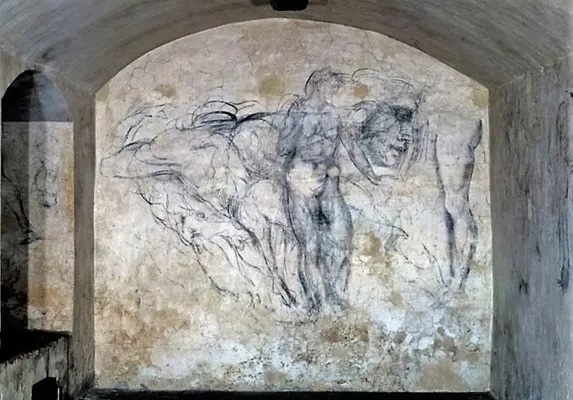
By November, the Pope said Michelangelo could come out of hiding—he had a certain chapel ceiling to finish painting.
He had never told anyone where he had been hiding; perhaps he thought h may need to beat a hasty retreat back there at some point. As a result, Michelangelo’s secret room and its drawings weren’t discovered until 1975, when the director of the Museum of the Medici Chapel accidentally came across them.
The room is unvented and, given the fragility of the artwork, it has only sporadically been open to the public. No indication of whether it’s open at present, but if you happen to be in Florence (take us with you!), you can visit the Medici Chapel.
Influencer Epidemic
Who was history’s first “influencer”? (God, how we hate that word.) France 24 suggests it may have been Marie Antoinette (hence the guillotine…), given the overwhelming response to a “Write to Marie Antoinette” campaign launched by the Château de Fontainebleau to mark its Marie Antoinette and Louis XVI theme year.
Less formal than Versailles, Fontainebleau had been a country retreat for French royals for almost eight centuries. A little ominously, Louis and Marie spent their last days there 240 years ago.
The “To your pens! Write to Marie Antoinette” initiative has so far received more than 4,000 letters.
Most of the letters addressed to Marie Antoinette received by the Château de Fontainebleau begin with the same honorific: "Your Majesty".
“Those who write to her play along wholeheartedly. They address her in a very formal and respectful manner,” said Sylvain Moulène, director of development and communications at the royal palace, some 60 kilometres southeast of Paris.
It’s all part of a year-long schedule of events to commemorate the theme year.
To illustrate the monarchs’ special attachment to the site, exhibits, tours, shows and concerts have been planned throughout the year. The celebration's most original programme invites the public to write a letter directly to the queen. Whether from their own home or from a "boudoir" specially recreated for the occasion outside the castle shop, everyone is invited to write to French history's most famous monarch.
Historian Cécile Berly, who came up with the letter-writing campaign, found that even more than 200 years after her death, Marie Antoinette still fascinates people.
"I could see from the students’ letters that they view her as an influencer. They are extremely struck by her modernity. They see her as a fashion icon who, had she lived in our time, would have played a key role on social media,” said Berly who has written several books on Marie Antoinette. “It’s quite surprising, but they also often judge her and point out that she didn’t always behave very well.”
Marie has gotten a bad rap over the years (she never said “Let them eat cake,” for example), and there were all sorts of nefarious things attributed to her that were not true. Even her husband Louis XVI early on wasn’t a horrible tyrant, as he was content to go hunting and play with his locks. At worst, they were just clueless about how normal people actually lived—well, until they tried to recruit the Austrian army to invade France when the Revolution was in high gear (Marie was actually Austrian, the daughter of Emperor Francis I).
You can find out more about Marie and the French Revolution in several episodes of a podcast we have become completely obsessed with, The Rest Is History.
Pulp Nonfiction
(Optional musical accompaniment to this item.)
Do you have some old books or magazines hanging around, even books that you might think are not worth anything? You might want to think again. Via Boing Boing:
A worn copy of a 1912 pulp magazine, graded just 2.0, sold for $58,560 this month because Tarzan is on the cover. All-Story No. 94, from October 1912, contains "the First Appearance of Tarzan" — Edgar Rice Burroughs' introduction of Tarzan of the Apes — and this rare U.K. price variant led Heritage Auctions' Pulp Magazines auction. Bookery's Guide to Pulps notes there are "probably fewer than 20 existing copies" of the U.S. version.
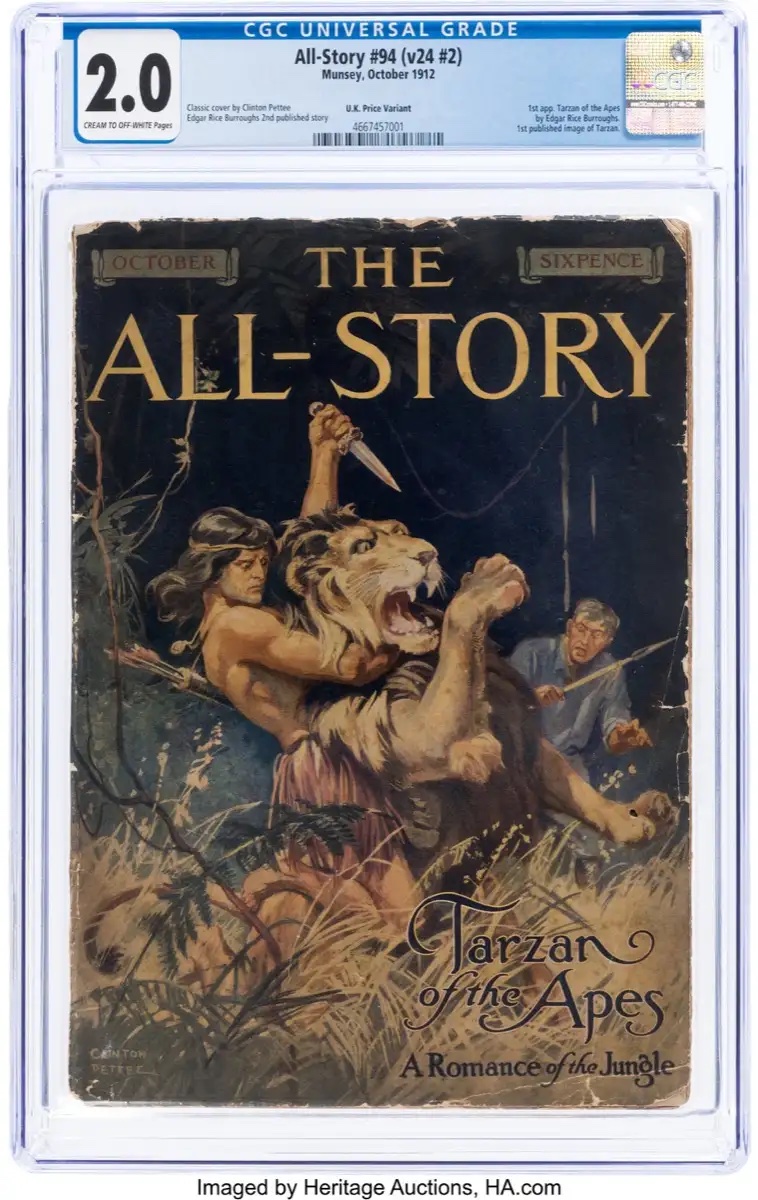
Other lots: a color-variant Weird Tales No. 1 from 1923 at $51,240, and Harlem Stories No. 1 from 1932 at $34,160 — "a rare instance of a pulp series focused primarily and positively on Black characters."
Graphene Makes Book
Was it a good week for graphene news? It’s always a good week for graphene news! Don’t know what to get the graphene lover in your life? Try the new book, The Graphene Handbook - Making Sense of Graphene at Its Inflection Point. From (who else?) Graphene-News:
The Graphene Handbook…provides a clear, structured overview of graphene: its fundamental properties, the main production methods in use today, and the wide range of application areas being explored - from composites, coatings and energy storage to printed electronics, thermal management, sensors and more. The book then connects these technologies to the current state of the industry and market, with coverage of commercial products, key players and large?scale projects.
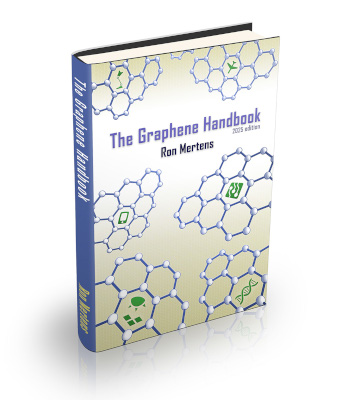
A steal at—dah!—$160, although that is for a hardcover edition. A digital edition can be had for a mere $97.
Ham it Up
OK, here’s a headline we don’t understand. From Futurism: “Visa Officially Allowing AI Agents to Go Ham With Your Credit Card.”
“Go ham”? Are AI agents stealing credit card numbers and going on buying sprees at the Honey Baked Ham Company? Are the AI agents overacting or doing impressions of William Shatner? Are they cheering on West Ham United? Or is this some new slang term for something?
According to the article:
On Wednesday, the payment titan Visa announced that it’s integrating its payment network into ChatGPT, allowing the AI chatbot to buy stuff on your behalf, The Associated Press reports.
So it could go on a buying spree at the Honey Baked Ham Company. What could possibly go wrong?
It’s a clear victory for AI companies, which have been pushing AI-powered shopping experiences on customers for over a year. The tech is already widely used for product recommendations and financial advice, but with the rise of AI agents, the likes of OpenAI have been touting the autonomous models’ ability to handle the entire shopping process, from picking the actual product to handling shipping details, all from a prompt.
Unfortunately, this is also starting to insinuate itself in print buying.
As for “go ham,” according to the Urban Dictionary, it means “putting in a lot of effort,” and we’ll let you go check out the unfortunate etymology.
Because It’s There
Robots are running marathons, doing kung fu, doing parkour—and now they’re climbing mountains. Via Interesting Engineering:
A Unitree G1 humanoid robot is being prepared for a planned Mount Everest expedition later this year after taking part in a high-altitude test on Mount Chimborazo in Ecuador.

The robot, named Pemba, was provided by Eastworlds Labs, the AI robotics initiative of Virtuals Protocol. It was part of a Geologic Dome expedition that placed the robot at 20,312 feet on June 5, 2026.
It’s not just a stunt to prove what robots can do, but rather to see if humanoid robots can support conservation, research, and monitoring in places that humans can’t reach easily or safely.
Legless
Looking for a unique way of sitting? Specifically, on a chair without legs? Well, via Core 77, industrial designer Villo Hietanen, who goes by “Nude Modular,” creates his own furniture, such as chairs without legs that get their support from the environment, using magnets, suction units, or straps.

“What made it even more exciting was taking it out in the world. There's something special about attaching this strange-looking chair to a tree or a metal post. It looks unexpected, and suddenly you’re using the environment as part of the object. When I sat on it, it felt like I was part of the tree or structure I was using. Any time I can take a design out into the world and make it interact with its surroundings, it adds another dimension for me. It becomes part of the environment.”
As you like it.
The Flying Monk
Sally Field was famously the Flying Nun, but did you know there was also a flying monk? In the early 11th century, a young Benedictine monk called Eilmer lived in an abbey in the English town of Malmesbury. For whatever reason, he fashioned a pair of wings from willow wood and cloth, climbed to the top of the abbey’s 150-foot tower, and took…well, not flight exactly. He managed to sail 600 feet over the city wall before he crashed in a small valley, breaking both his legs and crippling him for life.
But, via Ars Technica, Eilmer has another claim to fame: in his old age, in 1099, he witnessed Halley’s Comet, and what may have been for the second time in his life.
Eilmer witnessed Halley’s comet in 1066, commenting, “It is long since I saw you.” Some historians have interpreted this to mean that Eilmer saw Halley’s comet on an earlier fly-by in 989, when he would have been a young boy.
These stories about Eilmer come to us via 12th-century historian William of Malmesbury in an account written circa 1125. There are some gaps and omissions in William’s accounts, which historians have since tried to reconstruct.
Assuming Eilmer was at least 5 years old in 989, he would have been born no later than 984. This would make Eilmer in his 80s in 1066, with his attempt at flight—which occurred when he was “in his first youth”—likely falling between 1000 and 1010. However, it’s an estimate that is based on a lot of assumptions, according to James Aitcheson of the University of Leicester, who argues in a paper published in the journal Notes and Queries that Eilmer may have seen a different comet altogether in his youth—the comet of 1018. If so, he would have been born much later, and the date of his flight would have occurred between the 1020s and 1040s.
The original story led to recent speculation that Eilmer saw and figured out the periodicity of Halley’s comet long before the 17th-century astronomer Edmond Halley. So should we be calling it Eilmer’s Comet?
Aitcheson thinks not. He acknowledges that Eilmer could have had access to historical records of comet sightings in Britain and Europe, and thus could have spotted the pattern of its cycle among all the other records of comet appearances.
The one thing we do know for certain, though, is that strapping on a pair of home-made wings and jumping off a tower is a really bad idea.
A True Omnivore
Meet William Buckland, a geology professor at the University of Oxford in the early 19th century. Buckland had a passion for geology and paleontology—and eating. Indeed, his goal was to eat as many different animals as he possibly could. Via Atlas Obscura:
William entertained guests at his home and the college with exotic meals of things like hedgehogs, roast ostrich, porpoise, crocodile steaks and even cooked puppies. His son, Francis, had an equally egalitarian palate. Together, they viewed Noah’s Ark as a dinner menu.
No one is entirely sure when or why he began feasting on everything he could find.
William had a fondness for mice served on toast. The common mole held the crowning achievement of the vilest dish he had eaten until he chewed on the bluebottle fly.
Most notably, William allegedly ingested the 140ish-year-old mummified heart belonging to King Louis XIV of France. The heart had been stolen during the French Revolution until William’s friend, Lord Harcourt, somehow acquired it. When Harcourt withdrew the heart from a silver snuffbox, William quickly popped it in his mouth.
L'entrée, c’est moi
This Week in Printing, Publishing, and Media History
June 15
1752: Benjamin Franklin proves that lightning is electricity.
1878: To settle a bet, Eadweard Muybridge takes a series of photographs to prove that all four of a horse’s hooves leave the ground when it runs. The results become the basis of motion pictures.
June 16
1903: The Ford Motor Company is incorporated.
1904: Irish author James Joyce begins a relationship with Nora Barnacle and subsequently uses the date to set the actions for his novel Ulysses; this date is now traditionally celebrated as “Bloomsday.”
1911: IBM is founded as the Computing-Tabulating-Recording Company in Endicott, N.Y.
1917: American publisher Katharine Graham born.
June 17
1882: Russian pianist, composer, and conductor Igor Stravinsky born.
1898: Dutch illustrator M. C. Escher born.
1901: The College Board introduces its first standardized test, the forerunner to the SAT.
June 18
1466: Italian printer Ottaviano Petrucci born.
1812: Russian author and critic Ivan Goncharov born.
1854: American publisher and founder of the E. W. Scripps Company E. W. Scripps born.
1858: Charles Darwin receives a paper from Alfred Russel Wallace that draws eerily identical conclusions about evolution as Darwin had been developing. Darwin thus races to publish his own conclusions.
1942: Paul McCartney born.
1948: Columbia Records introduces the long-playing (LP) record, which, curiously, is seeing a bit of a renaissance today as a medium for delivering music.
June 19
1623: French mathematician and physicist Blaise Pascal born.
1846: The first officially recorded, organized baseball game is played under Alexander Cartwright’s rules on Hoboken, N.J.’s Elysian Fields with the New York Base Ball Club defeating the Knickerbockers 23–1.
1897: American comedian Moe Howard born.
1934: The Communications Act of 1934 establishes the Federal Communications Commission (FCC).
1947: Indian-English novelist and essayist Salman Rushdie born.
1948: English singer-songwriter Nick Drake born.
1978: Garfield, holder of the Guinness World Record for the world’s most widely syndicated comic strip, makes its debut.
2018: The 10,000,000th United States Patent is issued (“Coherent Ladar Using Intra-Pixel Quadrature Detection,” assigned to Raytheon Company).
June 20
1840: Samuel Morse receives the patent for the telegraph, which becomes the dominant communication method. Until...
...1877: Alexander Graham Bell installs the world’s first commercial telephone service in Hamilton, Ontario.
1928: American saxophonist, flute player, and composer Eric Dolphy born.
[year withheld]: Frank Romano born. Shortly thereafter, was visited by three “iMagi” bearing gold from Gutenberg’s goldsmith shop, a line of type from Ottmar Myrrh-genthaler, and he’ll be Frank-incensed if he reads this.
1975: The film Jaws is released in the United States, becoming the highest-grossing film of that time and starting the trend of films known as “summer blockbusters.”
2003: The Wikimedia Foundation is founded. The Wikimedia Foundation is a nonprofit charitable organization dedicated to encouraging the growth, development, and distribution of free, multilingual, educational content, and to providing the full content of these wiki-based projects to the public free of charge. Most notably, it operates Wikipedia.
June 21
1903: American caricaturist, painter and illustrator Al Hirschfeld is born.
1905: French philosopher and author Jean-Paul Sartre born.
1944: English singer-songwriter and guitarist Ray Davies born.
1957: American author, illustrator, and creator of the Bloom County comic strip Berkeley Breathed born.
1973: WTF: the Supreme Court hands down the decision in Miller v. California 413 US 15, establishing the Miller test for obscenity in U.S. law.
1978: The original production of Tim Rice and Andrew Lloyd Webber’s musical Evita, based on the life of Eva Perón, opens at the Prince Edward Theatre, London.