The Sun and the Moon
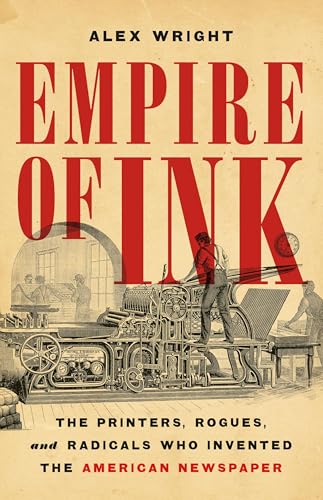 A couple of weeks ago, we highlighted a new book called Empire of Ink: The Printers, Rogues, and Radicals Who Invented the American Newspaper (we have since ordered it). Big Think excerpts a portion of it, highlighting how the 1835 “Moon Hoax” made ridiculous news stories credible.
In the early 1830s, New York City printer Benjamin Day launched an experiment: a one-cent newspaper called The Sun. At the time, most weekly newspapers cost six cents, most sold via subscriptions, and Day saw an opportunity to sell his newspaper on the street. While working as a compositor for the New-York Evening Post, he met Dave Ramsey, another compositor, and the two embarked on the publishing adventure. They purchased some basic printing equipment and, armed with a business plan, published the first edition on Monday, September 2, 1833.
The first edition featured two tall tales — one about a dueling Irish captain, and another about a Vermont boy cursed with a permanent whistle — as well as advertisements, squibs, and assorted stories culled (copyright-free) from the sixpenny papers. From the outset, The Sun struck a far lighter tone than its contemporaries, with a healthy dose of fiction, humorous columns, and so-called humbugs — brief tidbits of editorial filler, intended to amuse or instruct — on its front page. The Sun pioneered a gritty new brand of reporting that moved beyond the traditional confines of business and politics to cover a greater swath of everyday life: “fires, theatrical performances, elephants escaping from the circus, women trampled by hogs,” and more.
If “women trampled by hogs” represented “everyday life” in the 1830s, maybe we’ll stop complaining about our current era.
Anyway, The Sun’s most famous story was the infamous “Moon Hoax,” in which they reported on life discovered on the Moon using a powerful new telescope ostensibly owned by British astronomer Sir John Herschel, who was a real person (his father had discovered the planet Uranus—no hoax), at a made-up observatory at the Cape of Good Hope.
The stories describe a made-up lunar landscape of lush forests, herds of strange brown and blue quadrupeds, water birds, and four-foot-tall “man-bats” with huge, semi-transparent wings. These creatures engaged in all manner of odd behaviors that, as the paper delicately put it, “ill comport with our terrestrial notions of decorum.”
The story was a hit.
Over the course of a week, the paper ran five front-page articles chronicling the fantastic otherworldly sights that Sir John had supposedly captured through his telescope. The hoax caught on immediately, quickly picked up and reprinted in other newspapers via the exchange networks.
But Day had an agenda:
He and his reporter Richard Adams Locke had hoped to expose the complacency of traditional newspapers — demonstrating how readily they would seize on and republish a sensational story without vetting its source. The ploy worked. Most of the traditional press was outraged when they realized they had been duped and issued indignant condemnations.
It also was a huge boon for circulation. On its first day, The Sun sold 300 copies, within a month, it hit 1,200, and within a year, 10,000—and nearly doubled that soon after. The Sun became the most popular newspaper in the world.
And of course it spawned copy cats—and in fact launched the whole genre of the tabloid newspaper. The penny papers also changed the demographics of newspaper readers.
The earlier generation of papers had emerged from an agrarian culture of “gentry rule” but were now contending with the pressures of a more democratic, market-driven urban culture. It would take the better part of the century for this conflict to play out, but the penny papers served as the first salvo in the making of a new, populist form of journalism for the masses.
Motor West
(Mandatory musical accompaniment to this item.)
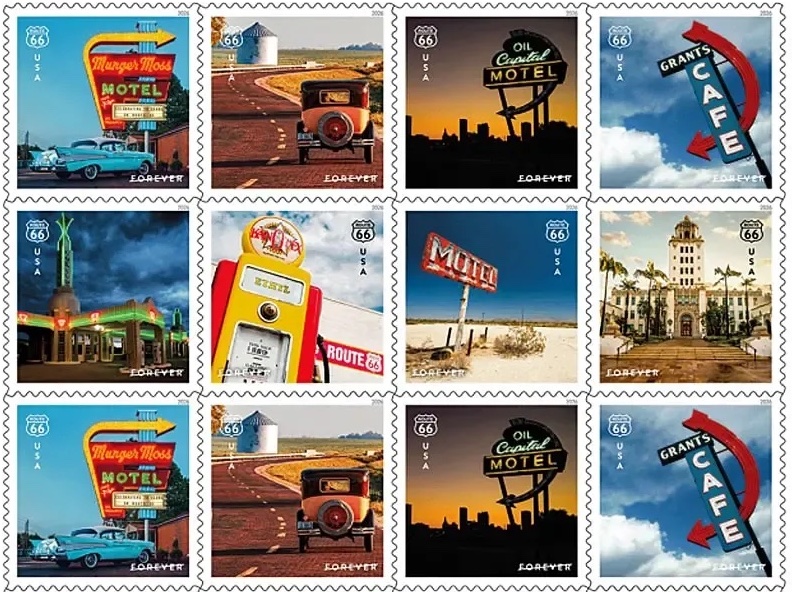
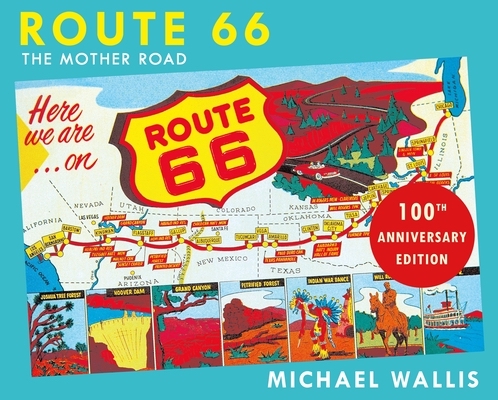
Perhaps the most storied road in America is the iconic Route 66. Called The Mother Road (the term was coined by John Steinbeck), it ran from Chicago, through Missouri, Kansas, Oklahoma, Texas, New Mexico, and Arizona, and ended in Santa Monica, Calif., covering, all told, 2,448 miles. A popular route for tourists heading out west, a wide array of businesses and “roadside attractions” grew up in the towns through which the route ran. Alas, the advent of the Interstate system meant people could bypass the towns and attractions along Route 66, and much of them declined and/or went out of business. Much of the original Route 66 is gone, but parts do still exist, and what we’ve heard is that it’s still possible to get your kicks on Route 66—although not as many as you once could. Indeed, a great book to pick up if you’re interested in the old route is Mike Wallis’ 1990 Route 66: The Mother Road, the Route 66 “Bible”:
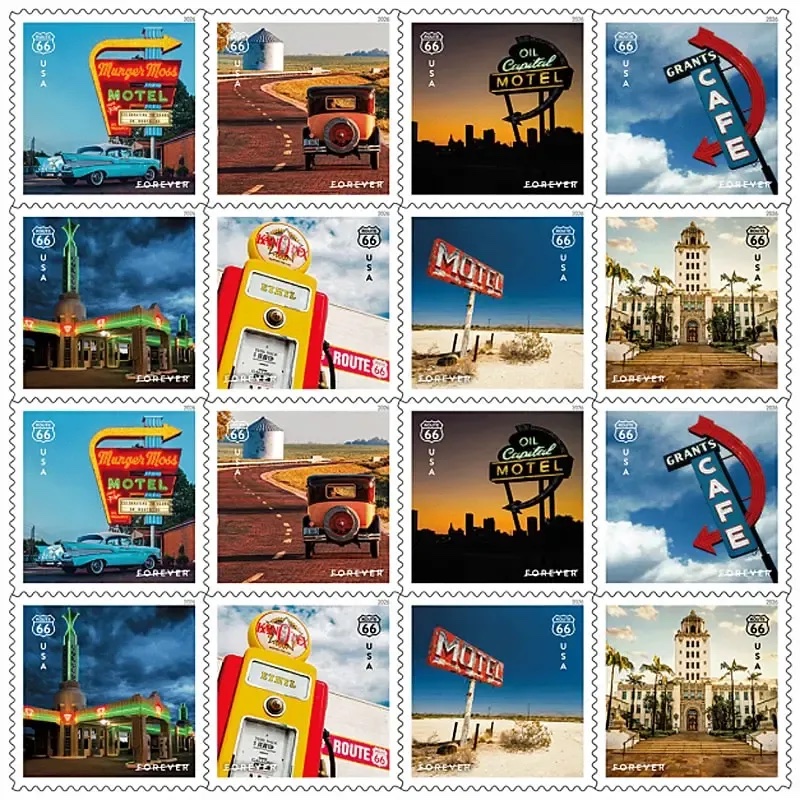
We mention this because 2026 marks the 100th anniversary of the construction of the original Route 66, and to commemorate the occasion, via Print magazine, the USPS is issuing the 2026 Route 66 Centennial Stamp Collection, featuring images taken by “Mother Road” photographer David Schwartz.
On Brand
Last month saw the annual Sustainable Brands Conference, held in San Diego, an annual event going on almost 20 years. We did not attend, but if you work with brands and/or retailers, as a designer or as a printer/converter, it was a must-attend conference, as it detailed what companies will be requiring vis-à-vis sustainability in the years to come, if not sooner. Print magazine was there and reports from the event.
California continues to lead the way in environmental policy, and one of the most discussed topics throughout the event was the state’s landmark packaging legislation, SB 54. By 2032, producers of single-use packaging and plastic food service ware will be required to dramatically reduce plastic use, increase recycling rates, and take responsibility for the waste they generate.
And as we all know, that doesn’t just affect California businesses; if you do business with California companies, you’ll be on the hook for complying with those regulations. As a result, a major theme of the Conference was parsing what those regulations mean and how brands are preparing for them.
Speakers emphasized that sustainability is no longer about simply being “less bad.” The next twenty years will require businesses to rethink entire systems, from supply chains and manufacturing processes to consumer engagement and product design.
One question that has been hotly debated for literally decades is: How much are consumers willing to pay for a more sustainable product? At the Conference research from EcoFocus attempted to quantify it.
While sustainability-marketed products increased their share of the U.S. market by 1.5% from 2024 to 2025, these products are growing nearly five times faster than conventionally marketed alternatives. Categories such as pet food, candy, and dairy are seeing notable growth, while both private-label and national brands with sustainability positioning continue to gain market share.
Additionally, consumers say they are willing to pay a 25–27% premium for sustainable products. (Of course, there can be a disconnect between what consumers say and what they actually do.) Given that the cost of everything is going up perilously, we’re paying a premium for things whether they’re sustainable or not.
For our industry:
Packaging, branding, and visual communication play a critical role in helping consumers understand sustainability efforts. While material innovations and operational improvements are essential, the way those changes are communicated can determine whether consumers notice—or trust—them.
Be sure to click through for more coverage of the Sustainable Brands Conference.
Color My World
As we in this industry know intimately, color perception is a tricky business, and color management has for decades—if not longer—attempted to quantify it, at least for the pragmatic purpose of accurate color reproduction. But researchers have been attempting to quantify color perception for ages based on the familiar values hue, lightness, and saturation.
The standard understanding of color perception has been Schrödinger’s color theory, posited by physicist Erwin Schrödinger, perhaps most known for his quantum wave equation (and famous cat). Says Los Alamos National Laboratory:
Humans have three cones with which to distinguish color — centered around red, blue and green — and that characteristic establishes three dimensions of color spaces, or organizations of color. Bernhard Riemann, the 19th-century mathematician, first suggested that these perceptual spaces are not straight but curved; in the 1920s, Schrödinger defined the perceptual attributes of hue, saturation and lightness, derived from a metric of color perception in the Riemannian model of color perception.
However, problems remained.
Schrödinger’s definitions of hue, saturation and lightness are based on the location of a color relative to the neutral axis — the line of grays connecting black to white — but he did not provide a definition for this axis. This lack of an underlying basis makes his derived constructions crumble: Without a defined neutral axis, the construction is formally undefined.
At the same time, modern color theory can’t explain the “Bezold-Brücke effect,” “which describes how light intensity changes our perception of a hue.” It also can’t explain why “large color differences appear less intense than the summation of small color differences.”
Now, via Popular Mechanics, a new study published in the journal Color Graphics Forum by scientists at the Los Alamos National Laboratory have created what might be the most accurate mathematical representation of photoreception ever.
At the heart of this breakthrough lies the physical way our eyes perceive colors—three cones with specific sensitivities red, green, and blue. This makes our eyes trichromatic (some people are actually tetrachromatic, but that’s a discussion for another day). Trichromatic eyes allow color to be perceived in three-dimensional color spaces, and it’s taken centuries of work to perfectly capture how our photoreceptors interpret color using mathematics and geometry.
…In this new study, the LANL authors successfully defined this neutral axis by working outside of the Riemannian model. They also resolved both the problem of the Bezold-Brücke effect (by applying a “geodesic path in perceptual color space” between a color and black) and the principle of diminishing returns (by using the shortest path in non-Riemannian space).
The result is formal geometric definitions of hue, saturation, and lightness that are “fully derived from the perception of closest similarity and nothing else,” the authors wrote.
For more details, be sure to check out the study itself.
How this will affect the Pantone Matching System remains to be seen.
A Hard Case
If you happen to be in North Dakota tomorrow—for whatever reason—be sure to head to Medora, where the Theodore Roosevelt Presidential Library is set to open on July 4. Hey, it’s only been 107 years since TR died, so better late than never.
TR was one of the great US Presidents (we highly recommend Edmund Morris’ three-volume biography)—and, yeah, he was a little nuts at times—but just in terms of nature and wildlife protection alone he created the United States Forest Service (USFS), established 150 national forests, 51 federal bird reserves, four national game preserves, five national parks, and 18 national monuments. The National Park Service is loaning a variety of artifacts and other Rooseveltiana to the museum, including, via Popular Science, the eyeglass case that saved his life.
On October 14, 1912, while running for a third term as president with the Bull Moose Party, an assassin named John Flammang Schrank shot at Roosevelt during a campaign speech in Milwaukee, Wisconsin. His steel eyeglass case and a folded 50-page campaign speech helped save his life. While the bullet ultimately lodged in Roosevelt’s chest, the eyeglasses case and speech papers slowed down the bullet and it stopped just short of hitting any vital organs.
(We’re never going to complain about having to carry around reading glasses ever again.)
In typical Roosevelt fashion, be it ill-advised or not, he refused medical attention and continued with his speech—while still bleeding. He told the crowd, “It takes more than [a bullet] to kill a Bull Moose.” (Anyone who ever gave an industry presentation with Dick Vinocur in the audience can sympathize.)
The Theodore Roosevelt Presidential Library opens on July 4 and sits at the entrance to Theodore Roosevelt National Park. If we’re ever in North Dakota (and what are the odds?), we’d love to check it out.
AI-Yi-Yi, Part the Infinity: Fleurs du Mal
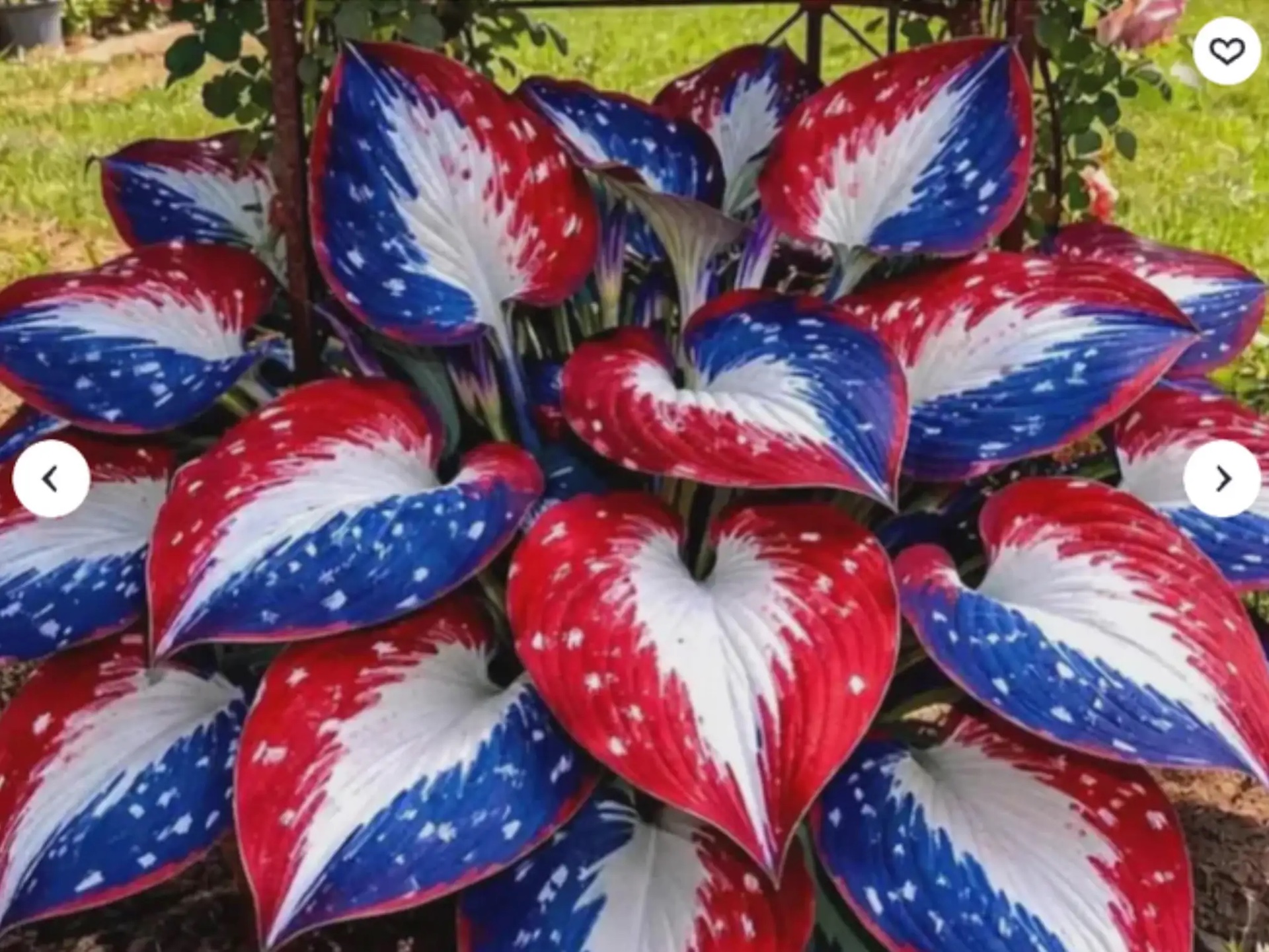
Oh, why are we not surprised. A good ol’ gardening scam—where very few are chosen, and fewer still are called. Via Boing Boing, if you’re on Etsy looking for seeds (for whatever reason), caveat emptor. The plant images are AI-generated and the seeds are fake.
One Etsy seller's seed listings include a hosta that looks like a bunch of screaming demon shrimps, a plant shaped like a butterfly, and a red-white-blue patriotic shrub. The images are obviously AI-generated — and seeds for fake, AI-illustrated roses sold 37,271 times on eBay before the seller was finally banned.
It's an old scam, and you can’t even blame AI.
Emanuel Maiberg at 404 Media has a look at this flood of fake seed listings on eBay, Amazon, and Etsy, which has been running for years. A moderator of the r/mycology Reddit community explained the business model: "There is no cost involved beyond an envelope and postage, a plastic bag and a few hours to collect random seeds. The selling price may be low but enough people buy them to make it add up."
By the way, it’s not just a case of wasting money, but planting random seeds can introduce invasive species—indeed, three states have issued warnings about planting unknown seeds received in the mail.
Eye-Yi-Yi
(Optional musical accompaniment to this item.)
Some years ago, after tattooing hit critical mass as a form of body…uh, decoration, we surmised that the next fad would be something along the lines of dental scrimshaw. We were wrong, thankfully, but now it seems there is a new body…uh, decoration fad on the rise: corneal tattooing. Via Futurism, it is what it sounds like: coloring the cornea, for some reason.
Developed in 2019 by French ophthalmologist Francis Ferrari (really?), it is officially called Femtosecond Laser-Assisted Annular Keratopigmentation—or FLAAK (really?). It’s not been without controversy, and the American Academy of Ophthalmology has issued warnings against the procedure. It’s also still not approved by the FDA (for what that’s worth these days), says a recent New York Times piece on the trending practice.
The procedure goes like this—and we caution that if you’re squeamish about invasive eye things, you may want to skip to the next item.
first, Ferrari numbs the patient’s eyeball. Then he uses the eponymous femtosecond laser to carve a tunnel in each cornea, which is then widened using a surgical hook. From there, he uses his trademark “Ferrari scalpel” — a tool he designed and patented — to shovel pigment into each of the waiting corneas, before painting them with careful brushstrokes. And voilà: your eyes are now “Riviera blue,” “honey gold,” or an uncanny shade of green.
Basically, the process works by covering the iris, which is the true source of eye color, rather like a contact lens. Which—hey!—is a proven and relatively safe way of changing your eye color. Just FYEye.
There is also the chance that you could permanently scar your eyes.
But any physical damage that may be incurred pales in comparison to the mental anguish that Ferrari’s patients have to endure for living with their boring, decidedly not-paled-colored eyes.
People are strange.
Graphene Flies Under the Radar
Was it a good week for graphene news? It’s always a good week for graphene news! Graphene radar-absorbing coatings for defense use. From (who else?) Graphene-News:
Researchers in Portugal are developing a graphene-based material designed to reduce the radar visibility of drones and military aircraft, potentially contributing to Europe’s capabilities in stealth technologies.
The graphene is produced using plasma processing from carbon-based precursors such as methane or ethanol. The process allows tuning of material characteristics depending on the intended application. Beyond radar absorption, the group points to potential uses in electromagnetic shielding, hydrogen storage, and separation processes involving critical materials.
Bad Strawberry Moon Rising
Last Monday, if you were hanging out in a valley in some remote part of North America or Europe, you may have had an excellent view of the “Strawberry Moon.” It was the lowest-hanging full moon of the year (perhaps like the fruit itself) and was one of the smallest full moons. Explains LiveScience:
Full moons that occur close to the summer solstice, which happened on June 21 this year, follow a lower path across the southern horizon. That's because the solstice places the sun at its northernmost point on the ecliptic (the path of the sun through the daytime sky), so the full moon near that time appears low in the southern sky. Because a full moon, by definition, sits opposite the sun in Earth's sky, it mirrors the sun's path from approximately six months earlier.
If you were in the Southern Hemisphere, you’d see the opposite: the Strawberry Moon would be high in the sky and would be the year’s highest-rising full moon.
In addition to the Strawberry Moon, this year has already seen a Wolf Moon (January), a Snow Moon (February), Worm Moon (March), Pink Moon (Nick Drake’s favorite—April), Flower Moon (May 1), and a Blue Moon (May 31—that’s when a lot of very rare things happened).
And we’re only halfway through 2026. Upcoming moons are:
- Wednesday, July 29: Buck Moon
- Friday, Aug. 28: Sturgeon Moon—also a partial lunar eclipse
- Saturday, Sept. 26: Harvest Moon
- Monday, Oct. 26: Hunter’s Moon
- Tuesday, Nov. 24: Beaver Moon—also a supermoon
- Wednesday, Dec. 23: Cold Moon—also a supermoon
Collect the set!
By the way, if you are a fan of musician Peter Gabriel, throughout 2026 he has been releasing a new single every full moon. This month, it is “I Belong to the Sky.”
Zapped!
Here’s a question that came up whilst hanging out with an old friend: do bug zappers still exist? Back in the 1970s and 80s, they were ubiquitous, and the constant zzzzztt!! of the neighbor’s bug zapper was the soundtrack to summer. One doesn’t hear them anymore; do they still make them and, if they do, do they work—and have they ever worked?
Well, yes and no. Yes, they still exist and, no, they don’t really work. Or, that is, not the way 1970s and 80s pool owners thought they did. According to the New York Times Wirecutter:
Bug zappers kill bugs by the thousands. But there’s a problem: They kill the wrong bugs. They are ineffective against mosquitoes and other biting flies, and their otherwise indiscriminate killing can disrupt pollination and generally throw the environment out of balance. Plus, the force of their electrocution can spew a mist of disease-ridden bug parts out into the air.
So…that’s bad.
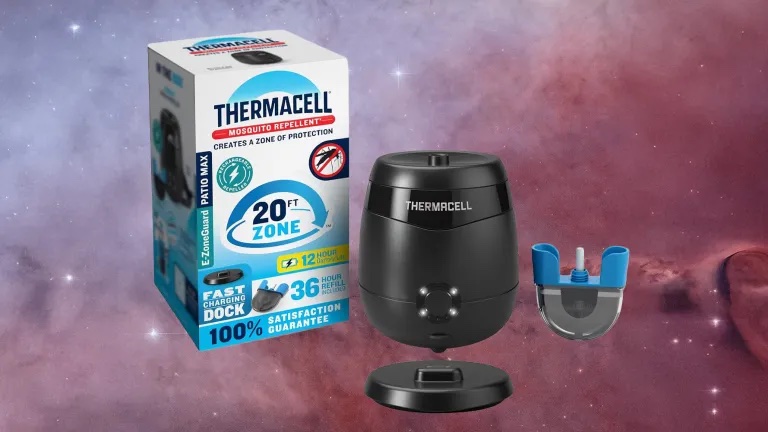
As we head into prime barbecue and backyard activity season, what are the effective forms of mosquito control? Popular Science recommends Thermacell repellents, “which create an on-demand, unscented DEET-free zone of protection from blood-thirsty bugs. Whether you’re on the patio, at the campsite, or in a tree stand, Thermacell has options….”
We are less worried about mosquitoes and more concerned about ticks, and it turns out that Thermacell has Tick Control Tubes.
These tubes are filled with treated nesting material that mice carry back to their hideouts to target the ticks out in the grass, where they start.
Or, just stay inside, which is our preference.
Dog Water
Do you like hiking or other outdoor activities? No, nor do we. But if you do, and you engage in these activities with a dog, all the more reason for us to stay inside. No, actually—via Core 77, Korean e-tailer Gaenim is selling a handy little silicone attachment that turns any human-oriented water bottle into a way for your (or anyone else’s) dog to hydrate.
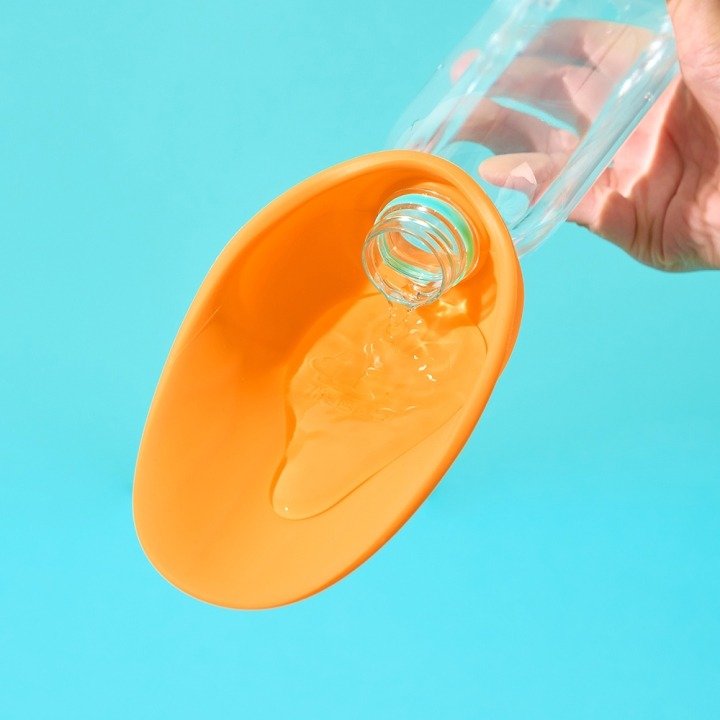
Presumably any other animal can use it as well. So if you like to hike with your pet cat, marmoset, emotional support aardvark, etc., be sure to pick one up. A steal at 9,900 won (we guess).
No Lye
Speaking of drinking water, we all know that proper hydration is important for one’s health. Especially in hot temperatures, staying properly hydrated is essential. It’s easy enough to determine how properly hydrated you are, using a handy chart (like one in the lav at our gym):
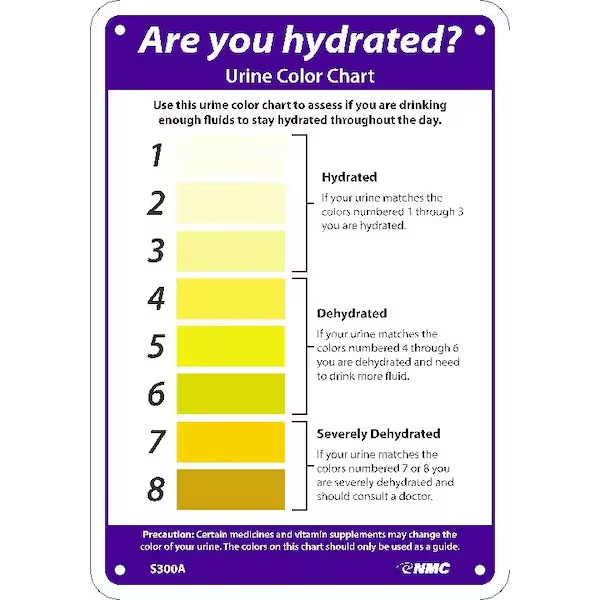
Number 8 could probably be captioned “Urine trouble now.”
Anyway, it will come as no surprise to anyone that health and wellness experts randos on TikTok have been circulating the idea that alkaline water is better for hydration than, say, tap water.
Some TikTok videos claim that alkaline water can help “hydrate you at a cellular level,” while implying that tap water can’t do the same. “I use alkaline water all day, every day, and I feel better than ever,” one poster said on TikTok.
Is alkaline water more expensive than your average bottled water? Do you even have to ask? Via Food & Wine, there is no evidence that alkaline water is better for hydration than any other kind of water.
First of all, what are we talking about here?
The “alkaline” in alkaline water refers to where it falls on the pH scale. The pH scale determines how acidic or basic a liquid is. “‘Alkaline’ simply means that the solution is basic, as opposed to being acidic,” explains Derek Daniels, PhD, professor and chair of the Department of Biological Sciences at the University at Buffalo. “It’s more like baking soda than vinegar.”
We don’t recommend chugging vinegar as a form of hydration, although that’s probably on TikTok somewhere.
In theory, tap water has a neutral pH of 7, but it can become acidic (less than 7) or basic (greater than 7) when elements are added, Daniels says. “Commercially available alkaline water tends to have a pH near or above 9,” he adds.
Alkaline water is created by adding calcium, magnesium, or other minerals to proper water. It can also be created using an ionization process, whereby water is zapped with an electric current.
“While it’s often marketed as health-boosting, it’s really just water with altered pH, which doesn't translate to a clinically meaningful advantage for health or wellness,” Acosta says. S. Adam Ramin, MD, urologist and medical director of Urology Cancer Specialists in Los Angeles, agrees, saying that there’s “absolutely no need” to drink alkaline water.
The study that is frequently cited by alkaline water boosters was published in the Journal of the International Society of Sports Nutrition in 2016. (It was sponsored by a manufacturer of alkaline water, so make of that what you will.) One hundred adults were split into two groups and put into a hot, humid environment that made them sweat. Then they gave one set of participants tap water and the other set alkaline water, and then took a bunch of health measurements. The results? The participants who drank alkaline water had better blood viscosity. Is that good?
“Blood viscosity refers to how thick or ‘sticky’ your blood is — basically, how easily it flows through your blood vessels,” Acosta says. “When you’re dehydrated, your blood can become more concentrated, which may increase viscosity slightly.” But while hydration is sometimes linked to blood viscosity, Acosta says that’s not really an accurate measurement of how hydrated you are.
Ergo:
“There’s no strong evidence that alkaline water hydrates better than regular water,” Acosta says. “The human body tightly regulates fluid balance and blood pH regardless of what you drink. For most healthy people, water is water when it comes to hydration.”
We also don’t recommend gin as a form of hydration—some days.
This Week in Printing, Publishing, and Media History
June 29
1613: London’s Globe Theatre, constructed by William Shakespeare’s playing company, burns down. A second Globe was built by 1614, so all’s well that ends well.
1900: French poet, pilot, and author of The Little Prince, Antoine de Saint-Exupéry, born.
1920: American animator and producer Ray Harryhausen born.
1975: Steve Wozniak tests his first prototype of the Apple I computer.
2007: Apple Inc. releases the iPhone.
June 30
1685: English poet and playwright John Gay born.
1937: The world’s first emergency telephone number, 999, is introduced in London.
July 1
1874: The Sholes and Glidden typewriter (aka Remington No. 1), the first commercially successful typewriter, goes on sale.
1881: The world’s first international telephone call is made between St. Stephen, New Brunswick, Canada, and Calais, Maine, United States.
1892: American journalist and author James M. Cain born.
1963: ZIP codes are introduced for United States mail.
1979: Sony introduces the Walkman.
1869: American author and educator, and co-author of The Elements of Style, William Strunk Jr. born.
July 2
1566: French astrologer and author Nostradamus dies (b. 1503). (Funny, he didn’t see it coming.
1698: Thomas Savery patents the first steam engine.
1897: British-Italian engineer Guglielmo Marconi obtains a patent for radio in London.
1900: The first Zeppelin flight takes place on Lake Constance near Friedrichshafen, Germany.
1900: Jean Sibelius’ Finlandia receives its première performance in Helsinki with the Helsinki Philharmonic Society conducted by Robert Kajanus.
1961: American novelist, short story writer, and journalist, Nobel Prize laureate Ernest Hemingway dies (b. 1899).
1962: The first Walmart store, then known as Wal-Mart, opens for business in Rogers, Ark.
1977: Russian-born novelist and critic Vladimir Nabokov dies (b. 1899).
2013: American computer scientist, inventor of the computer mouse Douglas Engelbart dies (b. 1925).
July 3
1767: Norway’s oldest newspaper still in print, Adresseavisen, is founded and the first edition is published.
1877: German-born Swiss poet, novelist, painter, and Nobel Prize laureate Hermann Hesse born.
1886: The New-York Tribune becomes the first newspaper to use a linotype machine, eliminating typesetting by hand.
1883: Czech-Austrian author Franz Kafka born.
July 4
1804: American novelist and short story writer Nathaniel Hawthorne born.
1826: John Adams, 2nd President of the United States (b. 1735), and Thomas Jefferson, 3rd President of the United States (b. 1743), both die on the same day.
1831: American soldier, lawyer, and politician, 5th President of the United States James Monroe dies (b. 1758).
1855: The first edition of Walt Whitman's book of poems, Leaves of Grass, is published In Brooklyn.
1950: Radio Free Europe first broadcasts.
1883: American sculptor, cartoonist, and engineer Rube Goldberg born. It was a needlessly complicated birth.
July 5
1687: Isaac Newton publishes Philosophiæ Naturalis Principia Mathematica.
1833: French inventor, creator of the first known photograph Nicéphore Niépce dies (b. 1765).
1954: The BBC broadcasts its first television news bulletin.
1958: American author and illustrator Bill Watterson born.
July 6
1865: The first issue of The Nation magazine is published.
1893: French short story writer, novelist, and poet Guy de Maupassant dies (b. 1850).
1962: American novelist and short story writer, Nobel Prize laureate William Faulkner dies (b. 1897).
July 7
1752: French weaver and inventor, inventor of the Jacquard loom Joseph Marie Jacquard born.
1907: American science fiction writer and screenwriter Robert A. Heinlein born.
1928: Sliced bread is sold for the first time (on the inventor's 48th birthday) by the Chillicothe Baking Company of Chillicothe, Missouri. At the time, it was said to have been the greatest thing since...hmmm…
1930: British writer Arthur Conan Doyle dies (b. 1859).
July 8
1822: English poet and playwright Percy Bysshe Shelley dies (b. 1792).
1889: The first issue of The Wall Street Journal is published.
1947: Reports are broadcast that a UFO crash landed in Roswell, N.M., in what became known as the Roswell UFO incident.
July 9
1901: Prolific English author Barbara Cartland born. She published 722 novels and holds the Guinness World Record for the most novels written in a single year (23 in 1976). When she died in 2000, the paper industry went into a severe recession.
1911: Decidedly less prolific English author and illustrator Mervyn Peake born.
1945: Decidedly more prolific author (but nowhere near Cartland’s output), Dean Koontz, born.
July 10
1851: French photographer and physicist, inventor of the daguerreotype Louis Daguerre dies (b. 1787).
1856: Serbian-American physicist and engineer Nikola Tesla born.
1863: American author and educator Clement Clarke Moore dies (b. 1779).
1871: French novelist Marcel Proust born. In Remembrance of Things Past, he probably wrote as many words in one novel as Cartland wrote in 722.
1888: Greek-Italian painter and set designer Giorgio de Chirico born.
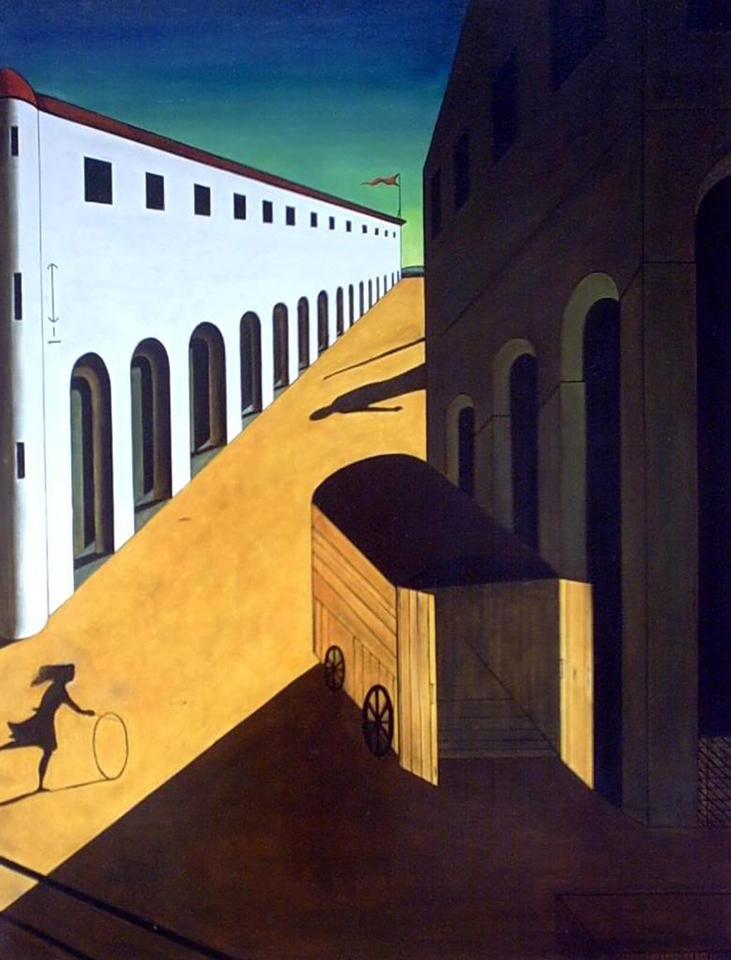
1962: Telstar, the world’s first communications satellite, is launched into orbit.
1978: ABC World News Tonight premieres.
2008: Apple’s AppStore opens.
July 11
1804: He did not throw away his shot: U.S. Vice President Aaron Burr (spoiler alert) mortally wounds Alexander Hamilton in a duel.
1899: American essayist and journalist E. B. White born.
1927: American-Canadian physicist and engineer, inventor of the laser, Theodore Maiman born.
1960: To Kill a Mockingbird by Harper Lee is first published in the United States.
July 12
1493: Hartmann Schedel’s Nuremberg Chronicle, one of the best-documented early printed books, is published.
1580: The Ostrog Bible, one of the early printed Bibles in a Slavic language, is published.
1804: American general, economist, and politician, 1st United States Secretary of the Treasury Alexander Hamilton dies (b. 1755).
1817: American essayist, poet, and philosopher Henry David Thoreau born.
1854: George Eastman, founder of Eastman Kodak, born.