By Johnny Shell, Principal, Senior Principal Analyst for Wide-Format Printing Service
Over the past decade, the wide format industry has steadily improved and expanded what it can produce, including higher resolution, broader media compatibility, faster throughput, and entry into adjacent applications. Print quality still matters and continues to differentiate at the margins, but it is no longer the primary limiter of growth. Until now, success has primarily been defined by capability.
What is changing is the operating ecosystem. Client expectations are now shaped by consistent product quality and sustainability transparency. Regulatory scrutiny is intensifying, labor remains tight, and application diversity continues to rise. Reduced turnaround requirements place additional pressure on execution and customer satisfaction. As these pressures converge, operational efficiency and cohesion become the defining challenge.
 Wide format workflow automation has grown more complex over time, often shaped by incremental process additions rather than unified design. Core production activities frequently operate as loosely connected stages, relying on manual handoffs and operator judgment instead of shared data.
That fragmentation is now a liability. Capability alone no longer determines success. As production environments become more complex and customer expectations rise, competitive advantage depends increasingly on how well technology is integrated, workflows are coordinated, and execution is managed day to day.
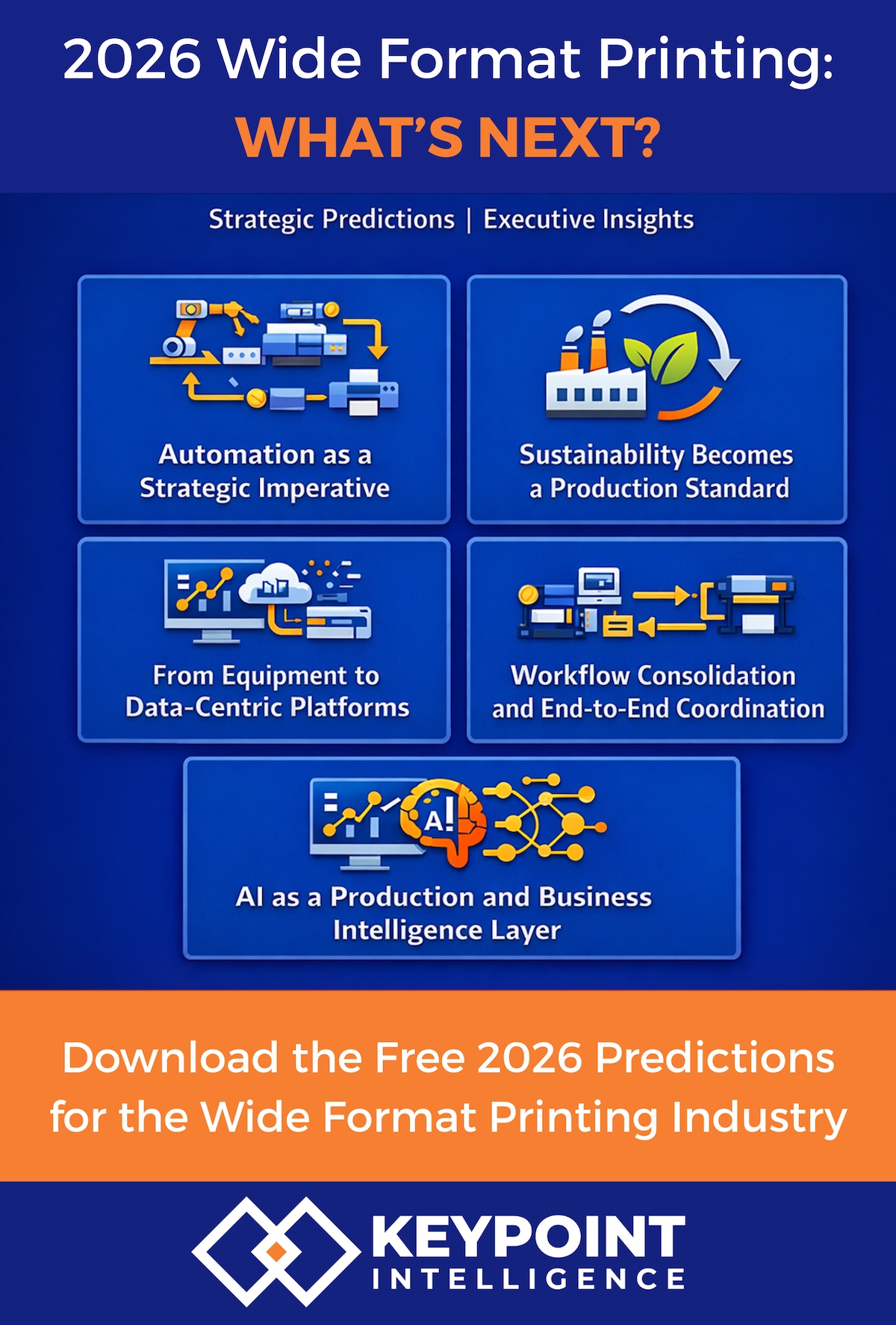
Keypoint Intelligence’s 2026 Wide Format Printing Predictions highlight how technology is redefining production efficiency, competitive positioning, and profitability. The five predictions that follow focus on the application of automation, data, workflow integration, and artificial intelligence in shaping the industry’s next phase.
The first shift is the elevation of automation from a productivity aid to a strategic imperative. In wide format production, automation is increasingly shaping how work moves through the business, reducing reliance on manual intervention and aligning previously disconnected stages into a single operating flow. This orchestration supports consistent execution under labor and turnaround pressure, making automation a prerequisite for maintaining competitiveness in wide format production.
A second shift reflects the growing reliance on production data to guide efficiency, compliance, and service performance. Wide-format systems generate more operational data than ever before, and that information is increasingly embedded into core workflows. Used effectively, this data supports consistent output and strengthens accountability across production and service operations, directly influencing customer satisfaction.
Workflow consolidation represents a third and closely related development. As production complexity increases, fragmented software environments and standalone tools create bottlenecks that slow turnaround times and place additional strain on labor. Competitive advantage increasingly favors operations that consolidate workflows and coordinate activity across the production chain, reducing manual intervention and supporting more consistent execution as variability increases.
AI is emerging as an enabling layer. AI is most closely associated with improving workflow reliability, planning, and decision support, particularly in areas such as quality assurance and predictive maintenance. Adoption remains uneven, shaped by operational realities, but expectations around system intelligence and reporting capability continue to rise.
Together, these technology shifts are enabling more distributed and flexible production models. As workflows become more coordinated and data-driven, wide-format providers gain greater confidence in balancing work across locations, applications, and equipment. This flexibility supports new opportunities while improving resilience amid labor, supply chain, and regulatory pressures.

The full 2026 Wide Format Printing Predictions Report explores these dynamics in detail, examining what they mean for print service providers and industry stakeholders navigating the next phase of wide-format production. The operating landscape has shifted, and familiar advantages no longer carry the same weight. In 2026, advantage will be determined by how deliberately wide-format businesses integrate technology, align workflows, and execute under growing operational and environmental demands.
This report is available free for a limited time. Download here.