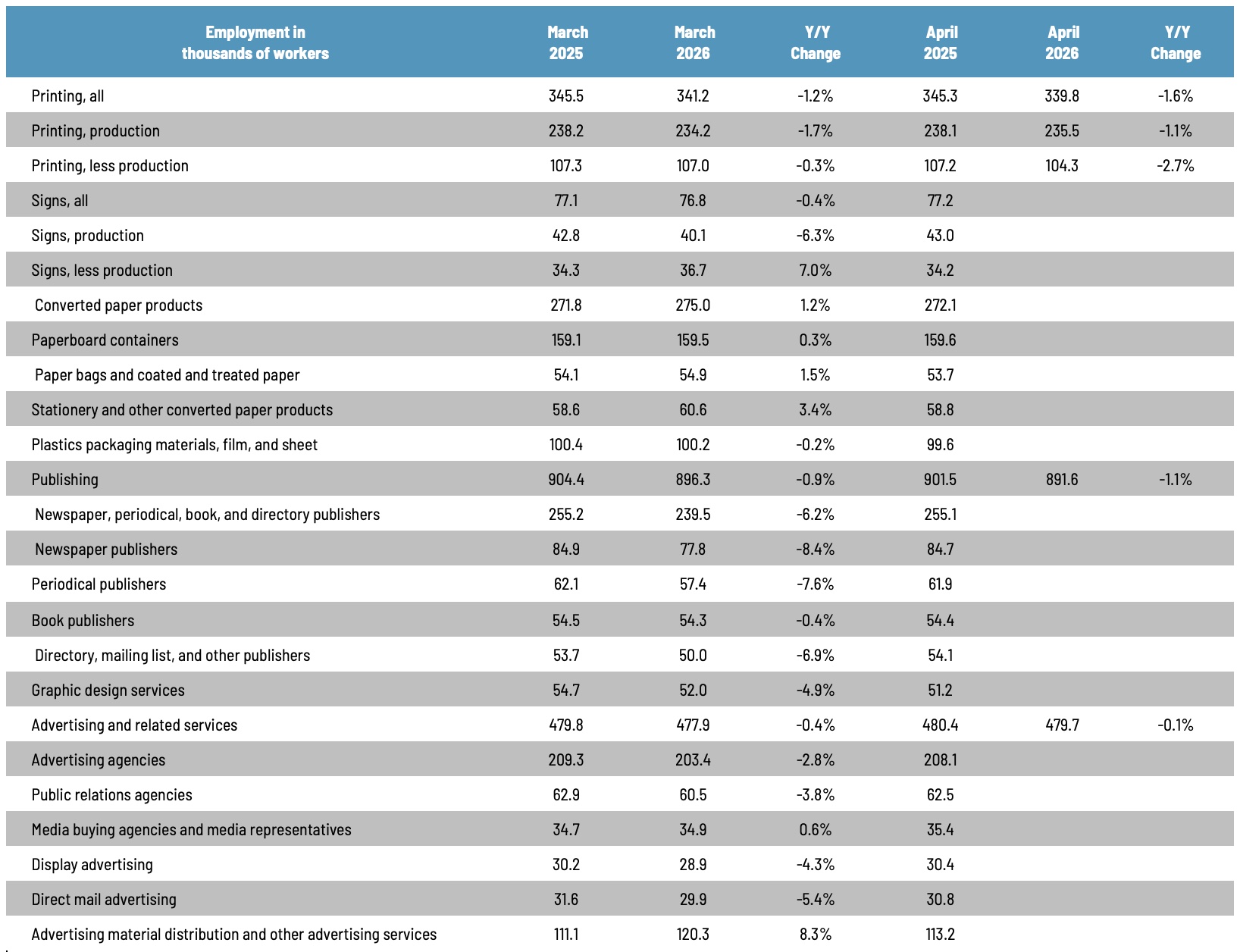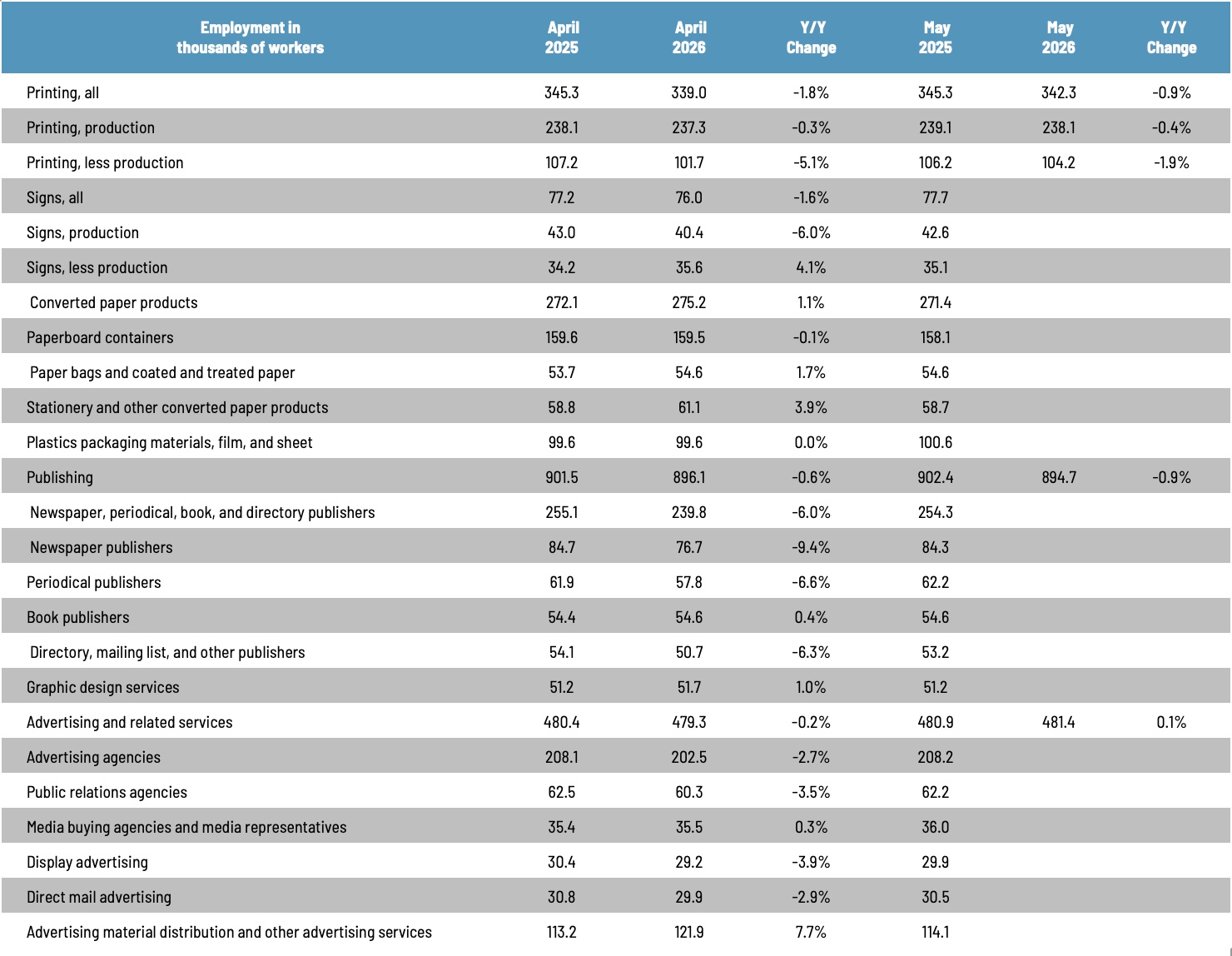
The story so far: We kicked off 2026 with a 2.7% decrease in overall industry employment in January; February employment was generally flat; in March, overall employment was up 0.3%; and in April, employment was down 0.4%. Easy come, easy go.
Happily, the employment situation picked up in May, with overall employment up 1.0% from April, production employment up 0.3%, and non-production employment up 2.5%.
Publishing employment, on the other hand, was down 0.2% from April to May.
Looking at other business categories, the reporting of which lags a month:
Overall employment in the signage industry was down 1.0% from March to April, with sign production employment up 0.7% and non-production down -3.0%.
Converted paper products employment was up 0.1% from March to April, with paperboard container employment unchanged and paper bags and coated and treated paper employment down 0.5%.
Looking at some specific publishing and creative segments, from March to April, periodical publishing employment was up 0.7%, newspaper publishing employment was down 1.4%, and book publishing was up 0.6%. Graphic design employment was down 0.6%, ad agency employment was down 0.4%, and PR agency employment was down 0.3%. Direct mail advertising employment was unchanged from March to April.
As for May employment in general, it was not particularly encouraging. The BLS reported on June 5:
Total nonfarm payroll employment increased by 172,000 in May, and the unemployment rate was unchanged at 4.3 percent, the U.S. Bureau of Labor Statistics reported today. Job gains occurred in leisure and hospitality, local government, and health care. Employment in financial activities declined.
The U-6 rate (the so-called “real” unemployment rate which includes not just those currently unemployed but also those who are underemployed, marginally attached to the workforce, and have given up looking for work) decreased from 8.2% to 8.1%.
The labor force participation rate was unchanged at 61.8% and the employment-to-population ratio increased from 59.1% to 59.2%. The labor force participation rate for 24–54-year-olds inched up from 83.8% to 83.9%.
The revisions this time were good:
The change in total nonfarm payroll employment for March was revised up by 29,000, from +185,000 to +214,000, and the change for April was revised up by 64,000, from +115,000 to +179,000. With these revisions, employment in March and April combined is 93,000 higher than previously reported.
A pretty encouraging jobs report, well above the consensus forecast of 96,000 jobs added and substantial upward revisions.
Spoiler alert: yesterday’s June employment report was decidedly less encouraging.