By Marc Mascara, Principal Analyst
Printing businesses are making decisions in an environment defined by uncertainty, and that reality is already reshaping how strategy is set and investments are justified. In labels and packaging, this shift is driving a more deliberate approach to growth.
Strategic decisions increasingly focus on whether production floor investments can expand what a business is able to produce by opening access to new job types, shorter runs, greater variability, and applications that are difficult to serve efficiently with traditional processes alone. Uncertainty has changed how decisions are made across the segment, pushing companies to be far more selective and to prioritize solutions that complement existing operations and support growth, rather than adding complexity for its own sake.
That discipline is most visible in how digital adoption is evolving. Digital adoption in the segment has entered a more mature phase, with printers and converters spending less time on what digital makes possible and more time evaluating how it fills production gaps, how it scales, how reliably it runs, and how cleanly it fits into existing operations.
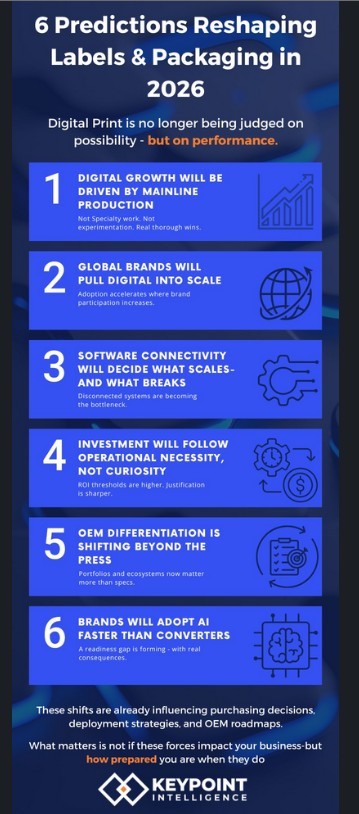
Keypoint Intelligence’s 2026 Labels & Packaging Predictions reflect this more disciplined moment. The forces shaping the year ahead are not dramatic technology leaps. The report explores a wide range of predictions; the following highlight a few that illustrate how digital priorities are evolving.
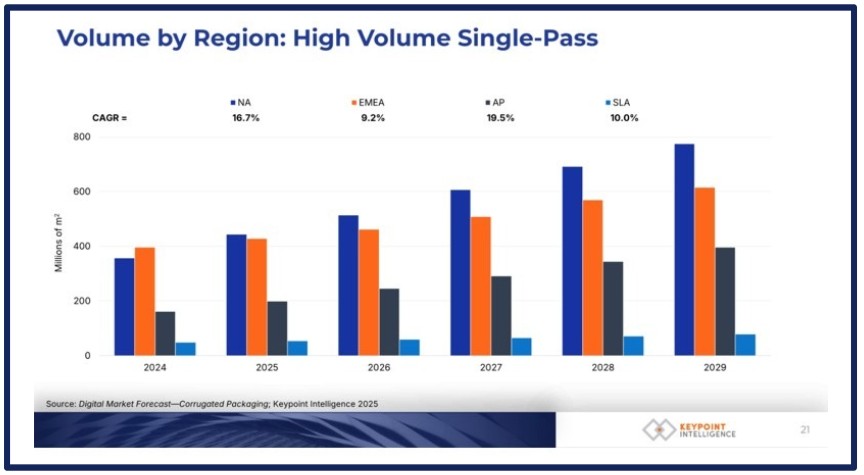
Growth in digital print is increasingly tied to mainline production. Systems positioned for specialty or low-volume work still have a place, but they are no longer setting the pace. Converters are prioritizing platforms that can carry real production load without introducing friction elsewhere in the plant. Digital is being evaluated less as an alternative process and more as a competitive strategy.
Brand owners are playing a larger role in that shift. In labels and corrugated packaging in particular, deeper brand participation is pulling digital further into production strategies. Expectations now extend beyond print quality to speed, responsiveness, data access, and operational accountability. Where brands commit, digital adoption tends to accelerate.
As volumes rise, software has emerged as one of the clearest constraints. Fragmented systems across prepress, production, finishing, and business operations become harder to manage as complexity increases. Most organizations recognize the issue. The challenge is execution. In 2026, integration is less about innovation and more about removing drag.
Capital decisions reflect the same discipline. Investment activity hasn’t slowed, but the rationale behind it has tightened. Projects are expected to solve defined problems—capacity limits, labor efficiency, cost pressure—before they move forward. Curiosity alone no longer clears the hurdle.
For OEMs, differentiation is shifting as well. Buyers are looking beyond the individual press and evaluating how complete portfolios hold together over time. Hardware still matters, but cohesion across software, consumables, and services increasingly shapes long-term decisions.
AI adds one final layer of complexity. Brand owners are moving faster, embedding AI into analytics and planning. Converter adoption is more cautious, shaped by operational realities. That mismatch is already shaping expectations around speed and responsiveness—and it won’t resolve itself.
The full 2026 Labels & Packaging Predictions Report explores these dynamics in detail, focusing on what they mean for converters, suppliers, and industry stakeholders navigating the next phase of digital print. The pressure points are already visible. The advantage lies in how deliberately, and realistically, they are addressed. This report is available free for a limited time. Download here.