Winners Announced!fl
Sydney, Australia – Tuesday 7th July, 2026
Professional and amateur photographers worldwide were invited to enter the 2nd International Aerial Photographer of the Year competition.
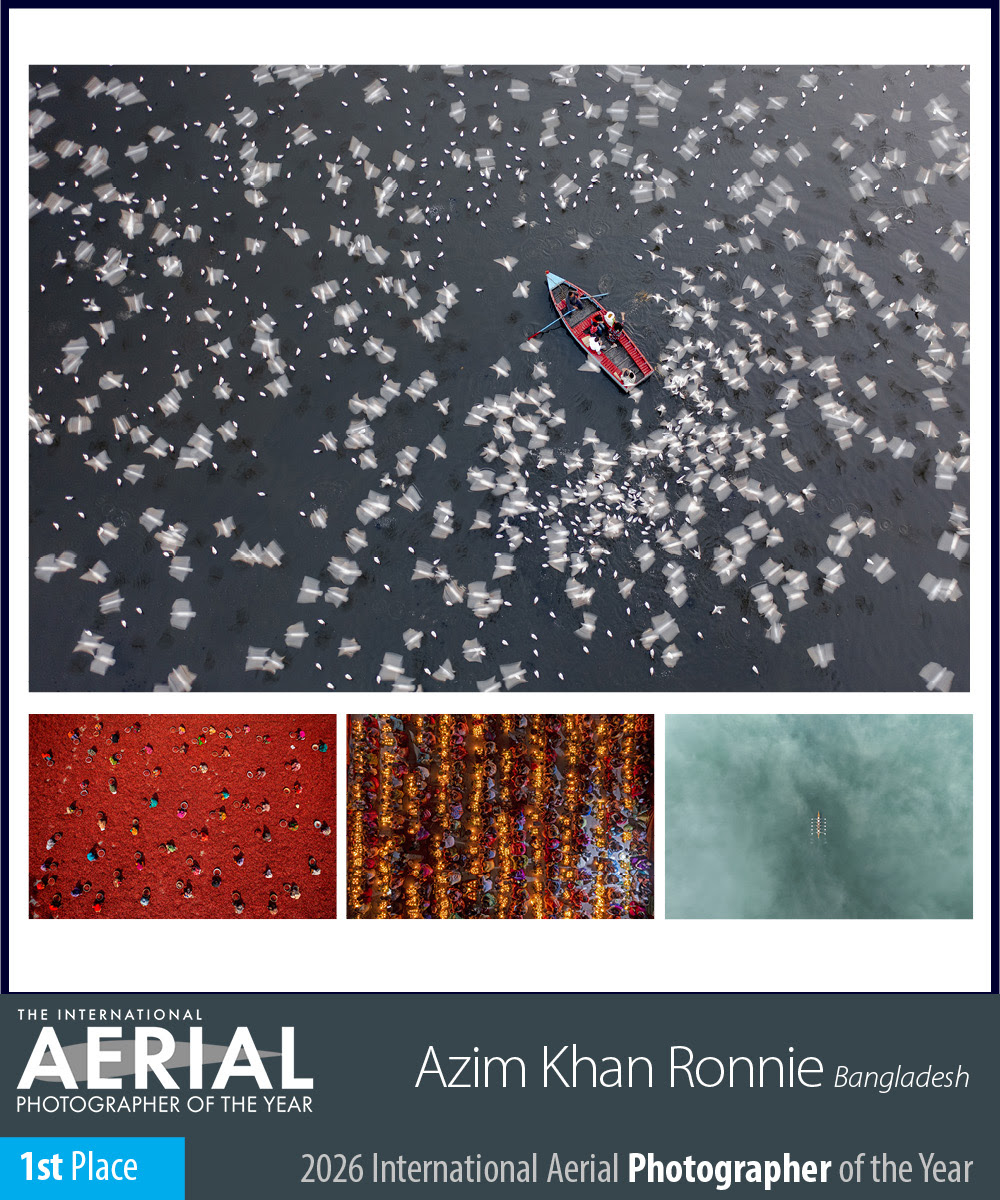
From 1587 entries from around the world, the winner of the 2nd International Aerial Photographer of the Year (based on a folio submission of at least 4 images) is Azim Khan Ronnie of Bangladesh. Azim Khan Ronnie is a professional photographer from Bangladesh and currently living in France. He has been working in photography for 11 years, covering travel, aerial, documenting news, culture, sports, humanitarian issues, and everyday life with a strong emphasis on visual storytelling. His work has taken him from major sporting events to remote communities, capturing moments that reflect both resilience and the human condition. Professionally he was a journalist on many news channels for more than 19 years.
Azim Khan Ronnie’s journey into photography began with a fascination for telling real stories through images. What started as a passion gradually developed into a full-time profession, driven by a commitment to documenting authentic moments that might otherwise go unnoticed. He believes photography has the power to inform, inspire, and preserve history.
Today, his work focuses on creating compelling visual narratives with both journalistic integrity and artistic sensitivity. His photographs have been recognised in international competitions and published by media organizations around the world.
“I use a combination of mirrorless cameras, action cameras, drones and professional lighting equipment that gives me the flexibility to work across photojournalism, documentary, sports, wildlife, and aerial photography.
“For aerial photography, I use the DJI Mavic 4 Pro and DJI Mavic 3 Classic, allowing me to create images that reveal scale, patterns and perspectives impossible to capture from the ground. I always shoot exclusively in raw to capture the maximum amount of image data, giving me greater flexibility during post-processing while preserving image quality.
“I use Adobe Photoshop for all of my post-production work. My workflow typically includes raw processing, exposure and white balance adjustments, contrast and tonal corrections, colour reflnement, sharpening, noise reduction and selective local adjustments.
“My post-processing philosophy is based on enhancement rather than manipulation. I believe editing should strengthen an image without altering its truth or narrative. Every adjustment is made with the goal of accurately reflecting the atmosphere, light and emotion I experienced when I pressed the shutter. Especially in my documentary and photojournalistic work, I am committed to ethical editing practices that preserve the integrity of the photograph. For me, post-production is the flnal step in realising the image I envisioned in the fleld, not creating a different reality.
Azim Khan Ronnie says what he enjoys most about aerial photography is its ability to transform familiar landscapes into something entirely new. “From above, everyday scenes reveal patterns, geometry, textures and relationships that are often invisible from the ground. Aerial photography allows me to tell stories about people, nature and the environment from a perspective that inspires curiosity and offers a deeper understanding of the world.
“In my photographs, I look for strong composition, beautiful light, meaningful moments and visual balance. Whether I am photographing landscapes, sporting events, humanitarian stories or everyday life, I aim to create images that are both aesthetically compelling and emotionally engaging. I want viewers to pause, explore the details and connect with the story behind the image.
“I am influenced by the work of photographers who combine technical excellence with powerful storytelling. The photographers of National Geographic, especially those who document culture, nature and the human experience, have been a constant source of inspiration. I also admire contemporary aerial photographers who use perspective, scale, and geometry to reveal the beauty and complexity of our world. Their work encourages me to keep exploring new viewpoints, while remaining authentic to the stories I tell.
Azim Khan says he is drawn to locations that reveal something unexpected when viewed from above. Each of the locations in his portfolio had a unique story to tell, whether it was the quiet simplicity of rowing on the Lake Zurich in Switzerland, the dramatic interaction between people and birds at Yamuna Ghat in Delhi, India, the vibrant geometry of red chilli peppers drying in Bogura, Bangladesh or the spiritual atmosphere of the Rakher Upobash ritual in Dhaka, Bangladesh.
“I visited these locations while working on documentary and travel photography projects, and I chose them because I saw the potential to transform everyday scenes into compelling visual narratives. Behind each photograph was patience, waiting for the right light, the perfect arrangement of people, or a fleeting moment when everything came together. Those brief moments are what make aerial photography so rewarding.
“I entered the International Aerial Photographer of the Year because it celebrates creativity, storytelling and the unique perspective that aerial photography offers. It is an opportunity to share my work with an international audience and to learn from some of the world’s best aerial photographers.
"I also enter selected international photography competitions, particularly those that value documentary storytelling, photojournalism and aerial photography. For me, competitions are not only about winning awards, they are a way to challenge myself, receive recognition from respected judges and be inspired to continue exploring new perspectives and telling meaningful stories through photography.”