Carded
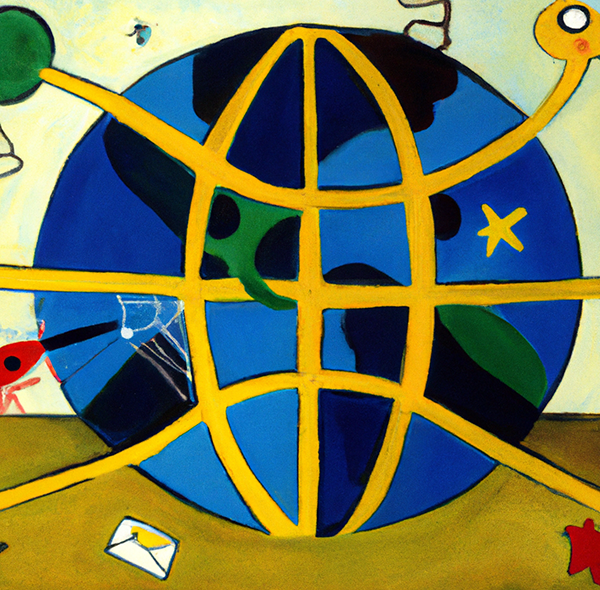
Illustrator Amy Cowen has a Substack newsletter called An Illustrated Life, and this year, she is issuing a monthly challenge: mail a postcard to someone on a specific topic.
In a series of monthly prompts, we will create a set of postcards, each one responding to a simple nudge. You can use existing postcards, focusing on filling the blank side. This is the easiest approach. Or, you can use blank cards, your responses filling both sides.
Month by month, you will develop a set of postcards, a series of epistolary art. You might choose to work in the same medium or style or palette each month or work with repeated elements that help tie the cards together. Or you may view each postcard as a standalone piece, disconnected from others, and let the prompt guide your choices.
The idea is to connect with others using the perhaps old-fashioned medium of the printed and mailed postcard or, as she refers to it, “Epistolary convergence and distillation, a new monthly challenge with a quietly vintage feel.” Cowen encourages people who are participating in the challenge to think about each prompt with a specific recipient in mind. She launched it last October, where the prompt was (since Halloween was approaching) a costume, prompt #2 was a “spiral,” prompt #3 was a snowflake, prompt #4 was the book (or stack of books) you plan to read in the New Year, and February’s postcard prompt is “a naked tree”—i.e., sans leaves.
It would be an interesting experiment. It reminds us of the time we tried to write an epistolary novel but couldn’t afford the postage.
Micro Publishing
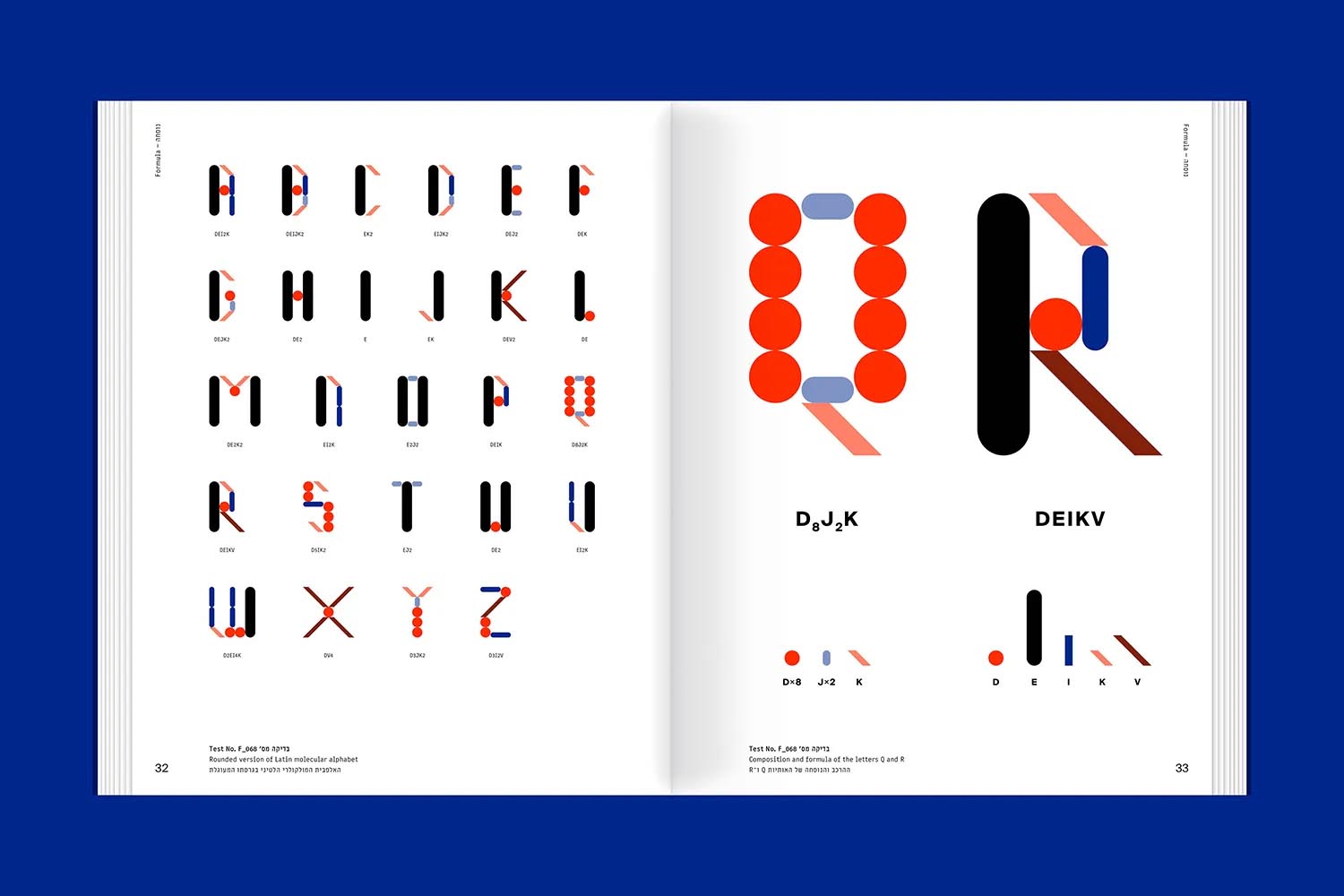
Here’s something that today’s typographers may never have realized: letters have a molecular structure. Say what? Yep, via Print magazine, Kobi Franco, a leader in the master’s design program at Shenkar College in Tel Aviv, has been conducting research in “Molecular Typography,” which has describes at length his book Molecular Typography Laboratory, based on “the speculative premise that the characters of the Hebrew and Latin alphabets possess a molecular structure.”
Over 150 distinct experiments were conducted on the topic, categorized into 11 primary themes in the book: Foundations, Language, Gender, Formula, Weight, Gravity, 3D, Generative Research, Color, Word Play, and Type and Image.
Our immediate question is, “What the heck are you talking about?” Based on earlier work by philologist and scholar H.F. Henderson (via a lecture by designer and artist Woody Leslie)—who argued that the letters of the Latin alphabet were composed of a combination of several atoms—Franco looked to expand on Henderson’s work which, as it turned out, was not necessarily intended to be taken literally, or even seriously. Print’s Steven Heller spoke to Franco.
“Understanding Molecular Typography” was later revealed to be an artistic project, a figment of Leslie’s imagination. Nevertheless, I became enchanted by the speculative process of thinking about a Hebrew alphabet composed of similar yet different “atoms.” I embarked on a journey—an experimental, pseudo-scientific study based on the assumption that the Hebrew letters indeed had a molecular structure. I sought to explore how this assumption could be applied to the Hebrew alphabet, Hebrew words, and the Hebrew language.
As we all know, every substance in the universe is formed by the combination of a very finite number of atoms into molecules. So, too, letters, apparently.
The molecular principles are straightforward: a limited number of atoms, or basic shapes, connect to one another through electromagnetic attraction, forming all the letters of the alphabet. Leslie based his study on the Futura typeface (1927), designed by Paul Renner, and broke it down into seven atoms.
And at this point the acid seems to have kicked in.
Each letter in the Latin and Hebrew alphabets is composed of combinations of two to 11 atoms. The combinations of atoms that make up the letters are arranged as though composing a chemical formula. In this way, the first Hebrew letter, Aleph—composed of four squares, a short vertical rectangle, a parallelogram tilted to the right, and a parallelogram tilted to the left—is represented by the formula D4JKV. Each atom is surrounded by a fixed electric charge that causes an electromagnetic interaction. The combination of atoms into letters parallels the combination of letters into words. The atoms are 3D units, and their combination forms letters or 3D signs.
Be sure to click through for much much more detail.
AI-Yi-Yi, Part the Infinity: Making Book
So it’s come to this, has it? Says The Verge: “Books written by humans are getting their own certification.” The Authors Guild has introduced a initiative via which authors can certify that their book was written by an actual human and not by artificial intelligence.
The Guild says its “Human Authored” certification aims to make it easier for writers to “distinguish their work in increasingly AI-saturated markets,” and that readers have a right to know who (or what) created the books they read. Human Authored certifications will be listed in a public database that anyone can access. The project was first announced back in October in response to a deluge of AI-generated books flooding online marketplaces like Amazon and its Kindle ebook platform.
At the moment, the certification is only available to Authors Guild members and books written by a single author, but the Guild says that at some point it will be open to non-Guild members and multiple authors.
It’s kind of sad that we need this, but whatever.
Intra Mural
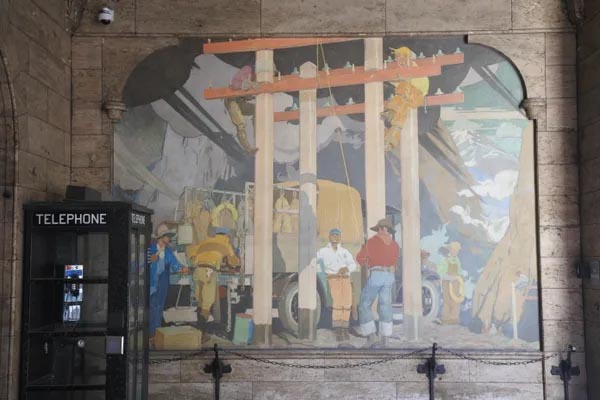
When in Denver, be sure to check out the Mountain States Telephone Building. Built in 1928 and opened in 1929, the Gothic Revival structure is often referred to as “The last of the Bell System Palaces,” since it was the last of Bell’s buildings to be constructed before the stock market crash of 1929 and subsequent Depression. What is notable about it, says Atlas Obscura, are the Art Deco murals that adorn the lobbies. Painted by Colorado muralist Allen Tupper True between 1927 and 1929, they illustrate the history of communications in the West as well as the people who built it all. They had gone to seed over the course of the 20th century, but were restored in the 1980s.
Alas, the building itself is closed to visitors, but:
if you visit during regular business hours, you can duck into the foyer of the building on the 14th Street entrance. In this lobby, there are two additional murals. The building itself is closed to visitors. On the Curtis side there are additional murals that can be seen behind a security gate.
True’s murals can also be found at various sites throughout Denver, such as the Colorado National Bank, The Brown Palace, and the Denver Civic Center.
Seeing Things
Last year around this time, we linked, with no small amount of incredulity, to a story about a pair of AI glasses. Now, we find an actually useful application for AI in eyewear (AIwear?): glasses for the hard of hearing that transcribe spoken words. (It’s not strictly speaking AI, just transcription, but it uses machine learning to quickly determine accents, speech patterns, and languages.) Says Laughing Squid:
Hearview, makes a pair of really useful smart glasses that transcribe speech to text in real-time, letting those who are deaf and/or hard of hearing participate in conversations, see movies, look at social media videos, and watch television when close captioning isn’t available.
How do they work in real life? Well, Good News Network writes about Kendyl Pool, a deaf 10-year-old girl who was “blown away” when she received them as a gift from her mother.
“Kendyl had no idea these even existed so when she put them on and I started talking, she was completely shocked,” said Bri. “She was just blown away, she even cried a little bit because she couldn’t believe she could see what I was saying right in front of her.”
There is also a corresponding app that can store conversations, which even hearing people would find useful, although one wonders if this can fall afoul of laws regarding recording conversations.
Still, pretty neat.
About those frames, though…
The Sound of Graphene
Was it a good week for graphene news? It’s always a good week for graphene news! Graphene-coated drivers for noise-cancelling headphones. While graphene-coated drivers are normally found in high-end products, the Philips H8000E is a mid-range set of headphones. From (who else?) Graphene-Info:
the wireless, over-ear device will come with adaptive Adaptive Noise Cancellation (ANC). Inside, there are graphene-coated 40mm drivers that allow for high-resolution playback and Spatial Audio functionality.
Not So Silent Running
Uh oh. Here is what could be the first salvo in the upcoming war between humanity and robots: a half marathon pitting human vs. robot runners. It will take place in Beijing in April. Says Futurism’s The Byte:
The race will be roughly 13 miles, and robotic competitors both cannot have wheels and must stand between 1.5 and 6.5 feet tall. In a statement, E-Town added that "competing robots must have a humanoid appearance and mechanical structure capable of bipedal walking or running movements."
Can the humans have wheels? Hosted by the Beijing Economic-Technological Development Area (aka E Town), upwards of 12,000 humans and robots are expected to participate.
It seems like the robots are getting pushier. Last fall, a robot called Tiangong jumped into Beijing's Yizhaung half-marathon toward the end. It only ran about 100 meters but it got a medal anyway because it crossed the finish line. Harrumph.

It is not uncommon for race participants to bring their dogs along for the run—which can be annoying—but now some runners are bringing their robot dogs along.
Just a few week after Tiangong's surprise marathon debut, the RAIBO2 robodog competed in a full marathon weeks later in South Korea. Though the adorable quadruped was significantly faster than Tiangong, it still took nearly four hours and 20 minutes to run the 26.2 mile race — nearly double the time of the human winner, who clocked in at around two hours and 36 minutes.
RAIBO2 will not be eligible for the E Town half marathon, being neither humanoid nor Chinese, but Tiangong will, and is expected to be capable of running 10 kilometers (6.2 miles) per hour by race time. (Instead of water stops, will the robots have oil stops?) And if a robot wins, what will its words to the press be? “I’m going to robo-Disneyland!”
Belle & Sebastian will have to update their song.
Hammer Time
As we write this, we see via the periscope that it is snowing outside the Around the Web Cultural Accretion Bunker, meaning that at some point the drive that leads to it will need to be shoveled, as provisions down here don’t last forever. As anyone who routinely shovels a driveway knows, there is one particular challenge caused by driving on an unshoveled driveway. Sometimes we need to get to an appointment, work, the supermarket, the liquor store, Jazzercise, etc., before we have shoveled and when we return, we find that the tire treads have solidified into dense strips of patterned ice. So when we go to clear the driveway, the shovel slams into the ice chunk, which can provide injury or entertainment to the neighbors (or both). Which is why we were interested to see on Core77 that someone has invented a snow shovel designed for this exact predicament: the Hammerhead Snow Shovel.
The polycarbonate shovel head is reversible (it's on a hinge), and one end has teeth molded into it. This toothed edge tears right through hard-packed snow. Once the tracks are broken up, you can reverse the shovelhead and shovel normally.

We’re curious….
A steal at $22 for an 18-in.-wide model or $27 for a 20-in. version. Decisions decisions…
Alexander the Great White?
Here’s an interesting headline from LiveScience: “Was Alexander the Great eaten by sharks?” We weren’t even aware that anyone would have suggested that, but apparently someone has. The thing is, no one actually knows where his body went.
Alexander III (aka The Great) was born July 20/21, 356 BC, ascended to the throne of Macedon in 336 BC (at age 20), and spent most of his 20s conducting a lengthy military campaign throughout Asia and Egypt, which puts to shame how some of us spent our 20s. By age 30, he had built one of the largest empires in history. He died on June 10 or 11, 323 BC, at age 32 in the palace of Nebuchadnezzar II in Babylon. Causes of death conflict—was it foul play? Bad wine? No one is quite sure. But even more mysterious is where his tomb ended up, which, as it turns out, is one of the biggest unsolved mysteries in archeology. Was it in Macedon (now Greece)? Egypt—specifically, Alexandria? Somewhere else?
“As long as his tomb isn’t found, he lives on in a quasi-mystical limbo, forever sparking new ideas and theories and controversies,” Nicholas Saunders, a professor emeritus in the Department of Anthropology and Archaeology at the University of Bristol in the United Kingdom and author of the book “The Life of Alexander the Great” (Brighter Child, 2006), told Live Science in an email.
Hey, maybe he’s still alive. Weirder things have been known to happen. (Well, no, not really…)
The tomb may be hidden beneath the streets of modern-day Alexandria [Egypt], at the intersection of two ancient thoroughfares, she said. An intriguing Hellenistic statue and other signs of ancient quarters from the right period point to a very promising location.
Part of the problem is that his body was moved, so he was buried more than once.
In addition, historical records of the tomb are scarce and were often written hundreds of years after the events they describe. Each of those sources had a political agenda or bias, said Paul Cartledge, a professor emeritus of Greek culture at the University of Cambridge.
Another problem is that no one knows what the tomb looked like; no one did a selfie standing in front of it, for example. And, finally, if it is in Alexandria, the modern city was built on top of the ancient one, meaning that archaeologists would have to dig up people’s homes and businesses which is kind of a deal-breaker, although imagine what you could get for your house if it turned out that Alexander the Great’s tomb was in a sub-basement.
As for the shark theory, one line of thought is that Alexander was buried in a mausoleum in Brucheum, a sector of Alexandria where the royal quarters were. It was located close to the sea and, as the sea level rose over the millennia, big chunks of historical Alexandria— including the royal quarters—ended up underwater. Ergo:
if a mausoleum is found, there's no guarantee a body would be inside. "Unless he was in a coffin that preserved his body, he will never be found," Cartledge said. "My guess is that his body could've been eaten by a shark."
A bit of a reach, but it makes as much sense as any other theory.
It’s All Downhill
Do you like skiing? If so, did you know that you don’t need snow to ski? Yes, via Boing Boing, apparently it is perfectly possible to ski on sand. And if you happen to find yourself in Bavaria, you can even stay at a resort that specializes in sand skiing.
Monte Kaolino is similar to a ski resort, but instead, it is a sand resort. Located in Hirschau, Bavaria, Germany, this outdoor location has giant hills of sand instead of snow. There is a lift that takes you up to the top of a tall sand dune and you can ride down on a board or on sand skis.
The resort came about thanks to a nearby kaolinite mine, which over the years has generated 35 million tons of excess sand. Wikipedia adds:
By the 1950s the pile of sand had grown large enough that people experimented with skiing on it, and in 1956 a ski club was formed. Uniquely to this hill, skiing is done directly on the sand and as a result, its operating season is inverse with ski areas elsewhere – it only opens in summer, even though the area does snow in winter.
Sock it To Me?
No, just no. We will subscribe to magazines. We will subscribe to newspapers. We will subscribe to WhatTheyThink. We will subscribe to a streaming service. We will even subscribe to wild conspiracy theories. But we will not subscribe to socks. Which, yes, is a thing. Via Wired, which carries on like it is a sensible thing:
THE BEST SOCKS will make your day.
That’s setting the bar pretty low as far as days go.
There's nothing worse than scrambling for a clean pair when you're running late,
We can think of many, many things worse than that.
and nothing quite beats the feeling of slipping into a fresh, cozy set. And though socks might not be the star of your outfit, they sure can make a statement. You don't want to be caught in the boardroom with a mismatched pair—what would your mother say?
What’s my mother doing in a boardroom? Sounds like some Freudian nightmare. Anyway, we continue:
I've rounded up some of the best options to deliver fresh pairs right to your door—whether you prefer a monthly mystery box or a pair on your own schedule. Forget the hassle, and let someone else take the legwork out of keeping you stocked with high-quality socks.
Surely you’re in the habit of occasionally doing laundry, you barbarian.
We’re not subscribing to underpants, either, which is probably a thing—a disturbing thing—as well.
Fishy
We question the timing of this, but if you’re a Harry Potter fan, you’ll want to pick up the new, limited edition Harry Potter-themed Butterbeer Goldfish Grahams. Via (who else?) Food & Wine:
The new crackers, the company noted in a statement provided to Food & Wine, come with a "rich butterscotch flavor, hints of creamy vanilla, and a touch of magic in each fun-shaped bite."
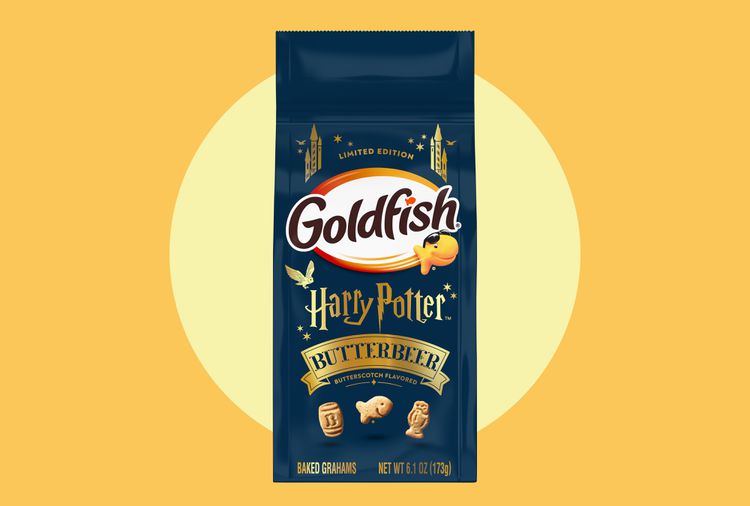
"Goldfish wanted to connect with snackers who are entering new phases of adulthood but still want to keep their playful spirit alive," Fanelli shared as to why the company wanted to make these treats now. "Together with Warner Bros., we noticed a significant overlap between Harry Potter and Goldfish fans over the years
We’d love the see the data that generated that Venn diagram.
Given these shared values, and with an uptick in snackers craving little sweet treats, we saw it as the perfect time to launch a magical snack that taps into nostalgia for fans who grew up enjoying Goldfish and watching Harry Potter."
The 2000s are nostalgia now? Oy…
Anyway, look for them in March where they should be at your favorite retailer for about $3.69. No word on whether you can have them delivered by owls.
This Week in Printing, Publishing, and Media History
February 3
1690: The colony of Massachusetts issues the first paper money in the Americas.
1811: American journalist and politician Horace Greeley born.
1844: Tolbert Lanston, inventor of the Monotype, born.
1907: American author and philanthropist James A. Michener born, in rather epic fashion.
1947: American novelist, essayist, and poet Paul Auster born.
1947: English singer-songwriter and guitarist Dave Davies born.
1959: The day the music died: Rock and roll musicians Buddy Holly, Ritchie Valens, and J. P. “The Big Bopper” Richardson are killed in a plane crash near Clear Lake, Iowa.
February 4
1859: The Codex Sinaiticus is discovered in Egypt.
1960: American composer and playwright (Rent) Jonathan Larson born.
2004: Facebook, a mainstream online social networking site, is founded by Mark Zuckerberg.
2020: The COVID-19 pandemic causes all casinos in Macau to be closed down for 15 days.
February 5
1909: Belgian chemist Leo Baekeland announces the creation of Bakelite, the world's first synthetic plastic.
1919: Charlie Chaplin, Mary Pickford, Douglas Fairbanks, and D. W. Griffith launch United Artists.
1924: The Royal Greenwich Observatory begins broadcasting the hourly time signals known as the Greenwich Time Signal.
1926: American publisher Arthur Ochs Sulzberger born.
1940: Swiss painter, sculptor, and set designer (Alien) H. R. Giger born.
February 6
AD 60: The earliest date for which the day of the week is known. A graffito in Pompeii identifies this day as a dies Solis (Sunday). In modern reckoning, this date would have been a Wednesday.
1515: Italian publisher, founded the Aldine Press Aldus Manutius dies (b. 1449).
1756: American colonel and politician, 3rd Vice President of the United States Aaron Burr born. Wait for it.
1945: Jamaican singer-songwriter and guitarist Bob Marley born.
February 7
1497: In Florence, Italy, supporters of Girolamo Savonarola burn cosmetics, art, and books, in a “Bonfire of the vanities.”
1812: English novelist and critic Charles Dickens born.
1885: American novelist, short-story writer, playwright, and Nobel Prize laureate Sinclair Lewis born.
1898: Émile Zola is brought to trial for libel for publishing J'Accuse…!.
1997: NeXT merges with Apple Computer, starting the path to Mac OS X.
February 8
1587: The death of Mary, Queen of Scots (b. 1542).
1828: French author, poet, and playwright Jules Verne born.
1834: Russian chemist and academic, and creator of the Periodic Table of Elements Dmitri Mendeleev born.
1915: D. W. Griffith’s controversial film The Birth of a Nation premieres in Los Angeles.
1922: United States President Warren G. Harding introduces the first radio set in the White House.
1946: The first portion of the Revised Standard Version of the Bible, the first serious challenge to the popularity of the Authorized King James Version, is published.
1971: The NASDAQ stock market index opens for the first time.
1978: Proceedings of the United States Senate are broadcast on radio for the first time.
February 9
1737: English-American philosopher, author, activist, and pamphleteer Thomas Paine born.
1870: US president Ulysses S. Grant signs a joint resolution of Congress establishing the U.S. Weather Bureau.
1881: Russian novelist, short story writer, essayist, and philosopher Fyodor Dostoyevsky dies (b. 1821).
1923: Irish rebel, poet, and playwright Brendan Behan born.
1964: The Beatles make their first appearance on The Ed Sullivan Show, performing before a record audience of 73 million viewers across the US.
1986: Halley’s Comet last appeared in the inner Solar System.