Background
Camber Marketing started about 25 years ago as a consumer direct marketing company that partners with clients to become an extension of their marketing efforts. The company offers a turnkey solution for clients, primarily focusing on mortgage companies, banks, consumer loan companies, and auto lending.
According to CEO Jeff Bernard, “The types of clients Camber Marketing serves, include small and medium-sized businesses, as well as large corporations.” Retail is another vertical where Camber Marketing works, helping new businesses connect with customers through trigger-based monitoring elements. As an example, a new business opens in the area, and they want to figure out how to connect with customers, “so we will introduce them through various, primarily trigger-based monitoring elements. That could include, somebody recently moved into their neighborhood, somebody currently lives in their neighborhood, somebody just had a life event happen that would necessitate products from that particular establishment, etc.”
Evolution
Camber started as a data-focused business but evolved into a full-service marketing company. Bernard came out of the financial services business, where he loved the value of data in marketing communications. So when he started Camber, it was 100% built around providing data to the end user and the clients were the same sort of clients he had worked with in the past. “We were just giving them the data points that they needed, and then they took care of the marketing, the simplest form of engagement, but very important piece of the puzzle for them to be able to do marketing.”
He quickly realized that, even though they handed them the right data, it didn’t mean they knew what to do with it, and Camber was getting frustrated by the shortcomings these clients were seeing. “They weren’t executing proper campaigns with it, we already had marketing experience again from prior jobs, and we knew there were better ways to do this, so we started dabbling in that space.” Bernard realized that providing data alone was not enough, as clients struggled to execute proper marketing campaigns, and within a few years Camber started offering full-service marketing for these companies. To support this program and in order to streamline and maximize their efforts, at a time when Salesforce and the others were not ready, Camber Marketing developed its own proprietary CRM and hired data scientists to handle back-end analysis and modeling.
Enter Print
The company’s growth included internalizing various services, such as print production, to maintain control over the entire marketing process. “When we facilitate their marketing in the retail-specific side, while we do a little bit of digital, too, we tend to focus on either letter- or postcard-based print. Honestly, our angle is more kind of separate from digital because we want to get to people in a traditional way to try to eliminate a lot of the noise in the digital space.” The mailbox is one of those places where people still have a one to one connection, and typically you get undivided attention, albeit for a brief period of time, but it can be enough time for them to decide to engage.
Digital and variable-data printing became important as traditional presses could not meet the evolving needs of marketing. The company initially outsourced print production but eventually brought it in-house as they gained confidence in the market and the process. They researched options, which included a digital press for $500,000 which might be 30- or 40-ft. long, require its own dedicated space, and at the end of the day only put out 100 pages per minute—but there had to be a better way.
“We had to figure out how can we do this in an economical way, but also scale it, so we gravitated towards a model of less up-front cost but more equipment.” So they started purchasing laser printer after laser printer after laser printer, and effectively daisy chained these machines together. With this type of solution, they could place multiple 30 page per minute laser printer machines in that same footprint, but could also go vertical with the placement of them. “The way we built them was, we took the engines, got rid of all the extra attachments that made them bigger, and just focused on the printer part, and the paper assemblies would go under it, so it could go vertical, but not wide, and we could stack these things and put them on carts, getting 300 or 400 pages per minute out of the same footprint as what one of those half a million 100 page per minute machines would do. And we could do it at a fraction of that cost, since we weren’t paying clicks, we were just paying for the actual consumables we were using.”
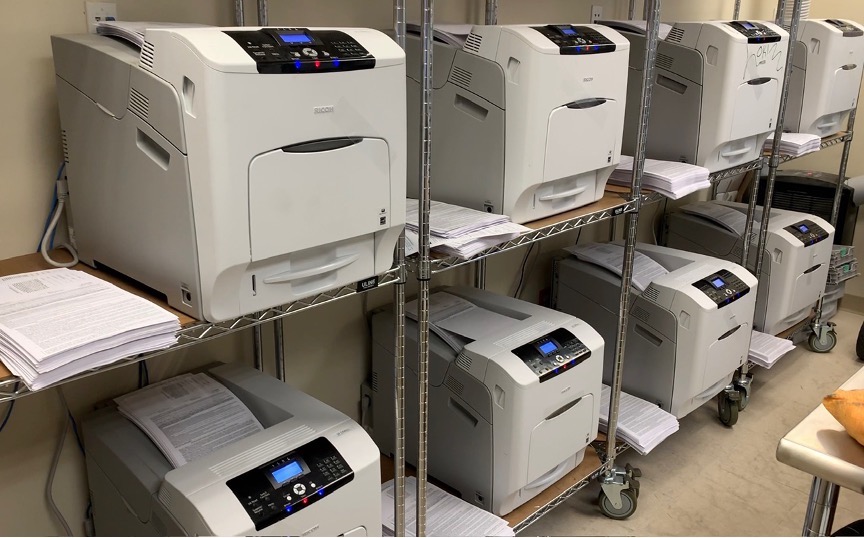
Over time, machine costs kept driving down. They became a commodity, and so a printer that was $50,000 eventually became only $5,000 after 10 years. So they what they could do is buy a machine and use it for a year, literally throw it out, since the machine had no value to them at that point, and constantly cycle machines. “If we had 50 color machines online, we probably went through 25 of those every year and bought new ones, put them online and threw the old ones out, but that was just part of the process.” At the peak, they probably had 40 or 50 color machines, and a near equal number of black-and-white machines, before they started testing and switching towards inkjet. While they had a selection of laser printers from Xerox, HP, and Ricoh, they also used Kyocera. At the time, they found the Kyocera printers and dealers were the more reliable and cost-effective of them all.
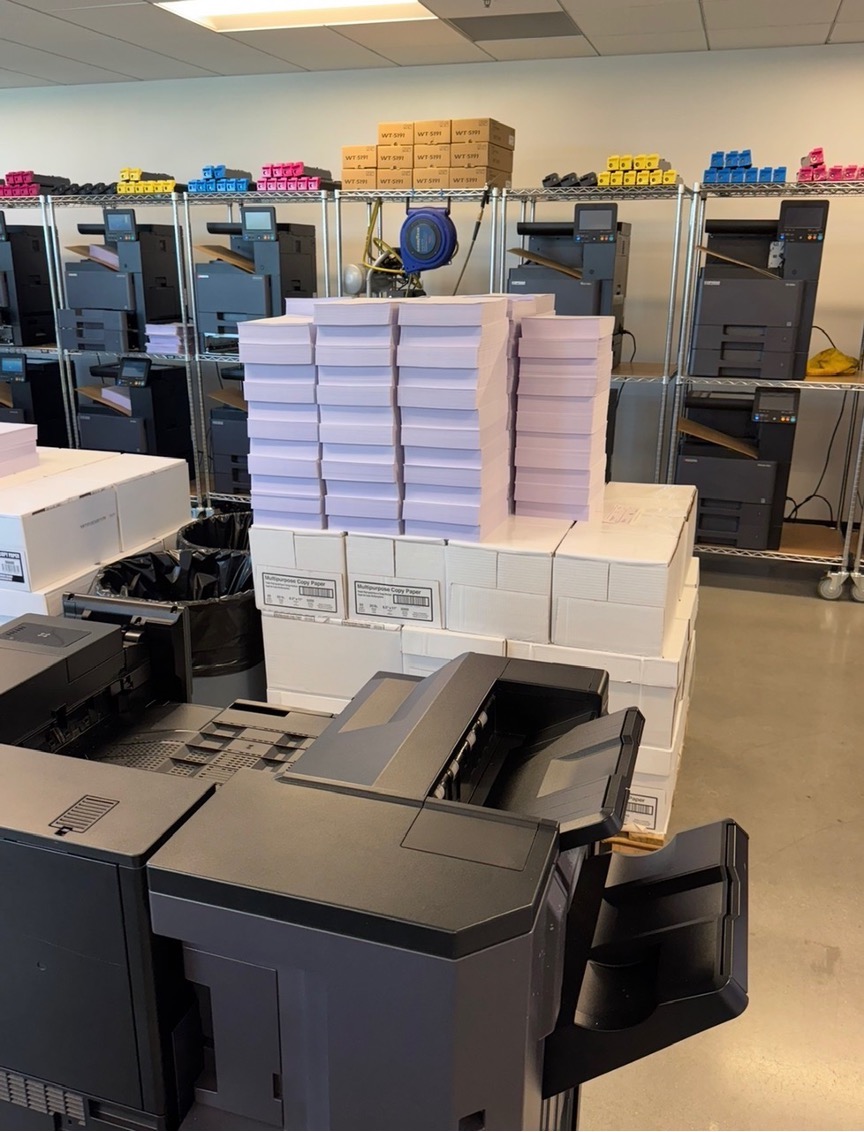
As color became more requested by clients, the company had to balance consumable costs and effectiveness, using spot colors to draw attention without “painting the page” and increasing costs. In 2024, they attended a PRINTING United event to see what the printer market was like and what their options were. They stopped by the Kyocera booth, among others, and “our eyes were open to what inkjet could do.” “We saw their machine in action, and that started conversations with them directly about how we could potentially utilize this product type with our business model, and they were very good about following up after the show. Within a month, we were full-speed ahead trying to put together the pieces of how we could build out our first machine and test it to see if it would do what we needed to.
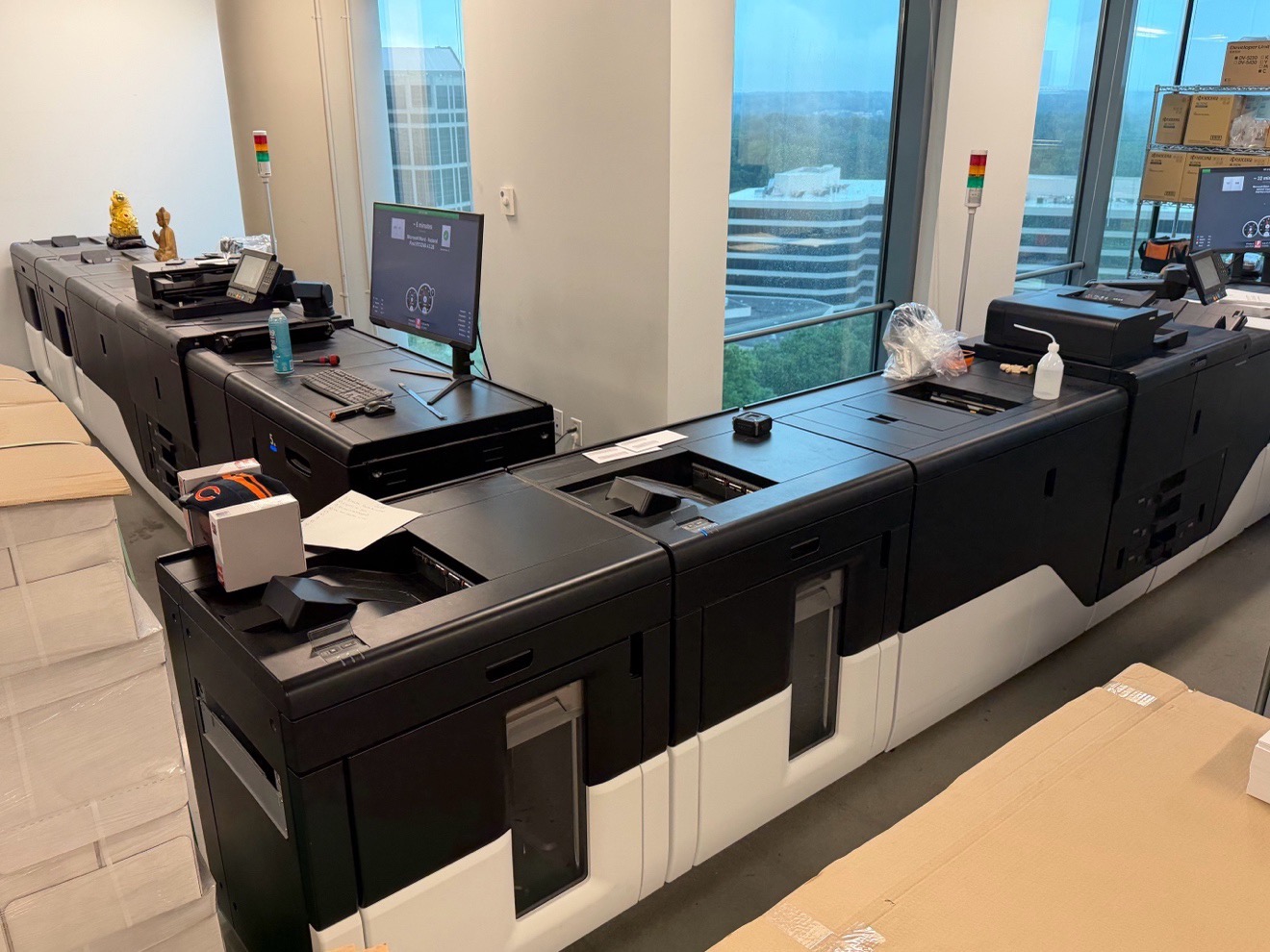
Camber Marketing installed its first Kyocera TASKalfa Pro 15000c inkjet machine in January, 2025, and has since expanded to four machines, with plans to add more. “The inkjet machines have significantly improved our efficiency, reducing paper handling and touchpoints, and allowing for higher throughput,” said Bernard. “Instead of only loading a few 1,000 sheets of paper, they we can put almost 10,000 sheets of paper into the machine. It can not only print on those sheets, but then stack those on the output side to where we’re only touching that machine maybe once every 30 minutes, whereas before with these smaller form factor machines we were touching them every few minutes.” The benefits of the Kyocera TASKalfa Pro 15000c—including lower cost per page, better color control, and higher throughput—have been a game-changer for them.
Today, 15 months later, on the first machine alone they have printed over 25 million pages and that’s just one machine. “So we’ve done more than we ever thought we would on one machine, plus all the others we are adding, and that’s because the machine’s been able to give us everything we’ve asked of it,” said Bernard. They have three now, with a fourth coming online soon. They are actually building out a warehouse facility where they will have a more dedicated space for all of the print and finishing.
What About the Future?
Camber is looking forward to Kyocera’s development plans to add new features to its inkjet machines, such as dual-engine capabilities and in-line perforation, perhaps even a rollfeed to further improve efficiency.
With the TASKalfa Pro 15000c press, Kyocera has created a nice balance. They’ve always thrived on their low cost-per-page print terms of what users spend on the consumables, but inkjet machine costs have been really high, so Bernard feels it’s good to see that they’ve compressed it to where they found a nice balance, between the machine cost and the consumable costs. “The cost per page is a lot lower than what the laser cost per page,” he said, “but it’s really giving them flexibility to print unlimited color on a sheet and it doesn’t move the pricing needle at all for them or for us.”
According to Dustin Graupman, the Senior Director of the inkjet business for Kyocera Document Solutions America, “The TASKalfa Pro 15000c is a perfect combination of capabilities, low acquisition costs, and image quality. It’s uses aqueous inks, which are recognized as the industry standard for high-volume production inkjet. I used to say it was the best-kept secret in the industry, but we really can’t say that any more. According to recent IDC data, it has been thenumber one best-selling inkjet press over the last three quarters. But really when we access all the data over a few years, it’s been a leader for quite a period of time. We’re anxious to make that announcement once we see the full year’s data. Our view is that market leadership is a recognition that it’s a product that hits the sweet spot of what a lot of customer environments are looking for.”
More to Come…
I would like to address your interests and concerns in future articles as it relates to the manufacturing of Print, Packaging, and Labels, and how connected Industry 4.0 and 5.0 are changing the landscape. If you have any interesting examples of hybrid and bespoke manufacturing, I am anxious to hear about them. Please feel free to contact me at [email protected] with any questions, suggestions, or examples of interesting applications.