- Nearly three-quarters of surveyed businesses always or frequently used direct mail as part of their marketing strategies.
- Many respondents indicate that direct mail continues to deliver a competitive return on investment, often surpassing that of digital-only campaigns.
- To truly thrive in today’s landscape, direct mail campaigns must go beyond demographics—incorporating real-time, behavioral insights to deliver more meaningful customer experiences.
By Riley McNulty
Introduction
In an era defined by rapid digital transformation, businesses across a variety of vertical markets are navigating a delicate balance: embracing modern marketing technologies while retaining the customer engagement strengths of traditional channels. Direct mail is a long-standing staple of communication that continues to hold its ground, but it must evolve to meet the demands of today’s increasingly connected world.
Direct Mail is Still Relevant
In late 2024, Keypoint Intelligence completed a series of comprehensive multi-client studies to gain a better understanding of how print demand is changing in key vertical industries. The verticals that were covered in-depth during 2024 included casinos/gaming, home services, government, non-profits, and utilities.
Over 450 total respondents from businesses with 100+ employees participated in this survey. Despite the growing dominance of digital channels, our survey results confirm that direct mail remains a critical tool in today’s rapidly evolving marketplace. Of 468 respondents, 405 (nearly 87% of the total) were involved in direct marketing or direct mail for their companies. Of these, 73% always or frequently used direct mail as part of their marketing strategies. Meanwhile, only 1% of respondents used it rarely.
Figure 1: Use of Direct Mail
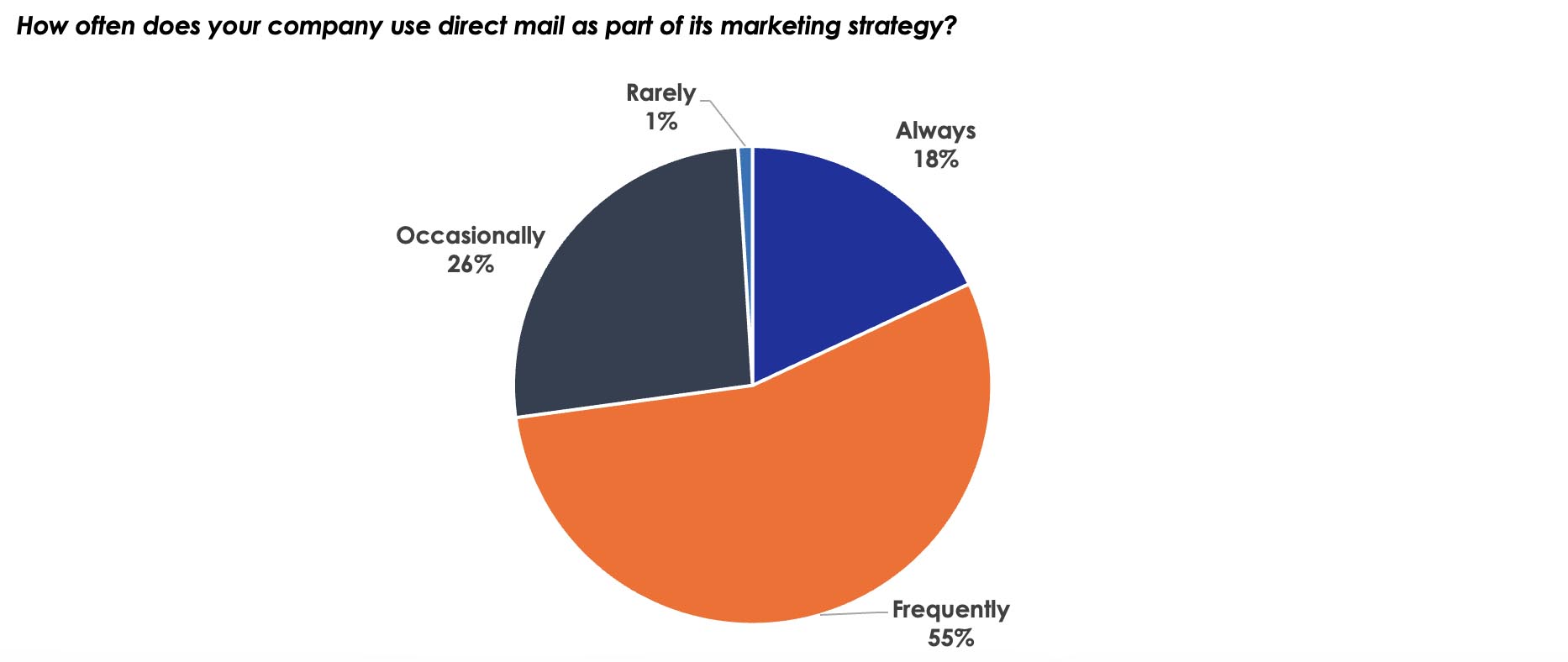
N = 405 Respondents that are involved in direct marketing or direct mail
Source: United States Vertical Visions Multi-Client Study; Keypoint Intelligence 2024
On average, surveyed firms sent nearly 9,300 direct mail pieces on a monthly basis. Furthermore, many respondents indicate that direct mail continues to deliver a competitive return on investment, often surpassing that of digital-only campaigns. This speaks to the continued efficacy of direct mail for fostering customer engagement.
Challenges and Opportunities
Despite its strengths, direct mail certainly faces hurdles in our rapidly digitizing environment. Integration with digital channels is advancing, but it remains incomplete. While 68% of respondents report moderate integration of direct mail with e-mail, mobile apps, and push notifications, only 27% achieve full integration within a codified omni-channel strategy. This partial integration underscores the untapped potential for direct mail to more seamlessly complement digital campaigns.
A significant barrier to deeper personalization is data integration, which requires the unification of diverse data sources across on-premises and cloud systems. To truly thrive in today’s landscape, direct mail campaigns must go beyond demographics—incorporating real-time, behavioral insights to deliver more meaningful customer experiences.
Encouragingly, most businesses can employ some level of predictive modeling via their marketing technology platforms. Even so, only 24% are fully leveraging predictive tools to anticipate customer needs, such as churn or behavior patterns. Similarly, automation in customer journey mapping is growing due to marketing technology investments, but only 19% of firms have fully automated, real-time lifecycle marketing. Regardless, the industry is clearly making progress in this area and direct mail will have to compete in an increasingly real-time, event-driven communication paradigm.
Figure 2: Predictive Modeling and Automation
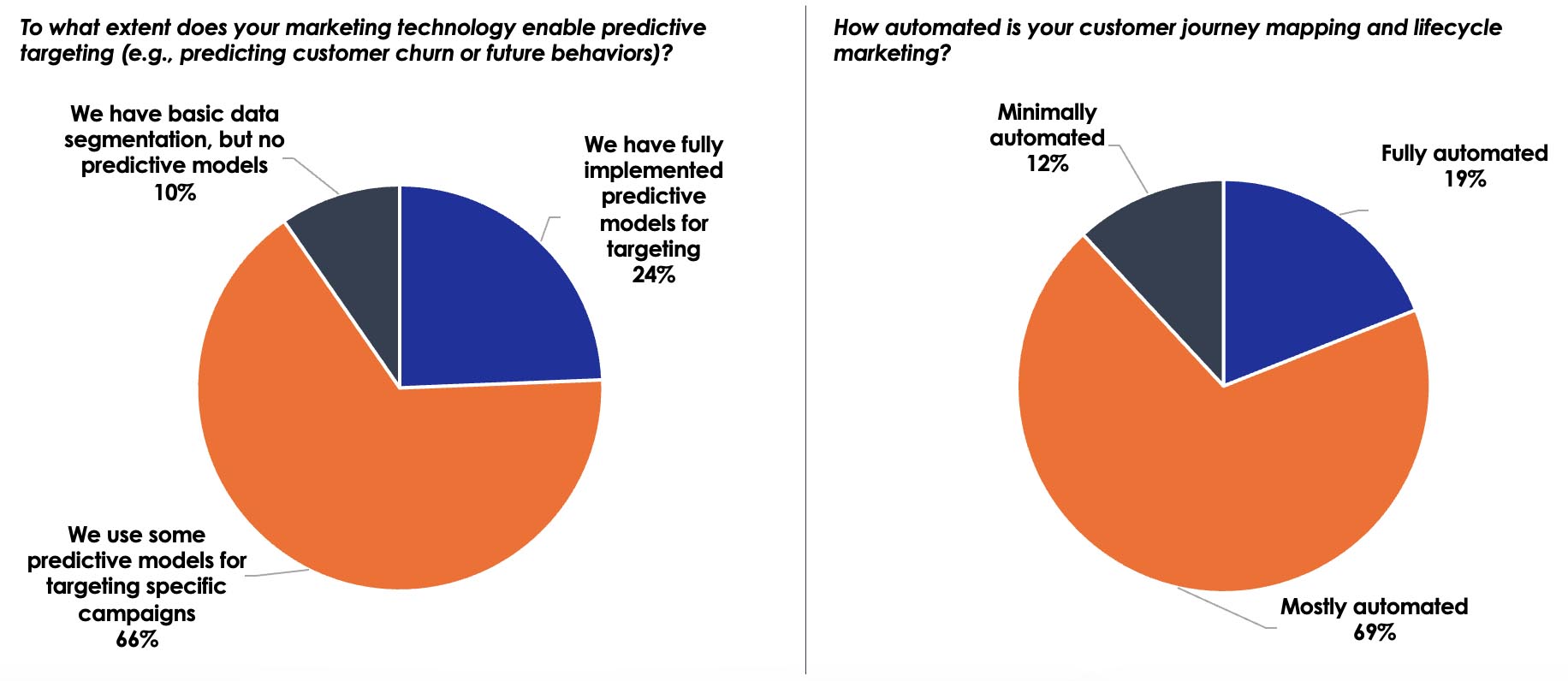
N = 437 Respondents involved in direct marketing, direct mail, or transactional communications
Source: United States Vertical Visions Multi-Client Study; Keypoint Intelligence 2024
The Bottom Line
To remain relevant, direct mail must embrace its role within a broader, digitally enhanced customer engagement strategy. As businesses across all verticals continue to invest in marketing technology, there’s growing potential for direct mail to complement real-time, event-driven communications. By syncing with digital touchpoints and employing predictive tools, direct mail can become a powerful part of an omni-channel toolkit. This will become increasingly important as postage rates increase, as this places a headwind in the face of continued direct mail use.
In conjunction with its research, Keypoint Intelligence conducted a series of in-depth interviews with a variety of senior-level executives across vertical industries. According to a Senior Director of Marketing Technology at a regional bank, “If you don't have the right report or the right data and it’s not readily available to you, you will miss the opportunity. Having three-to-five-day latency might have been okay a couple of years ago, but those days are gone.” This sentiment applies to all marketing strategies, including direct mail. Success lies in embracing immediacy, precision, and integration.
Riley McNulty is the Vice President of Customer Experience and Consulting at Keypoint Intelligence. He is responsible for managing and producing custom research for hardware and software vendors and industry participants. Customer engagements range from market sizing and forecasting, quantitative trend analysis, and qualitative voice of the customer analyses to benchmarking studies. Mr. McNulty holds a B.A. in History and French from the University of Maine, and an MBA from Boston University.