- One of the most exciting things about production inkjet is the increasing proliferation of inks that work seamlessly on regular offset papers.
- Personalization remains one of the highest-value services that PSPs can offer and will continue to drive production inkjet volumes in the future.
- In the print industry, AI has the potential to provide more flexibility for automation to work effectively with a wide variety of applications.
By Karen Kimerer
Introduction
The printing industry has undergone a significant transformation in recent years, and production inkjet technology has emerged as the cornerstone of this modern printing revolution. Although it was once primarily associated with large-scale commercial printers, inkjet has become a versatile and efficient solution for print service providers (PSPs) of all sizes.
From highly personalized direct mail campaigns to on-demand book publishing, inkjet's versatility and efficiency have revolutionized business communications. As we move into the future, critical factors like automation, artificial intelligence (AI), and greater media flexibility promise to further enhance inkjet's capabilities while uncovering new opportunities for growth and innovation. This document explores what's now possible for PSPs as we examine the ongoing advancements in inkjet technology.
A Growing Range of Applications
Naturally, PSPs want to be able to say yes to as many jobs as possible. One of the most exciting things about production inkjet is the increasing proliferation of inks that work seamlessly on regular offset papers. In the past, inkjet printing was limited to specific paper types and often required treatment before going into production. This was not an ideal scenario, and it sometimes eliminated inkjet technology as an option. Fortunately, things have since changed. Today’s inks make it possible for print providers to use more affordable, readily available paper without sacrificing quality.
This shift helps lower costs, opening the door to a wider variety of print jobs and enabling PSPs to offer their clients more flexible and budget-friendly options. Using standard paper brings more possibilities to inkjet printing, whether it's for transactional documents or direct mail. As a result, modern inkjet technology offers a real advantage over traditional and toner-based methods.
Just as importantly, the quality of inkjet printing has significantly improved over the past several years. PSPs can now achieve offset quality on inkjet presses with higher ink density and better resolution. This leap in image quality means that applications previously reserved for offset or digital toner printing (e.g., high-end marketing materials, brochures, and even photo-quality prints) can now be produced with inkjet. Inkjet exposes PSPs to new revenue streams, enabling them to serve markets where visual impact and fine detail are paramount.
The Value of Personalization
Cut-sheet inkjet presses are one of the fastest-growing areas in inkjet technology. These models are well-suited for the growing demand for shorter print runs. According to Keypoint Intelligence's latest forecast data, unit sales will achieve double-digit compound annual growth rates (CAGRs) in both inkjet press categories between 2024 and 2029.
Figure 1. US Color Large Production Cut-Sheet Forecast (Unit Sales)
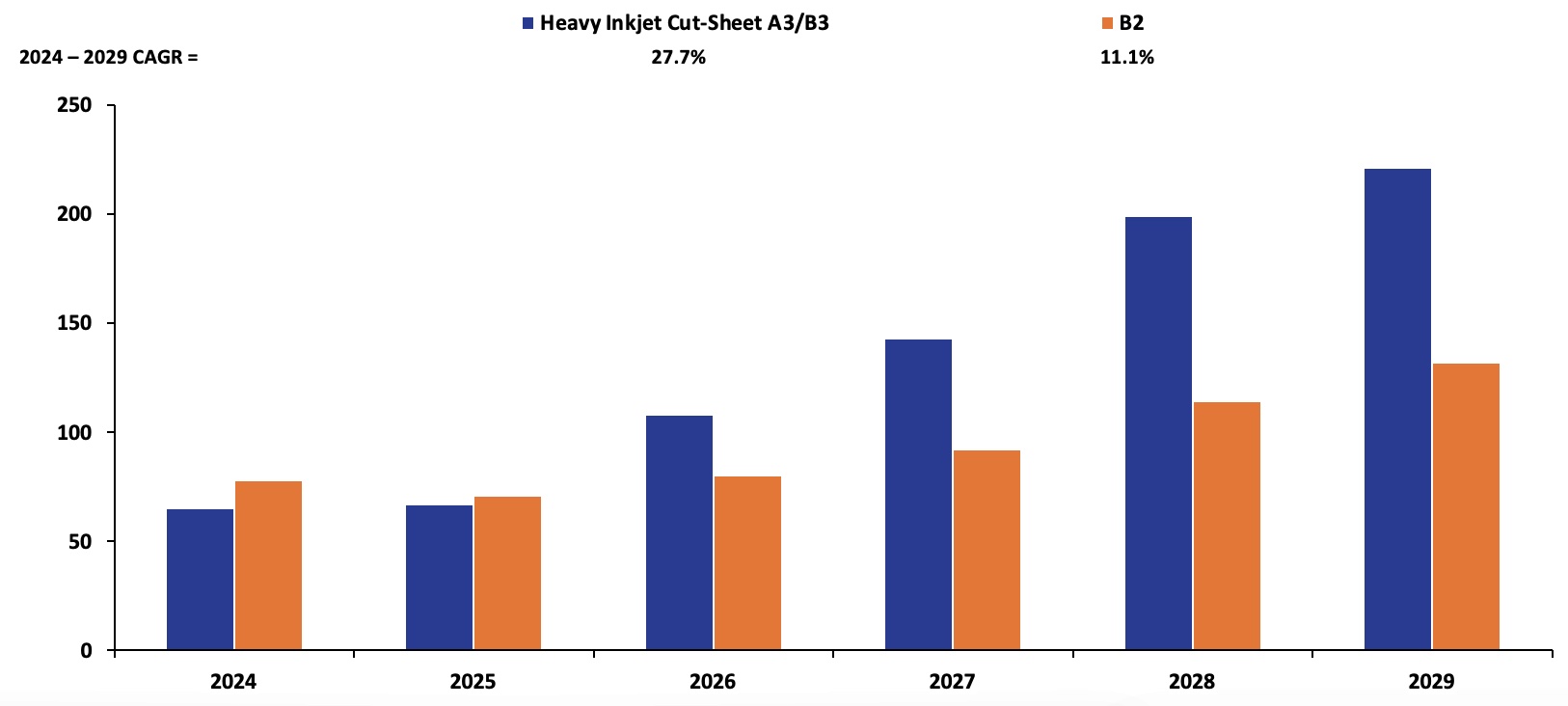
Source: US Global Production Copying & Printing Market Forecast; Keypoint Intelligence 2025
The significance of cut-sheet inkjet presses becomes even more apparent for organizations that handle a diverse range of print jobs. These presses enable dynamic, personalized content produced at scale and eliminate the downtime that is traditionally required for paper changes, boosting overall productivity. Today’s customers want to feel seen and understood, so the rising demand for personalized print is no surprise. Personalization remains one of the highest-value services that PSPs can offer and will continue to drive production inkjet volumes in the future. From customized campaigns to unique marketing collateral, the ability to tailor each piece to the recipient or produce versions meant for a specific audience boosts customer engagement and improves the customer experience.
In the future, applications of data-driven personalization will become even more advanced. With production inkjet presses at the forefront, PSPs can produce highly targeted print campaigns that truly complement digital marketing efforts, making them indispensable partners in their clients' marketing strategies. Personalized print stands out in a world that is overwhelmed by digital noise, delivering impactful messaging in a tangible, memorable format.
From Ink to Intelligence
Inkjet's impact on workflow efficiency and labor costs is evident. Unlike traditional printing methods, production inkjet presses need much less setup time, enabling PSPs to get the presses running faster while seamlessly switching between jobs. In addition, with no need for plates and fewer consumables, the cost per page for shorter print runs is lower. As a result, PSPs can handle smaller jobs quickly and more profitably. On top of that, many inkjet presses come with high levels of automation. Everything from color calibration to substrate handling is monitored by the intelligence built into the device. This reduces the need for constant monitoring, minimizes errors, and helps make the whole process smoother and faster.
Still, when it comes to executing the tasks that are required to get print jobs on the press, many print operations are only in the early stages of automation. This low adoption rate is often a result of traditional automation that follows predefined rules and conditions. This makes it difficult for PSPs that regularly produce a large variety of job types to see the benefits. For this reason, interest in artificial intelligence (AI) is quite strong in the print industry. AI has the potential to provide more flexibility for automation to work effectively with a wide variety of applications.
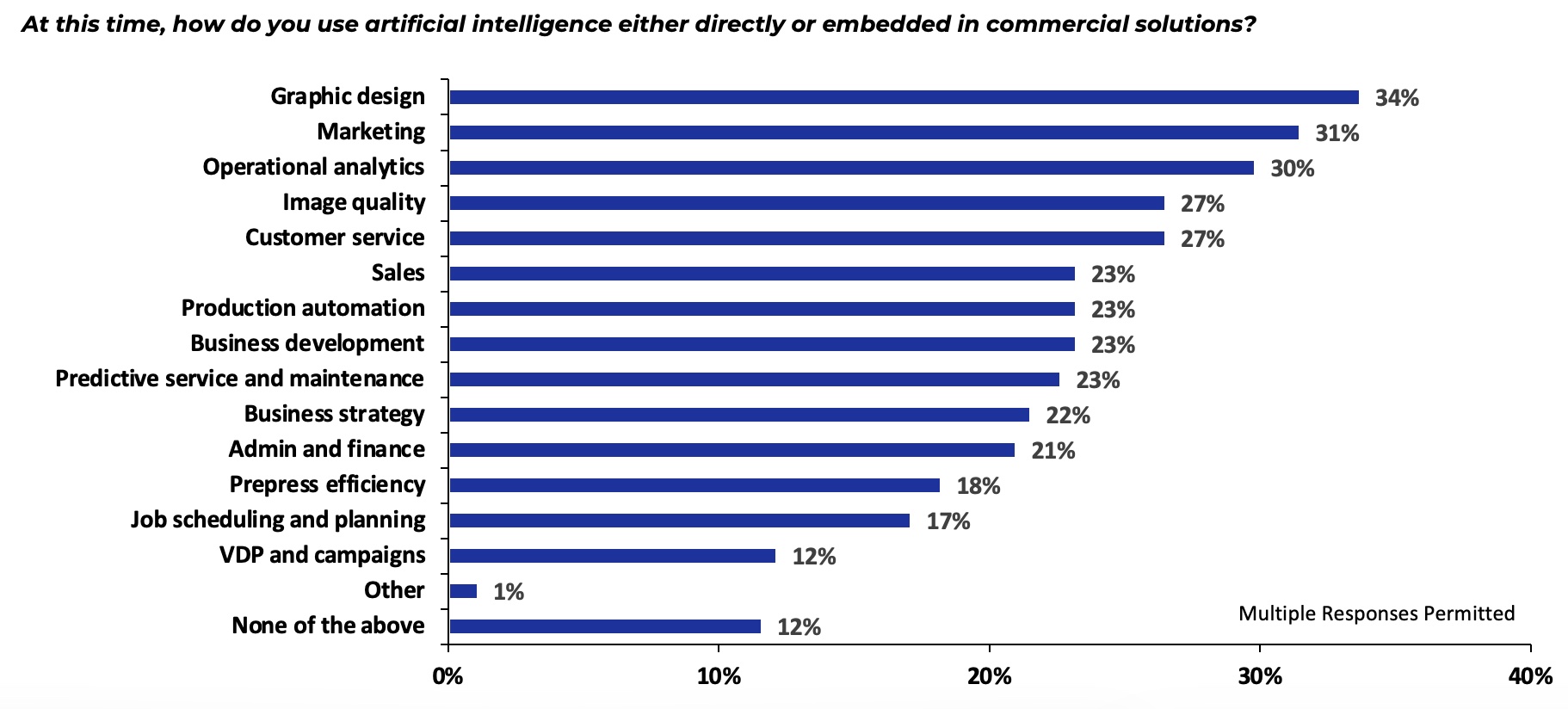
Recent research from Keypoint Intelligence brings light to this subject. When respondents in North America were asked about how they were using AI, the most common areas were graphic design, operational analytics, and marketing. Less than 20% of respondents weren’t using AI for anything.
Figure 2. Use of AI—Current
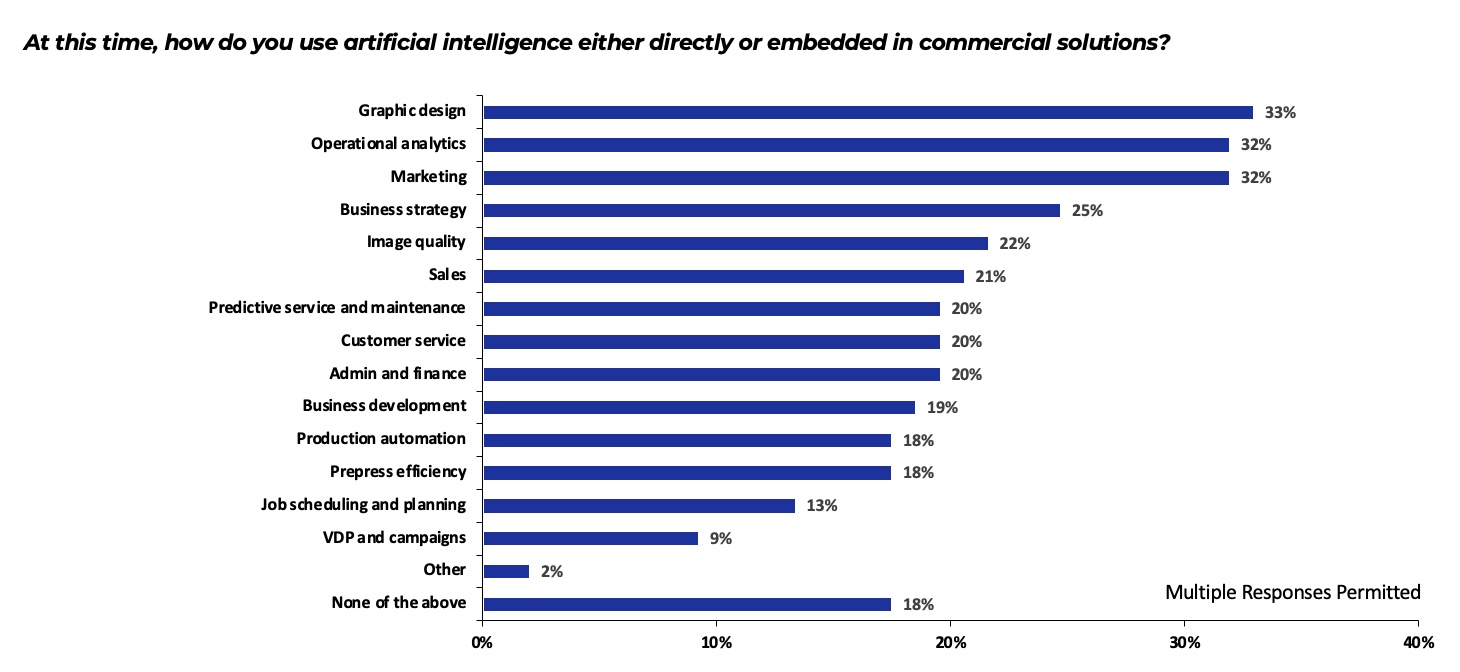
N = 97 Total Respondents in North America
Source: Global Software Investment Outlook; Keypoint Intelligence 2025
Inkjet technology has emerged as a game-changer in the printing industry because it aligns perfectly with the evolving demands of modern communication. The inkjet market is thriving, with today’s manufacturers continuously innovating and expanding their offerings. From sheet-fed to roll-fed and B2 to B3 formats, the potential of inkjet technology is vast. However, its true value can’t be achieved when these presses sit idle, waiting for print jobs to load up properly.
Moving forward, technology providers and PSPs that are willing to change how work gets done will unlock the full value of inkjet technology through intelligent operation. AI can transform inkjet operations into highly efficient and responsive systems. By leveraging machine learning and real-time data analysis, technology providers can give PSPs the tools they need to optimize their processes, predict equipment failures, and proactively schedule maintenance. This helps avoid unexpected breakdowns that compromise uptime and throughput. With its ability to continuously learn, AI ensures that inkjet presses are running at peak performance for improved efficiency and profitability.
The Bottom Line
The advancements in cut-sheet inkjet technology, combined with the ever-expanding possibilities of data-driven personalization, present an opportunity for print providers to redefine their value to clients. The question isn't whether inkjet will continue to evolve—it's how savvy PSPs will adapt to harness its full potential. Those that are willing to embrace ongoing innovations and position themselves as leaders will meet the growing demand for tailored content while also playing a pivotal role in shaping the future of printed communications. The challenge ahead is not simply adopting the latest technologies; it’s leveraging them strategically to stay ahead of market needs and deliver exceptional value.
As part of the Business Development Strategies Consulting Service at Keypoint Intelligence, Karen Kimerer has experienced the many challenges of expanding current market opportunities and securing new business. She has developed a systematic approach to these opportunities, addressing the unique requirements of becoming a leader in our changing industry.