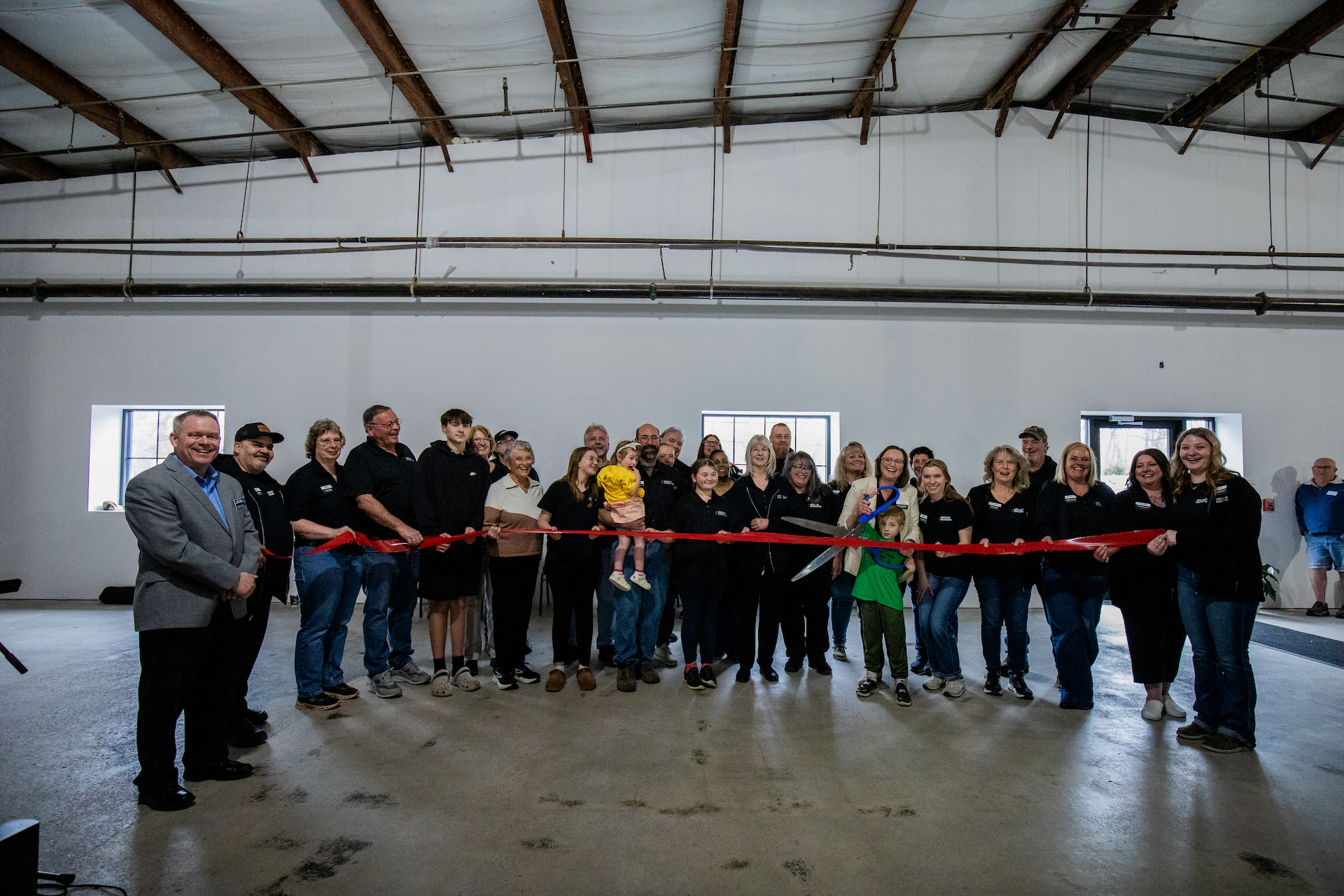
Becky Almeter and her son Richard cut the ribbon at the new home of Hodgins Engraving in Batavia, N.Y., on May 1, 2026.
In Part 1 of this interview, Becky Almeter, President of Hodgins Engraving, spoke with Kim Tuzzo of the Print & Graphic Communications Association (PGCA) about how her company initially recovered from the fire that completely destroyed its plant in Batavia, NY on May 2, 2025. The two went on to discuss how Almeter and her team have turned the catastrophe into an opportunity to forge a new identity and direction for the business.
The interview originally appeared in Signature, PGCA’s membership newsletter, and is reprinted here with the permission of PGCA —Ed.
Kim Tuzzo: After you relocated the business to a new building after the fire, how did you decide what type of work you were going to continue doing?
Becky Almeter: We had to decide what made sense for us to purchase, and what was available. We had an offer to buy a die stamping press in Rochester, N.Y., that was in perfect shape, pretty much ready to go, and it was close by. So that made sense. We learned very quickly that a lot of our engraving customers were willing to stick with us. Those customers were saying, “We’ll be here. Once you get back up and running let us know.” So we knew that engraving was something we wanted to continue to offer.
The engraving community is so small, through connections and talking to people, we bought two engraving presses out of St. Louis, Mo. Through St. Vincent’s Press in Rochester, we bought a couple of small offset presses they were looking to get rid of that were in pretty good shape. We found that a lot of other printers either switched the flat print work to digital or they're running big offset presses, full size or half size offset presses, so the small offset presses allow us to maintain that niche in the industry.
The small-format offset presses that we were running are very affordable. Our operators have been running them for 20 years or so. And it was a no-brainer to say, “Yep, we want to continue with that. The work is there, they're at the right price, they're very efficient, and they're out there for sale.” We also found a platemaker and a cutter. There’s a huge used equipment market, as you know. We have some decisions to make about things that we haven't gotten back yet, like foil stamping and photoengraving.
Farewell to an Old Standby
We know that we're not going to do magnesium (engraving) anymore. It was a good piece of business because we had an established facility, infrastructure, and trained employees. To start over and get into it again wouldn’t make sense. There’s all the compliance that is part of that and the hazardous materials handling, and obviously the liability, we were just not doing that. It’s just too much.
KT: It’s almost like tempting fate to bring it back.
BA: The photoengraving, it was profitable, but also, we just didn’t have the heart to even bother. We can’t go through an accident like that again. It was so traumatic. Even if it were easy and it made good money, we were just thinking, “I can’t handle the prospect of having that in our building again.”
We’re just on the verge of making a decision on a digital press. We decided at the time of the fire that we were going to outsource all the digital work because everybody does it. There’s so many printers out there that can do digital.
I had decided to hold off on the decision to purchase a new digital press. Would we have enough business to support buying a press? Then we realized that we did have enough business. Luckily I started the research before the fire and we're just about to make a decision on that. Hopefully it will be installed the first quarter of this year.
Coverage Was Crucial
KT: How was the insurance process, working with your adjuster and that kind of thing?
BA: We ended up going with a private adjuster, National Fire Adjustment Co. (NFA) out of Buffalo. Given the magnitude of what happened and the loss, we decided to go with them, and I’m glad we did. They’ve been really helpful.
Luckily, we had a policy in place that was very robust, which I didn’t even realize. I didn’t know we had business income coverage (or business interruption insurance) which replaces lost net income and pays for fixed operating expenses, including payroll, rent, and taxes, if a covered property loss, such as fire, theft, or wind damage, forces a temporary shutdown.
If something happens that causes you to cease your operations, the insurance covers your loss of income. However much more it’s costing you to operate and keep your business, they’re covering the difference. For us, the coverage was extended for a year after the fire.
So, we had a year to breathe a little bit, to say, “Okay, what do we need to do to get back up and running?” It just gave us room to be strategic instead of having to make these decisions immediately after the fire, which would've been impossible to do.
KT: What happened with your employees after the fire?
BA: We had 31 employees at the time of the fire. We immediately started a group chat, a text with all of our employees, to keep them posted. And we said, “Okay, we’re just going to pay everybody for the next two weeks, so you don’t have to worry. It’ll give us some time to think, figure out what’s going on.”
When we got our temporary offices set up that week after the fire, we were able to establish full-time work for some of our office staff. We added folks back as we could, as the work came back and re-established our processes. While I would have liked to fully employ everyone we had before the fire, it’s not going to be possible immediately, because we have decided to discontinue some processes in-house.
My long term goal is to continue to grow, not just back to pre-fire levels, but beyond and continue growth through acquisition. With that growth, I look forward to adding to and supporting our “work family” as much as possible.
Embracing the Flame
KT: I read in your fire update that you changed your logo to reflect what happened. It has a flame design.
BA: We’ve been thinking about rebranding for a while, even before the fire. It seemed like a perfect time because we really are starting over, sort of reinventing what we’re going to be. This new look incorporates a graphic that hints at a bi-directional flame, symbolizing that the fire brought us both positive and negative outcomes, all of which will shape our company as we move forward.
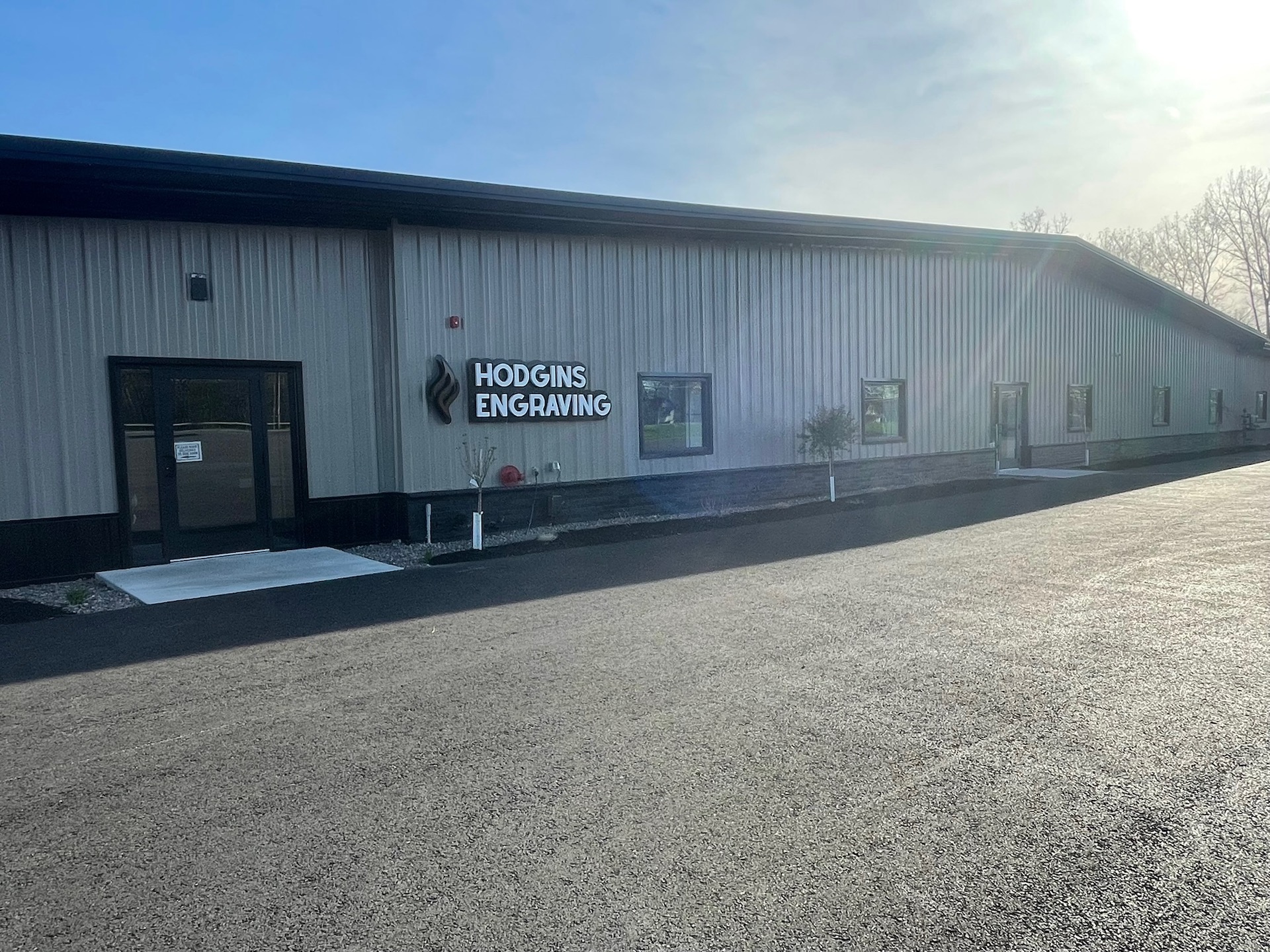
Hodgins Engraving has rebranded with a new symbol, a bi-directional flame symbolizing the positive and negative outcomes of the fire that will shape the company as it moves forward.
KT: I know you’ve acquired some other businesses down in the Metro New York area. You’re not just local, don’t you have customers all over the place?
BA: When I first got involved with the business, we were doing exclusively wholesale sales. It was a lot of thermography, engraving, and foil stamping, things that other printers weren’t doing in house. We started acquiring other businesses and folding in their book of business and we started mixing in direct work with wholesale work. Now we have a lot of customers in the Metro New York/New Jersey area.
About two years ago, we purchased Harper Engraving, which was huge for us. They were about the same size we were, so we doubled in size in about a month. It was insane. Those customers are scattered: from the West Coast, Midwest, Northeast, and a lot in the South.
Fire and Family
KT: How did this affect you and your family? This whole thing must have been pretty stressful.
BA: Yeah, obviously it was very stressful on me, my husband, and our five kids. The day the fire happened, two of my daughters had their dance recital that night and the next night. At one point we were at the fire and their dance costumes and dance bags were in my van parked right next to the building. They wouldn’t let me go to get my car because it was too close to the building.
So, I was kind of upset and crying, and a Genesee County Sheriff was there with me. I said, “It’s their dance recital tonight and my girls’ things are right there, and I don’t know what they’re going to do.” And she’s like, “I got it.” She got permission to go in my car and get what I needed.
We tried to keep things normal for our kids, continue on with the recital, continue on with normal activities. We had a babysitter get them ready and take them to the recital. We missed it that night, but we went the next day. But you know how news travels so fast? People knew about the fire immediately.
Our oldest son, he’s 14 now and he has a cellphone and I thought, “Oh, my gosh, he’s going to find out.” We called the school and asked them, “Can you just go tell him what’s going on and just let him know everything’s okay? Nobody got hurt. It’s being handled. Everything’s okay.” Just so he doesn’t hear about it from someone else first, and think the worst.
“It’ll Be Okay”
Our youngest daughter’s birthday is May 3rd, so the day after the fire, my youngest turned two. She obviously won’t have any recollection of it. My next oldest turned six in December, and he knows that something went wrong and there was a fire.
My two middle daughters, who were 9 and 10, were worried that we wouldn’t be able to work and have money to buy things. We told them we’re still going to work, we’re fine, that we can go buy groceries, it’ll be okay. We tried to give them enough information to make them feel okay, but not too much information.
There was probably a month straight where I was working 12-hour days, six days a week, just because there was so much to try and figure out. My husband didn’t have any work to do because he ran our shop and there was no shop. I was gone all the time, working, working, working, and he was doing everything with the kids, everything at home. And that was hard for everybody.
We got through it, and we just keep telling the kids we’re really lucky. It could have been so much worse. We had to explain what insurance was in a simple way, to say, “We didn’t lose everything.” We lost the building, but insurance will help pay to replace things.
KT: How did you help employees to get through what had happened?
BA: A couple of weeks after the fire, we got together with all of our employees for breakfast, so everybody could hear what was going on, see each other, and just hang out. And I think that was helpful. We kept the group texts going so that everybody stayed in the loop whether they were working or not.
I think now, mentally, it always could be worse. Nobody got hurt, which was the big thing. If somebody had been stuck in that building or a firefighter had gotten hurt, I don’t think I would’ve been able to pick up in the days afterwards and say, “Hey, let’s do business.”
We lost some minor things, but we didn’t personally lose anything substantial. We were able to go home at the end of the night. I think that it’s hard because you see everything that you worked for be destroyed. But at the same time, you get a chance to start over that you wouldn’t otherwise have. And you get a chance to build what you want it to be. And that has been invaluable.
“We Get a Chance to Start Over”
Looking back, before we had the fire, the business was doing good, but it was also stressful. We had too much stuff in our building that we had inherited when we bought Harper. We were trying to find a better way to manage mostly customer inventory and special made stock. And it was just getting out of control. And we also had procedures in place, the way we had always done things that really weren’t the best for our company. It wasn’t the best for our people.
And then after the fire happened, when we started thinking: what’s our policy going to be on pricing or on holding inventory or on what we’ll do for customers, or what we’ll invest in? Well, you know what? We get a chance to choose. We get a chance to start over. We set the rules of how we want to do this. And if it doesn’t work, then it doesn’t work. But if it does work, then I think it’s going to make us a much better company ultimately.
So even though the fire itself was traumatic and the several months following were traumatic, and it was a lot of work, ultimately there’s a silver lining in the sense that it gives us opportunities we wouldn’t normally have to start over and start fresh. It has mentally taken a long time to get to that point where I see it as a benefit or I see it as a good thing rather than just being painful.
And we are at that point now, for sure, especially in our new building. It’s wonderful to get a fresh start. We have new offices; we’ve designed everything from scratch including workflow, storage, offices and how people interact. It's nice.
Lessons Learned and Shared
KT: Any advice for your colleagues or final thoughts, reflecting on what happened in the past nine months?
BA: Insurance is one of those necessary things as a business. We reviewed it every year with our broker. They went over, “Okay, this is what you have. Is this sufficient? Would you like to make any changes?” And most of the time, I say, “I’ve got stuff to do. Where do I sign? Just get it done.” I'm not going to look through a 60-page document of what fire coverage we had. Thankfully, we had this coverage in place that was enough to carry us through this tragedy.
My advice to other companies is, obviously check their insurance coverage and see what they have. It’s always a balance between how much premium do you want to pay and how much coverage do you want to have.
Regardless of what the tragedy is, if you have a flood, or fire, or a pandemic, when everyone had a shut-down, have some sort of backup plan. How would you continue operations, what would you do? Even if you don’t know exactly what to do, think of where to start.
First, Plan for the Worst
Have a disaster plan in place that at the very least gives you that first step, because after a disaster, it’s difficult to think clearly. There are so many things that you have to think about. You have to think about IT, accounting, compliance, insurance. We had to go through the investigation of the fire.
I would recommend having a plan that includes not just production or how you would continue operating, but how would you get messages to your employees? What’s important to communicate? How would you handle continuation of benefits? How would you reach out to customers and vendors quickly and easily?
Having the associations, PGCA and IEGA, jump in and say, “We’re going to gather together a list of other printers who will do your production.” That was extremely helpful, and would never have happened without the industry organizations I was in.
KT: I hope our members think of the Association as a community that can help when something like this happens. If you didn't have this Association, how would you go about finding printers to partner with?
BA: Exactly. Not just for doing work, but as I mentioned, to find people looking to sell equipment or people that offered to help in other ways. Having the connection and having the organization is invaluable, especially during a tragedy.