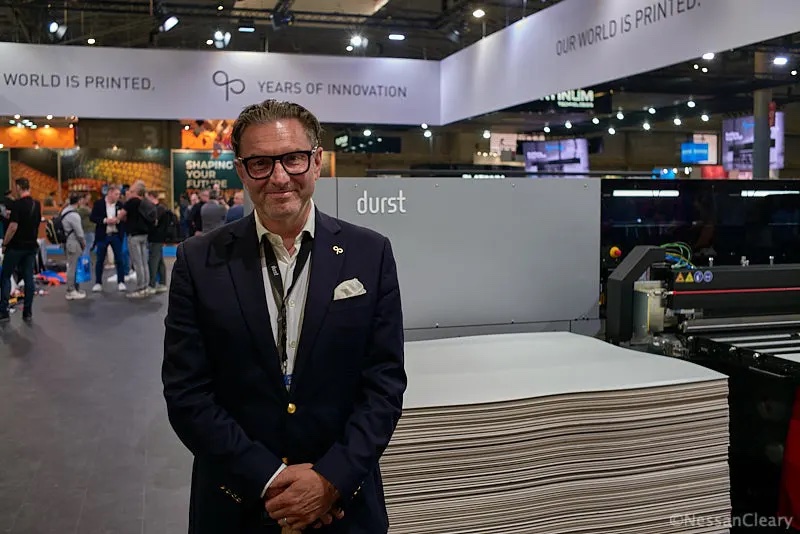
Durst took one of the biggest stands at last month’s FESPA trade show and yet its wide-format offering was more of a work in progress so I hesitated to write this story which will inevitably be incomplete.
In many respects, Durst is way ahead of its competitors, and is looking to expand by further developing its automated workflow solutions. However, a key part of this is the Kyveris production management system, which is said to heavily use artificial intelligence, but is still at a very early stage in its development. Consequently, this was shown as a technology demonstration and statement of intent rather than an actual capability. Christoph Gamper, CEO and part-owner of Durst Group, told journalists at the company’s FESPA press conference that AI has moved out of the browser and into the print shop, adding: “And I’m convinced that the next 20 years belong to industrial intelligence.”
Later he told me: “I think our industry will go lights-out and autonomous and we need to think about this so that’s what we are showing here.” However he added: “Lights-out doesn’t mean that we don’t need the operator anymore, just that we can do more with less.” I think it’s worth pointing out that people have been talking about lights-out print factories for more than 20 years now.
Durst itself operates as a large group that includes multiple companies, with Gamper explaining: “When we start something new, we start a new company.” That applies to Kyveris, which has been set up as a separate company within the Durst Group.
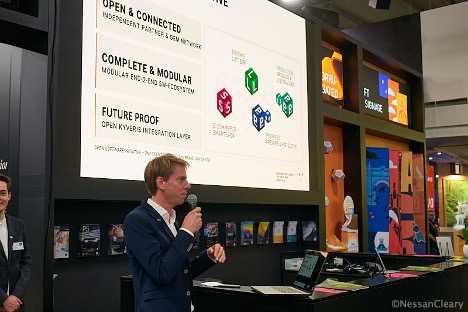
Michael Deflorian, vice president of Durst’s Kyveris and software solutions.
It’s difficult to properly describe Kyveris as the company has only shown a small part of the system so far. For now, Durst has discussed the Kyveris Sandbox, which appears to be a development lab for combining the different building blocks of a production workflow. That would obviously include a printing system, and the necessary printing software, such as the job queuing, RIP, and so on that make up the existing workflow.
On top of this Durst has added a robotic automation layer, including autonomous mobile robots, which at its simplest can be used for loading and unloading, as well as for moving pallets around a factory floor, say from the printing to converting processes. Such integration would also make it easier to integrate print technology into other manufacturing systems, which would be particularly useful in the labels and packaging sectors.
Durst has also added a digital twin concept, which is common in additive manufacturing, and involves creating a digital model of a product using real data to predict its behavior. Such twins can also be compared against the final product for verification. This is all underpinned by Durst’s existing analytics system, which provides real world production data, particularly around predictive maintenance.
Michael Deflorian, vice president of Kyveris and software solutions, describes Kyveris as a software integration layer. As such, it appears to offer some of the features that the Job Definition Format promised to the commercial print sector. It includes an OSI Open Software Initiative, with open APIs and documented interfaces to allow for integration with MIS, workflow and finishing systems. Deflorian points out that you need to have interoperability between systems or at least between the way those systems communicate, noting: “If not, you have a challenge to use that data.”
He continues: “We want to make the machines more intelligent. You might not need higher productivity but more intelligence can give you higher quality.” And he adds: “To have a bit more automation makes sense to all our customers.” He concludes: “I think now is the right time because technology is improving all the time. Our products are becoming faster and we can acquire technology and make that technology more accessible to everybody.”
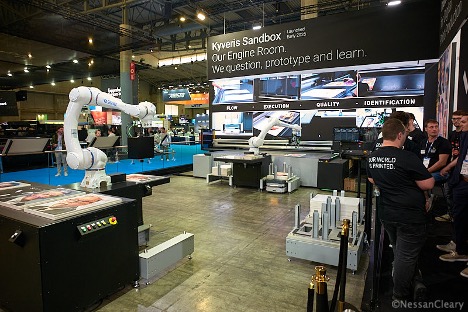
Durst invited feedback at Fespa for its Kyveris Sandbox.
Gamper says that Durst will continue to split its operations between its hardware and software. On the hardware side, Durst introduced a new P5 Core hybrid printer at FESPA, though this is really more of a restatement of the existing P5 platform that Durst has been selling for some years now. In that time Durst has installed around 855 P5s, including some that have been retrofitted to keep them up to spec.
Wolfgang Knotz, Durst’s chief technology officer and managing director of Durst Austria, describes it as a mid-range printer, adding: “So it’s a good way to get your first Durst.” He explained: “It builds on the current P5 350 but it has more features. So we have now ten channels where before it was eight, which gives more versatility. And it has double the UV LEDs and improved roll-to-roll capability.”
Otherwise it has the same Ricoh Gen5 printheads, with a native drop size of 7pl. Resolution varies from 700 x 1200 to 900 x 1200 dpi. It will print to boards up to 3.5m wide, and rolls up to 3.47m. It can print to dual rolls side by side up to 1.6m wide each and it can be configured for three-quarters or fully automated loading and unloading. It can produce up to 325 sq.m/hr. though most people will use the Production mode which varies between 125 sq. m/hr and 170 sq. m/hr.
Reinhard Moser, project manager for the P5 from Durst’s development department, notes: “We want to make it simpler for the customer. So we have reduced the number of print modes.” That’s meant redesigning parts of the machine to make it easier for operators to work, and to reduce the set-up time around jobs. There’s also a new vacuum belt to allow for better material flexibility.
Knotz continues: “And it’s the first product to be Kyveris-ready so the software architecture is future proofed. The customer may not see the difference but in the future that will make a difference, so that we can deliver the right data to create new applications.” He says that this is about industrial intelligence, adding: “Thats where we think the market will go so we want to discuss it with our customers and get their feedback. We are completely convinced that data is key.”
This data could include everything from the performance of the machine to its energy consumption. He continues: “If you have the data then you can make improvements. And the next step could be to introduce robotic systems. And the final step automatic systems that can work without human intervention. And this is a journey we start here at FESPA.”
Durst also showed a second P5 variant, the 350 HSI, which now gains Digital Substrate Alignment to help reduce the time needed to load substrates onto the machine. Elsewhere on the stand, Durst showed the 5m wide dye sublimation P5 500 Tex iSub that it introduced at least year’s FESPA show. But for this year there was a 5m wide Hassler cutting device for finishing jobs produced on the iSub. It’s a small footnote in the wider portfolio but does show Durst’s commitment to the exhibition segment that these devices are designed for, and where there is very little other competition.
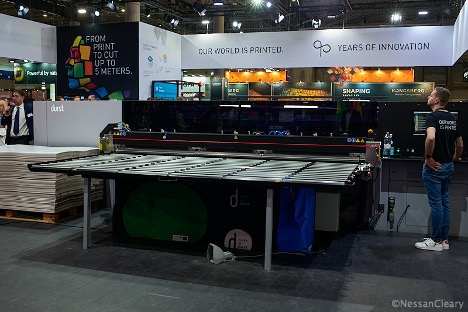
The Durst P5 Core is a mid-range 3.5m wide hybrid printer.
This year marks Durst’s 90th anniversary, which Gamper was keen to celebrate, telling me: “We are 100 percent private so we have no external investors. We had the best 10 years, achieving double digit growth and have kept the money in the company.” Naturally, as a private company there are no public records that might give us an idea as to how successful Durst really is. Nonetheless, the company itself says that it has revenues of over €430 million and that it hopes to double this revenue over the next five years.
I asked Gamper if he was worried about being priced out of the market as a European manufacturer by cheaper Chinese hardware. He replied that if you look at the automotive sector then the Chinese have put a lot of pressure on hardware, adding: “We have to be very careful in Europe to think about what we want. You can differentiate in the production capacity that you have if you can integrate things into the hardware by making it more intelligent, then you have a good chance to differentiate.” But he went on to say that China is a hub for innovation.
Durst has tried to counter this through its Kraftwerk business, which is essentially an umbrella to incubate many small businesses, including several involved in 3D printing. Gamper says: “If we see things that would work at Kraftwerk we bring them in and this helps us to keep our pipeline open.”
Textile Printing
Durst is one of several wide-format vendors that have developed dye-sublimation textile printers for the soft signage market, and who all thought they could extend their textile printing solutions into the home décor and garment markets. That led Durst to introduce its Alpha series of textile printers in 2015. But the optimism around this market subsequently cooled off, mainly because the vendors have struggled to develop the technology, and particularly the pigment inks, as quickly as they had hoped.
Nonetheless, Gamper told me: “I see that most of the textile machine production went from Italy and some went to China but I see a good chance. And we will show a new machine at next year’s ITMA.”
Durst is now making a more concerted return to the digitally-printed textile market, with the announcement since FESPA of a new production center to be built in the heart of Italy’s textile printing industry in the Como area of Lombardy. Up to now, Durst’s textile business has mostly been based in Kufstein, in the Austrian Tyrol region. This site will continue to develop superwide textile and graphics equipment, such as the 5m wide iSub soft signage printer, along with associated drying equipment.
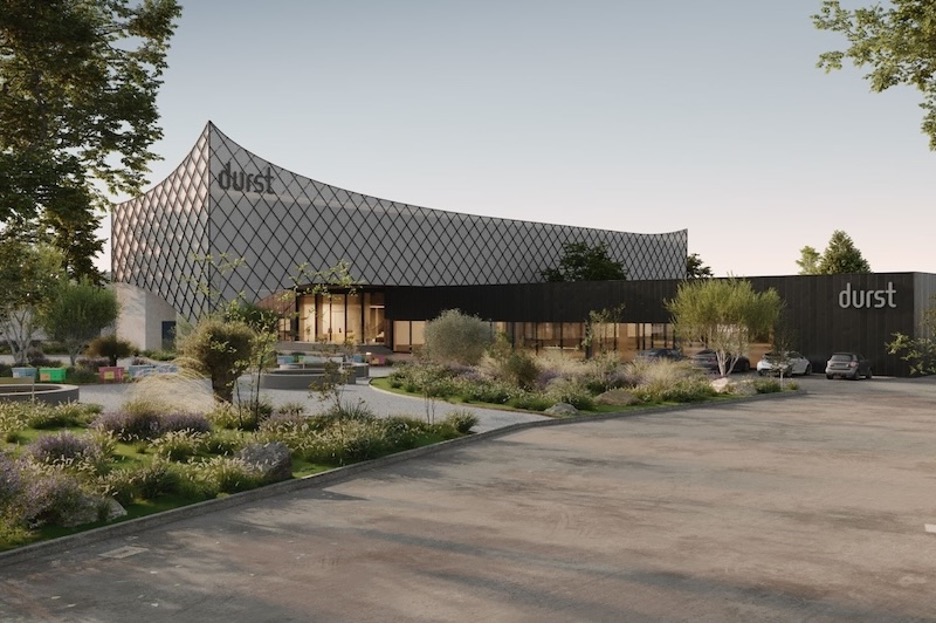
Durst will invest some €20 million to develop its Como site for textile printing.
The new Durst Como facility, which will largely resemble Durst’s other statement buildings, will reportedly cost some €20 million and will be the group’s third R&D center after Brixen and Lienz. This follows on from the acquisition of Aleph, which Durst completed in 2025. As such, the new Durst Como hub will mainly focus on fashion and home textiles. Durst says that over time it will also grow into a center for customer collaboration and for textile-related automation and software.
Rather than build a brand new facility, Durst will revamp an existing site and add sustainable energy including heat pumps and solar panels. The site will also be home to a bee colony in a bid to support biodiversity and the local ecosystem.
Alessandro Manes, director of global sales of industrial textile for Durst, commented: “Our objective is to create in Como a highly specialized technology and production hub, capable of attracting expertise, developing new professional skills, and generating new opportunities for the local area.”
Durst may reveal more about its plans, particularly for the Kyveris software and for textile printing, at the end of this month when it will hold its Durst Next Technology Festival at its Brixen headquarters in South Tyrol on 26 June to celebrate its 90th anniversary. In the meantime, you can find further details from durst-group.com and on the Kyveris software from kyveris.com.
Reprinted with permission of the Printing & Manufacturing Journal.