One of the issues holding back further development of Direct-to-Film textile printing is that current solutions rely on applying a powder on top of the still wet ink but a number of vendors are working on powderless solutions, with Matsui claiming to be further ahead than the others.
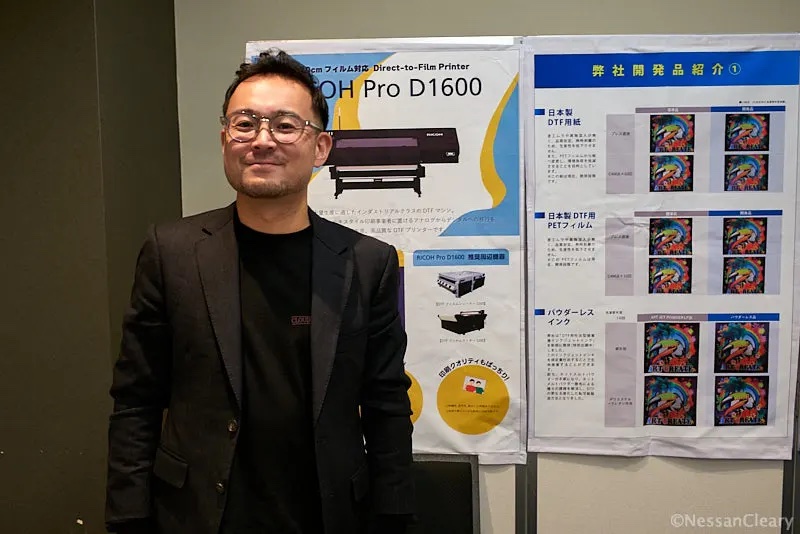
I met Tomoya Matsui, manager of Matsui’s international department, at the recent Japan Inkjet Technology Forum in Tokyo who explained the company’s progress. It’s no secret that Matsui has been working on this as the company showed off a working solution back in 2024.
Matsui explained that although the system prints, the difficulty has been in improving the washability of the prints to match the powder systems. He says that the secret lies in the drying unit, which needs a bridge to the printer and that there should be a straight path from the printer and then on through the drier because by this stage the glue will have started setting so it’s not ideal to have the substrate at any kind of an angle. In addition, the drying path needs to be longer to give the drying more time, though there’s no need for more powerful heating.
These requirements mean that Matsui has had to abandon its original approach—adapting an existing powder shaker. He told me: “We are asking a Chinese company to make a new drier for jettable glue.” Ultimately this should lead to a simpler system as there won’t be any need for the powder handling in a conventional powder-shaker. The samples that Matsui have previously shown also lead to a thinner film, so that the final print looks less plasticky, giving it a nicer feel on a garment.
As I noted, other companies, such as Dupont, are also working on a powderless ink. Matsui acknowledges this, saying that a few other companies have similar solutions “but I think that our glue is better.” He notes: “The chemistry is very similar between vendors but we have put the whole system together.” He adds: “The key is the drier. So if we make a good drier then it will be a benefit us.”
For now it’s still in development with Matsui saying that the washability is not yet good enough. He says: “The wash fastness is still less than powder but it depends on the design and the customer. We can pass around 15 to 20 washes. For some DtF that’s enough so it depends on the customer.”
This new ink is still a water-based pigment ink and so can be used with existing DtF printers, but it does require at least three separate printheads – not just three channels – which will rule out many of the current DtF machines. One head is for the CMYK colours, which is then followed by one for the white, and after that one head for the glue. Matsui says that it needs more than one channel for the glue and that actually four heads are better.
Perhaps unsurprisingly, this powderless ink will cost more than the average cost of today’s powder+ink solutions. He adds: “But I think people will buy it because the powder is not good for the users. It can contaminate the air.”
The system should be ready later this month. You can find further details on Matsui’s conventional DtF solutions from its website at msc-color.co.jp.
Reprinted with permission of the Printing & Manufacturing Journal.