Signs of the Times, Part the Ongoing: All That Jazz
When we think of “signage” we often think of commercial signage—channel letters, monument signs, or even wide-format-printed display graphics. But “sign writing”—hand-lettering signage—is almost a lost art. Print magazine talks with Nan Parati, a sign writer who works as the on-site sign writer the New Orleans Jazz Fest, a position she has held for 45 years. She developed a unique hand-lettered style that has become the default visual style of music festivals, as she has also developed signage for, among other events, the Newport Jazz and Newport Folk Festivals.
I was in my early 20s, working in the produce department at Whole Foods, and I got fired for talking too much to people and having too much fun. So I said, “I should be in the cheese department, because in the cheese department you have to be able to talk to people!” So I went into cheese and I got fired again two weeks later for whatever, and that same day the sign writer was leaving. I said, “That’s my real job! I’ve never done it professionally but I know I know how to write signs, I know it, please let me try that!” “This is your last chance,” they said. Then, interestingly enough, after getting fired twice there, I became the art director for their advertising. It’s funny to go from getting fired twice to handling all the advertising. But it worked out!
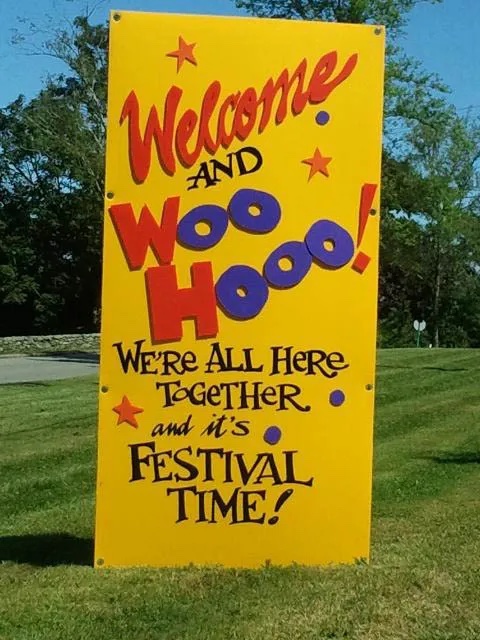
Then two years later, in 1985, Jazz Fest came over and said, “Hey, we need a sign writer!” They asked me to write signs for all the performers’ names. I didn’t really have a specific font or style at that time, so I just wrote the artists’ names in cursive. Next year, I started trying to come up with something that would be easily read from far away, stand out, high contrast, all of those things. I had no serious style then, it really developed being here at Jazz Fest and having to come up with something that would be visually pleasing— I wanted a serif style, I love serifs and I don’t like sans serif. Then I just started going from there!
Keep Watching the Skies
(Optional musical accompaniment to this item.)
We love photography awards, wherein photographers (amateur or professional) capture some of the most amazing, beautiful, and/or inspiring images. Just recently awarded was the “2026 Milky Way Photographer of the Year” winners. Via Capture the Atlas, this year’s finalists sought out the world’s darkest skies to capture what many of us in populated regions rarely see at night: the full splendor of the Milky Way galaxy.
This year’s selection takes us across deserts, mountains, coastlines, islands, and remote landscapes where the Milky Way still shines with extraordinary clarity. From carefully planned compositions to fleeting celestial moments, these images show not only the beauty of our galaxy, but also the dedication required to capture it.
One wonders how long these awards will continue to be awarded:
Beyond their artistic and technical achievement, these photographs also remind us how rare truly dark skies are becoming. As light pollution continues to erase the stars from many places around the world, this collection is both a celebration of what still exists and a reminder of what we stand to lose.
For example, “My Perfect Night” by Daniel Viñé Garcia, captured in Catamarca, Argentina.

Says Garcia:
Reaching this location required traveling deep into the Argentine Puna, a remote region accessible only by 4×4 vehicles along rough dirt tracks, far from any source of light pollution. The nearest settlement was Antofalla, a small village of around 60 inhabitants, where electricity is generated locally and turned off at night. Beyond that, the closest towns are several hours away, surrounded by vast and isolated landscapes. Situated between 3,500 and 4,000 meters above sea level, the altitude and remoteness make this an exceptional environment for night sky photography.
These are just amazing. Be sure to click through and check out 24 more.
AmIsh
Some years ago, whilst attending the HOW Design Conference (still around today as HOW Design Live), we were chatting with a group of graphic designers one of whom happened to design websites for the Amish. Makes sense—they’re probably not going to be designing them themselves.
Then again, maybe the Amish are not as technology-averse as we thought. According to a story in The New Yorker (via Futurism), AI appears to be catching on among the Amish.
the men of Holmes County, Ohio’s Amish community — the area with the largest concentration of Amish people in the country — have embraced generative AI as a new tool to do things like write emails, draft contracts, create spreadsheets, and otherwise manage their oft-family-run businesses in fields like manufacturing, construction, and agriculture.
One can only be so isolated these days.
Wengerd, whose business employs about 30 staffers, explained to the magazine that his business gets “involved in some state work, federal work, private work.” In other words, he’s busy — and he says that without tech, chatbots included, he and his many employees would be out of a job.
Still:
Not all Amish folk enjoy access to the internet, and when they do, it’s generally quite limited. (One expert, historian Marcus Yoder, told NY Mag that he believes that fewer than half of Holmes County’s Amish population is online, and of that population, he estimates that under 10 percent have given AI a whirl.)
And we continue to admire the Amish:
Not a single person NY Mag spoke with uses a smartphone; they either use zhuzh-ed up “dumb phones” or flip phones.
They may have the right idea.
Airing Out
As summer approaches—and weren’t we just complaining about winter not that long ago?—the time is getting near when we’ll need to run the A/C. But what about when we leave the house? Via Engadget, you can always pick up Sony’s wearable air conditioner. The Sony Reon first appeared back in 2017, was launched two years later thanks to a crowdfunding campaign, and has since been commercialized and put on sale in Asia and, as of late, the West. Now it’s being upgraded, and the Reon Pocket Pro Plus will be available in the UK and Europe through Sony’s store and online retailers, including That One.
It's not simply a wearable fan attached to your neck. The Reon works through the Peltier effect. The device sits at the base of your neck, with an electrically cooled metal plate delivering lower temperatures at the ideal place for your circulatory system, like a tiny ice pack with a USB-C port.

Hmmm…looks like kind of a high-tech Richard III. (“Now is the…summer of our discontent”?)
Over almost ten years, Sony has refined the device, expanding battery capacity and improving its design for greater comfort. The new Pro Plus improves performance further, with a two-degree Celsius (3.6-degree Fahrenheit) increase in cooling: a 20 percent increase. It also has an improved cooling algorithm that more accurately monitors temperature changes on the device and in the surrounding area. While it's more powerful than its predecessor, it'll still run for up to 10 hours on its second-highest cooling setting.
A steal at £199 in the UK and €220 in Europe. No US release, apparently, because as everyone knows the UK and Europe are much hotter than the US.
Bagging It
Produce bags. What—
Oh, right…sorry. We’re using “produce” as an adjective, not a verb, so that’s not meant as a command to “Produce bags! We need more bags!” We’re talking about produce bags, those little plastic bags you pick up in grocery store produce departments for your broccoli or asparagus or whatever. But what do we do with them when you’ve consumed the produce? We don’t want to just chuck them. Can they be reused?
Well, via Core77, they can be reused as trash bags, and Japanese housewares brand Marna has come out with a little folding frame to make it easy to do so.
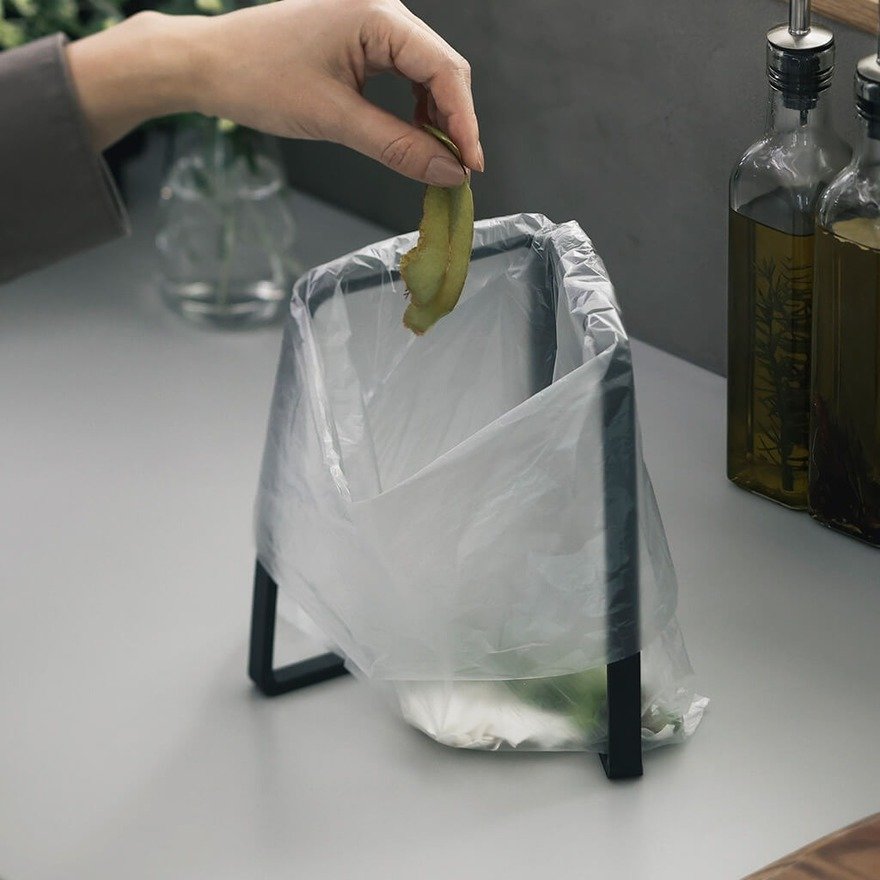
Sure, we should be guilted into composting that kind of food waste (if that’s what that is), but the framey thing can also be used to bag sauce, if you have an aversion to Tupperware or similar liquid storage containers. Just make sure that whatever produce you bought hasn’t poked any holes in the bag.
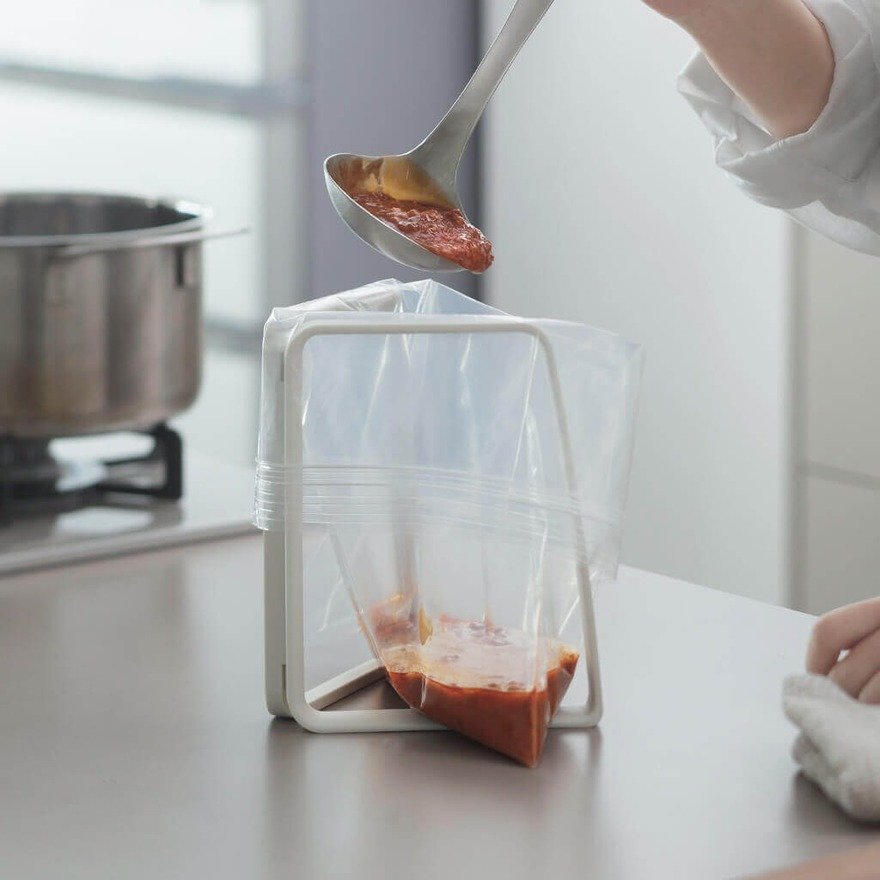
It snaps closed to keep bugs out and even has little anti-slip pads on the bottom.
A steal at ¥1,210 (US$7.60) but alas doesn’t seem to be available in the US, so we’ll have to keep throwing out produce bags away like a barbarian.
Water Clock
Here’s another example in our ongoing series of clocks that make it almost impossible to determine that time it is. This one comes via Laughing Squid, designed and built by Jens of Strange Inventions Lab that uses 60 water bottles as pixels and involves an elaborate water pump system.
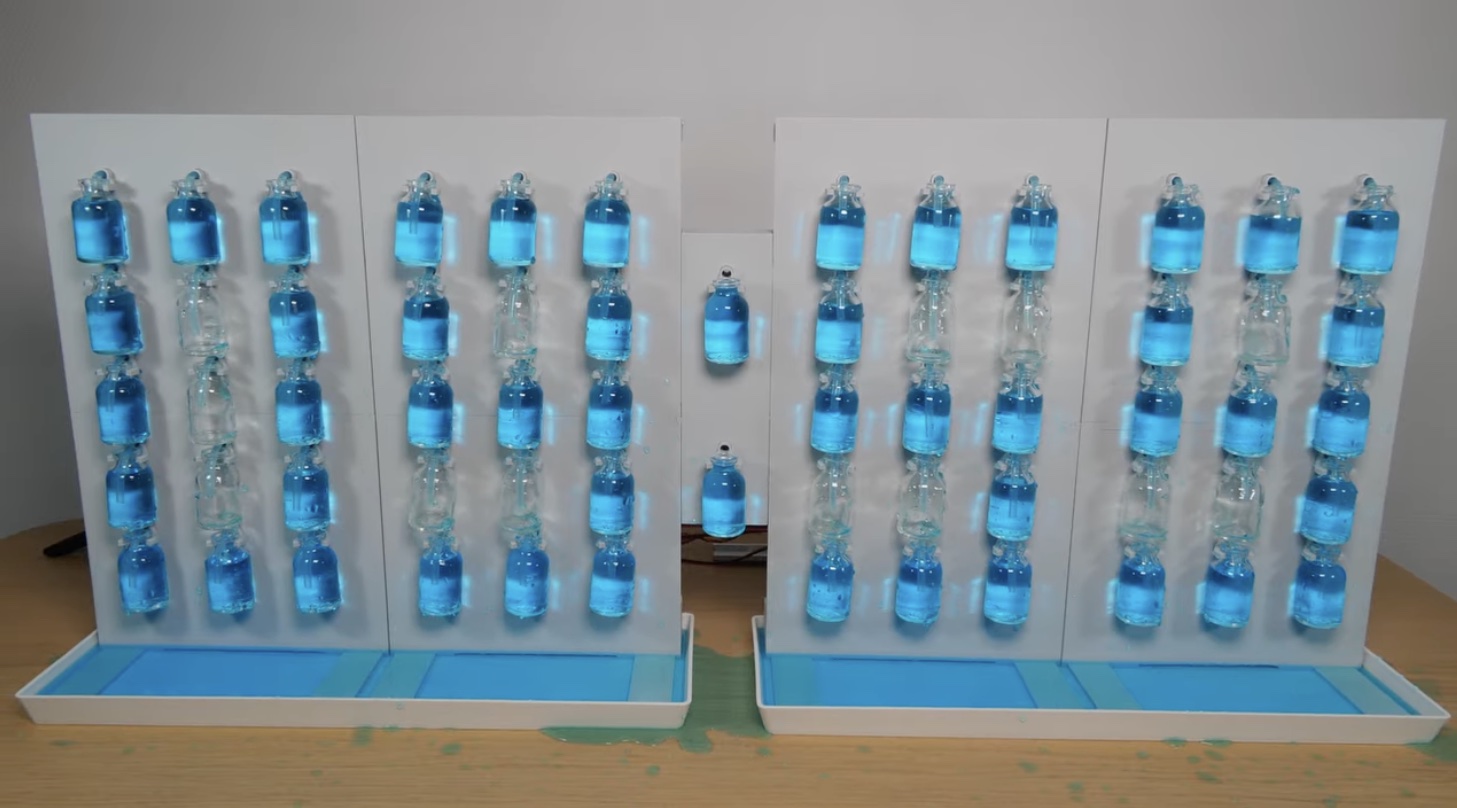
Check out his video for the elaborate mechanism he had to create to get the thing to work.
Water, Water Everywhere
But where to get water for a water clock? Via Food & Wine, a Nobel Prize–winning technology is able to extract water from dry air—even desert air. The technology is based on a “metal-organic framework” (MOF):
a crystalline scaffold that's mostly empty space. Think of it as a tiny molecular sponge that's both rigid and porous, allowing gases to flow in and be stored for later use. These MOFs are remarkably effective, with Nature reporting that one gram of the material has enough internal surface area to cover an entire soccer field.
Omar M. Yaghi created the first MOF in 1998, and in 2025, Yaghi, Susumu Kitagawa of Kyoto University, and Richard Robson of the University of Melbourne won a Nobel Prize for their work on MOFs.
Although not originally intended for this purpose, Yaghi started looking at MOFs for water capture and storage.
In 2020, Yaghi wrote more about MOFs in ACS Central Science, explaining that they could help trap "water at relative humidity levels as low as 10%," which is even lower than the average humidity in Death Valley, California, on a hot summer day. In fact, Yaghi tested his technology in that very place just to be certain it could work for everyone.
He founded Atoco, a climate technology company, which is developing MOF units the size of 20-ft. shipping containers that can be placed anywhere and generate up to 1,000 liters of water a day. That’s a lot of clocks.
Still, as with all great innovations, there are some caveats to the technology. MOF production is in its early stages, so it's still expensive. Scaling the technology will take work, but the team at Atoco says they’re ready to start taking orders in 2026, specifically targeting data centers in water-stressed regions as their first customers. And all that hard work to come isn't deterring Yaghi from pursuing his mission, which will likely become vital to the planet soon.
Nothing to Sneeze At
Allergy season is now kicking in, at least in the Northeast, and as hellish as routine allergies can be, PopSci identifies one that is even more hellish: an allergy to water. Yes, there really is such a thing.
The medical term for an allergy to water is aquagenic urticaria, a form of hives. The condition is so rare that only an estimated 100 to 150 cases have ever been reported. However, researchers believe many more cases go undiagnosed: When a patient comes in complaining of hives, “it could be water” is probably not the first thing that leaps to mind.
When people with aquagenic urticaria are exposed to water, it triggers the body’s “mast cells” (a type of immune cell), which then release histamine, the chemical responsible for allergic reactions.
Within minutes of water touching the skin, a person with aquagenic urticaria will develop raised, intensely itchy welts. The reaction typically lasts anywhere from 30 minutes to an hour, and the longer the exposure, the more severe the symptoms.
The first thing that may have occurred to you is, “Wait—isn’t the human body something like 60% water? And don’t we die if we don’t drink water? Norman, coordinate.” Well, as long as you are hydrating by drinking water and not pouring it on your skin, you’re fine.
As you can imagine, showering is not without its challenges, but fortunately there are treatments, such as an antihistamine called cyproheptadine and a newer drug called omalizumab.
It does makes the Wicked Witch of the West a bit more sympathetic.
Graphene Has a Vested Interest
Was it a good week for graphene news? It’s always a good week for graphene news! Laser-induced graphene on Kevlar enables multifunctional structural composites. From (who else?) Graphene-News:
[Researchers from IMDEA Materials Institute, Polytechnic University of Madrid, University Rey Juan Carlos, Universidad Politécnica de Madrid (UPM), National Institute for Aerospace Technology (INTA) and Universidad Francisco de Vitoria] fabricated laser-induced graphene (LIG) directly on Kevlar fabric via laser photothermal conversion, then incorporated this LIG@Kevlar layer into basalt fiber/biobased epoxy laminates using vacuum infusion, a process compatible with industrial-scale manufacturing. This in-situ conversion strategy avoids separate LIG films or transfer steps, helping to maintain interlaminar integrity and eliminating foreign interfaces that could otherwise weaken the composite.
…Overall, this work demonstrates a scalable route to embed electrical, sensing and thermal functionalities directly into non-carbon fiber composites while preserving their structural integrity, opening opportunities in sectors such as electric mobility and wind energy.
On the Road
We’re always keen for a good road trip—but, with the price of gas being what it is, as close to home as possible, the better. So, via Atlas Obscura, a list of the “most desired” place in each of the 50 states. That is, every location in the Atlas Obscura has a set of buttons: Been Here, Want to Go, and Add to List. So, they determined the location in each state with the most “Want to Go” clicks.
For example, New York: Old City Hall Station in Manhattan. “The very first subway station in New York City is beautiful, decked out in chandeliers, and ... abandoned?”
Minnesota? Orfield Labs Quiet Chamber. “The lab is called an anechoic chamber, meaning there is no echo as the room absorbs 99.99 percent of sound.”
Rhode Island? Providence Athenaeum. “A 19th century library favored by Edgar Allan Poe and H.P. Lovecraft, known by locals as ‘the Ath.’”
Pennsylvania? Eastern State Penitentiary. “The world’s first penitentiary, meant to be humane, drove men insane.”
Click through for more potential day trips.
You Have GOT to Be Kidding, Part the Ridiculous: AI Face
Subhead from The Guardian: “the rise in plastic surgeons asked to create ‘AI face.’” Do we want to know? Probably not, but regardless:
Plastic surgeons are increasingly concerned about the rise of “AI face”, as more and more clients arrive in their offices with unrealistic AI-generated visions of what they want to look like.
Good grief.
People using AI chatbots to generate their ideal faces are increasingly arriving at surgeons’ offices with briefs demanding flawless skin, sharply sculpted cheekbones, refined noses and near-perfect symmetry – standards that are too time consuming, prohibitively expensive and, in many cases, physically unattainable.
Knowing AI as we do, those requests probably include wanting six fingers per hand. Hmmm…Maybe we’ll shoot for the David McCallum look from The Outer Limits episode “The Sixth Finger”:

Accept Cookies?
BTS is one of the world’s (searches Wikipedia…) most beloved Korean boy bands, whose hits include “Dynamite,” “Savage Love,” “Butter” (butter?), “Permission to Dance,” and so forth. Or so we’re told, and apparently they just released a new album. (They debuted in 2013, so we’re not sure the term “boy band” is entirely apt anymore.) Anyway, BTS has teamed with Oreo (the cookie) to release limited edition OREO x BTS Cookies. Says (who else?) Food & Wine:
The cookie wafers are deep purple, a color with deep ties to the band. In 2016, BTS member V told fans, “I purple you,” and since then it’s been a mainstay in the brand’s visual identity.
Sorry, guys; Prince got there first.
The wafers are sandwiched between a brown-sugar–pancake-flavored cream, a nod to the hotteok, a stuffed pancake popular in Korean street-food markets that’s traditionally filled with brown sugar and cinnamon and served warm, a treat BTS grew up eating.
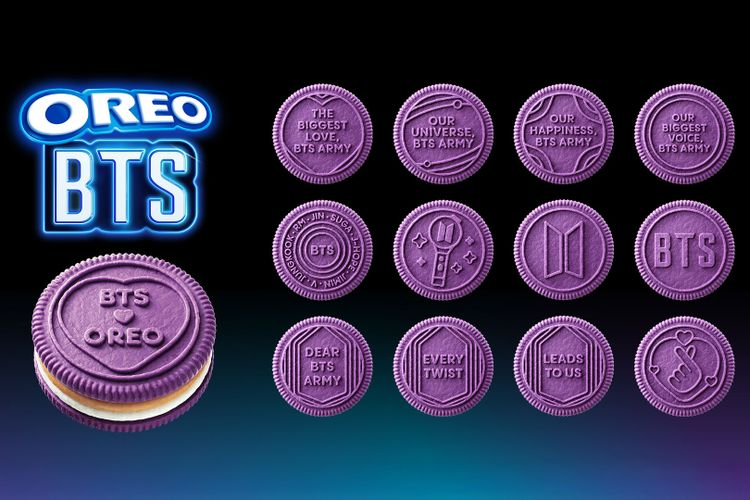
To mark their 13th anniversary, there are 13 embossed designs on the purple wafers, including the BTS light stick, band member names, and the group’s popular finger heart symbol. There are also three cookies that spell out a special message for fans. The embossments vary by pack, so fans may need to collect multiple packages to find all 13 designs.
Sounds unlucky.
This Week in Printing, Publishing, and Media History
May 18
1048: Persian mathematician, astronomer, and poet Omar Khayyám born.
1593: Playwright Thomas Kyd’s accusations of heresy lead to an arrest warrant for Christopher Marlowe.
1822: American photographer and journalist Mathew Brady born.
1872: British mathematician, historian, philosopher, and Nobel Prize laureate Bertrand Russell born.
1912: The first Indian film, Shree Pundalik by Dadasaheb Torne, is released in Mumbai.
1931: American cartoonist Don Martin born. (Splork!)
1949: English progressive rock keyboardist and songwriter Rick Wakeman born.
May 19
1743: Jean-Pierre Christin developed the centigrade temperature scale.
1864: American novelist and short story writer Nathaniel Hawthorne dies (b. 1804).
1941: American director, producer, and screenwriter Nora Ephron born.
1963: The New York Post Sunday Magazine publishes Martin Luther King Jr.’s Letter from Birmingham Jail.
May 20
1570: Cartographer Abraham Ortelius issues Theatrum Orbis Terrarum, the first modern atlas.
1609: Shakespeare’s sonnets are first published in London, perhaps illicitly, by the publisher Thomas Thorpe.
1660: English-American printer William Bradford born.
1799: French novelist and playwright Honoré de Balzac born.
1806: English economist, civil servant, and philosopher John Stuart Mill born.
1851: German-American inventor, and inventor of the Gramophone record, Emile Berliner born.
1873: Levi Strauss and Jacob Davis receive a U.S. patent for blue jeans with copper rivets.
1891: The first public display of Thomas Edison’s prototype kinetoscope.
1908: American actor James Stewart born.
1983: First publications of the discovery of the HIV virus that causes AIDS in the journal Science by Luc Montagnier.
1985: Radio Martí, part of the Voice of America service, begins broadcasting to Cuba.
2019: The International System of Units (SI): The base units are redefined, making the international prototype of the kilogram obsolete.
May 21
1471: German painter, engraver, and mathematician Albrecht Dürer born.
1688: English poet, essayist, and translator Alexander Pope born.
1703: Daniel Defoe is imprisoned on charges of seditious libel.
1927: Charles Lindbergh touches down at Le Bourget Field in Paris, completing the world's first solo nonstop flight across the Atlantic Ocean.
1932: Bad weather forces Amelia Earhart to land in a pasture in Derry, Northern Ireland, and she thereby becomes the first woman to fly solo across the Atlantic Ocean.
1981: Transamerica Corporation agrees to sell United Artists to Metro-Goldwyn-Mayer for $380 million after the box office failure of the 1980 film Heaven's Gate.
1992: After 30 seasons Johnny Carson hosted his penultimate episode and last featuring guests (Robin Williams and Bette Midler) of The Tonight Show.
May 22
1783: English physicist and inventor (the electromagnet and electric motor) William Sturgeon born.
1804: The Lewis and Clark Expedition officially begins as the Corps of Discovery departs from St. Charles, Mo.
1813: German composer Richard Wagner born.
1859: British writer Arthur Conan Doyle born.
1885: French novelist, poet, and playwright Victor Hugo dies (b. 1802).
1900: The Associated Press is formed in New York City as a non-profit news cooperative.
1906: The Wright brothers are granted U.S. patent number 821,393 for their “Flying-Machine.”
1907: English actor, director, and producer Laurence Olivier born.
1927: American novelist, short story writer, editor, and co-founder of The Paris Review Peter Matthiessen born.
1967: American poet, social activist, novelist, and playwright Langston Hughes dies (b. 1902).
2010: American mathematician, cryptographer, and author Martin Gardner dies (b. 1914).
May 23
1752: English-American printer William Bradford dies (b. 1660).
1829: Accordion patent granted to Cyrill Demian in Vienna, Austrian Empire.
1906: Norwegian director, playwright, and poet Henrik Ibsen dies (b. 1828).
1911: The New York Public Library is dedicated.
1934: Electronic engineer and inventor of the Moog synthesizer Robert Moog born.
1995: The first version of the Java programming language is released.
May 24
1595: Nomenclator of Leiden University Library appears, the first printed catalog of an institutional library.
1683: The Ashmolean Museum in Oxford, England, opens as the world’s first university museum.
1686: Polish-German physicist, engineer, and developer of the Fahrenheit scale Daniel Gabriel Fahrenheit born.
1830: “Mary Had a Little Lamb” by Sarah Josepha Hale is published.
1844: Samuel Morse sends the message “What hath God wrought” (a biblical quotation, Numbers 23:23) from a committee room in the United States Capitol to his assistant, Alfred Vail, in Baltimore, Md,, to inaugurate a commercial telegraph line between Baltimore and Washington D.C.
1895: American publisher and founder of Advance Publications Samuel Irving Newhouse Sr. born.
1941: American singer-songwriter, guitarist, artist, writer, producer, and Nobel Prize laureate Bob Dylan born.
1956: The first Eurovision Song Contest is held in Lugano, Switzerland.
1958: United Press International is formed through a merger of the United Press and the International News Service.
1963: American novelist, short story writer, and screenwriter Michael Chabon born.