We Get Letters
Two weeks ago, we linked to an item about the Pentel Multi 8 eight-color mechanical pencil. Afterward, “Joshua” wrote to us (not in pencil):
I just wanted to submit a correction for one of the “Around the Web” articles from the April 24th post.
The Pentel 8 color pencil actually debuted in the early 1980s as a children's coloring pencil. After they proved to be popular with a wider audience, Pentel redesigned and expanded the range.
The premium version mentioned in the article has both non-photo blue and diaso non-photo, which was somewhat glossed over but would seem to be of interest to printers, in a nostalgic way at least.
More info here - https://www.youtube.com/shorts/P_aVEXglsUk
A crazy pencil fan, bookmaker, and printer - Joshua
Thanks for that clarification, Joshua!
Unfolding Cartons
Via our Mount Monadnock Media Maven, an artist who transforms discarded cartons into “collagraphs.” Meet Ohio-based artist Rachel Mentzer. Says Colossal:
Mentzer’s practice emphasizes collagraphy, an intaglio printmaking technique in which flattened materials—especially paper and card but also other items like leaves or acrylic surfaces—can be used to create a plate from which to make prints. She meticulously carves the delicate surfaces of found cartons with motifs of birds, trees, and energy infrastructure, then brushes them in polyurethane to preserve and prepare them for printing. Occasionally, she also employs chine collé, which uses delicate papers, to add colorful backgrounds.
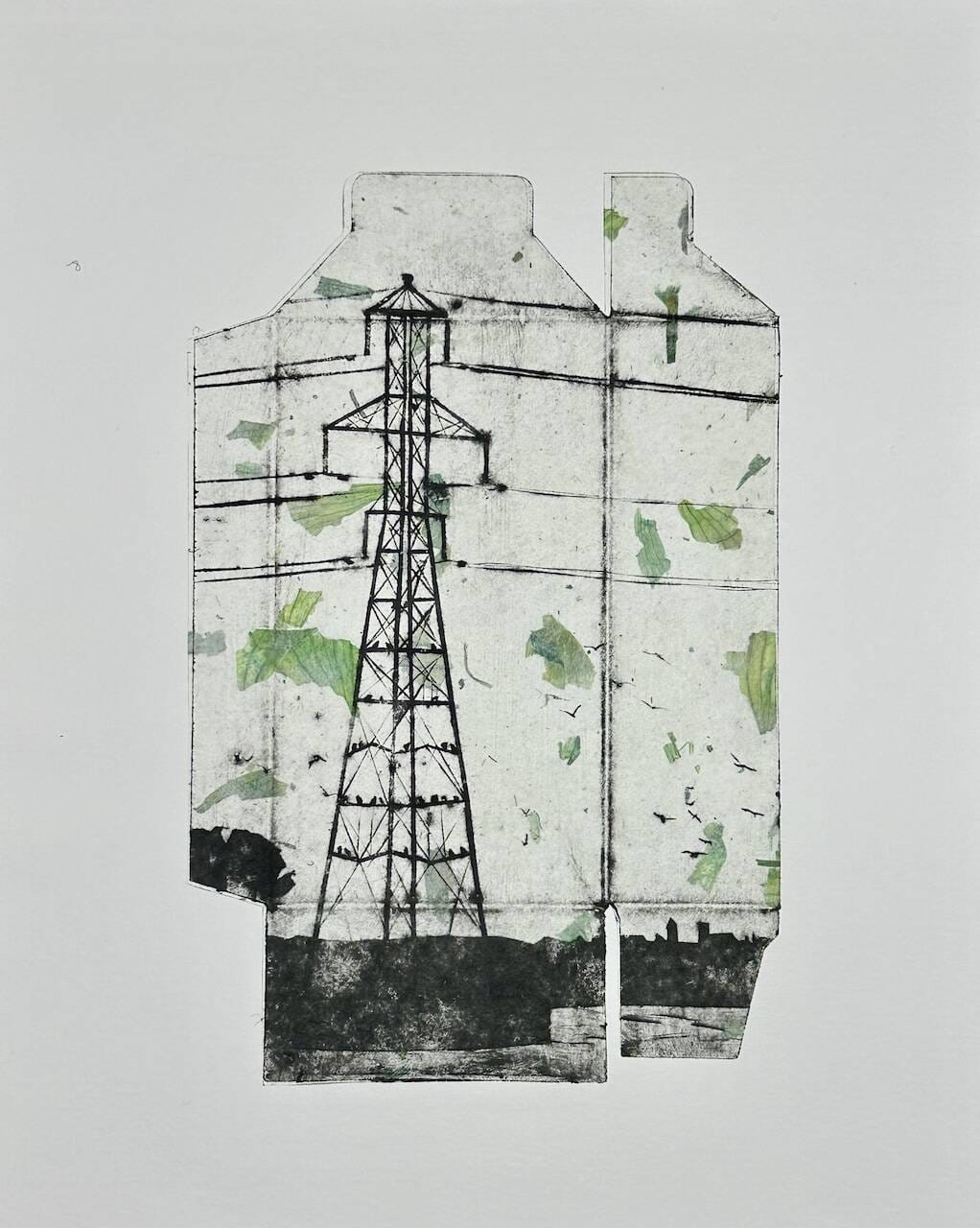
Mentzer’s work was recently included in the Manhattan Graphics Center’s community print studio exhibition, and this summer, she’s looking forward to participating in the Suzanne Wilson Artist-in-Residence Program at Glen Arbor Arts Center in Michigan. See the artist’s process on her website, where you can also check if she will be at an art fair in your area throughout the spring and summer. See more on Instagram.
Pretty neat.
Carry On, Jeeves
Some of us remember a time, pre-Google, when you had myriad choices in search engines. There was Lycos, Webcrawler, AltaVista…that’s all we can remember offhand, but there were a bunch of them. Google killed them all off, but one actually stuck around. Originally called Ask Jeeves (named after Bertie Wooster’s ever-resourceful valet in the P.G. Wodehouse stories), it was rebranded as Ask.com in 2006. It clung on for another 20 years, but, via Engadget, parent company InterActiveCorp has finally shut it down.
"As IAC continues to sharpen its focus, we have made the decision to discontinue our search business, which includes Ask.com," the statement on the website reads. "After 25 years of answering the world's questions, Ask.com officially closed on May 1, 2026."
The statement ended by thanking its millions of users, and saying, "Jeeves' spirit endures." As sad as it is to see a relic of the early Internet days fade into obscurity, we still have Ask Jeeves to thank for why some users still punch in full questions when querying Google. On top of that, Jeeves was built to provide detailed answers in natural language, which could have arguably acted as a precursor to today's AI chatbots like ChatGPT.
As Wodehouse wrote about his own creation: “Jeeves, of course, is a gentleman’s gentlemen, not a butler, but if the call comes, he can buttle with the best of them.” And so could Ask Jeeves.
Hard Wear
When we think about “wearables”—assuming we ever think about wearables—we often think of smart watches (aka “glorified joy buzzers”), smart rings (“My precioussssssss”), or more complicated electronic devices that are increasingly being integrated into clothing. But believe it or not, the concept dates back at least 100 years, and Gizmodo rounds up some of the weirdest wearables from a century ago.
We could go for this one: before noise-cancelling headphones, Hugo Gernsback conceived of the Isolator helmet, which appeared on the cover of the July 1925 issue of Science and Invention magazine.
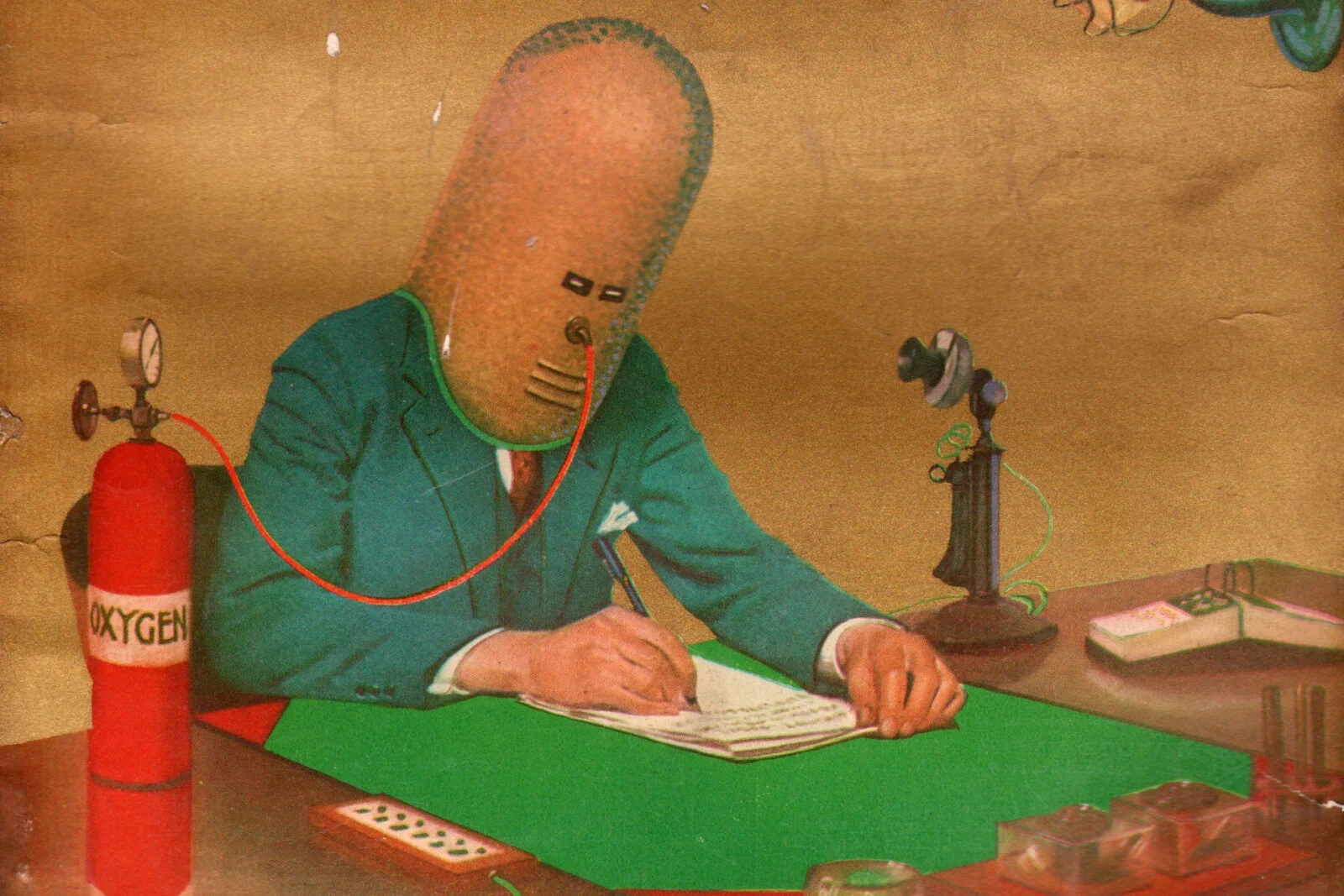
Gernsback even built a prototype, but finding a suitable noise-cancelling material proved challenging.
The problem was first to do away with the outside noise. The first helmet constructed as per illustration was made of wood, lined with cork inside and out, and finally covered with felt. There were three pieces of glass inserted for the eyes. In front of the mouth there is a baffle, which allows breathing but keeps out the sound. The first construction was fairly successful, and while it did not shut out all noises, it reached an efficiency of about 75 per cent.
Ah, but perhaps the most prescient wearable of yore was the Shockwatch. Inventor Emil Pruss drew up schematics for an electric wrist band designed for self-defense. If you are accosted on the street, you can use the Shockwatch to deter your would-be assailants by delivering them a 10,000-volt shock.

These days, you can use a Garmin Vivoactiv for the same purpose by having someone text you while you’re being attacked.
There are also early versions of what would become headphones, Walkmen, and other portable audio devices.
EV OO!
Looking for an inexpensive electric vehicle (EV)? You can find one for under $100—but you also have to be under five years old. Via Gizmodo, the Little Tikes Cozy Coupe has been a popular child’s conveyance for nearly 50 years.
What started as a simple red and yellow, plastic, foot-powered car, beloved by many in the 18-months- to 5-years-old range, has spawned more luxurious versions with ladybug spots and truck parts, but it’s now also, in a manner of speaking, the least-expensive new electric vehicle in the U.S. starting from $64.99 (MSRP).
Now, Little Tikes added a $32.99 Cozy E-Charging Station to its accessories, as a way to keep today’s tots au courant (or au current, as it were).

Features include lights, a “Power-Up Button” to mimic a start button, and sounds that likely aren’t far off from many modern EVs, since they make about as much noise as a foot-powered car.
Ironically, batteries are not included. (Don’t give EV carmakers any ideas!)
Your Name Here
Some of you may be familiar with Landsat, a joint program between NASA and the United States Geological Survey (USGS) that, since 1972, has been continuously collecting satellite images of the Earth, with a library/database numbering in the millions. As it happens, no small number of geographical features can—if you squint—look like letters. Ergo, via Boing Boing, NASA has launched a cool feature called “Your Name in Landsat,” in which users enter their name and the site spells it out using satellite images. As you can see, it’s kind of hit or miss.

Repeated letters use different images, but the same images are always used, so there is only one possible combination of images for each set of letters. The resulting image can be saved or shared via a link or QR code. Hovering over or clicking on an individual image reveals the name and GPS coordinates of the location featured in the image.

Pretty cool!
Stuck in Time
Now this is our kind of AI! Meet “Talkie,” a large-language model (LLM) that has been trained solely on books, newspapers, and other text sources from before 1930. Says Futurism:
With its thirteen billion parameters, the researchers behind Talkie say it’s the largest “vintage” model they’re aware of, capable of holding down a conversation as if truly stuck in a past when movies with sound in them were still a novel phenomenon, and when news announcers rattled off the latest signs of tumult in the world in a bouncy Mid-Atlantic accent.
It's not perfect, they say. Talkie sometimes displays incidents of “temporal leakage” (ooh, you don’t want that…) in which it generates anachronistic answers, such as, for example, indicating that “Franklin D. Roosevelt was president of the United States from 1933 to 1937”—anachronistic and a bit inaccurate.
That said, researchers wonder, can it predict the future? Not quite.
In one user’s testing, Talkie predicted that another World War would break out in 1936, and that “flying machines” would be in everyday use for transport. Though it also strangely predicts that by 1999, “the sun will have ceased to shine,” perhaps reflecting contemporaneous anxieties over the dawn of a new millennium.
We know someone who would agree with one of its assessments:
In another test by the researchers, Talkie called talking pictures — the slang for them being its namesake — “overrated.”
Well, if all it had to go on is The Jazz Singer, we concur. Wait until Citizen Kane, though…
Sweat the Small Stuff
When in Amsterdam, be sure to visit a zoo that is decidedly not a petting zoo: Micropia, a collection of the bacteria, microbes, and other tiny critters that live among—or on—us. Says Atlas Obscura:
Sitting in the heart of Amsterdam, the facility features exhibits such as petri dishes filled with artfully grown cultures that show the naturally occurring designs they create, and a "scanner" that shows exactly what is growing on people, and where. The only light in the exhibition comes from the displays themselves.
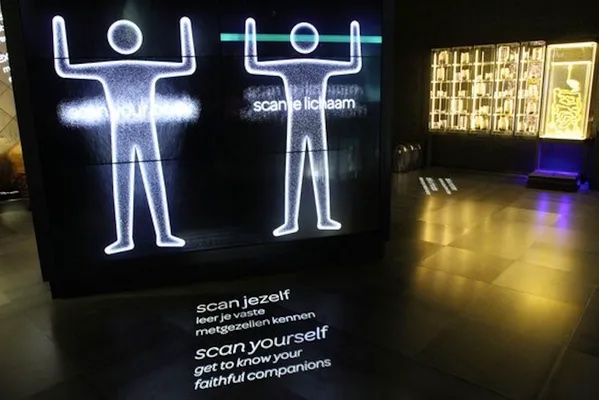

There is also a microbiology lab on site that grows and cares for the microbes on display. The lab technicians act as both zookeepers and docents, ready to answer any questions that aren't answered by the big screen microscopes that show what the little things look like up close.
We wonder if they sell Giant Microbes in the gift shop.
Graphene Drones On (Or Vice Versa)
Was it a good week for graphene news? It’s always a good week for graphene news! Plaid Technologies provides update on graphene coating initiative for drone systems. From (who else?) Graphene-News:
Plaid Technologies has provided an update on its ongoing collaboration with Graphene Nano Works (“GNW”) to evaluate and advance a proprietary graphene-based coating technology designed to enhance the performance, survivability, and stealth characteristics of next-generation drone systems across aerial, marine, and ground domains.
Plaid Technologies….weren’t they fashionable in the 1970s?
Plaid’s approach contemplates an initial focus on applying advanced coatings to existing drone platforms, enabling faster real-world validation and potential early-stage commercialization opportunities, while longer-term development may include integrated graphene-enhanced structures and systems.
Naturally, Plaid sees the global drone market as a growing opportunity.
Thereby Hangs a Tail
As we lurch toward our inevitable senescence, one major concern is that of balance, specifically maintaining it. Whilst some of us have always been challenged by a dodgy vestibular system, the problem becomes especially acute amongst older folks. One interesting solution was inspired by biomimicry. That is, many animals have tails to improve mobility and maintain their balance. You can see where this is going, so, via Boing Boing, a research team at Keio University Graduate School of Media Design (Media Design?) has introduced a prototype of what they call Arque, a meter-long robotic tail “to allow us to alter our body momentum for assistive and haptic feedback applications.”
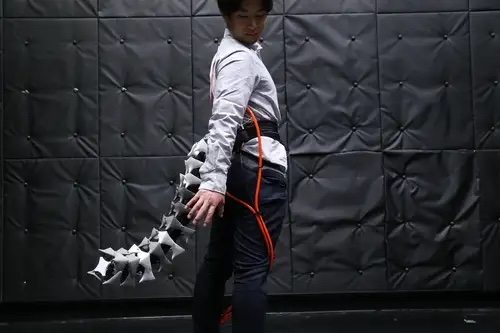
Looks kind of theatrical…
Cheetahs flick their tails to corner at full sprint. Monkeys use theirs as a counterweight in the canopy. Arque, the Keio team says, can do the same for us when crossing a slick kitchen floor. When the wearer leans one way, the tail swings the other, acting as a pendulum to nudge the body's center of mass back over its feet.
We’re not sure that’s the best solution, but it seems like the most fun. Perhaps wearers can even wag it to express emotions. (“Hey, grandpa’s happy to see us! Who’s a good boy?”)
Watch a video here.
Rocky, Too
Have you seen Project Hail Mary, the new sci-fi film starring Ryan Gosling? We have yet to see the movie (which Talkie would probably consider “overrated”), but we are absolutely enjoying the Andy Weir novel on which it is based—this month’s entry perhaps in the Around the Web Book Club. (Weir also wrote The Martian, which was also made into a by all accounts very good movie.) The Daily Grail has a good write up of Project Hail Mary.
Those who grew up in the 1980s will remember a certain sub-genre of sci-fi movies in which the protagonist teamed up with a non-human entity in a feel-good, family friendly adventure, such as Steven Spielberg’s 1982 movie E.T. The Extraterrestrial (with the glowing-fingered alien ‘ET’) and the 1986 film Short Circuit (with the robot ‘Number 5’). If that type of movie was/is your jam, then the new hit movie Project Hail Mary will definitely be up your alley.
Curiously, we hated both those movies. But if PHM stays faithful to the book, we probably will like it. It’s what is often called “hard science fiction,” a sub-genre that emphasizes scientific accuracy rather than what you might call fantasy. Things don’t just happen magically; there has to be a plausible explanation for the things that happen in these kinds of stories. Star Wars is decidedly not hard sci-fi, and while Star Trek (in all its iterations) gave it a solid go, sometimes it got bogged down in “technobabble.”
Anyway, back to Project Hail Mary.
Project Hail Mary tells the story of a mission to another star, in order to try and save Earth: After our Sun begins to dim, it is discovered that microrganisms known as ‘astrophages’ are infecting stars and feeding on them, including our own. With only three decades before Earth cools enough to wipe humanity from existence, a long-shot mission (the ‘hail Mary’ of the title) is launched to the only star in our galactic neighbourhood that has not been infected, to find out why it is immune.
What we like about the book (it’s very funny at times, which helps) is that it takes a more or less realistic (or at least plausible) approach to contact with an alien race, specifically attempts to communicate. (None of this “Universal Translator” stuff or “all aliens automatically know English because they intercepted radio and TV transmissions.”) As had been remarked when Arrival came out in 2016, a movie (based on Ted Chiang’s novella “Story of Your Life”) whose basic premise involves a linguist attempting to communicate with some extraterrestrial visitors, even that oversimplifies the complexities of attempting to communicate with an alien entity. Still, A for effort—and Arrival.
Back to Hail Mary (mild spoiler alerts):
And that technical side is itself a strong point of the film, with much of the science being realistic and rigorously thought out. The extraterrestrial buddy ‘Rocky’ is both very alien (made of Xenon, and ‘seeing’ via echolocation) but at the same time really not that different to us in motivation. (That’s not to say there weren’t parts that pushed the bounds of believability, such as the speed with which understanding between two different species was established, and Grace’s ability to pilot a spaceship with no training.)
… In a moment in time where things seem very dark, and the only sci-fi scenarios we seem to get are apocalyptic or horror-themed (both in fiction, and even in real life, such as those predicted by tech billionaires), Project Hail Mary provides an old-fashioned, Spielbergian dose of science fiction filled with heart and humour. Highly recommended!
Best of all, it’s not irritatingly “cutesy” the way E.T. was. We look forward to finishing the book and checking out the movie.
You’ll See Perpetual Change Stew
Here’s something we had never heard of before: perpetual stew. No, it’s doesn’t refer to someone who is always in a bad mood, but rather exactly what its name indicates: a stew that has been simmering literally for decades. We’re not even going to ask if it’s palatable because the first question that springs to mind is, is it edible? Is it something you’d find in the Micropia cafeteria? And apparently it is. Says (who else?) Food & Wine:
Content creator "Zaq Makes" (@zaq.makes) — who prefers not to share his real name — has been sharing updates on his perpetual stew on social media for 372 days, just a little over one year. The creator documents the evolving flavors of the concoction he has dubbed “Stewtheus” as he regularly adds new ingredients, including salmon, blackberries, lamb shanks, okra, eggs, and barley.
Zaq boasts 400,000 followers on Instagram and more than 200,000 on TikTok, because of course he does.
He takes ingredient requests from his followers, and the ever-changing components of his stew often sound like less-than-appealing combinations.
Interestingly (if that’s the word to use), the idea of a perpetual stew is not a new thing, and has existed for centuries before there was social media.
Perpetual stew is a dish that is cooked continuously — always simmering over heat — with more liquid and ingredients added as needed to replenish its volume. There are no required ingredients besides a liquid, which helps it maintain a high temperature without burning.

The concept of a perpetual stew dates back at least to the Middle Ages. As food historian Reay Tannahill describes in her book Food in History, European inns would keep cauldrons of stew constantly simmering over a fire to feed guests. Tannahill writes that “the cauldron was rarely emptied except in preparation for the meatless weeks of Lent, so that while a hare, hen, or pigeon would give it a fine, meaty flavor, the taste of salted pork or cabbage would linger for days, even weeks.”
Which brings us back to our original question: is it safe?
perpetual soup is safe to eat even after years of simmering because it’s kept at a constant high temperature that prevents bacterial growth. Francisco Diez-Gonzalez, PhD, the director of the Center for Food Safety at the University of Georgia, recommends that “the stew should always be at a temperature greater than 140°F” to ensure it’s safe to consume.
So if someone goes away on holiday, do they have to have someone come over and “stew sit” to make sure it stays at the desired temperature? Because it needs to:
If your perpetual stew drops below the critical 140°F, it may still be salvageable — within reason. Per Diez-Gonzalez, “If it stayed below 140°F for less than two hours, it would be safe to consume after reheating. If it is kept [below 140°F] for longer than 2 hours, the recommendation is to discard it, because some bacteria may grow and produce heat-stable toxins that will not be inactivated by reheating.”
To be honest, it’d be less work to just heat up a can of Dinty Moore when the stew mood strikes us.
This Week in Printing, Publishing, and Media History
April 27
1667: Blind and impoverished, John Milton sells the copyright of Paradise Lost for £10. (He never regained it.)
1791: American painter and inventor Samuel Morse born.
1882: American poet and philosopher Ralph Waldo Emerson dies (b. 1803).
1896: American chemist and inventor of nylon Wallace Carothers born.
1981: Xerox PARC introduces the computer mouse.
April 28
1926: American novelist Harper Lee born.
1948: Igor Stravinsky conducted the premiere of his American ballet Orpheus at the New York City Center.
1973: The Dark Side of the Moon by Pink Floyd, recorded in Abbey Road Studios, goes to number one on the US charts, beginning a record-breaking 741-week chart run.
April 29
1863: American publisher and politician William Randolph Hearst born.
1953: The first U.S. experimental 3D television broadcast showed an episode of Space Patrol on Los Angeles ABC affiliate KECA-TV.
1968: The musical Hair opens at the Biltmore Theatre on Broadway.
1980: English-American director and producer Alfred Hitchcock dies (b. 1899).
1986: A fire at the Central library of the City of Los Angeles Public Library damages or destroys 400,000 books and other items.
1996: The off-Broadway musical Rent opens on Broadway at the Nederlander Theatre. No day but today.
April 30
1897: J. J. Thomson of the Cavendish Laboratory announces his discovery of the electron as a subatomic particle, over 1,800 times smaller than a proton, at a lecture at the Royal Institution in London.
1927: Douglas Fairbanks and Mary Pickford become the first celebrities to leave their footprints in concrete at Grauman's Chinese Theater in Hollywood.
1938: The animated cartoon short Porky’s Hare Hunt debuts in movie theaters, introducing Happy Rabbit, an early version of Bugs Bunny.
1939: NBC inaugurates its regularly scheduled television service in New York City, broadcasting President Franklin D. Roosevelt's N.Y. World's Fair opening day ceremonial address.
1993: CERN announces World Wide Web protocols will be free.
May 1
1753: Publication of Species Plantarum by Linnaeus, and the formal start date of plant taxonomy adopted by the International Code of Botanical Nomenclature.
1786: In Vienna, Austria, Mozart’s opera The Marriage of Figaro is performed for the first time.
1840: The Penny Black, the first official adhesive postage stamp, is issued in the United Kingdom.
1971: Frank Romano’s national holiday—Amtrak (the National Railroad Passenger Corporation) takes over operation of U.S. passenger rail service.
1999: SpongeBob SquarePants premieres on Nickelodeon after the 1999 Kids’ Choice Awards.
2002: Dr. Joe Webb’s national holiday—OpenOffice.org releases version 1.0, the first stable version of the software.
May 2
1519: Italian painter, sculptor, and architect Leonardo da Vinci dies (b. 1452).
1611: The King James Version of the Bible is published for the first time in London, England, by printer Robert Barker.
1885: American actress and gossip columnist Hedda Hopper born.
1895: American playwright and lyricist Lorenz Hart born.
1952: The world’s first ever jet airliner, the De Havilland Comet 1 makes its maiden flight, from London to Johannesburg. (Certain airlines are still using it...)
1955: Tennessee Williams wins the Pulitzer Prize for Drama for Cat on a Hot Tin Roof.
2000: Rand McNally’s national nightmare—President Bill Clinton announces that accurate GPS access would no longer be restricted to the United States military.
2012: A pastel version of The Scream, by Norwegian painter Edvard Munch, sells for $120 million in a New York City auction, setting a new world record for a work of art at auction.
May 3
1469: Italian historian and philosopher Niccolò Machiavelli born.
1913: Raja Harishchandra, the first full-length Indian feature film is released, marking the beginning of the Indian film industry.
1935: American businessman and founder of the Ronco Company Ron Popeil born. But wait! There’s more!
1952: The Kentucky Derby is televised nationally for the first time, on the CBS network.
1957: Walter O’Malley, the owner of the Brooklyn Dodgers, agrees to move the team from Brooklyn to Los Angeles.
1958: Danish-English comedian, author, and radio host Sandi Toksvig born.
1959: English actor, director, and screenwriter Ben Elton born.
1960: The Off-Broadway musical comedy The Fantasticks opens in New York City’s Greenwich Village, eventually becoming the longest-running musical of all time.
1965: Welsh actor and comedian Rob Brydon born.
1973: The 108-story Sears Tower (now officially the Willis Tower) in Chicago is topped out at 1,451 feet as the world's tallest building.
1978: The first unsolicited bulk commercial email (which would later become known as “spam”) is sent by a Digital Equipment Corporation marketing representative to every ARPANET address on the west coast of the United States.