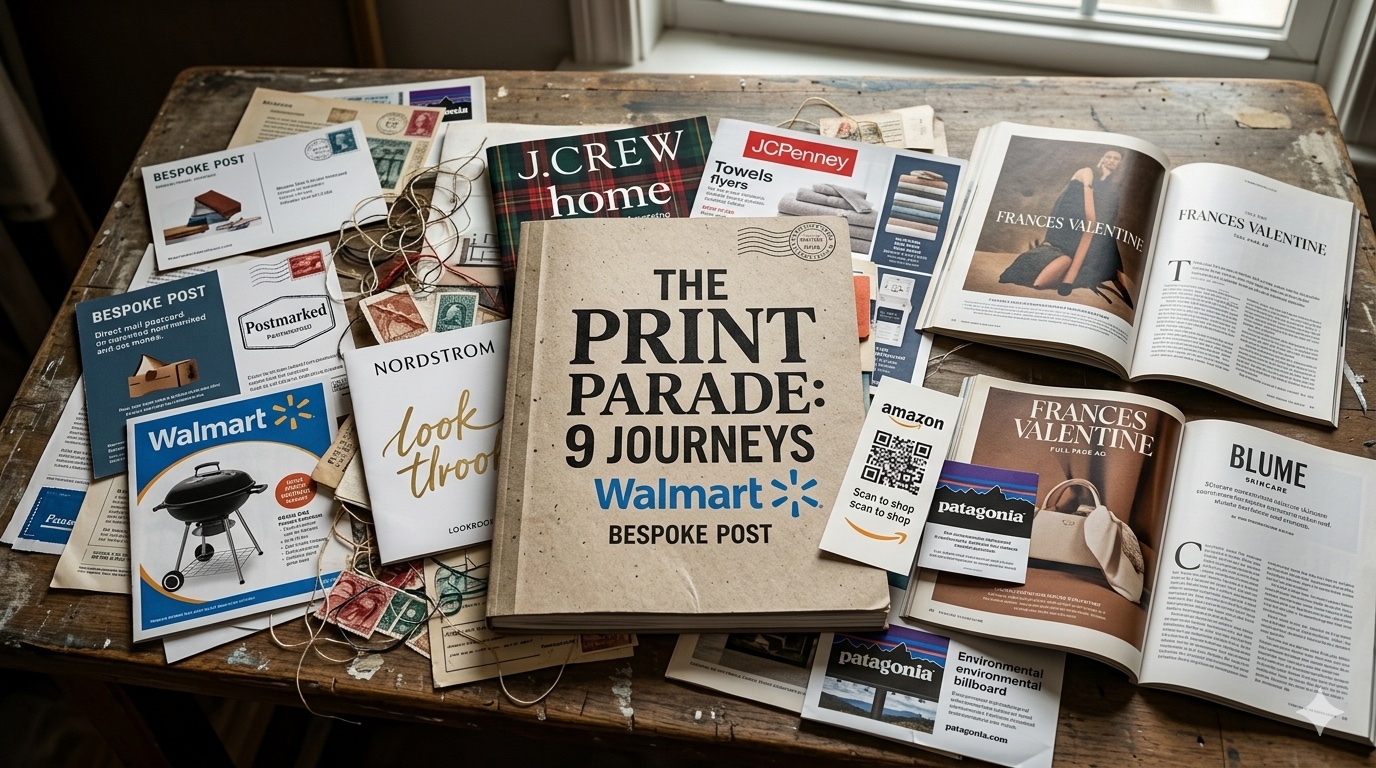
Image created using Google Gemini
Are you seeing clients pulling back from print to save money? If so, you aren’t alone. When economic times are uncertain, print marketing is one of the first things from the marketing budget to go.
If your clients are among those pulling their print budgets, you can remind them of other companies who once did the same—and regretted it. There are also those (including e-commerce companies) who have added print to their marketing strategies and not regretted it.
Here are some examples:
J. Crew: After cutting back, J.Crew returned to producing catalogs, acknowledging their role in driving website traffic and purchases. The brand brought its catalog back in 2023 to shift from a focus on heavy discounting back to editorial, brand-focused storytelling
J.C. Penney: Although the company no longer produces its iconic “Big Book,” it did bring back a slimmed down, 120-page version after realizing that physical mailings actually drove online sales. Today, even as the retailer has drastically cut back on its physical stores, it maintains its foothold in print with “look books” and targeted specialty mailers that drive customers online.
Amazon: Despite being the world's largest online retailer, Amazon has reintroduced physical toy catalogs to build excitement and encourage in-home engagement, particularly for the holidays. This year’s 92-page Kids Gift Book blends both physical and digital elements.
Walmart: This giant retailer has introduced not just one catalog, but multiple. In 2025, its 72-page Let’s Go to the Toy Shop provided inspiration and drove holiday sales. In late 2025, Walmart launched its first-ever dedicated home catalog, as well.
Nordstrom: This high-end retailer has revived its print catalog strategy as of May 2026. While many retailers moved entirely to digital, Nordstrom brought back its physical mail traditions to reconnect with customers through tactile media. This includes a 125-page anniversary catalog, 100-page Holiday Gift Guide, and specialty catalogs.
Frances Valentine: This fashion brand uses catalogs to stand out in a less-crowded “mailbox” compared to the high competition of digital ads. Its “counter-trend” print strategy doubles down on physical catalogs while other fashion brands shift primarily to digital. The brand views high-quality print as a critical tool for storytelling and customer connection. Business Insider reports that the catalog strategy has led to 40% higher order volumes than digital-only efforts.
Bespoke Post & Blume: These brands have experimented with direct mail, reporting that customers reached via print have higher order values and engagement rates. Bespoke Post has reported that direct mail customers are 30% more likely to make purchases, and when they do, their average order values are about 50% higher than the average customer.
Patagonia: Patagonia has evolved its print strategy from a traditional product catalog into a high-quality, biannual publication known as the Patagonia Journal. Rather than focusing on direct sales, this strategy prioritizes brand storytelling and environmental activism that offers an immersive “recreational shopping” experience that digital platforms sometimes fail to provide.
What the Data Shows
These aren't isolated examples. Research from Harvard found that catalogs paired with email campaigns generate 15% to 24% higher sales than email alone (depending on market segment). Additional studies show that physical marketing materials create stronger memory formation and emotional connection than digital equivalents.
But (and there is a big “but” here) the data also show that students learn better and retain more information, more accurately, when they read in print. Yet schools continue to cut budgets for printed textbooks anyway. So just because it works doesn’t mean that businesses, organizations, and educational institutions will do it.
Even so, it’s always good to have the information on hand.
The Bottom Line for Your Customers
Your customers don't need to be J. Crew or Nordstrom to learn from these brands’ experiences. We get to learn at their expense. These lessons apply to businesses of all sizes: abandoning print entirely because “everything is digital now” often leads to a case of multichannel regret.