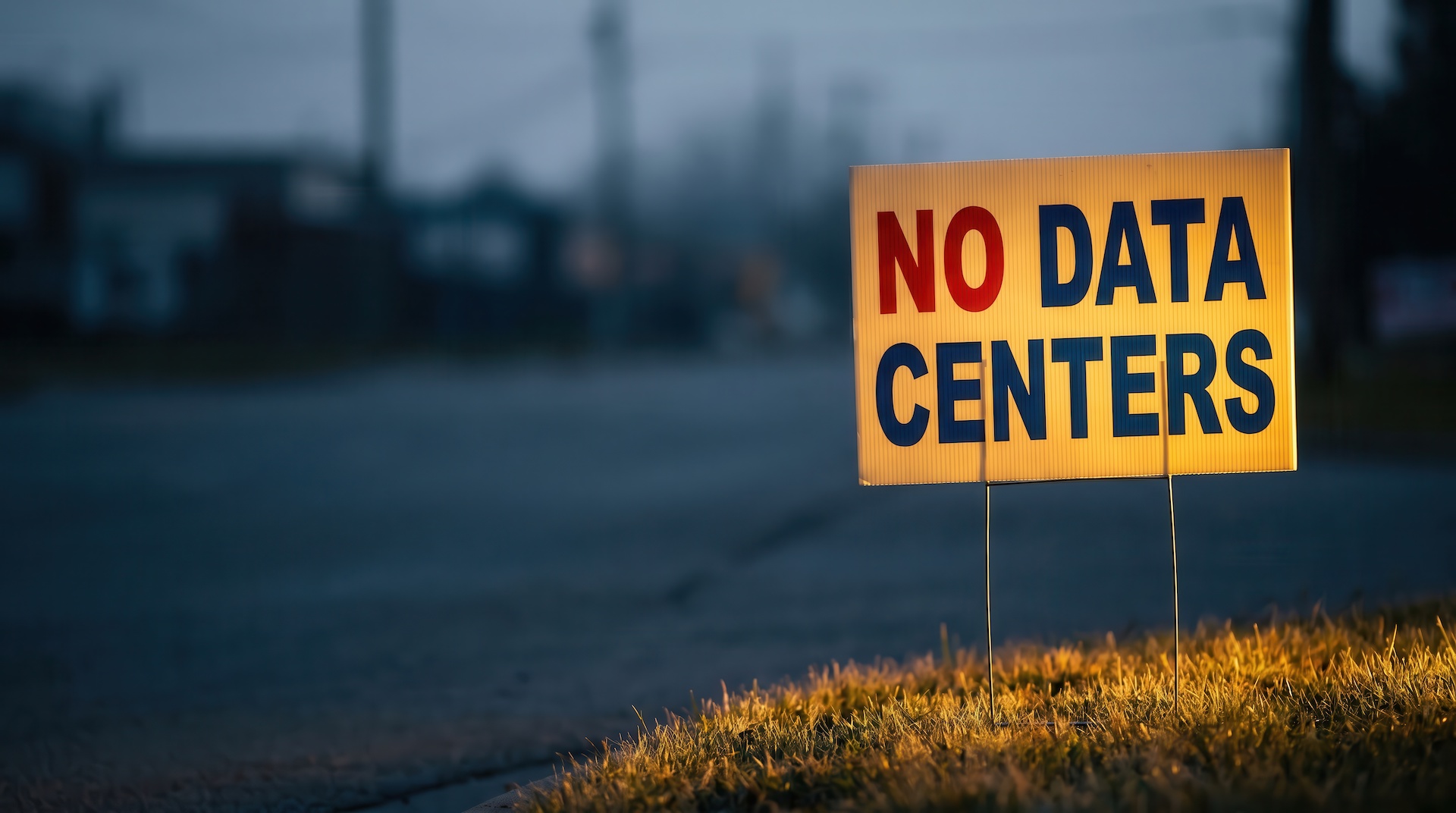
The place is Harford County, Md. Take a scenic drive or just head out to the grocery store and you’ll see them—line after line of signs: “No Data Centers in Harford County!” One is slated to be built in a bucolic agricultural community just outside Bel Air, Md., bringing light pollution, noise pollution, competition for water, and spiked electric bills to the surrounding residents, whether they want the data center there or not (and they vehemently do not).
Social media users (especially those on Facebook and NextDoor) and local news stations compete for the next breaking news on every twist and turn of the battle. The developer who wants to plunk the data center in the middle of a farm field vs. all of the residents who, while streaming Stanley Cup playoffs on their mobile devices and placing orders on Wayfair during commercials, are swinging axes to fight it.
Across the country, thousands of data centers have already been built (or are slated to be built) to satisfy Americans’ insatiable thirst for data. But despite the fact that printing is an energy- and water-intensive business, print shops are barely in the conversation.
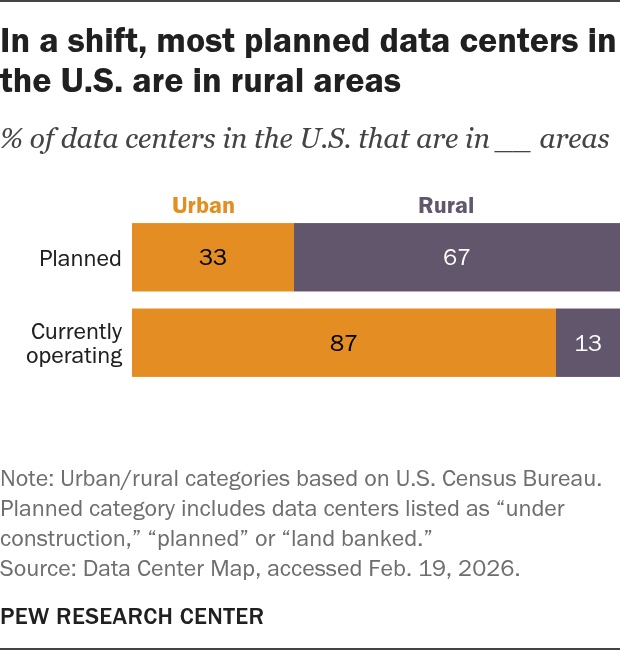
Unlike previous data centers, which are concentrated in urban areas, the new builds are largely in rural areas.
The Heavy Users
Presses, dryers, climate control systems. Cooling systems, press washup, chemical processing. In any community where a data center is being built or planned, printers should be paying attention. In those communities, their operating costs are about to change in ways they can't control. Yet when you ask printers whether they're thinking about data centers, the response is mostly a collective shrug.
Al Kennickell, president of The Kennickell Group, isn’t surprised. “It’s not being discussed here either,” he says. His operation is in the Savannah, Ga., region, where there’s so much warehouse development happening that there’s no available land for data centers anyway. “We’ve got massive warehouses being built where there is any open ground. We don’t have a lot of available land that can be turned into a data center. People would rather build a million-square-foot warehouse.”
But if the land were available? Kennickell is a pragmatist. “Nobody wants their electric bill to go up. But I spend a lot of time in the world of AI, and we are in an AI ‘arms race’ with China. It’s not a battle we can afford to lose. In order to not lose the battle, we have to have data centers.”
By some counts, nearly 4,300 data centers have already been built in the United States. Another 1,500 are actively slated for development, primarily in rural communities. But someone has to pay for all that power and water.
What the Numbers Say
Electricity prices have already climbed. Average electricity prices in the United States increased to 19 cents per kilowatt-hour by the end of 2025, about 27% more than in 2019, with prices expected to increase by up to 40% by 2030 compared to 2025.
One study from Carnegie Mellon University estimates that data centers, in combination with cryptocurrency mining, could lead to an 8% increase in the average U.S. electricity bill by 2030, potentially exceeding 25% in the highest-demand markets (such as central and northern Virginia). Printing is already a tight-margin business. If you’re running a print shop in one of the data-center-heavy regions, the last thing you need is a 25% spike in your energy bill.
But it’s not just energy. It’s water, too. In 2023, the country’s data centers directly consumed about 17 billion gallons of water, and hyperscale data centers alone are expected to consume between 16 billion and 33 billion gallons of water annually by 2028. In water-stressed regions, competition for this resource has real-world consequences.
Grid reliability is another hidden risk. In July 2024, a voltage fluctuation in northern Virginia triggered the simultaneous disconnection of 60 data centers, prompting a 1,500-megawatt power surplus and forcing emergency adjustments to prevent cascading outages. Nobody wants to be part of something like that.
Where the Irony Gets Thick
If printers aren’t focused on energy costs, water competition, and grid instability, what are they focused on? For some, it’s the work they can get printing signs to keep them out.
Joked one Sir Speedy location on Reddit: “I just hope they come to me to print their ‘no data center’ signs.” Another shop owner was more direct: “Print signs and have made thousands of ‘NO DATA CENTER’ signs. They are good for my business—well, the keeping them out part anyway.”
The irony is obvious. At least some printers are profiting from the battle against data centers while being seemingly unaware or unconcerned about the infrastructure costs those data centers could impose on them once they're built.
Another irony? At least a handful of those 4,300 data centers are housed in empty industrial buildings that used to house printing companies. Examples include the old R. R. Donnelley plant and the Chicago Sun-Times building. There has at least been consideration of doing the same with a former paper mill in Wisconsin Rapids.
Why This Matters Now
The anger against data centers is real, but if there is impact on print shops, it’s consistently happening “elsewhere.” At least, for now.
But it might not always be this way. Expectation is that things will continue as they have been (data centers being constructed or inhabiting old industrial buildings in large population centers where their impact on the community is minimal or masked), but as data centers increasingly move into rural areas, their light and noise pollution, water requirements, and impact on the electrical grid will be harder to hide.
So, especially if your shop is in a rural area, gear up for the debate that’s brewing. Because the greatest likelihood is, it’s coming to a town hall meeting near you.