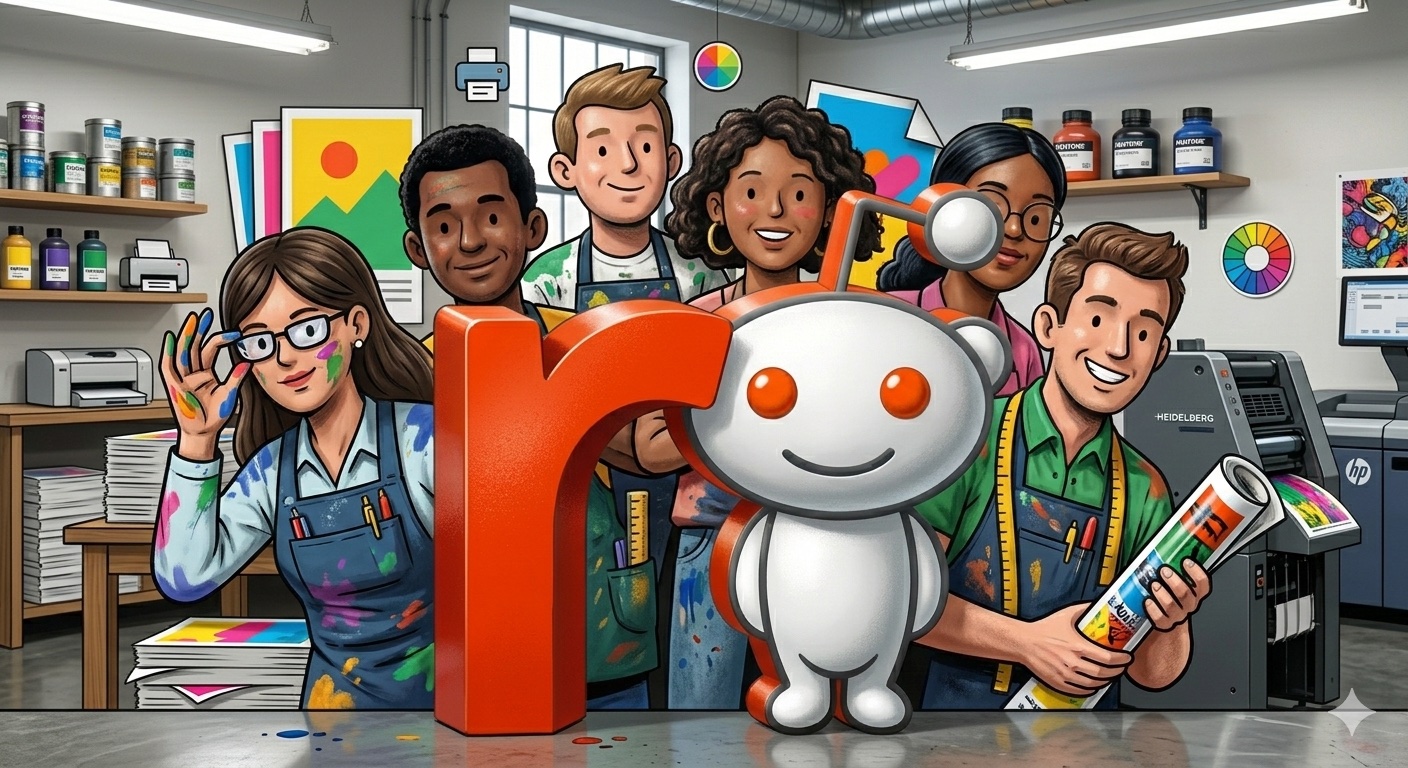
A Reddit thread that started in late February (and is still drawing responses) offers a rare window into what single-operator print shops are experiencing in today’s often brutal print industry environment. Let’s take a look at what small shops are saying among themselves about keeping their doors open.
The original poster laid it out plainly: She ran a print and design business for 15 years, made a decent living, and loved the flexibility. Then COVID hit. Her two biggest clients disappeared in corporate shakeups, life got complicated, and burnout set in. She closed up shop in 2024, moved out of state, and tried other work. Now? She’s missing the print business and considering starting over. But she’s hesitating because "a lot of the things that were hurting my business and causing constant headaches before, I have to assume have only gotten worse (online undercutters, constant crappy ‘art' from Canva, losing business because I didn't have every latest and greatest capability out there, and so on)."
The question to the community: Is anyone making a decent living as a one-man show? So it began.
The Numbers Behind the Struggles
The concerns this and other small shops voiced aren't just anecdotal. Industry data from 2024-2025 paints a challenging picture for small shops. According to Mordor Intelligence's 2025 Commercial Printing Market report, raw material costs rose by double digits in 2024 and 2025 due to global pulp shortages, natural gas price spikes, and pigment supply interruptions—and that was before the tariffs of “Liberation Day.” Fixed-price agreements left smaller operators particularly exposed, exactly the scenario playing out in these Reddit posts.
Meanwhile, the U.S. Bureau of Labor Statistics reported that printing industry employment declined 3.0% on average over the five years between 2020 and 2025, falling to 361,498 people. Printing Impressions’ 2025 Economic Outlook for Commercial Printing found that operating cost inflation outpaced price increases 3.9% to 2.7% on average among commercial printers surveyed, a squeeze that hits hardest when you're working alone.
For print-on-demand operations specifically, survival rates tell yet another sobering story: only 24% of POD shops are still operating three years after they start, according to 2024 datafrom Dropshipping.com.
The Honest Answers
So what do these Reddit users have to say?
One commenter who’s been solo for eleven years described a “weird twist of fate” where high-profile customers meant turning away smaller jobs, which now makes finding new business harder. “The area has been flooded with print shops all over, and it seems to be impossible to get a leg up with organic SEO, which used to be my number one business driver,” the Reddit user wrote. His advice? “Try and specialize as much as possible and diversify within that niche to be able to keep the service at a premium.”
Another Reddit user runs what he calls a “1.5 person shop,” just paying bills, getting by, and having struggled with burnout for years. His wife is ready to close the doors and coast on recurring clients. The couple has made peace with Canva submissions: “I got over the crappy Canva submissions by printing what the customer provides,” he writes. “If they don't like it, it’s their error, not mine.”
Then there’s the two-year operator in a rural tourist location with no competition within 150 kilometers who still can’t get enough business to stay profitable. Locked into a five-year digital press contract and running on savings, he’s wondering how to survive the next three months. “I still haven't given up,” he wrote, “but that’s my reality at present.”
That prompted another commenter to observe: “Machine companies feel so VC/PE-minded now looking for any way to charge a subscription or charge more for disposables. I feel like I’m working for them first, the landlord second, the bank third, and oh yeah, then lastly the customers.”
The Survival Strategies
Not everyone was struggling. But the ones making it work had specific strategies.
Several pointed to print brokering as a viable path—selling print, outsourcing production, and keeping overhead low. One broker supporter noted: “Costs for rent, machine leases, utilities, service contracts, repairs and maintenance would make it extremely difficult to be profitable on your own….I’d recommend you find a local printer and team up.”
Others pointed to government and nonprofit contracts as a lifeline. One four-person shop stays afloat primarily on mailing, sending out student loan notifications daily. “Getting contracts help with consistent work,” he commented. Walk-in customers and large format? “That stuff is just little extra money.”
A 70-year-old business that downsized from 10 employees to two offered this: “Time, technology, and the industry have changed.” The shop is still going, though the owner admits being “a bit burned out from wearing all the hats.”
One printer who downsized to just themselves with “a couple printers, cutters, and laminator” called it “a great additional source of income” supplemented by website sales, Amazon, and Etsy, but he emphasized getting health insurance and benefits from a part-time job first.
What Nobody’s Saying Out Loud
The thread reflects a well-worn industry truth: printing is brutal for solo operators. SEO doesn’t work like it used to. Equipment contracts feel predatory. Canva-generated files are the new normal. Online undercutters are everywhere. Even in markets with no nearby competition, there’s not necessarily enough work to stay profitable.
But it also shows resilience. The two-year operator in rural Canada offered concrete suggestions: local ad mailers where businesses pay to lock out competitors, print-on-demand partnerships, and government bids. Another commenter offered encouragement: “As the years go by and you start getting repeat orders, that’s where the money is. It’s not an easy game, but there are worse—believe me.”
The original poster hasn’t updated the thread with a decision. But the conversation continues, printers sharing what they'd not likely say in front of a vendor or at an industry panel. Just sharing what they're actually dealing with, day to day, trying to make it work.