It’s a bit like listening in to a private conversation. It’s the Digital Embellishment Designer Meetups sponsored by Taktiful in which designers come together to learn both from the presenter and from each other. This past week, the topic was “From Tracing to Taste: How AI Is Changing Embellishment Design” with Matthew Redbear, creative consultant with Takiful and E3D director at Elite Print Finishing (Ft. Lauderdale, FL) with the goal “to break down real, practical ways AI can speed up embellishment design without sacrificing taste, intent, or production reality.”
You have to imagine it—designers coming together to hear about how AI is going to take away their jobs. Like attending your own funeral, right? Not in the least. Both Redbear and the designers who chose to chime in and share their experiences felt the opposite. When it comes to print embellishments, AI actually made their jobs faster and more creative, ensuring that they looked good in front of their clients and their designs came out better.
In full spoiler mode, Redbear offered the conclusion first: “AI gives me smarter math, faster decisions, and I end up with more creative ideas—things I hadn’t thought about that get suggested to me.”
This doesn’t mean that Redbear is letting AI think for him. Rather, he uses a paid model of ChatGPT(5.2) that he trains on his perspective, his creative process, and his client so that it facilitates, not its own vision, but his.
“We aren’t short on creativity, but we have time constraints,” he explained. “We have issues with predictability when we are designing for embellishments. I get stuck, unsure, hesitate, and then get frustrated. Then I lose my creative edge.”
Fortunately, there is an AI for that.
Redbear covered a lot of ground, including different AI tools to speed bottleneck manual functions, such as masking, and then asked designers to chime in with how they are using AI in their own work. Here is some of what they said.
Helps Find a Starting Point:
What is the piece designed to do? “The biggest bottlenneck is trying to figure out what we are trying to do with the piece,” notes Ryan Moskun, marketing manager for Harris and Bruno International. “[Are we trying to] draw the eyes? Invite touch? Highlight a specific element? Finding the start point and what the subject matter should be.”
There’s an AI for that:
Redbear notes that coming up with ideas is one of AI’s strong points. He’ll ofteh use it to come up with variations on the same idea. “This is a question we should all ask,” he said. “What if you could do 10 variations in the time it takes you to do one?”
He concluded—and Sabine Lenz of PaperSpecs later agreed—that AI idea generation can be really helpful. Not that you are going to rely on it as a final solution. But simply to get some ideas. Simply upload the image, give it some parameters, and ask it questions like, “If I were creating this [widget] and needed ideas, what would you give me?”
“Then it comes up with ideas I might not have thought of,” he says. “Then I’m going to take everything it gave me and decide what I’m going to do with it. Decide how I’m going to work it into one of my options I’m going to give the customer. It opens up channels that I might not have thought of. I have more information to suggest.”
“The key is ‘suggest,’” Sabine Lenz of Paper Specs chimed in. “AI as an idea generator? Yes. As decision maker? Not so much?”
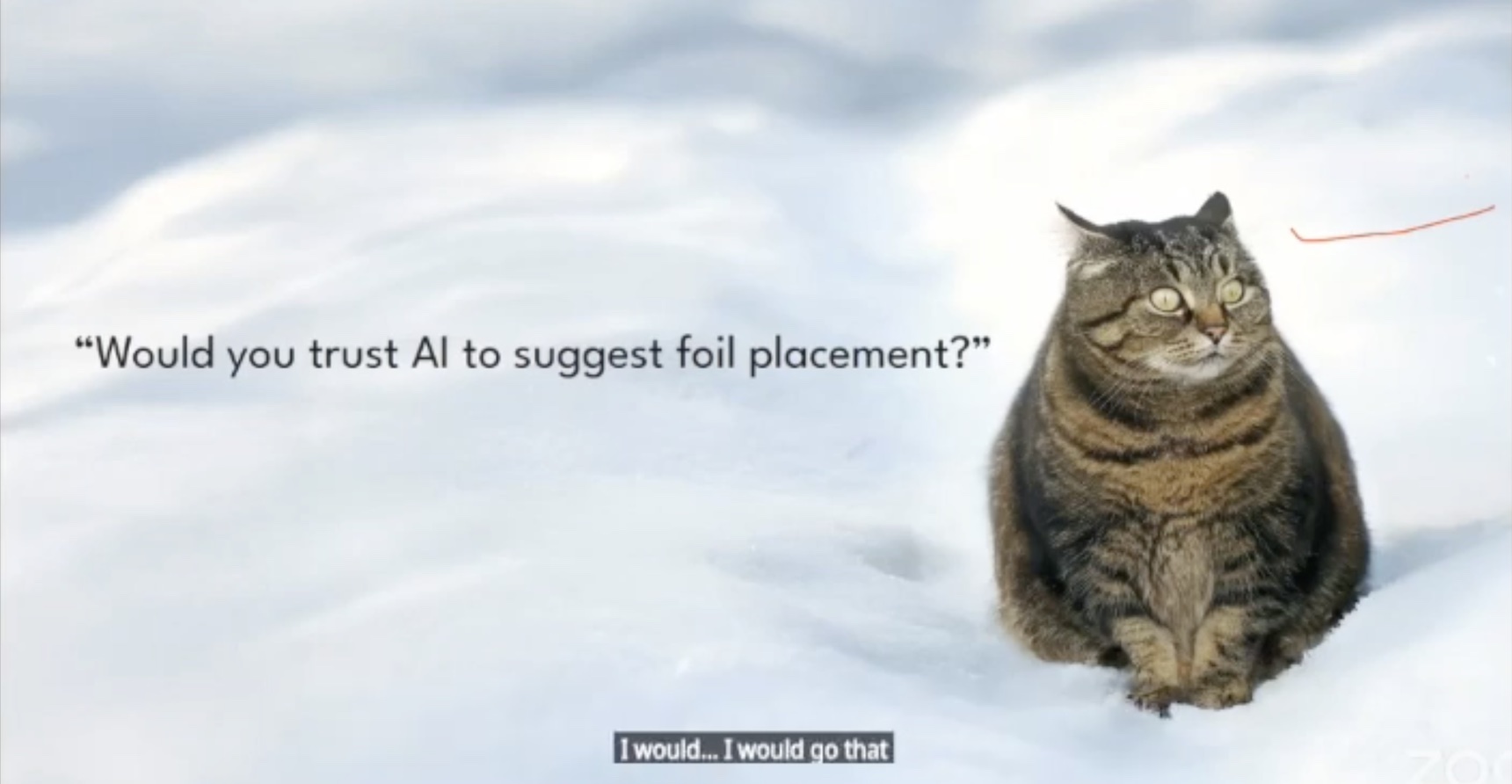
As the discussion was unfolding. Kevin Abergel, founder at Taktiful, took a screenshot of the PowerPoint slide in Redbear’s presentation, uploaded it to ChatGPT, and asked, “Where would you put foil on this piece?” Here’s what it said:
- Foil the word AI only.
- Do just the cat’s eyes.
- Foil not the whole eye, but only where there is color.
- Avoid the snow. Don’t foil anything with snow.
Redbear added that, when it comes to AI, there are two approaches it can take: Is it obvious or is it curious? “That [ChatGPT’s observations about placing foil around the cat] is obvious. But sometimes it comes up with curious elements. If you had never thought of putting foil there, now you know.”
To ensure the smoothest, most accurate design suggestions, Redbear uses the paid version of ChatGPT 5.2 I teach it what embellishments are, how embellishments work, where I am more likely to use them. “I train it only how I think, as a design, and the work I do,” he explains. “Then I ask it quests for alternatives. I teach it the language, the use, and placement of those terms and how they fit together and it learns from me and knows my trends. I teach it what Taktiful does . it comes back and says, based on T’s recommendations, based on what you’ve told me you are doing with T, this is the best approach. You can train your own use model.”
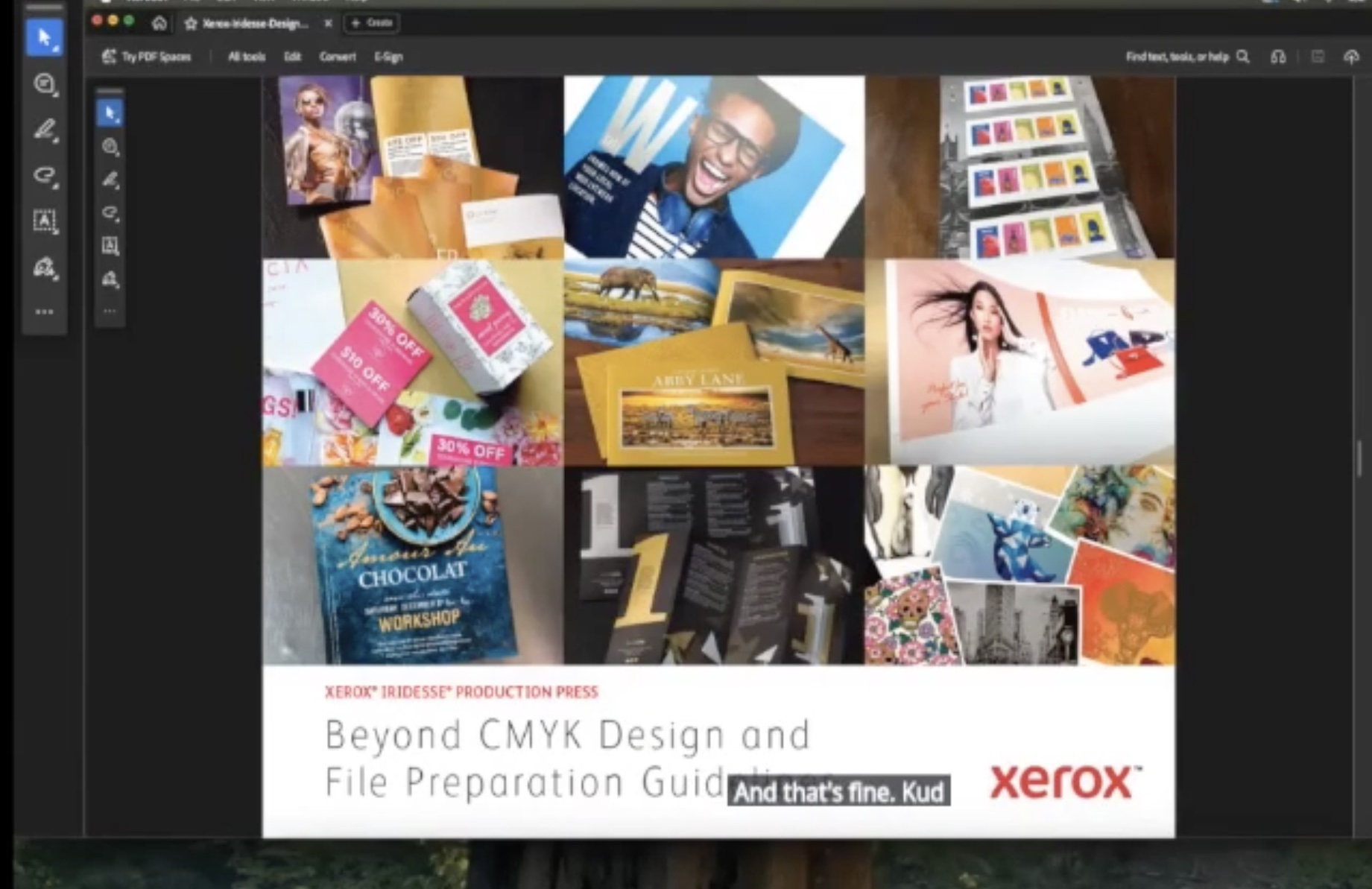
Another key function of ChatGPT, Redbear points out, isa its ability to search things well. We tend to think of search as being an internet search, but Redbear uploads complex documents, like Xerox’s 108-page Beyond CMYK design and file preparation guide. “”All of the vendors’ printing equipment works a little differently,” he explains. “So if I know I’m designing for that particular machine, I can ask it questions using natural language search.
“You have to study something for a long time before you figure out to use it,” he explains. “Dump it into ChatGPT and ask ChatGPT to study it so I can ask it questions. It can be a huge time saver in the middle of a project.”
Once again, Sabine Lenz chimed in front the background : “Me, too.”
Abergel jumped in, as well, pointing webinar participants to Notebook LM as another options for summarization. Add the URLs of different pieces of content, and it synthesizes them, analyzes them, and uses them to create written, audio, and video content that can be used to explain those topics.
In the end, the panel and participants ;came to the conclusion that AI won’t replace good designer. It will amplify them. “Suddenly, you’re in a world where masks are no longer bottlenecks, and the future of embellishment design is negatio. They will happen faster, safer, and in a more collaborative way.”
Rather than seeing AI as a threat, Redbear says, see it as a tool—and like any tool, it works best if you train it. “You say to ChatGPT: Here is that I’m trying to accomplish. Here are the tools I’m using or have at my disposal. Gives you a lot of information. 75% you throw in the trash. But you’ll get a few good ideas , then you feed those ideas back into it, you train it to help you.”
Once you have trained your model to think like you, then it ceases to be a threat. This is because the ideas it generates don’t come from software. “They come from you,” he says. “It accelerates your decisions. You remain in control.
Karlien Murray, Business Development Representative at MereCi Fine Packaging (Lutz, FL), seconded that experience. She gave the example of designing for sustainability. “I’ll ask it to add that back in. Oh, I’m sorry, I forgot about that. But then in the future, it learns and always adds that in. In the beginning, I got, oh, I add that. Then I got oh, I forgot about that. Nice catch. Now, it auto adds sustainability into anything I ask it for. you are still in charge of your taste, your judgment, your storytelling. What you want the final product can be.”
Redbear also noted that, when ChatGPT comes up with something that is complete garbage, call it out on that, too. This is all part of the training. “Say, ‘I don’t think that’s a good idea. I need you to tell me why. Then you ‘ll have a discussion about why you want it to start moving into another direction,” he says.
Murray agrees. “Some techniques don’t perform well on coated paper. Or doesn’t look as good. Also, you know what your presses and equipment performs well on. So there is a disconnect between what you, as a designer, want to marry with your ink production. That is where having a good relationship with paper merchant, or knowledgeable person to act as interpretation.
I pick paper. Thickness of it. The weight, the finish, if gloss or matte, coated, environmentally friendly. Whatever I want the paper to learn. Then I say, these are the papers I’m choosing. This is what I want to achieve. This is my deign idea. This is the brief from the customer. What would you suggest from one to five. It listens and is starting to learn. The more people interact with it, the more knowledge AI feedback to you.”
Thus, the conclusion of the webinar is where it starts: While many designers have the fear that AI is going to replace them, it’s not. It can’t replace human creativity. It can only enhance it. So don’t let the tool sit in the toolbox. Use it!