There is a change in online search that is fundamentally altering how customers find your business. It’s the use of AI.
No, we’re not talking about those AI summaries that show up at the tops of your Google searches. We’re talking about the use of ChatGPT and other AI platforms to conduct the search instead of Google. Because of the way generative AI works (we’ll use ChatGPT as an example), the results look very different from those of traditional search, and the impact is, too.
The way generative AI works, search results tend to generate higher quality leads. One print vendor found that the average dwell time (the amount of time people spend on its site) of new visitors referred by ChatGPT was 6.5 minutes, dwarfing the time spent by those referred by organic search (79 seconds) or any other referral source by more than five times.
The owner of another print shop commented that, anecdotally, he and his team had noticed more and more leads coming from ChatGPT. While the number of those leads was still relatively low, he notes that these leads stand out because they nearly always convert:
“With SEO, the majority of those leads still end up going nowhere,” he told WhatTheyThink. “Or we end up spending a whole bunch of money on SEO, only to have most of the leads come in from companies trying to sell us something. But when we get leads from ChatGPT, it’s like those prospects are predisposed to doing business with us. We close nearly all of them.”
How Does It Work?
When you look at how AI-driven search works, the reasons start to make sense.
Let’s say a business is looking for a new print shop. Instead of Googling “commercial printers in Greater Baltimore,” the owner turns to ChatGPT instead. He inputs the following query: “Give me a list of commercial printers in Greater Baltimore capable of printing a trifold brochure, four-color plus spot UV, in a run of 1000 copies on a short turnaround. Only give me companies with good reputations or lots of positive reviews.”
Here are the actual results of this query:
- Printer #1 – Baltimore, MD
Veteran?owned since 1977, with hundreds of 5-star reviews, award-winning quality, and a strong portfolio in brochures, booklets, and specialty finishes like spot UV and foil stamping. Offers digital and offset printing, laminated covers, die cutting, binding, plus expedited service—digital print jobs often ready in 3–5 business days. [Links to local reviews]
- Printer #2 – multiple greater Baltimore locations
Local branches serve Beltsville, Crofton, Catonsville, etc. Known for excellent customer service, fast turnaround, and high-quality printing. They offer flyer and brochure printing, digital and offset options, and UV coating capabilities—plus walk-in design help and quick local pickup. [Links to local reviews]
- Printer #3 – Baltimore, MD
A full?service local shop handling brochures and annual reports, along with marketing materials, trade?show collateral, and specialty finishes. Known for professionalism and project-level attention. [Links to local reviews]
These options were followed by five more, totaling eight ChatGPT referrals. This list was followed by a comparison table:
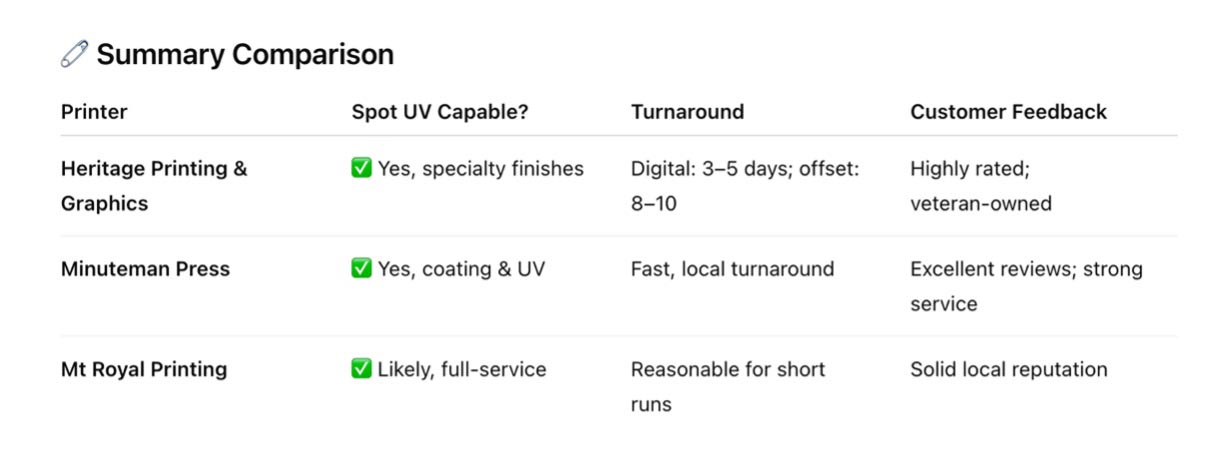
Why ChatGPT Referrals Are More Likely to Convert
The reasons for the high conversion rate of ChatGPT referrals become clear pretty quickly. Based on the details provided in the query, ChatGPT provides the contact with information highly relevant to that query. Simply by scanning the ChatGPT results, the contact has a pretty good idea which referral is going to be a good (or the best) fit. Thus, as the print shop owner noted, they are already pretty much sold before they even contact you.
It’s no wonder that ChatGPT and similar platforms are transforming the way potential customers search. These searches are more contextual, more relevant, and more precise. Since they provide high-quality leads more likely to convert, as a printer, you’ll want to optimize your website for these natural-language, AI searches.
Sounds like just more work? It isn’t, necessarily, since the things that ChatGPT likes to see are really helpful in traditional SEO, as well. In a study, JS Interactive, for example, found that 32% of businesses “reported a noticeable shift in how users phrase their searches, moving toward conversational queries.” Even traditional search is shifting to natural language, and if you poke around, you’ll find that steps to optimize your site for ChatGPT search are often the same ones recommended to optimize it for today’s SEO, as well.
Optimizing for ChatGPT Search
So, how do you optimize your site for ChatGPT search? Why not ask ChatGPT? After all, no one knows how ChatGPT thinks better than ChatGPT itself. (Bonus points for inputting your own URL and asking it for specifics related to your own website.) Seriously. Don’t be shy. ChatGPT likes to talk about itself, so go ahead and ask. It will tell you.