In our first kicking off our series about inkjet printhead health, we talked about the concept of print latency and nozzle open time. This article continues the discussion of print head properties and how they are tested, with a look at the positive influence of inkjet recirculation, especially when it flows past the nozzles.
To Flow or not to flow?
As we discussed in the previous article, stopping the printing is not the best thing for inkjet nozzles, since they are effectively pumps. Like pumps, they need to keep themselves freshly primed with ink by firing. In continuous inkjet (CIJ) this is not a problem, since the whole concept is that ink is always flowing through the nozzle; when the “head” is switched on, at least.
In drop-on-demand (DOD) heads, Ink recirculation was devised to address the issue that there can be quite a bit of time between droplet requests, and there’s only so much you can do with non-firing “tickle” pulses that we discussed before without creating other side effect, like self-heating of the heads (in piezo ones anyhow).
The issue was recognised quite early on in industrial development, since there is an inherent competition between nozzle drying and ink drying that was hard to fix with ink alone. The earliest patent you humble Insight author has on file comes from Tektronix, whose head business was integrated into Xerox.
The principle is that the ink supply channels that lead to the head are augmented by another set of channels to take it away again. Simple enough right? Well, not really since the head is a pump then you must carefully balance the design to ensure the preferred pumping direction is still going to be through the nozzle! This meant having two restrictors either side of the piezo parts, an approach still reflected in many contemporary printhead designs, including Ricoh’s “Flowthrough” technology implemented in their MH-series heads.
[caption id="attachment_7154" align="aligncenter" width="1495"]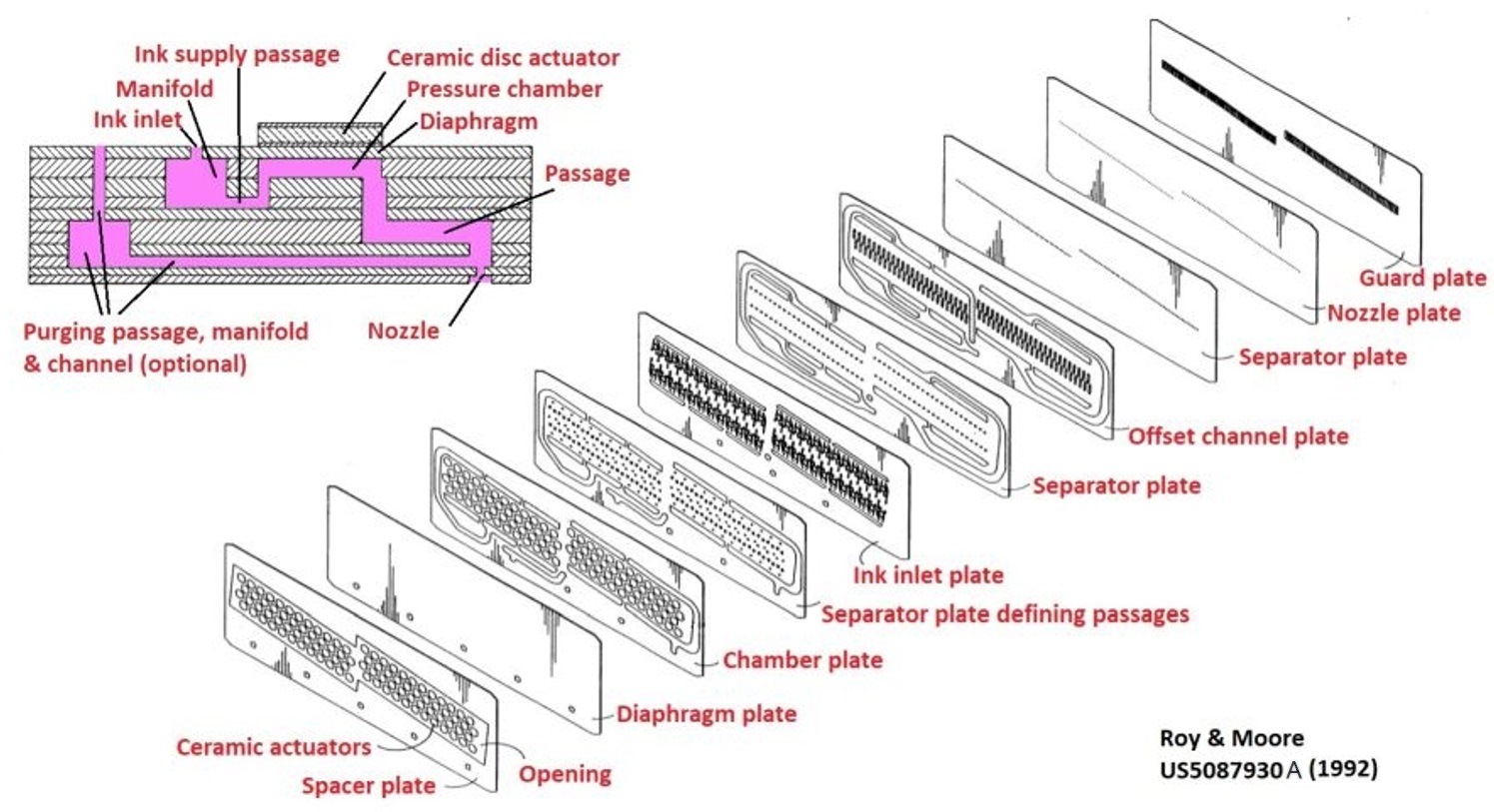 An early example of a recirculating printhead design from Tektronix.[/caption]
Xaar are widely credited as taking recirculation mainstream in industrial piezoelectric DOD heads. Their “Through Flow” innovation based upon the fact their shared-wall technology used the piezo material as the substrate. By optimising the construction, a low impedance fluid flow path could be formed whilst not impeding the ability to jet. As we discussed in a recent re-post, this allowed for heavier inorganic ceramic pigments to be used more reliably, but most recently Xaar have been exploiting the other main benefit: higher viscosity.
Lab Examples
The lack of restrictors also allows for a higher flow, and this is mirrored to some extent in other manufacturer’s head of similar design like Seiko Printek’s RC1536. Although the outcome is very ink dependent, the higher flow gives the best chance of keeping nozzles “open” without additional controls.
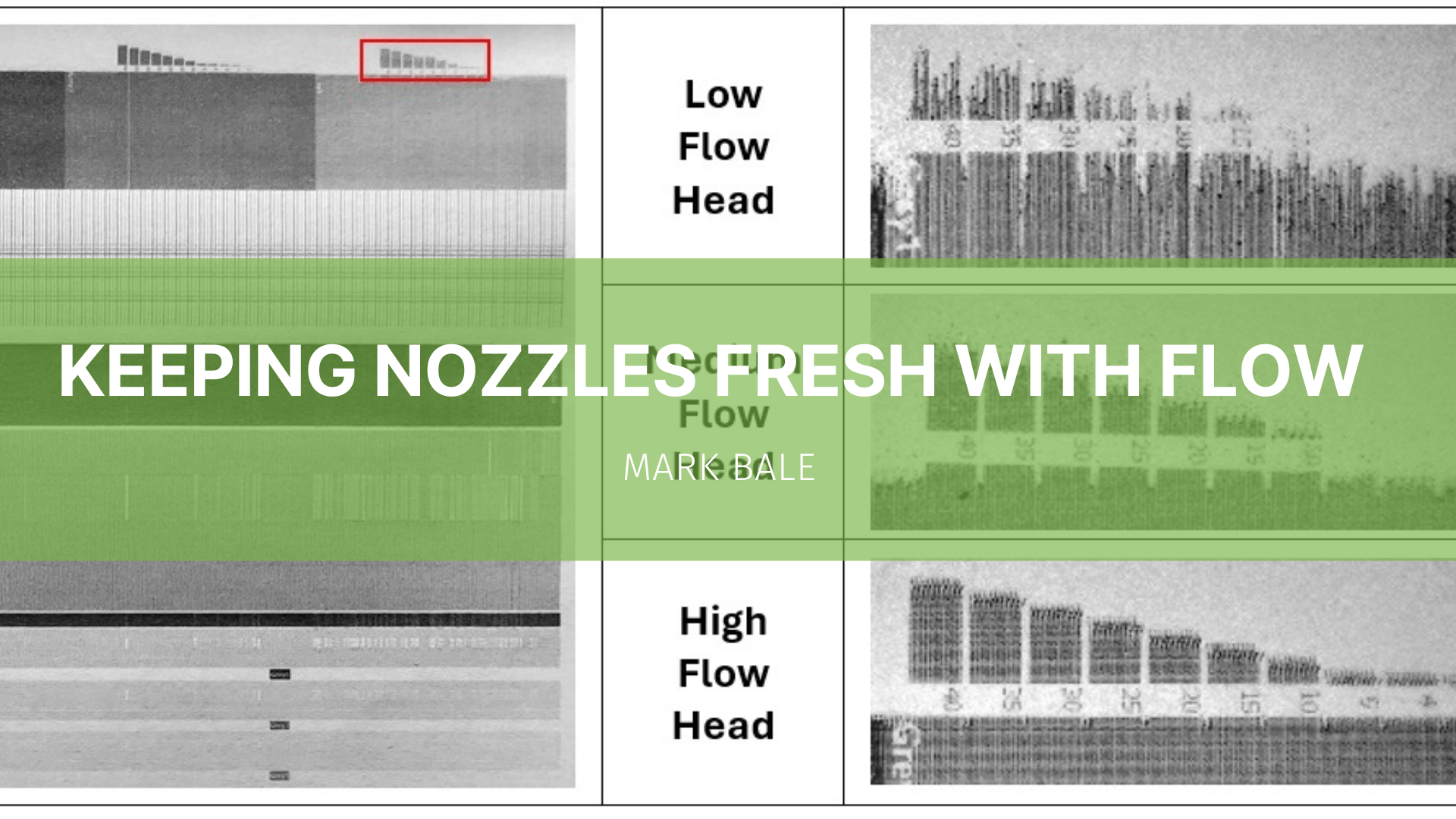
Using some of the same lab printing methods described in my previous article, let’s look at the benefits with a test fluid. As shown below, the faster the recirculation the better the nozzle stays alive in this test, which has a print delay of just 1 second!
[caption id="attachment_7153" align="aligncenter" width="1185"]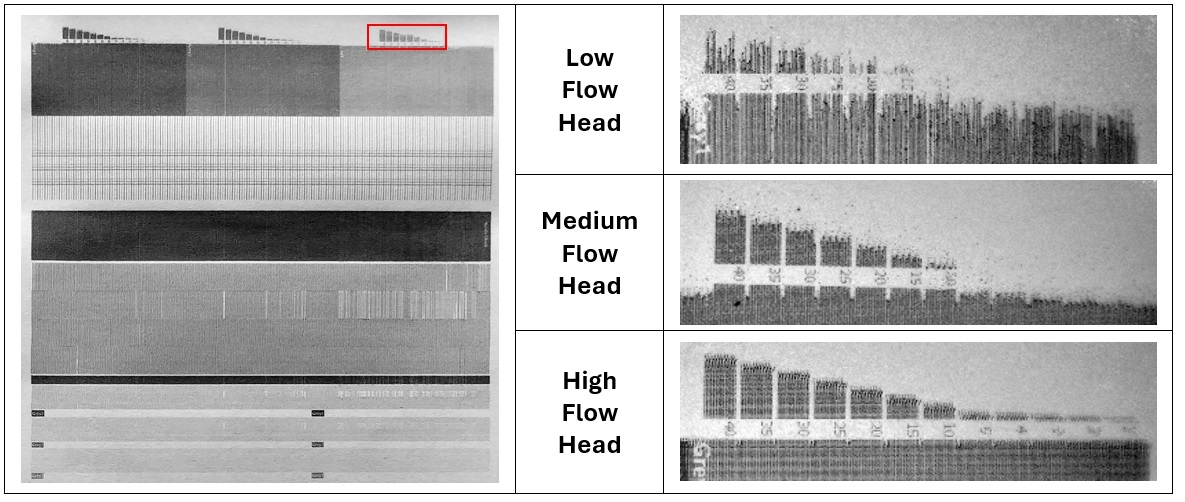 Effect of head design and flow rate on the ability to fire first jets after a short pause.[/caption]
Since it is always better to have a real contemporary ink example, our second lab test compares a water-based white ink intended for corrugated packaging in a non-recirculating version of a KM1024a printhead to a recirculating version with a similar nozzle size. The test pattern has the same staircase style shown above, but now the lack of recirculation can be seen to have a massive impact. This time the print delay is 30seconds for the recirculating head, but much better 5 minutes for the head that recirculates. In both cases a tickle pulse has been used, which is something we’ll be discussing in more detail next time. This makes the second example quite similar to the one we gave in one of our previous packaging ink discussion posts back in 2021! Nothing if not consistent... because that’s how it works!!
[caption id="attachment_7155" align="aligncenter" width="1600"]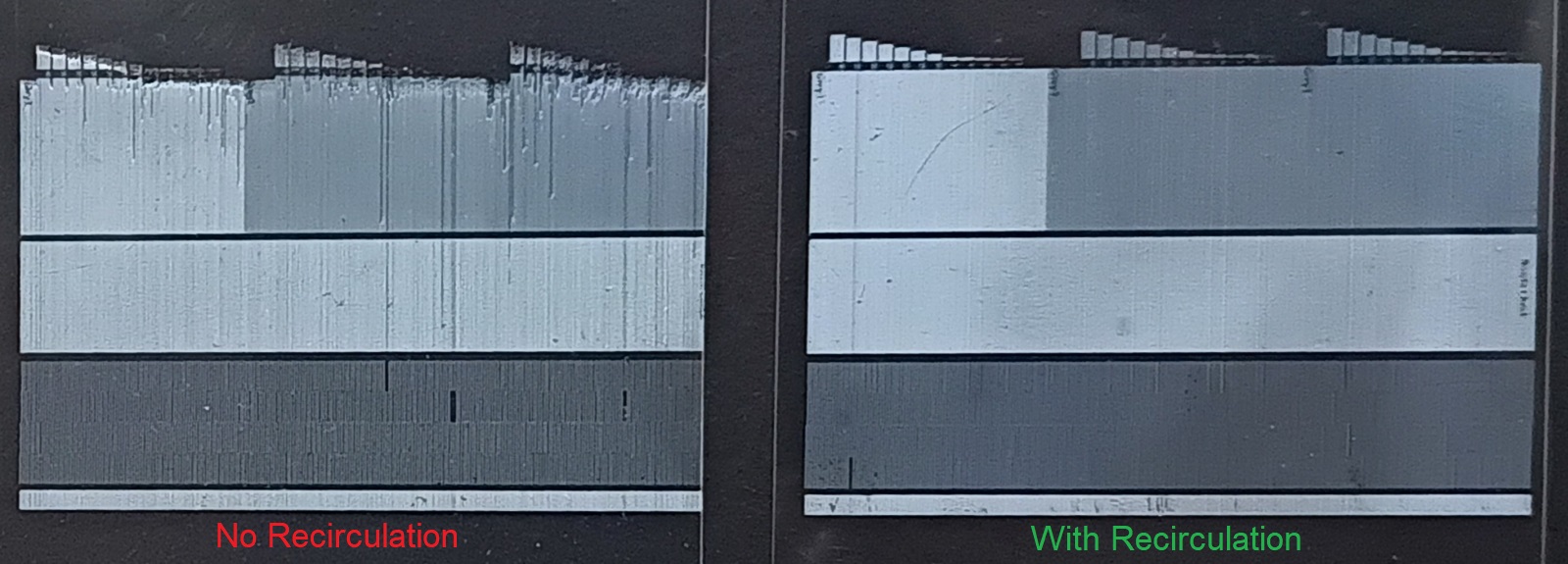 Powerful demonstration of the benefit of recirculation demonstrated on an inorganic TiO2 white ink in water.[/caption]
These benefits to nozzle health and reliability have resulted in recirculating printhead offerings from multiple manufacturers throughout the 2010s and into the 2020s. This includes Epson’s D300A1-R, Kyocera’s latest 1200dpi head and Thermal inkjet technology from HP of course, as well as the emerging functional material heads discussed last year by me and Ralf.
So now you know a little bit more about keeping nozzle healthy by managing latency with recirculation so next time we’ll dig a bit deeper into other controls like tickle pulsing and spitting. Let us know if you have any questions or request from Inkjet Insight’s resident lab nerd. Otherwise, I might just go ahead a few more examples of recirculation in a bit more detail just for a bit of fun.