 In the past, when you started a company whose major product was fabric hung from a frame, you fell into one of two categories: sail maker or tent maker. Since the year was 1896 and not 1796, the man who founded the company destined to be Rainier Industries settled on tent making, just in time for the Klondike Gold Rush. Being located in Seattle - the gateway to Alaska - certainly didn't hurt.
(More Photos: Rainier Industries Slide Show)
Fast forward a hundred-plus years and you have a company that uses digital printing on a variety of substrates for branding, as ornament, for information, to protect, and as shelter. It has only been recently that Rainier Industries has expanded from fabrics and textiles to printing on paper as well as direct to more unusual substrates like wood and tile.Print is Dead! Long Live Print!
"The rumors of my death have been greatly exaggerated!"Every day we hear stories telling us that print is dead. Books will no longer be printed! Newspapers are history! Direct mail is disappearing! The paperless office us just around the corner! Well, actually that one has been a rumor for nearly a generation.Mark Twain
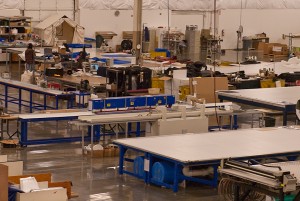 What we don't often hear is that there are some forms of print that are alive, well, thriving and growing. For example, the retail value of output from wide-format graphics printers is projected to be more than $17 billion by 2010, according to I.T. Strategies, and has been growing at a substantial rate for the last several years.
Much of that growth is coming from grand format printers that print media from 95 to 195 inches wide. Equipment that can print on roll stock such as paper, vinyl, or textiles, and "direct to substrate" on rigid media, wood, Plexiglas, or other flat surfaces.
What we don't often hear is that there are some forms of print that are alive, well, thriving and growing. For example, the retail value of output from wide-format graphics printers is projected to be more than $17 billion by 2010, according to I.T. Strategies, and has been growing at a substantial rate for the last several years.
Much of that growth is coming from grand format printers that print media from 95 to 195 inches wide. Equipment that can print on roll stock such as paper, vinyl, or textiles, and "direct to substrate" on rigid media, wood, Plexiglas, or other flat surfaces.
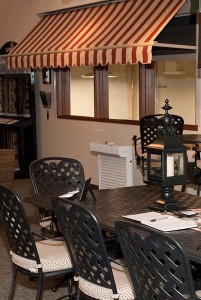 Making tents, sewing banners, silk screening signs, and fabricating awnings changed - in some ways dramatically - when digital technology became available. Rainier Industries is proving that the future for printed, assembled, and fabricated pieces is strong.
Print as Architecture
Printed structures like awnings, shades and screens are not only decorative but are not likely to be replaced with electronic substitutes, even as the use of digital billboards slowly increases. Rainier adds images and designs to awnings by sewing, fusing appliqués, or printing on fabrics and vinyl. Banners and panels can be used indoors or out as decorative installations or to prevent UV damage from light entering windows or skylights.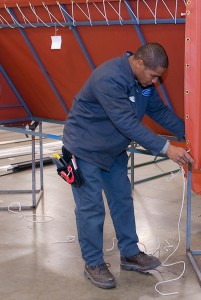 One of the biggest challenges the company faces is applying images to buildings as architectural elements. Turning architecture into art bumps up against coding and regulations as soon as fabrics and textiles are applied to the outside of a building. Simply put: inside means ornament and decoration, outside means signage.
Inside a building, the only code issues that must be considered are safety issues; for example, is the fabric fire retardant? As soon as you put an image on the exterior it becomes a sign, whether the image conveys a message or logo or not. And municipal codes, permitting, and regulations drive the requirements for signs.
One of the biggest challenges the company faces is applying images to buildings as architectural elements. Turning architecture into art bumps up against coding and regulations as soon as fabrics and textiles are applied to the outside of a building. Simply put: inside means ornament and decoration, outside means signage.
Inside a building, the only code issues that must be considered are safety issues; for example, is the fabric fire retardant? As soon as you put an image on the exterior it becomes a sign, whether the image conveys a message or logo or not. And municipal codes, permitting, and regulations drive the requirements for signs.
A Big Green Printer
A printer who has two 5-meter and eight 3-meter grand format printers as wells as five HP 60-inch printers uses substrate by the mile and ink by the barrel. Given that kind of printing power, can Rainier Industries be green? Absolutely! By infusing every decision, every process, and every product with a concern for how it affects the environment, Rainier Industries believes green is good business. Now in the process of ISO 14001 certification, Rainier has implemented a wide range of environmental initiatives:- Solvents, for example, have no place in the plant, whether printing inks or coatings in the wood shop. The print shop is rapidly moving to all UV-curable inks and the wood shop has converted to water-based coatings.
- Waste management and recycling mean that fabrics such as Sunbrella, four types of plastic, steel, aluminum, corrugated, and office papers are all recycled.
- Business travel has been reduced and employee carpooling is encouraged. Employees travel by train from Tacoma, 20 miles to the south, to the Kent station and carpool to Rainier's plant. In good weather, several of the staff are regular bicycle commuters.
- All kitchen waste is composted with wood scraps.
 As owner of three Durst Rho printers, the recent approval of Durst Rho Roll Ink by the Environmental Test Institute Nordic Ecolabel and the right to use the Nordic Swan symbol has been especially encouraging for Rainier.
"We see ourselves as a change agent," said Scott Campbell, President of Rainier Industries. "Being in the Pacific Northwest, the pressure to be green is much higher that in other parts of the country. We provide options for reused, repurposed, recycled, and recyclable substrates.
Considering the entire supply chain and the environmental impact of not just the product but also the supplier means learning much more about the distribution system. The company gives preference to suppliers more closely located to avoid excessive transportation, for example, or suppliers that use reduced or more sensitive packing materials.
As owner of three Durst Rho printers, the recent approval of Durst Rho Roll Ink by the Environmental Test Institute Nordic Ecolabel and the right to use the Nordic Swan symbol has been especially encouraging for Rainier.
"We see ourselves as a change agent," said Scott Campbell, President of Rainier Industries. "Being in the Pacific Northwest, the pressure to be green is much higher that in other parts of the country. We provide options for reused, repurposed, recycled, and recyclable substrates.
Considering the entire supply chain and the environmental impact of not just the product but also the supplier means learning much more about the distribution system. The company gives preference to suppliers more closely located to avoid excessive transportation, for example, or suppliers that use reduced or more sensitive packing materials.
 Biographix®
A product line, a philosophy, and a way of doing business, Biographix is a visible statement of Rainier's sustainability commitment.
Most companies address purchasing and production of their products, but very few are looking at managing "end of life" for those products. Biographix also includes finding ways to take back, reuse, or repurpose printed materials as well as recycling them.
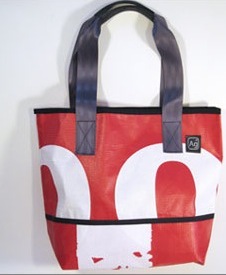 Thousands of square feet and tens of thousands of pounds of printed signs and banners that would have ended up in landfills, face an entirely new "second life" as everything from landfill or railcar liners, shipping bags, and tarps for contractors to totes (bag at right from Alchemy Goods, Seattle), backpacks, and skateboard bags.
"Through this program, we've kept at least 15,000 pounds of material out of landfills in the last year and a half," Campbell proudly notes, "that's more than 20 four-foot high pallets."
Thousands of square feet and tens of thousands of pounds of printed signs and banners that would have ended up in landfills, face an entirely new "second life" as everything from landfill or railcar liners, shipping bags, and tarps for contractors to totes (bag at right from Alchemy Goods, Seattle), backpacks, and skateboard bags.
"Through this program, we've kept at least 15,000 pounds of material out of landfills in the last year and a half," Campbell proudly notes, "that's more than 20 four-foot high pallets."