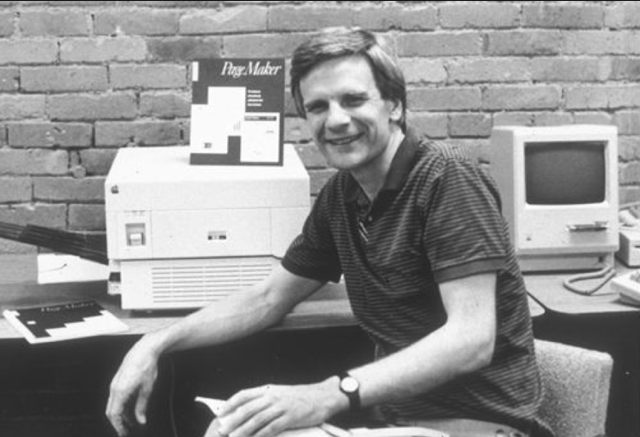
Paul Brainerd at the Aldus office in Seattle’s Pioneer Square neighborhood, on July 5, 1985. (David Healy Photo)
On February 15 of this year, Paul Brainerd passed away—he was 78.
I discovered this by watching a video from Frank Romano that was hosted on WhatTheyThink.com. For those of you that are not aware of the impact that Paul had on this industry, here is a brief history of the first 50 years of the graphic arts industry that encompassed its roots and progress.
The fact that I had not heard about Paul’s passing made me think that there must be a bunch of people who are similarly in the dark about this. Not only that, there must be an even larger contingent that were not aware of the heritage of our industry from those days in the mid-1970s. So, I thought I would embark on a story of how I saw DTP (desktop publishing) evolve over the 50 years of my involvement with this amazing industry.
As we wander through this story, I may have got some of the dates and numbers a bit wrong, but I am sure that I have enough well-intended industry colleagues that will correct me.
I first met Paul in about 1976—do the math and you’ll see that it was 50 years ago!
I was working at Monotype in the UK. He was handling OEM relationships for a company called Automix Keyboard Incorporated (AKI—based in Seattle, Wash.) and Monotype was OEMing a paper tape keyboard (the NJ 400) to drive the then state-of-the-art computerized phototypesetter, the Monophoto 400/8. This was a phototypesetter that moved a matrix of 400 characters in the X/Y space that was driven by 8-channel, ASCII paper tape—yes, paper tape! The “massive” processing power for this came from a mini computer from CAI (Computer Automation, Inc.) that had about 64K x 16-bit words of what we would now call RAM!!
The workflow was that the keyboard operator generated a paper tape that contained the type specs (font, size, leading, linelength etc.) and the copy for the job. That paper tape was loaded onto the 400/8 which dutifully clattered away to produce photographic film or paper that would be physically cut and pasted into galleys of hyphenated and justified type (the name “galley” was retained from hot metal days) that would be composed into pages, exposed to plates, and then mounted onto presses.
We are talking of an age where we were moving from letterpress (physically raised type that accepted ink that was transferred onto paper) to offset (the plate picked up ink that was transferred onto a rubber blanket that was transferred onto the paper).
Note that in this workflow, there was no editing of the paper tapes—that came several years later—you had to get it right the first time. And there were typesetting companies whose existence was based on supplying the film to the platemakers (also called engravers).
I still find it hard to believe that this was only 50 years ago—letterpress was what Gutenberg used!
My job at Monotype was to test items like the NJ400 and make sure it worked the way it should do. So, my early communications with Paul were to perfect the keyboard’s functionality.
In 1980, I moved to the US to set up technology in the newly-founded Monotype Chicago office. By this time, editing terminals and front-end systems had evolved, and we were looking at capabilities of electronically creating full pages and outputting them on the next generation of phototypesetters—imagesetters. And Monotype had one of the early successes in this technology with a device called the Lasercomp. It was capable of outputting a full, broadsheet (14 x 22-in.) in a minute at 1,000 x 1,000 dpi on film or photographic paper.
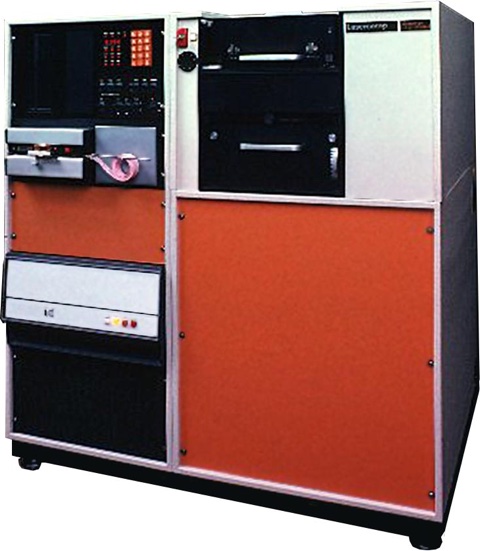
A Lasercomp circa 1977. Note the 10MB hard disk (5 fixed and 5 removable) and the paper tape reader!
As a slight aside, Lasercomp was developed by Dr. David Hedgeland who created the output device and the method of digitizing the typefaces as his PhD project at Cambridge University. He subsequently joined Monotype and I had the distinct honor and pleasure of working closely with him as Lasercomp grew in capabilities and reputation.
It was this output device that brought me into the orbit of a fledgling company called Adobe and its founders; John Warnock and Chuck Geschke (both sadly passed away). We had sold John and Chuck the output portion of the Lasercomp (with no RIP) that would be powered by their new concept of a “PostScript RIP.” When I met them in San Jose, Calif., they were just working with Steve Jobs and Apple to finalize the development of the Apple LaserWriter, a device that could take this new PostScript language (and, yes, it was a fully functional computer language, which many people probably do not realize) and output it to a 300 dpi black-and-white laser printer with “reasonable” quality typography—although to those who were used to the matrix printers of the day, the improvement was dramatic!
That brings us to 1984/85, and Paul re-enters the story. He and his team in Seattle, at a company called Aldus (after Aldus Manutius, a 15th-/16-century Italian printer and publisher) released PageMaker. It was a Macintosh-based page assembly application that allowed the operator to integrate graphics into text and output them as a PostScript stream to, initially, LaserWriters, to print to plain paper, and later to imagesetters that could interpret PostScript. Wow!
And Paul is credited with coining the phrase “desktop publishing.” It truly did change our industry.
During the same period, I had parted company with Monotype and found a new home with Quad/Graphics in 1986. Quad was, and still is, a major printer in the US, headquartered in Sussex, Wis., and I was hired to set up a division (from scratch) christened Quad/Text to “Take typesetting back to our magazine and catalog clients.” Sounds like fun until you sit there as employee number one and have to work out what you are going to do.
Well, I wrote a specification for what I believed was required to get our clients to do their own layout and subsequently create pages in PostScript (and later PDF). I presented this to a gentleman called Jonathan Seybold, who was a major rainmaker in these relatively early days of desktop publishing, and he suggested that I talk to the three players in page assembly on the desktop—Aldus, Quark, and Manhattan Graphics (PageMaker, QuarkXPress, and Ready Set Go! respectively). The proposal I had for them was to share this vision that included integrating with the significant investment that Quad had with Scitex.
For those who are unaware of that name, Scitex, Hell, Crosfield, and Dainippon Screen all had color correction hardware and software that allowed users to edit color at high resolution. This was an incredibly computer-intensive operation and was priced accordingly—$300,000 for a color correction terminal, and an equally eye-watering price for a film output device. This functionality can now be achieved on a Mac or a PC (be they pretty beefy ones) without the need for output to film with the advent of computer-to-plate (CTP). So it should come as no surprise that none of those companies exist anymore.
Enter Paul again. I contacted him to see if he would be interested in partnering with us to take this next step of integrating with Scitex to move DTP into the high-resolution world of four-color output with integrated text and graphics. Ironically, Paul was in the middle of moving PageMaker onto the PC, so his engineering resources were tied up with that.
I didn’t hear back from Manhattan Graphics, but Tim Gill of Quark responded, and he and Fred Ibrahimi made the trip to Wisconsin and we agreed to go forward with me evolving the spec, and Quark sending me the latest version to test. We ended up with what became QuarkXPress 2.0, but we were having challenges getting the desktop world to communicate with our Scitex system. Eventually, we got Scitex directly involved and solved the problem with an offering called Visionary. At Quad/Text, we took this, added a full Bitstream library font license and added a team of Advocates and Trainers for our catalog and magazine clients. We went live with this in 1989 with an offering called ADEPT.
Since then, the industry has moved along into computer to plate and the incredible output platforms that are now available to put ink on paper and realize the current aim of most printers and that is to perfect the art of “mass customization.”
But we owe much of this to the pioneers of the industry noted in this article, but I especially want to thank Paul. He sold Aldus to Adobe in 1984, and Adobe went on to develop their all-powerful stack of Photoshop, Illustrator, and InDesign. Instead of doing what many of his predecessors and successors have done and going out and creating a new tech company, Paul turned his focus to conservation and philanthropy.
I feel blessed to have known Paul, and really enjoyed the way we intertwined our professional lives. I hope that you will all join me in thanking the developer of desktop publishing and wish his family well as they cope with their loss.