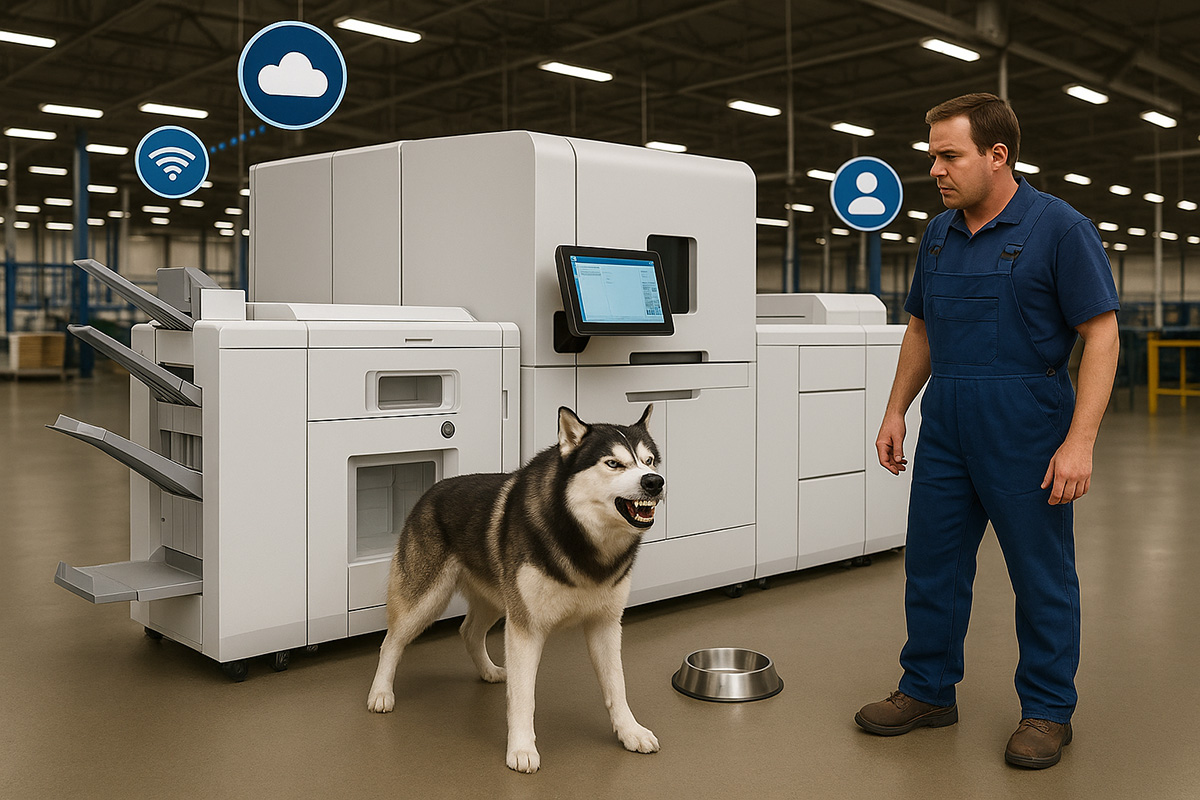
Photo generated through ChatGPT
By Alan Darling
Overview
I am a sucker for quotes, and one that I constantly refer to when talking about automation is “Everything should be made as simple as possible, but not simpler,” and that is from the revered Albert Einstein. While that may seem cryptic at first blush, in my experience, a lot of what we attempt to do when trying to turn our business into a Smart Factory is to simplify the processes that are involved.
That quote has its corollary, also from Einstein, which is “If you can’t explain it simply, you don’t understand it well enough.”
This is a great place to start when thinking about a Smart Factory. You have to fully understand all the aspects of your business, and just investing in an MIS system is not some magic wand that will solve all your issues.
At the risk of being contradicted (and with the WTT audience, I am sure that will happen), the term “Smart Factory” has been around since the late 90s and the Digital Smart Factory Forum was driven by the late Chuck Gehman. He described it as “The application of Information Technology (IT) across the printing enterprise including customer-facing systems, business systems, and manufacturing systems.” While that’s a great start, it really became part of our psyche since the 2016 DRUPA—which is generally what happens when the large vendors’ PR teams latch on to the hip terms on which they believe they can hang their hats, spend some serious marketing dollars, create some visibility to the term, and, hopefully, generate some more sales.
Components
Key to the ability to implement a Smart Factory is the integration of the MIS/ERP (Management Information System/Enterprise Resource Planning) system, with the intent to fully automate print production workflows. This could also involve the integration of a CRM (Customer Relationship Management) system and a Web-to-Print system.
That brings to mind an old joke of the automated press which is run by a man and his dog. The man is there to feed the dog and the dog is there to keep the man away from the press controls.
While that is a (hopefully) amusing tale, if you take the underlying messages, you will notice that it deals only with the press, and that comes along with many of the vendors “sticking to their knitting” and focusing on their portion of the workflow. Not to pick on them, but an example of this is the digital press manufacturers who focus on receiving the files and printing them with some “pre-bindery” considerations. While that can be a help to some users, it only goes part of the way to achieving a fully integrated Smart Factory.
If you look at the whole process, your Smart Factory has to include the following:
- Sales
- Web-to-print
- Estimating
- Job planning
- Scheduling
- Shop floor data capture
- Warehouse management
- Material management (e.g. getting paper and ink to the press)
- File management (including prepress/premedia)
- Print production
- File production (repurposing the print files for the www)
- Cutting
- Folding
- Binding
- Hand work
- Packaging
- Shipping
- Delivery
- Billing
- Data analysis
Then there are the variables of the size and geography of your company where you need to work out other complex issues like scheduling across multiple sites, or, even worse, across multiple time zones, or, worse yet, across multiple countries with different business rules.
Last, but by no means least, if it isn’t obvious, the implication of all this is that the majority of the elements in this list imply Electronic Data Interchange (EDI). That brings its own set of gotchas such as file security and standards compliance.
Hardly a one-size-fits-all candidate.
Eating the Elephant
Wow! Where do you start? How do you begin to eat this elephant?
Well, it’s still “one bite at a time.” I doubt if any of us have the staff or the time to attack everything at once. In fact, I have seen multi-site integrations take over three years to be implemented.
So what can you do?
The obvious answer is to break it down into digestible chunks (note that I did not use the words simple or easy in that statement). Before you embark on any such quest, it is imperative that you work out where your “One Version of the Truth” lives. To have more than one version of all the data that your business runs on is suicide. Once you have that location worked out, then you have to establish how other processes and systems access that truth in a read only manner.
Now that you have your “Single Version of the Truth,” let’s pick a logical group of processes that we might want to attempt to integrate. It would appear that we could integrate the Sales, Web-to-Print, Estimating, and Job Planning functions so that we could make all the processes associated with those functions more productive.
For example, let’s say we have a self-service Web-to-print solution where clients can log in and place an order with a credit card. That’s great and gets work into the shop relatively frictionlessly. But how about adding that client to your sales management module so that a Business Development (or sales) person can follow up with them to get more work? How about guiding that prospect to a Customer Service person who can assist and possibly upsell or cross sell to other revenue generating products in your company? How about if the Web-to-print system is integrated with the Job Planning module where the components of the job can be assigned to the various pieces of equipment to get that job done (opening the door to future integration with automated scheduling)? Or how about your sales team using the Web-to-print module to take orders themselves?
All of these actions look like we may be about to do more with less.
Before we disappear down this rabbit hole, let’s think about what we are taking on in terms of system integration to achieve the goal of coalescing those four functions. Depending on the size of your PSP (print service provider) company, your MIS/ERP may have a sales module, an estimating module, a Web-to-print module, and a job planning module in a single package. Others may have a CRM system, a separate web to print system, and a print MIS system that handles estimating and job planning.
If it is not a fully integrated package, you have to factor in the integration of the various components.
A word of caution here, though. Be careful of creating “Islands of Automation” that cannot be integrated with other systems and processes in the future, and could be guilty of the generation of its own data sets in violation of the “One Version of the Truth” dictum.
Bear in mind that this may require some software development and professional service costs from the various vendors. However, there is a wonderful set of standards from CIP4 (The International Cooperation for the Integration of Processes in Prepress, Press, and Postpress) called JDF (Job Definitions Format) and JMF (Job Messaging Format) that many hardware vendors have implemented in their equipment that facilitates various pieces of equipment to “talk to each other” or talk to other systems.
We could carry on with the sales/estimating integration, but suffice it to say that several different items could be identified within a system or from system to system, but the functionality and the efficacy of any or all of the modules makes that a daunting task for an article such as this.
However, it is probably worthwhile to take a look at some other mitigating circumstances within the Smart Factory
More Animals in the Menagerie?
The more perspicacious of you will have noticed that we have not addressed another member of the animal world in the room—the 800-pound gorilla called “AI.”
While the following story may be viewed as a little flippant, I think it is probably worth sharing.
My first contact with AI (ChatGPT) was a couple of years ago. As a [sort of] joke, I asked ChatGPT to write a poem of seven verses to apologize to my wife for dragging her around the country to follow my career—we are currently in our 17th home since we married some 33 years ago. Lo and behold, a great little poem was generated in a few seconds!
Did I share it with my wife? Yes, I did, and I even told her that it was AI-generated.
She appreciated the thought!
That’s the “Wow” of AI.
If we take a step or two back from this, what can AI bring to the Smart Factory table?
Going back to our sales integration example, let’s say that your CRM doesn’t have the analytical tools to see what caused you to lose or win estimates. AI is FANTASTIC at taking large amounts of data, organizing it, and analyzing it by creating an “Agent” that is custom-built to perform this analysis. What’s more, you can point this Agent at your “One Version of the Truth” so that we don’t run afoul of our own rules.
How about grabbing the performance of your digital presses (that are typically available digitally) and using AI-driven analysis to predict maintenance issues?
There are also commercially available AI tools that help with “busy” jobs like automatically transcribing sales calls and populating your CRM from them, or automatically checking your spelling and grammar for estimates before they go out of the door and embarrass you!
So there is nothing to stop you adopting AI in your shop as long as it makes sense.
What we are going to see as AI broadens its scope and capabilities is that the system and equipment vendors will build AI into their applications and some of those specialized Agents you build will be subsumed by the commercially available ones. Not a bad thing to happen.
The Psyche of the PSP
All the foregoing addresses processes and technology, but there is a much more fundamental issue that needs to be addressed before you contemplate embarking on such a mission as creating a Smart Factory.
Let’s face it, most of the smaller printers got into the business of print because they love putting ink on paper. They can justify the hundreds of thousands (or even millions) of dollars to buy a press. However, when it comes to the lesser investment of an ERP system, they balk at the price. This typically leaves the ROI (return on investment) to the ERP sales person, which may or may not result in the selection of the correct system for the PSP.
Also, there tends to be fewer printers that have a sophisticated Production IT department (note that I have separated out Production IT from the General IT functions of system maintenance) and that have the staff that can, for example, gather and enter the information that is required by a fully-functioned ERP system to be able to estimate and schedule PSPs. In addition to this, those members of staff typically have a day job.
In the worst case, all of this can lead to a system being installed that is not fit for purpose, disillusioned staff and management and a shop that is not taking advantage of the potentials offered through the implementation of a Smart Factory.
Do any of you have any stories you would like to share with us about your experiences?
With fifty years of participation in publishing, advertising and direct mail production from both the user’s and vendor’s standpoint, Alan’s contributions include the advocacy of the PDF/X family of file formats to facilitate the business and production of digital ad exchange, be that through chairing the DDAP (Digital Distribution of Advertising) Association, participating in the authoring process of PDF/X standards through ISO, Involvement in the Ghent PDF Workgroup, and running a publication prepress shop where the walk got walked! Alan was also a member of the NeXT Computer Graphic Arts Advisory Board, the Apple Customer Advisory Board and a founding member of the MPA (Magazine Publishers of America) eBusiness Taskforce.