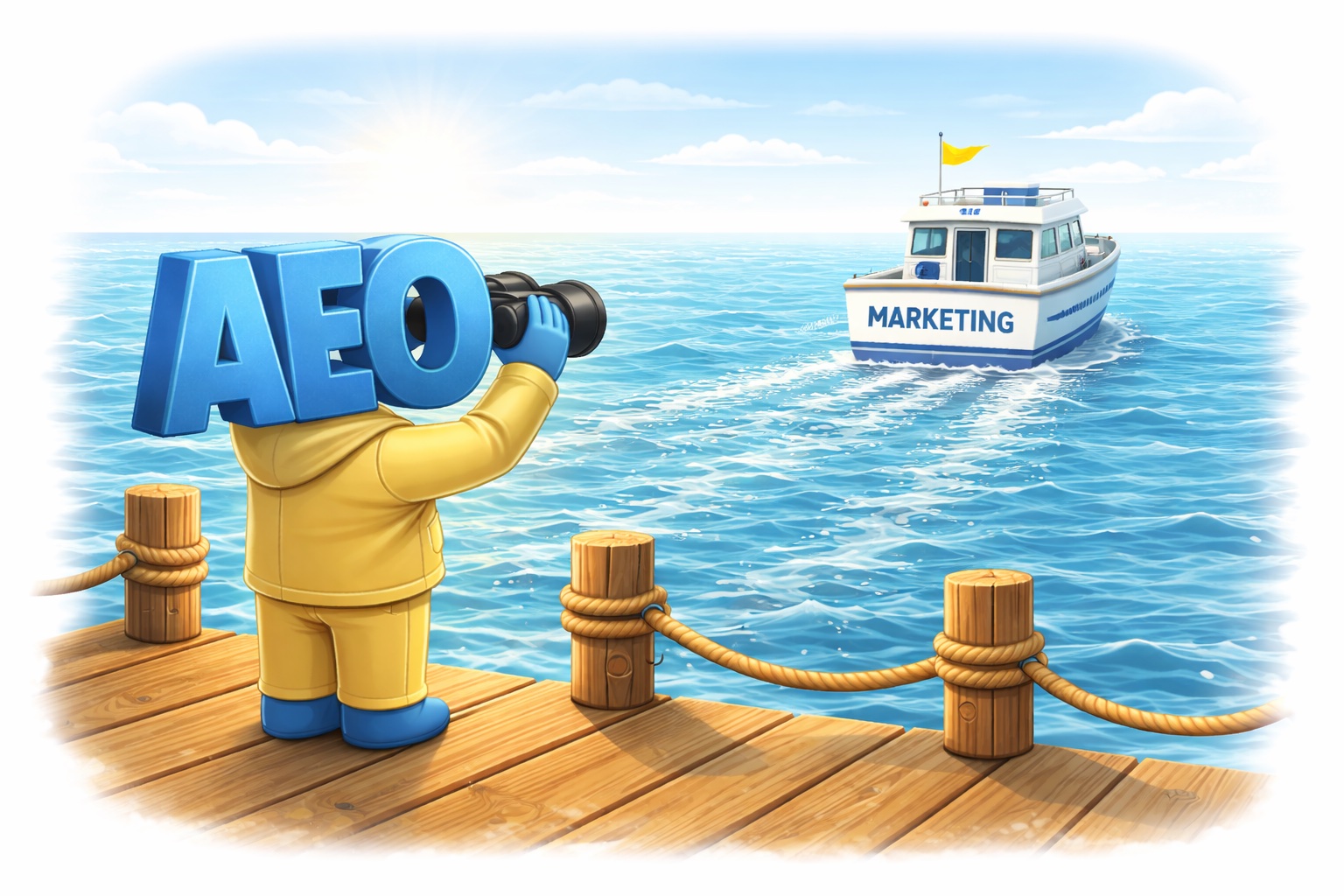
As AI search gradually overtakes traditional search for both business buyers and consumers, commercial printers are finding that their web and SEO metrics are tanking. As a result, they are increasingly eyeing AI search optimization (now being called AI Engine Optimization, or AEO) to keep their businesses visible to potential buyers.
Even within the last few weeks, you’ve probably noticed your inbox filling up with spammy solicitations from companies looking to jump onto the AEO bandwagon. You might have a few legitimate inquiries from companies who truly understand AI search but that don’t know the print industry. Or you might see notifications print marketing companies like Great Reach Communications, which offers AI-optimized FAQs and schema specifically for print businesses, or marketing platforms like HubSpot, which is rolling out tools to grade and improve AI visibility.
You know you have to do something.
But here’s what the AEO evangelists (at least the spammy ones) aren’t telling you: optimization is a tactic, not a strategy. You can have the most AI-friendly website in your market, but if your customer reviews are terrible, your positioning is unclear, and your service delivery is inconsistent, AI will surface all of it—and bury you in the results.
Even the best technical optimization won’t fix underlying marketing problems.
Marketing Fundamentals Don't Disappear with AEO
AEO may be overtaking traditional SEO for businesses and consumers looking for options. But that doesn’t mean foundational marketing principles suddenly don’t matter.
Think about SEO as being like the foundation of a building. Basic SEO includes signals about expertise and authority based on keywords and site structure. Words in H1 headers represent your primary market positioning, while H2 or H3 headers are the supporting value propositions beneath (i.e., H1: Commercial Printing in Baltimore; H2: Short-Run Digital Printing; H2: Wide-Format Signs and Banners; H2: Direct Mail Services). These headers aren’t just technical signals. They communicate your strategic positioning and service hierarchy.
AEO works the same way. It uses site structure to understand market positioning. It examines JSON schema, headers, and site organization not as isolated technical elements, but as indicators of your overall strategy. The difference is in how AI processes this information. Traditional SEO counted keyword frequency and placement. AEO evaluates natural language, understands intent, and looks for consistency between what you claim and what evidence is “out there” to support your claims.
If your market positioning is muddled, if your value proposition is unclear, and you can’t articulate what makes you different, no amount of schema markup or header optimization will save you.
AI Audits Your Entire Marketing Performance
This is where the gap between technical optimization and comprehensive marketing becomes so important. In traditional search, a user might go to Google and type in “commercial printer, Baltimore County, MD, four-plus color match.” That person would then receive an unvetted list of commercial printers with websites whose keywords and site structure matched this query.
AI search handles it differently. Instead of just indexing keywords, AI evaluates your entire marketing ecosystem, and it’s looking for consistency, credibility, and proof.
- Instead of keywords, AI looks for intent signals. It finds words and phrases like “we hit your color every time” and “our customers bring us their most color-critical jobs” that indicate capabilities.
- AI evaluates your reputation management. It examines reviews from Google, Yelp, and even TripAdvisor, looking for patterns in customer satisfaction and service quality.
- AI assesses your brand presence. It considers third-party references in trade publications, local newspapers, and industry directories.
- AI checks your business practices. It looks at the Better Business Bureau, consumer complaint databases, and even hiring sites like Indeed to understand how you treat customers and employees.
In other words, AI doesn’t just check your website for what you do. It audits the entire webverse to determine whether your entire business delivers on what your marketing promises.
Real-Case Scenario: What AI Really Evaluates
Let’s look at a real-life example. Someone goes into ChatGPT and asks, “What’s the best commercial printer in Baltimore County, Md., for high-precision color match for four-plus color process brochures?” ChatGPT thinks for about a fraction of a second, then comes back with this response:
Accent Printers—White Marsh, MD
https://www.accentprinters.com/
ChatGPT then provides an explanation for how it came up with this result:
- Long-run offset + high-end digital capability (important for consistency across quantities).
- Experienced with PMS + CMYK + extended gamut workflows.
- Will work from brand standards, LAB values, or physical targets.
- Known locally for operator-driven color management, not just RIP defaults.
- Will provide press proofs/wet proofs when requested.
Where's the Info Coming From?
Where did ChatGPT get this information? Some of it came from Accent Printers’ website. But scroll to the bottom of ChatGPT’s analysis where it says “Sources,” and you’ll find that it was looking at a lot more—and each source represents a different aspect of comprehensive marketing:
- Company website: Content marketing and value proposition clarity.
- LinkedIn: Brand presence and thought leadership.
- MapQuest, My Local Services, City Feet: Local market presence and directory management.
- TripAdvisor, Yelp: Customer experience and service quality.
- Better Business Bureau: Business ethics and customer service practices.
This isn’t a profile you can create overnight. AI looks at those signals over time.It also evaluates consistency across your entire marketing ecosystem. So if you’ve incentivized your best customers to pack Google with glowing reviews, but Yahoo! Local and the BBB show a pattern of unresolved complaints, AI flags that inconsistency. It doesn’t just look at what you’re saying. It cross-references whether the evidence supports it.
Fix the Fundamentals
This is the message many commercial printers aren’t hearing from the flood of spammy AEO consultants: AEO is built on a strong marketing foundation, including SEO. You cannot optimize your way out of bad marketing. If your service quality is inconsistent, if your customer experience is poor, if your market positioning is unclear, if your brand reputation is damaged, AI will expose all of it.
So yes, invest in AEO. Learn about schema markup, optimize your FAQs, make your content more conversational and intent-focused. Those technical elements matter. But don’t stop there. Use AEO as a forcing function to address the marketing fundamentals you may have been neglecting.