- What sets today’s AI revolution apart from earlier generations of automation is its unprecedented adaptability.
- The most successful AI adopters are developing integrated ecosystems where document management, e-signatures, workflow automation, and collaboration platforms work together.
- Once businesses experience the tangible benefits of AI (e.g., faster processing, higher accuracy, improved customer engagement), adoption not only continues but accelerates rapidly.
By Anne Valaitis
Introduction
A few short years ago, the use of artificial intelligence (AI) in the workplace felt like science fiction. It was a distant promise of what work might someday become. Today, AI is the operational backbone of how leading organizations create, collaborate, and deliver value to their customers. What we’re seeing is not incremental change; it’s a fundamental shift in what can be possible when human intelligence and artificial intelligence intersect. This article explores how AI is transforming workplace document workflows and accelerating the shift from simple automation to intelligent, human-centered ecosystems that enhance productivity and collaboration.
A New Generation of Automation
What sets today’s AI revolution apart from earlier generations of automation is its unprecedented adaptability. Because traditional workflow systems were bound by fixed rules, they could handle only structured and predictable data. By contrast, modern AI systems are dynamic and responsive. They can learn, operate, and adapt effectively even with unstructured or incomplete information. Intelligent document processing can now extract meaning from messy, unstructured information that would have overwhelmed traditional systems. Predictive analytics anticipates needs before they arise, while machine learning algorithms continuously improve performance without the need for human intervention. This flexibility makes AI invaluable in our ever-changing business environment, where the ability to respond quickly often determines competitive success.
Although efficiency gains remain a key benefit, something more significant is driving widespread AI adoption. In today’s industry, internal productivity only matters if it translates into superior customer outcomes. Savvy organizations are recognizing that AI isn’t just a back-office tool that is designed to cut costs; it’s a customer experience enhancer that helps businesses compete on the quality of every interaction. With faster response times, personalized communications, and more reliable service delivery, AI is helping companies compete on experience as much as on cost or convenience. With AI, businesses can differentiate themselves in the ways that will matter most to their customers.
The most successful AI adopters aren’t simply layering AI onto existing processes. Instead, they’re developing integrated ecosystems where document management, e-signatures, workflow automation, and collaboration platforms work in perfect harmony. This integration creates a multiplier effect because every component amplifies the value of the next. This makes it possible to produce seamless, intuitive experiences for employees and customers alike.
What the Research Tells Us
Earlier this year, Keypoint Intelligence released a new research study entitled Automation Adoption in Document Workflows, which surveyed nearly 300 IT decision-makers across the United States. The results of this survey illustrate the speed and scale of the AI evolution. As shown in the Figure below, over three-quarters of business respondents expect their investment in AI capabilities to increase over the next 12 months.
Figure 1: Anticipated Investment in AI Capabilities
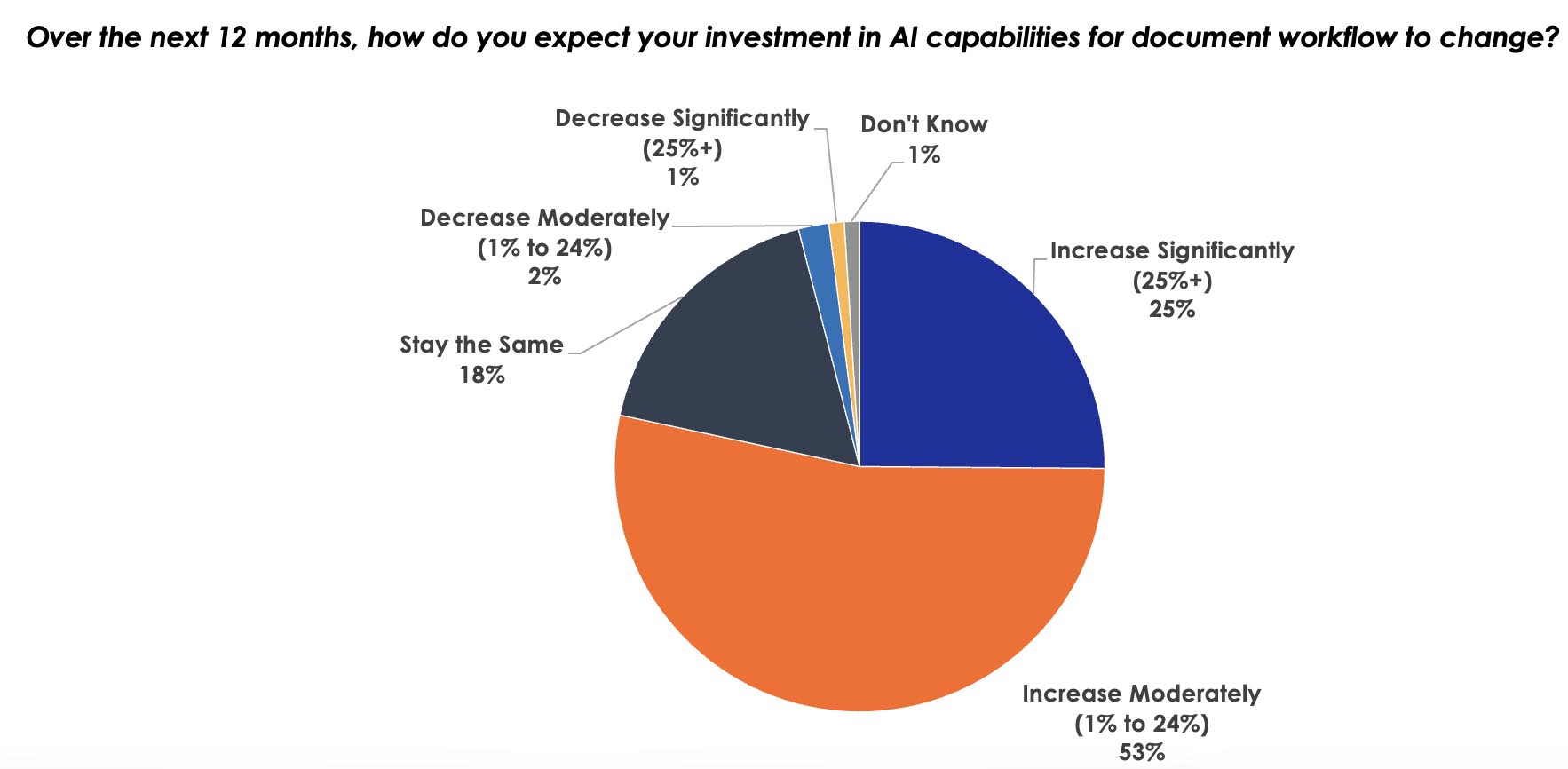
N = 298 Respondents in the United States
Source: IT Decision-Maker Study of Digital Experience Buyers; Keypoint Intelligence 2025
This same survey reveals that a majority of organizations have already begun embedding AI capabilities into their core document workflow processes, while only a small minority (11%) remain at the earliest stage of AI exploration. This highlights the rapid pace of change within the AI space. The study also shows that, once businesses experience the tangible benefits of AI (e.g., faster processing, higher accuracy, improved customer engagement), adoption not only continues but accelerates rapidly.
The Future
Looking forward, the next evolution is emerging in the form of agentic AI. The systems of the future will be able to plan, adapt, and execute complex tasks with minimal human intervention. They won’t just be sophisticated tools that respond to commands; they will be “digital colleagues” that are capable of managing entire workflows that previously required a significant amount of human coordination. This evolution suggests that we’re moving toward a future where AI doesn’t just support routine processes, but orchestrates them from start to finish.
Despite AI’s remarkable capabilities, a crucial truth is often overlooked: Companies that prioritize the human side of AI adoption are the ones that can extract the most value. They will invest heavily in comprehensive training programs that build confidence as well as competence. They will implement strategic change management to address concerns before they become obstacles. These successful organizations favor gradual rollouts that enable teams to adapt and provide meaningful feedback, and they establish clear success metrics that align AI initiatives with broader business goals. Most importantly, they involve employees early in the process, helping to transform potential skeptics into passionate champions. These leading firms will treat AI implementation not as a one-time technology deployment, but as an ongoing transformation that puts people at the center of every decision. Ultimately, even the most sophisticated AI system in the world is only as effective as the people who work alongside it.
The Bottom Line
The defining insight of this transformation is clear: AI isn’t replacing human intelligence at work; it’s amplifying what people can achieve. When implemented thoughtfully, AI expands human potential in ways that we’re only just beginning to understand. The result is workplaces that are simultaneously more efficient, more adaptive, and more human-centered than ever before.
The future of work will not be a contest that forces us to choose between human and artificial intelligence. It will be a partnership that blends analytical precision with human judgment to achieve outcomes neither could accomplish alone. Firms that embrace this synergy today are positioning themselves to lead the next era of the digital transformation. They will also help define AI automation for years to come.
To stay on top of today’s ever-evolving industry, browse Keypoint Intelligence’s Industry Reports page for the latest insights. If you aren’t already a subscriber to our AI-based Advisory Services, contact us for more information.
As Principal Analyst for Keypoint Intelligence’s AI Service, Anne Valaitis draws on her document management and artificial intelligence expertise to help clients identify opportunities where AI can streamline operations, reduce costs, and shape new offerings that drive market demand and generate revenue. She has led numerous research projects that have influenced the document solutions landscape.