Line O’Type
Fans of printing history have no doubt seen the 2012 film Linotype: The Film, a feature-length documentary about Ottmar Mergenthaler’s pioneering typesetting machine. However, via Print magazine, filmmaker Doug Wilson’s Linotype odyssey didn’t end with the movie. For the past two years, has been embarking upon “the Linotype Book Project.” In a video on his website, he says, “I’m still quite interested in the Linotype and how it impacted journalism, communication and society as a whole.”
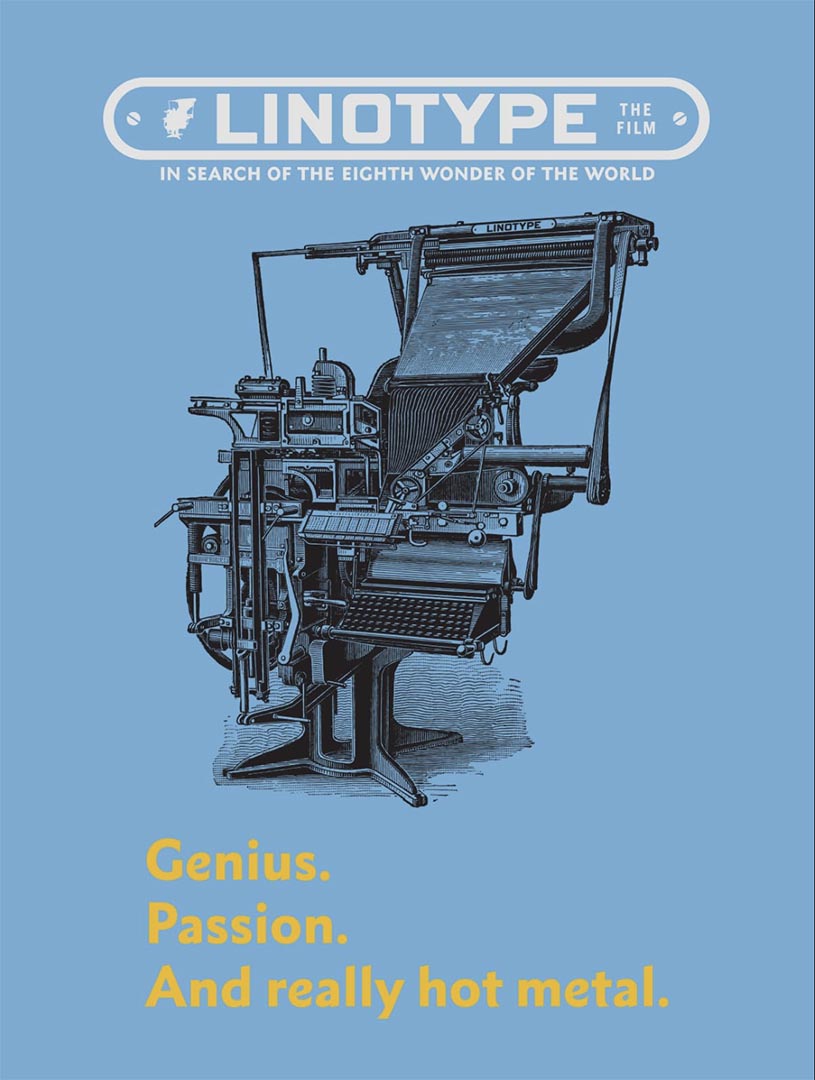
Thus he’s systematically traveled the world to find new stories and create a deeper narrative for what has become a singular passion. Wilson chronicles his discoveries in a frequently published newsletter, which is free to subscribers (and those who pay what they can to support the project). As many of the remaining operators are passing, this blow-by-blow “journal” of an incredible journey gives readers a sense of taking part in the adventure.
He lists some of the questions he is seeking to answer, such as:
- Where is the original Blower Linotype machine which hasn’t been seen publicly in three decades? (Does Frank have it?)
- What were the experiences of women & minority populations using the Linotype?
- Can we find the original 1936 NBC radio broadcast celebrating the 50th anniversary of the Linotype?
- How did the Linotype company transition to photo and computer typesetting technology?
Anyway, if you’re interested in a vital part of printing history, be sure to subscribe.
Kidding Around
Children’s books have a long and voluminous history, and via Boing Boing, the University of Florida’s Baldwin Library offers a digital archive of more than 10,000 historical children’s books, mostly from the Victorian era, as children’s books had become a very big niche in the 19th-century book publishing industry.
The digitized archive has a wide range of books, from religious instruction to adventure stories. Early children's books were “remorsely instructional… or deeply pious,” but by the late 1800s, fantasy and adventure stories began dominating the market. This transformation paved the way for the modern children’s literature genres we know today.
Some sample titles: Burtie Corey, The Fisher Boy, Or, A Wise Son Maketh a Glad Father; A Present to You from Santa Claus; The Burglar's Daughter, Or, A True Heart Wins Friends; Mother Wild Goose and Her Wild Beast Show (sounds fun), or maybe even An Astronomical and Geographical Catechism, which may be a bit heavy.
At any rate, if you have small children and want to switch up the bedtime stories, check the archive out.
The Fire’s Gone Out
Funny, we thought it had been discontinued ages ago, but via Boing Boing, the original computer connectivity standard that was an alternative to USB—IEEE 1394, aka FireWire—has been effectively killed. Favored by the likes of Apple, Sony, and Panasonic over USB, it did have its advantages: it was faster than USB, supported daisy-chaining (which those of us coming off the SCSI era appreciated), and was (at the time) more reliable. (The first-generation iPods connected via FireWire.) However, FireWire was more expensive to license and produce compared to USB, so the latter won the day. And while Apple hasn’t actually included FireWire ports on a desktop Mac in decades, the MacOS at least supported the standard if you could find an adapter. But, alas, the upcoming macOS 26 (now in beta) drops all support for FireWire.
Newspapers and other legacy media up and down the country have cabinets full of old FireWire drives. Surprises are in store when they need to get stuff off them in a few years and even the dongles don't work anymore.
So if you have any legacy storage devices, act now to retrieve and re-back it up.
Watch Your Internet Speed
What does the Grateful Dead have to do with the Internet? Well, aside from the usual official and fan sites, as it happens, the Grateful Dead were behind perhaps the very first online community.
The Dead—never a bestselling act—were known for (among other things) their super-devoted fans of “Deadheads.” Says the BBC:
Fans of the Dead, known as "Deadheads", were inspired by the band's embrace of all things technological, from their pioneering sound systems to their immersive multimedia visuals. Many fans were technologists and engineers themselves, working in Silicon Valley or at universities around America with access to early internet technology – which they were using by the late 1970s to swap hot commodities like Grateful Dead setlists and illegal drugs.
In the 1980s, years before the World Wide Web, a virtual online community emerged called the Well (the Whole Earth 'Lectronic Link). Centred on the San Francisco Bay Area of California, the Well not only thrived in its own right, but proved to be one of the most influential factors in the birth of the internet as we know it today. And its long life was in large part thanks to fans of the Grateful Dead.
Now, if you’re picturing something like Facebook or Instagram, remember, this was the early 1980s. The Well was a “bulletin board system” (BBS—remember them?), an early text-based form of online communication.
The Well People could dial into a BBS using a computer and a phone line, where they would send messages and share files. But the Well was more advanced than other BBS’s. In the 1980s, these systems typically ran off a single modem, usually in someone’s home, and only one person could dial in at a time. Real-time conversation between multiple users was impossible. The Well, operating out of the Whole Earth Catalog’s San Francisco office, was among the first to change that. It was professionally run on command-line PicoSpan software, and sported the hardware necessary for multi-user use and conversation – fifty people could be online chatting at the same time. This was a revolutionary experience.
And at the time, this really wasn’t that cheap.
Before long, the Well’s Grateful Dead space exploded in popularity. At $2 an hour to dial in (about $6 or £4.50 today) along with its $8 membership fee ($23 or £17.20 today), the Deadheads’ devotion to endless discussion of their favourite band helped fund the entire platform.
One does kind of long for those simple days…
Belt It Out
Longtime readers of Around the Web (both of you) know that we are instinctively dubious of any appliance or other gizmo referred to as “smart.” But, via Core77, Volvo’s idea of “smart seatbelts” doesn’t sound daft: the Multi-Adaptive Safety Belt.
By harnessing car crash data from their vehicles, Volvo has learned that seatbelts should not behave the exact same way with every crash and every user. "Modern safety belts use load limiters to control how much force the safety belt applies on the human body during a crash," the company explains. These load limiters rely on deformable metal parts within the retracting mechanism to deliver one of three different levels of restraint. The variance in these three levels is meant to compensate for both crash severity and occupant size.
However, these three levels are calibrated to the “50th percentile male” and thus do not accurately compensate for other kinds of body sizes and crash types. “For instance a short, skinny teenager and a six-foot-tall pregnant woman require different levels of restraint.” (And on a variety of levels…)
Thus:
By relying on a host of interior and exterior sensors in the vehicle, the Multi-Adaptive Safety Belt thus provides 11 different load-limiting profiles. These take into account everything from crash direction and severity to occupant height, weight, shape and even sitting position. "For example, a larger occupant in a serious crash will receive a higher belt load setting to help reduce the risk of head injury. While a smaller occupant in a milder crash will receive a lower belt load setting to reduce the risk of rib fractures."
Pretty neat.
AI-Yi-YI, Part the Infinity: CheckGPT
Have we now reached the point where so-called AI is not bragging about itself? Perhaps so and, like much bragging, is entirely unfounded. Via Boing Boing:
During a conversation with ChatGPT about artificial intelligence and chess, ChatGPT touted its skill in the game. The chatbot claimed it could easily beat Video Chess, a 4KB chess game for the 1970s-era Atari VCS.
And how did it go?
As described in a LinkedIn post, software engineer Robert Caruso set up an Atari emulator and spent ninety minutes watching as ChatGPT "confused rooks for bishops, missed pawn forks, and repeatedly lost track of where pieces were."
“Pawn forks”? Sounds like a lost Two Ronnies sketch. Anyway.
Caruso switched to standard chess notation when ChatGPT complained about the Atari icons, but it continued to have difficulty with board awareness. The chatbot kept asking to start over and try again before eventually giving up. Atari Video Chess was released in 1979, not 1977, as stated in the post, and is, by most accounts, a decent chess engine.
And the reason that ChatGPT should suck so badly at chess should be no surprise.
A large language model like ChatGPT is not true artificial intelligence; it is more like superpowered autocomplete. Even the most sophisticated models constantly spout nonsense with pure confidence and friendly exclamation points.
Indeed.
Attar Is Born
Via the Verge, AI has now apparently “infiltrated” the perfume industry—and for some it’s leaving a bad smell.
Osmo [is] a fragrance tech startup claiming to build artificial olfactory intelligence. Osmo has parlayed this innovation into offering turnkey fragrance compounding that promises a 48-hour sample turnaround from initial client prompt.
“Olfactory intelligence”—aka “OI.” Seems appropriate…
Osmo built its shiny new empire, hoping to disrupt the fragrance market, on its digitization of a plum and the speed with which it can analyze and transport odor molecules. Its goal: to disrupt the fragrance market with AI-powered scent creation. I first encountered the smell of this “digitized plum” at a scent conference, handed to me by an independent perfumer like contraband. A group gathered around the blotter, whispering: it was too medicinal, too clean. “Where’s the bruising, the rot — the heat?” someone asked.
Is that a thing? Smelling like a rotten plum? Anyway, so what’s got up people’s noses?
Pierre Vouard, a professor at FIT, sees both opportunity and loss: “Compounding by hand, knowing the exact amount of each material, weighing it yourself — that’s going to disappear. But is it crucial?” He knows AI is used in his own classroom. “Perhaps this will be true democratization of fragrance because it drastically reduces the cost of creating one. But it does make you ask: Where’s the craftsmanship? Where’s the perfumer?”
You can see where all this is going. AI is going to dominate every industry and at some point there will be a backlash and a “back to making things by hand” movement. Question is, how long will that take? Probably a generation or so, maybe longer.
Graphene Has a Taste
Was it a good week for graphene news? It’s always a good week for graphene news! A graphene-based food contamination detection platform. From (who else?) Graphene-Info:
LayerLogic, a Swedish deeptech startup spun out of Chalmers University of Technology, has secured €470,000 in pre-seed funding to accelerate development of its real-time food contamination detection platform. The round was led by Scientifica Venture Capital and follows LayerLogic’s selection in the Super Sapiens Europe initiative.
Unlike current food contamination detection systems, which can take up to four days to return results, LayerLogic’s system can provide results in 15 minutes—essentially in real time.
Designed for direct use on production lines, the compact device aims to help food manufacturers detect contamination early and reduce downtime, waste, and financial loss.
A Bridge To Shark
This summer marks the 50-year anniversary of Jaws, the Steven Spielberg thriller that basically invented the concept of the summer blockbuster. And whilst it was regrettable the impact the movie had on the perception of sharks and the decline in shark populations due to trophy hunting, etc., it’s still a darn good movie. As movie buffs know, the film was largely shot on and around Martha’s Vineyard (particularly the town of Edgartown) and one iconic location is the American Legion Memorial Bridge, aka the “Jaws Bridge.” It is still there for the visiting.
Via Atlas Obscura,
it’s part of Seaview Avenue, which connects Edgartown with the town of Oak Bluffs. The bridge also divides the Atlantic Ocean from Sengekontacket Pond.
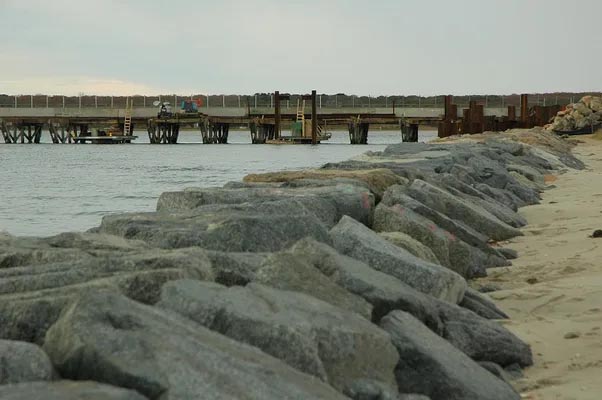
Best not to swim near it wearing a fake dorsal fin.
Despite its nickname [“Big Bridge”], the bridge is a small one, just a few car lengths in total, and it has been refurbished in recent years. The stone quay Roy Scheider ran during the Jaws attack at the bridge is still there and runs perpendicular to the bridge. The beach on the ocean side, called Joseph Sylvia State Beach, was where the rest of the scene was filmed.
If you’re on Martha’s Vineyard, check it out.
Cook’s County
Here’s an interesting bit of news for those interested in the Golden Age of Exploration: they recently found the wreck of Captain Cook’s Endeavour off the coast of Rhode Island.
James Cook (November 7, 1728–February 14, 1779) was one of the most important figures in world exploration. He was an officer, explorer, and cartographer in the Royal Navy, and became famous for his three voyages to the Pacific and Southern Oceans between 1768 and 1779. He was the first to circumnavigate New Zealand and was the first (known) European to visit eastern Australia as well as the Hawaiian Islands. He gets dissed a lot today, but unlike many explorers of his age (and earlier and later) what characterized his missions was the utmost respect he had for the cultures of the indigenous peoples he encountered, and the (generally) peaceful relations he and his crews had with those they met. He was also the rare sea captain of the time who understood the cause—and prevention—of the bane of long sea voyages: scurvy, a fatal vitamin C deficiency that decimated ships’ crews. By insisting on a vitamin C-rich diet on his voyages (which the crew were not always happy about), very few of those under his command fell victim to the disease.
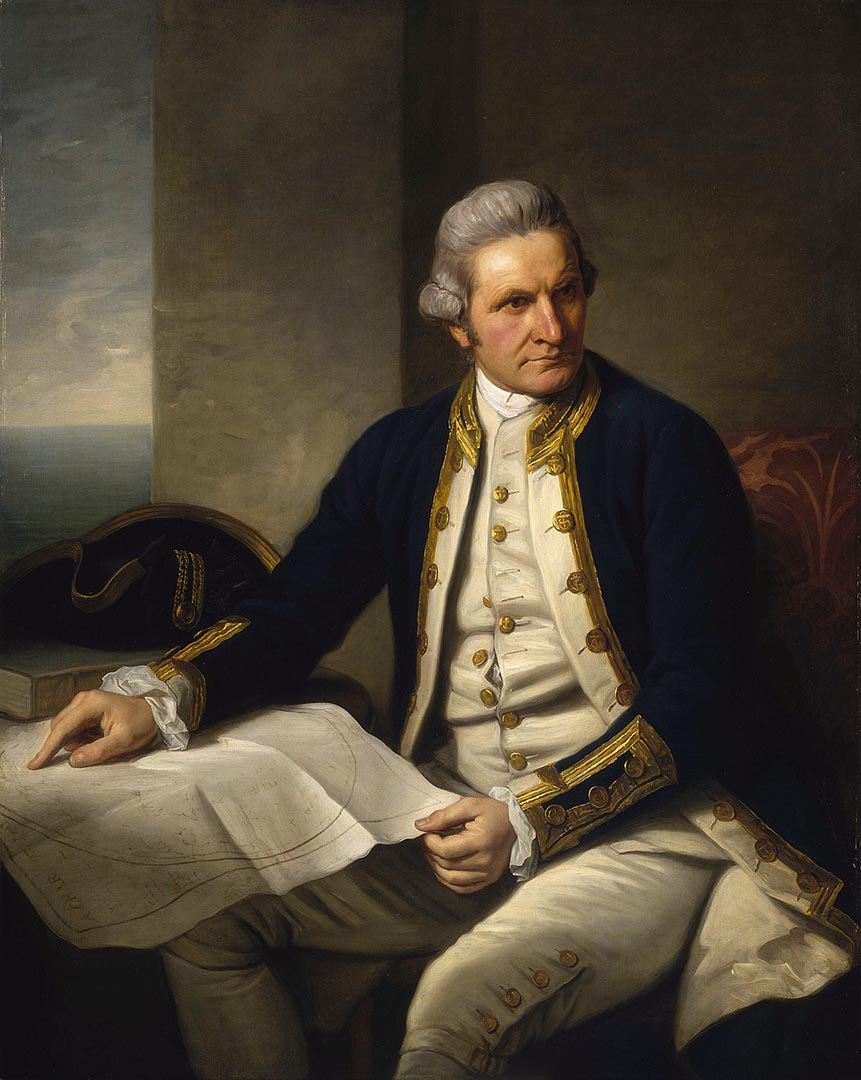
His first voyage saw him take the brand-new ship HMS Endeavour to the south Pacific Ocean from 1768 to 1771 to observe the 1769 transit of Venus from Tahiti as well as find evidence of the theoretical Terra Australis Incognita or “undiscovered southern land” in the southernmost latitudes. Cook was skeptical, but he did as the Royal Navy ordered. Anyway, he and his crew charted an abundance of new lands and discovered all sorts of new species.
He wasn’t home long before his second voyage, from 1772 to 1775, saw him replace the Endeavour with the Resolution and attempt to finally determine once and for all if there was any great southern landmass. Says Wikipedia:
On 17 January 1773, Resolution was the first ship to venture south of the Antarctic Circle, which she did twice more on this voyage. The final such crossing, on 3 February 1774, was to be the most southerly penetration, reaching latitude 71°10′ South at longitude 106°54′ West. Cook undertook a series of vast sweeps across the Pacific, finally proving there was no Terra Australis in temperate latitudes by sailing over most of its predicted locations.
Along the way he also charted many new lands (or at least new to the West) and brought back many new species.
His third and final voyage ended decidedly badly. From July 2, 1776 to October 4, 1780, he again took the Resolution, this time to sail to the North Pacific and poke around the North American continent in search of the fabled Northwest Passage. Along the way, he and his crew became the first Europeans to visit Hawaii and he also made extensive maps of the Alaska coast, before nearly getting stuck in Arctic ice and having to call off the trip until spring. This is where things went massively wrong. He returned to Hawaii to pick up supplies and fix the ship and while he had had generally good relations with the Hawaiians, eventually his crew wore out their welcome. It would have been fine, except that when the Resolution sailed off to return to the North Pacific, the ship was critically damaged in a storm and had to hobble back to Hawaii. After various scuffles with the Hawaiian leaders, Cook was killed. (It’s a complicated story and if you are interested, Hampton Sides’ Wide Wide Sea, an excellent account of Cook’s ill-fated third voyage, was published last year.) Another Cook book (as it were) is Richard Hough’s Captain James Cook, an excellent overall biography.
We could go on, but it was with great interest that we noted the confirmation last week of the discovery of the wreck of the Endeavour, the ship from Cook’s first voyage, which had been decommissioned by the RN and sold off.
The Endeavour (by then renamed the Lord Sandwich) met its demise in the Atlantic when it was one of 13 ships the British deliberately sank (or "scuttled") in a Rhode Island harbor during the American Revolution. Archaeologists and divers in 1993 consulted 18th-century maps and logs for information about the locations of the wrecks of the Endeavour and the other ships scuttled with it. Then the researchers took to the water with side-scan sonar to find the remains.
There was some debate for a few years over whether the wreck was in fact the Endeavour, but a new report confirms it.
The final report is now available, and both RIMAP and ANMM say they have confirmed that the wreck is indeed the Endeavour. (You can read the full report here.) “The timbers are British timbers. The size of all the timber scantlings are almost identical to Endeavour, and I’m talking within millimeters—not inches, but millimeters," Kieran Hosty, an ANMM archaeologist who co-wrote the report, told The Independent. “The stem scarf is identical, absolutely identical. This stem scarf is also a very unique feature—we’ve gone through a whole bunch of 18th-century ships' plans, and we can’t find anything else like it.”
That Can-Do Spirit
Gene Wolfe (May 7, 1931–April 14, 2019) may not be a household name, but he was an award-winning science-fiction and fantasy writer best known for the multi-volume novel The Book of the New Sun. And as respected and acclaimed he was as an author, his true legacy is a bit more prosaic and something you may have in your snack cupboard: he helped invent Pringles. Says Food & Wine:
Before he became a critically acclaimed writer of the Book of the New Sun series and was compared to Melville and James Joyce, Wolfe was a young engineer. Wolfe worked for Procter & Gamble in the 1960s, at the height of “food science.” These were the Jetsons years, when men in white lab coats with clipboards and pocket protectors worked to make everything better — which is to mean, mechanized and uniform.
Soon, thanks to a chemist named Frederick Baur, Wolfe got involved in potato chips. Baur had issues with chips:
Some were small, some were large, some were folded up and undercooked, or overcooked. And it seemed like there was always at least one green chip in the bag.
So Baur began redesigning the potato chip with a determination only the anal retentive could admire:
He used a mixture of potato, corn, and rice flour to ensure each one was the exact same size and consistency. By rolling the dough out and forming it into the iconic “hyperbolic paraboloid” saddle shape, he made sure they were easy to stack, with good strength and plenty of snap.
Then came the packaging.
He then stacked the chips into a futuristic tubular container shaped like a tiny missile silo so the chips wouldn’t bounce around and break.
Well, usually… By the way, after he died, Baur was cremated and his ashes buried in a Pringles can.
This is where Wolfe comes in. P&G loved the idea, and tasked Wolfe with creating a machine that would mass produce the chips. Said Wolfe in 2022:
“I was the engineer on the original Pringles cooker,” he said. “Pringles was invented by a German madman. He was making them with a kind of scissor-and-dip mechanism that wasn’t adaptable to mass production. There was a four-man team, and I did the cooker that closed around the future potato chips and dragged them through the hot oil and opened them up and dumped them out. The fourth guy, who did the canning machine, they literally drove crazy.”
There then ensued legal challenges over whether Pringles could be called “potato chips” (did they have enough potato in them?)—they settled on the term “snackers”—but that didn’t impede their popularity. Wolfe, of course, would go on to bigger and better things, although we have yet to determine if his books are as addictive as the chips.
Watch Pringles being made.
Everything to Everyone
We’re not sure when “everything bagel” became a thing, but apparently it has become popular enough that Trader Joe’s now sells “Everything Bagel Seasoning.” Says (who else?) Food & Wine:
In 2017, the grocery chain introduced its Everything but the Bagel Sesame Seasoning Blend, which instantly caught the attention of fans. And now, it's tossing it on 10 different products across its aisles. As Trader Joe's explains, "It turns out that garlic, onion, poppy, sesame, and sea salt synergize with a whole lot more than just bagels."

Like what? Well, they list five suggestions, from cheddar cheese to salmon. Check it out if you are an everything bagel seasoning aficionado.
As for when the everything bagel took off, the article suggests:
While the exact origin of the everything bagel has long been debated, reporter Michael Schulman at The New Yorker traced its likely origins back to the early 1980s when David Gussin, a bagel shop worker in Queens, swept up leftover seeds and spice bits from the oven floor and "instead of throwing them out, like I always did," decided to sprinkle the mix on fresh dough.
Oh…oven floor. Whew!
This Week in Printing, Publishing, and Media History
June 23
1860: The United States Congress establishes the Government Printing Office.
1868: Christopher Latham Sholes receives a patent for the “Type-Writer.”
1910: French playwright and screenwriter Jean Anouilh born.
1912: English mathematician and computer scientist Alan Turing is born.
1926: The College Board administers the first SAT exam.
1969: IBM announces that it will start pricing its software and services separately from hardware—thus creating the modern software industry.
1991: Sonic the Hedgehog is released to American audiences, then to PAL and Japanese audiences a month later, kickstarting the successful Sonic franchise.
2013: American author and screenwriter Richard Matheson dies (b. 1926).
June 24
1842: American short story writer, essayist, and journalist Ambrose Bierce born.
1930: American businessman, founder of Ziff Davis William Bernard Ziff Jr. born.
1947: Kenneth Arnold makes the first widely reported UFO sighting near Mount Rainier, Wash.
1949: The first television western, Hopalong Cassidy, is aired on NBC starring William Boyd.
1957: In Roth v. United States, the U.S. Supreme Court rules that obscenity is not protected by the First Amendment.
June 25
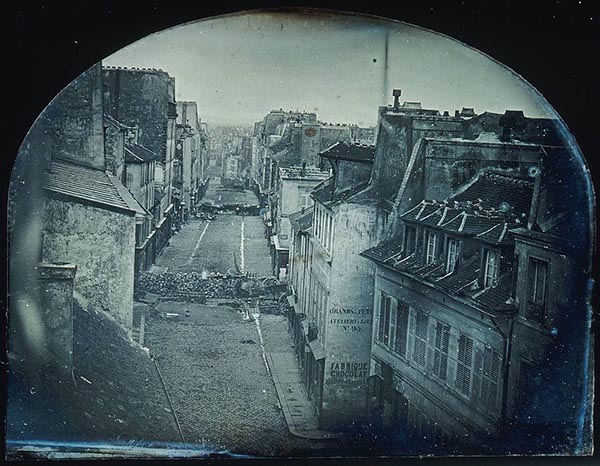
1848: A photograph of France’s June Days uprising, “Barricades on rue Saint-Maur,” becomes the first photograph used to accompany a newspaper story, launching the practice of photojournalism.
1903: British novelist, essayist, and critic George Orwell born.
June 26
1927: The Cyclone roller coaster opens on Coney Island.
1929: American illustrator and graphic designer Milton Glaser born.
1948: Shirley Jackson’s short story The Lottery is published in The New Yorker magazine.
1974: The Universal Product Code is scanned for the first time to sell a package of Wrigley's chewing gum at the Marsh Supermarket in Troy, Ohio.
1997: Oh, FFS: the U.S. Supreme Court rules that the Communications Decency Act violates the First Amendment to the United States Constitution.
June 27
1880: American author, academic, and activist Helen Keller born.
1895: The inaugural run of the Baltimore and Ohio Railroad’s Royal Blue from Washington, D.C., to New York City, the first U.S. passenger train to use electric locomotives.
1898: The first solo circumnavigation of the globe is completed by Joshua Slocum from Briar Island, Nova Scotia.
June 28
1846: Adolphe Sax patents the saxophone.
1926: American actor, director, producer, and screenwriter Mel Brooks born.
1975: American screenwriter and producer Rod Serling dies (b. 1924).
2018: American writer Harlan Ellison dies (b. 1934).
June 29
1613: London’s Globe Theatre, constructed by William Shakespeare’s playing company, burns down. A second Globe was built by 1614, so all’s well that ends well.
1900: French poet, pilot, and author of The Little Prince, Antoine de Saint-Exupéry, born.
1920: American animator and producer Ray Harryhausen born.
1975: Steve Wozniak tests his first prototype of the Apple I computer.
2007: Apple Inc. releases the iPhone.
June 30
1685: English poet and playwright John Gay born.
1937: The world’s first emergency telephone number, 999, is introduced in London.
July 1
1874: The Sholes and Glidden typewriter (aka Remington No. 1), the first commercially successful typewriter, goes on sale.
1881: The world’s first international telephone call is made between St. Stephen, New Brunswick, Canada, and Calais, Maine, United States.
1892: American journalist and author James M. Cain born.
1963: ZIP codes are introduced for United States mail.
1979: Sony introduces the Walkman.
1869: American author and educator, and co-author of The Elements of Style, William Strunk Jr. born.
July 2
1566: French astrologer and author Nostradamus dies (b. 1503). (Funny, he didn’t see it coming.
1698: Thomas Savery patents the first steam engine.
1897: British-Italian engineer Guglielmo Marconi obtains a patent for radio in London.
1900: The first Zeppelin flight takes place on Lake Constance near Friedrichshafen, Germany.
1900: Jean Sibelius’ Finlandia receives its première performance in Helsinki with the Helsinki Philharmonic Society conducted by Robert Kajanus.
1961: American novelist, short story writer, and journalist, Nobel Prize laureate Ernest Hemingway dies (b. 1899).
1962: The first Walmart store, then known as Wal-Mart, opens for business in Rogers, Ark.
1977: Russian-born novelist and critic Vladimir Nabokov dies (b. 1899).
2013: American computer scientist, inventor of the computer mouse Douglas Engelbart dies (b. 1925).
July 3
1767: Norway’s oldest newspaper still in print, Adresseavisen, is founded and the first edition is published.
1877: German-born Swiss poet, novelist, painter, and Nobel Prize laureate Hermann Hesse born.
1886: The New-York Tribune becomes the first newspaper to use a linotype machine, eliminating typesetting by hand.
1883: Czech-Austrian author Franz Kafka born.
July 4
1804: American novelist and short story writer Nathaniel Hawthorne born.
1826: John Adams, 2nd President of the United States (b. 1735), and Thomas Jefferson, 3rd President of the United States (b. 1743), both die on the same day.
1831: American soldier, lawyer, and politician, 5th President of the United States James Monroe dies (b. 1758).
1855: The first edition of Walt Whitman's book of poems, Leaves of Grass, is published In Brooklyn.
1950: Radio Free Europe first broadcasts.
1883: American sculptor, cartoonist, and engineer Rube Goldberg born. It was a needlessly complicated birth.
July 5
1687: Isaac Newton publishes Philosophiæ Naturalis Principia Mathematica.
1833: French inventor, creator of the first known photograph Nicéphore Niépce dies (b. 1765).
1954: The BBC broadcasts its first television news bulletin.
1958: American author and illustrator Bill Watterson born.
July 6
1865: The first issue of The Nation magazine is published.
1893: French short story writer, novelist, and poet Guy de Maupassant dies (b. 1850).
1962: American novelist and short story writer, Nobel Prize laureate William Faulkner dies (b. 1897).