Inkjet is taking the industrial world by storm. Following its introduction into the printing world over 40 years ago, inkjet technology has penetrated markets, not limited to display graphics, ceramic tile, labels, building materials, textiles, rigid and flexible packaging, and product decoration. You can learn more about the application of inkjet to these segments in the replay of our webinar from last month “Innovations in Industrial Inkjet.” We discussed that many surfaces require the application of a primer or surface treatment prior to painting, coating or analog printing, and inkjet is no exception. This article discusses that characteristics of primers and surface treatments suitable to different industrial applications.
Learning the hard way
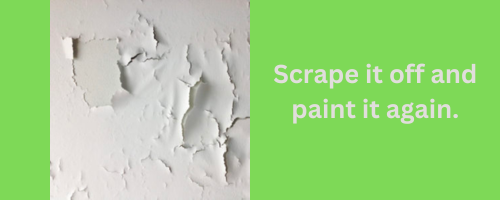
My first introduction to primers dates back to when I was 15 years old. My dad offered to pay me $1,000 if I repainted the gutters on our house. Our home had the old aluminum gutters that were painted by hand. They were white but the paint was peeling off in spots all over. For a thousand dollars, I could work outside in the sun, listen to Led Zeppelin and have that cash in my hand in no time. I set to work doing the minimum scraping to remove loose paint and quickly began painting the gutters with an exterior white recommended at the hardware store. I painted the gutters 360° around our house, first and second floors in less than two weeks. It was easy money. My dad was surprised at how quickly I had completed the job. As we walked around the perimeter inspecting my work, he turned and asked me, “Did you use primer?”...
Primers, as I was to learn, play a critical role in final product performance. A primer is typically defined as an initial coating applied to a surface to improve adhesion of a topcoat. In the inkjet world, primers allow inks to stick to glass or plastic, improve the text quality on paper, and prevent penetration or bleed of inks on textile or corrugated substrates.
Primers also enhance the bond strength of exterior paint to aluminum gutters. When you fail to prime the surface before painting, you will be back to flaking paint in no time at all. Not such easy money when you have to do the job twice. That’s true with gutters or printing.
Preparing industrial surfaces for inkjet printing
Inkjet inks are typically considered a topcoat unless we are talking about an application where a laminate is being constructed, luxury vinyl tile for example. With regard to printing, a primer will influence properties including surface wetting, ink penetration, image quality and even the curing of the ink itself.
In the mature display graphics industry, a variety of substrates are now available which have been pre-treated or precoated specifically for inkjet inks. Corrugated plastic sheeting such as Coroplast or fluted polypropylene for inkjet is surface treated to raise the dyne level (the measure of surface energy) to 45 dynes (g.cm/s2). The increased surface energy improves the dot gain and lay of inkjet inks with low surface tension. Keep in mind that fluids with lower surface tension will wet out surfaces with higher surface energy. The ability of a fluid to wet out a surface is determined analytically by laboratory instruments which measure contact angle. A portable version is available from Brighton Science.
[caption id="attachment_6876" align="alignleft" width="221"]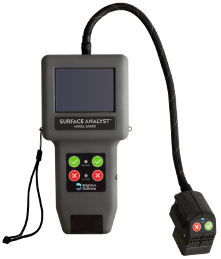 Image Source: Brighton Science[/caption]
Digital acrylic (DA) is a specially formulated acrylic resin panel and is priced at a premium compared to standard acrylic. DA is manufactured with enhanced adhesion properties built in for UV inkjet inks. Pressure sensitive vinyl and many other substrates have specific grades for use in the digital display graphics industry. In addition to increasing adhesion properties, it aids in surface wetting, increasing ink coverage. The resulting effect is increased color density of printed images while reducing the amount of ink needed to achieve the result. A common observation on a substrate which has been poorly treated is that the inks appear lighter in color. This is due to minimal dot gain. When specific digital grade products are used, it may not be necessary to use primers or surface treatments as the substrate has been processed, or formulated, with specific properties built into it for inkjet. Digital grade substrates are priced at a premium.
Beyond the realm of digital grade substrates
As industrial inkjet advances into areas without digital grade substrates, primers are required. Examples include drinkware, decorated glass windows, metal decor, films and corrugated substrates for packaging, and plastics decorating. These materials will require primers, surface treatments and often both.
One growing digital application which requires surface preparation/priming is glass drinkware. In order to deliver acceptable ink adhesion, a Pyrosil® coating technique is commonly used. In this process, a solvent based solution of a silicon compound such as hexamethyldisiloxane in isopropyl alcohol is injected into a propane-air mix fueling a flame treater. The doped flame treater now deposits a silicon oxide coating on the surface of the glass drinkware. The applied film of silicon dioxide, although invisible, significantly improves the adhesion of UV curable inkjet ink to the glass.
[caption id="attachment_6875" align="aligncenter" width="337"]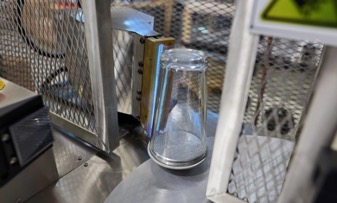 Image Source: Michael Perrelli[/caption]
Summary
When selecting a primer for specific application, the following questions should be considered:
- What is the substrate?
- What is the chemistry of the ink being applied?
- What performance attribute necessitates the use of a primer?
Of course, other considerations may include project budget, regulatory concerns, primer application method, curing system, etc. but we will focus on the former questions for now. As inkjet expands into more industrial applications the number of target substrates increases as well. The growing list of substrates includes paper, plastics, glass, ceramics, wood, metal, composites, textiles, and leather. With each new substrate, new technical challenges to producing a high quality finished good present themselves. Careful consideration needs to be taken when selecting the ink as well as a primer. As we will learn, there is not a universal primer. Primers are formulated for specific substrates, applications, and to deliver key product attributes.
Primers play a critical role in industrial inkjet. Primers can improve image quality, ensure adhesion between ink and substrate, and even catalyze a chemical reaction between an inkjet ink and the substrate. In upcoming articles, we will drill deeper into the process & chemistry of primers for specific industrial inkjet applications. Failure to master the use of primers may lead to a number of problems, including adhesion failures, poor image quality, upset clients and as I learned many years ago, having to repaint the gutters!
Stay tuned for a deeper dive on specific applications in future articles. Meanwhile, if you want hear me try to pronounce hexamethyldisiloxane, join our next webinar on November 14 at 1 p.m. ET where I will be discussing Inkjet for Textile Production with Debbie McKeegan and Elizabeth Gooding.