WhatTheyThink

Premium Commentary & Analysis

Buying the Middleman, How Fuji Film and PrimeSource Came to Terms

-

Tuesday, September 25, 2001

- PrimeSource: Moving $80 million worth of Fuji products a year - Heartland Imaging was involved early - Unusual trading on PrimeSource stock forces press release on deal (Our exclusive intelligence reports are based on company sources, public SEC documents and industry consultants following the print and publishing industry. At times, it is necessary to quote unnamed sources. As a tradeoff for protecting sources, we are able to reach beyond the surface and gain a deeper understanding of key issues impacting the industry. If you have any questions about this story, please contact us.) 9/25/01 - After months of negotiations, Fuji Photo Film USA announced on August 31st their intention to acquire PrimeSource. PrimeSource is one of the largest dealers of graphic arts supplies with over $500 million in annual revenue. PrimeSource sells around $80 million a year for Fuji’s Graphic Systems Division and is their largest customer. (Fuji said PrimeSource sold $79 million of their products in 1999, $87 million in 2000 and $42 million through June of this year.) The process started in November of 2000 as a simple idea to have a “meeting of the minds” to discuss opportunities and challenges within the print and graphic arts industry. We now know those discussions took several turns. What apparently started as general conversation went from discussing a possible Fuji financing of dealer consolidation to Fuji deciding to acquire their top three dealers outright. With PRINT 01 around the corner and heavy trading activity on PrimeSource’s stock, both decided to announce the pending deal. PrimeSource’s stock trading volume usually ranged between 1000 and 5000 shares a day. However, between Monday (8/27/01) and Thursday (8/30/01) volume skyrocketed averaging just over 21,000 shares per day. Meanwhile, PrimeSource’s stock price rose from $4.02 per share on August 22nd to $5.60 the day before the announcement, a 28% increase. Executives from both companies concluded that a press release was in order. On August 31st Fuji confirmed their Board in Japan had approved the transaction and would pay $10.00 per share in cash for PrimeSource’s stock. Time-Line Last November, Jim Mullan, PrimeSource’s CEO contacted Fuji to discuss economic conditions and options related to the distribution channel in the graphic arts supply market. Sources say at the time, there was no intention of having Fuji acquire PrimeSource. Those decisions would come much later - initiated by Fuji Film. Also at the time, Heartland Imaging’s principal, Bob Gourley contacted Mullan to discuss options for the future. Heartland is a privately held dealer of graphic arts supplies and also a non-exclusive dealer for Fuji Film. From Heartland and PrimeSource’s initial discussions, the plan was to combine the two companies with financial help from Fuji Film. A meeting took place in mid-December between Fuji, PrimeSource and Heartland executives. Financial data was exchanged and Fuji indicated it would consider financing the consolidation. Key executives involved in these discussions from Fuji were Stanley Freimuth, Chief Operating Officer, Sam Monroe, Director of Business Strategies and Daniel Maffeo, VP of Fuji’s Graphic Systems Division. A second, more formal meeting took place in late January between Heartland, PrimeSource and Fuji executives. Sources say this meeting included the Chief Financial Officers and involved “serious intent to move into the most sensitive areas of financial and operational data sharing.” Change of Heart In April, Fuji alerted PrimeSource that they were not interested in the financing discussed before, but wanted to propose an outright acquisition of PrimeSource. At this time, Fuji also alerted Heartland and Graphic Systems, Inc (another Fuji dealer led by Jon Wright) that they would seek an acquisition of those respective companies as well. By June, Fuji’s Board of Directors in Japan gave the official green light to pursue the purchase. PrimeSource then hired Berwind Financial, L.P. to advise the company of the possible sale. Fuji’s advisor, Bear, Stearns suggested an equity value of $9.00 per share. Berwind and PrimeSource balked and after a half dozen proposals and counter proposals, the two agreed on an equity value of around $69 million. (The total acquisition price is approximately $118.4 million, including transaction costs and PrimeSource's existing debt.) Fine tuning the agreement was a “pain staking process.” Negotiations continued even past the press release announcing the acquisition plan on August 31st. Areas of concern and negotiation included Jim Mullan’s employment after the sale, PrimeSource’s partnership with Xeikon in the Canopy Joint Venture, the minimum number of shares required to be tendered in order to consummate Fuji’s offer and the amount of any termination fee and cap on expense reimbursements which Fuji would receive in case the merger was terminated. No Looking Back Obviously, these matters have been resolved and Fuji is seriously committed to shoring up the dealer network. "The key to delivering value to our customers is to have a strong distribution channel,'' Daniel Maffeo of Fuji Film said after the announcement. "We have always been committed to the U.S. graphic arts market, and this action underscores that commitment. We see a changing market and believe the distribution and support of this market must change as well.'' Fuji Film believes the graphic communications industry needs a national distributor backed by a financially stable global company. Industry analysts say this move is good for the industry. It is certainly good for PrimeSource shareholders who have not seen their share price above $8.00 since the 3rd quarter of 1999. Jim Mullen will assume the role of President of the new $800 million subsidiary. Heartland’s Bob Gourley and Graphic Systems’ Jon Wright will become VP’s. It will be interesting to see what’s next from Fuji and their competitors - which not only includes Kodak and AGFA, but now Pitman, xpedx and 250 other dealers.


Continue reading your article
with a WhatTheyThink membership.

WhatTheyThink Annual Membership

Less than $4/week.

Get unlimited access to in-depth commentary and analysis covering the latest trends, emerging technologies, operational strategies, and key events across every segment of today's printing industry.

Stay informed. Stay competitive. Stay ahead.
WhatTheyThink Day Pass

$5 for 24 hours

Unlimited access to all of WhatTheyThink. Get your Day Pass

Already a member?
Sign In

About WhatTheyThink

WhatTheyThink is the global printing industry's go-to information source with both print and digital offerings, including WhatTheyThink.com, WhatTheyThink Email Newsletters, and the WhatTheyThink magazine. Our mission is to inform, educate, and inspire the industry. We provide cogent news and analysis about trends, technologies, operations, and events in all the markets that comprise today's printing and sign industries including commercial, in-plant, mailing, finishing, sign, display, textile, industrial, finishing, labels, packaging, marketing technology, software and workflow.

Recent Articles from WhatTheyThink

Print ERP Built Natively Inside Microsoft Dynamics 365

Print ERP Built Natively Inside Microsoft Dynamics 365

No third-party integrations. No disconnected systems. DynamicsPrint® extends Microsoft Dynamics 365 F&SCM with print-specific ERP designed to scale globally with your business. Read More
Around the Web: Of Moons and Mother Roads

Around the Web: Of Moons and Mother Roads

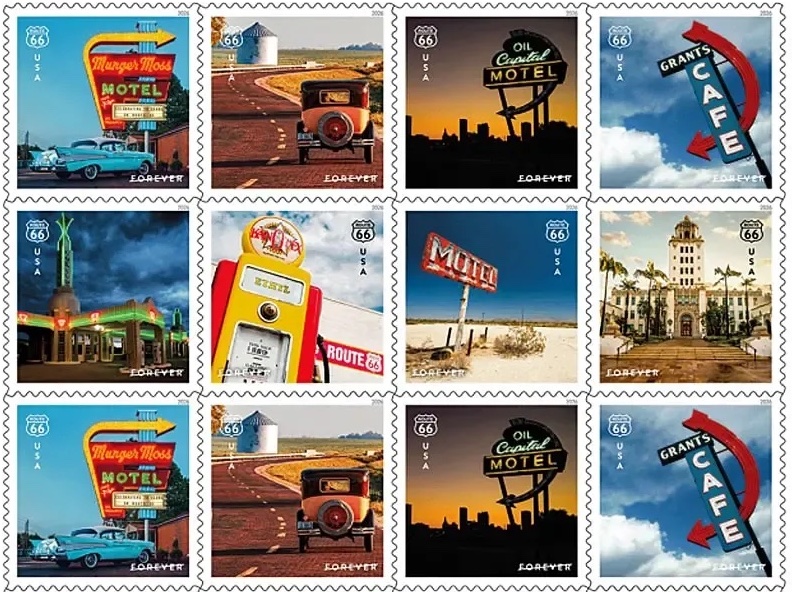
The 1835 “Moon Hoax” made ridiculous news stories credible. The USPS is issuing the 2026 Route 66 Centennial Stamp Collection. Highlights from the recent Sustainable Brands Conference. Researchers have created what might be the most accurate mathematical representation of color perception ever. When in North Dakota, visit the Theodore Roosevelt Presidential Library, which opens tomorrow, July 4. An Etsy gardening scam features AI-generated plant images and fake seeds.  Good grief: corneal tattooing is a thing. Graphene radar-absorbing coatings for defense use. If you missed Monday’s Strawberry Moon, more moons are coming. Answering the burning question: “do bug zappers still exist?” Turn any water bottle into a water vessel for dogs. Is there any advantage to “alkaline water”? Welcome to WhatTheyThink’s weekly miscellany. Read More
Graphic Arts Employment in May Up Overall—Substantially Among Non-Production

Graphic Arts Employment in May Up Overall—Substantially Among Non-Production

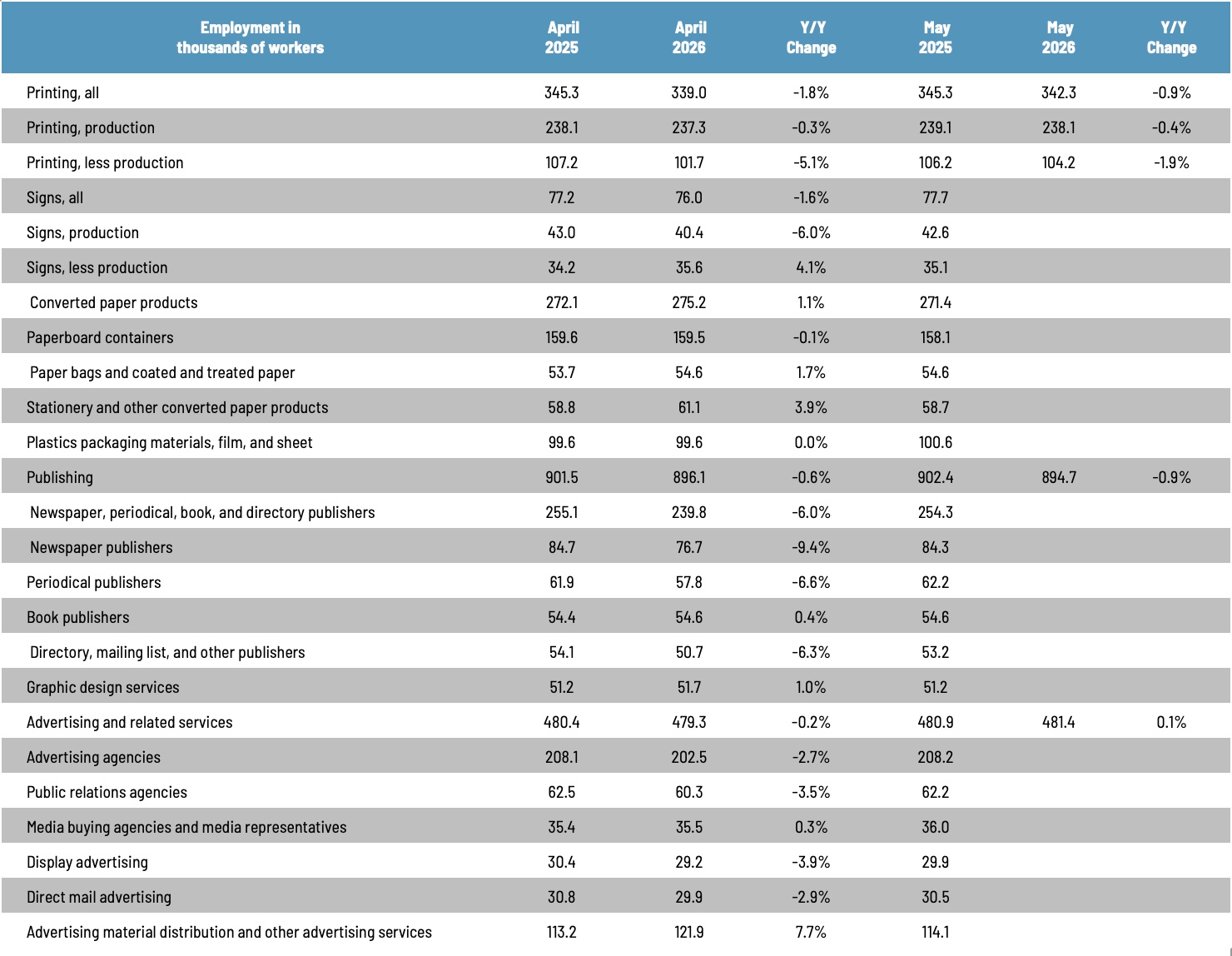
After a sluggish four months, the employment situation picked up in May, with overall printing industry employment up 1.0% from April, production employment up 0.3%, and non-production employment up 2.5%. Read More

Explore Mohawk's new paper options for all your digital printing needs

Explore Mohawk's new paper options for all your digital printing needs

Digital printing is the answer to the agility of modern work?ow. Mohawk Digital offers a diverse collection of fine and production papers for Inkjet, Dry Toner and HP Indigo presses. Read More

Around the Web: Of Botticelli and Beef

Around the Web: Of Botticelli and Beef

Newspaper Club has partnered with type foundry abcD8 to create a custom typeface inspired by the visual history of newspapers. MAD magazine has published its 600th issue. “Wordhord: Old English Word of the Day.” New evidence for the cause of death of the model for Botticelli’s “Birth of Venus.” Attending a Zoom meeting while on a roller coaster. Graphene-enabled PFAS-free firefighting foam. A jacket that can harvest moisture from the atmosphere. The iPhone’s Vehicle Motion Cues are surprisingly effective at reducing car sickness. An e-bike designed specifically to carry children. “Do fitness trackers still work if you have tattoos?” Rouser Lab’s “Earth’s black box” attempts to track humanity’s spiral into environmental destruction. “Beef tea” was a thing in the 19th century. Welcome to WhatTheyThink’s weekly miscellany. Read More