WhatTheyThink

Premium Commentary & Analysis

The Election: Can Everyone Finally Stop Whining About "Uncertainty"?

There was no uncertainty about the election results, but there was plenty of whining about "uncertainty" for months and months prior to the election. Now that the election is over, is there really any less "uncertainty"? Why do executives get the big bucks? To make decisions when there's uncertainty, real uncertainty. Dr. Joe explains what's uncertain and what's not... at least we think he does. Guess you'll have to read it to be sure.

Monday, November 12, 2012

At the end of 2011 and the beginning of 2012, Q&A's in webinars and private meetings often included questions about my thoughts about the upcoming election. I stated it was my expectation that the current administration would be re-elected.

For the past couple of years, there has been the bleat of "uncertainty" about the business environment. I have always felt there was none. Things were pretty clear. Laws and regulations were passed, and their contents were known and measurable. "Un-passing" laws and regulations rarely happens. Businesspeople, with plenty of advice from accountants, trade associations, Chambers of Commerce, and legal advisors, acted accordingly for their needs. Calling this "uncertainty" was certainly contrary to the decisive actions they were taking. Freezing their spending and holding headcounts were not actions based on uncertainty, but assessments of what they knew to be true about law and regulations, and upcoming government actions and unequivocally stated economic policies. What was this "uncertainty," really?

The claim of "uncertainty" was really executives expressing their dislike of the certainties and business conditions that they saw and that they were experiencing. Referring to things that are certain as being uncertain clouds decision-making and confuses staff. Decision-making in ambiguous situations with conflicting or no information is why businesses recruit experienced executives and pay them well. Stop whining. Complaining about "uncertainty" is an excuse for inaction. Perhaps enough business people actually "get it" now. Or else they will complain that they don't know what the 2016 election will be like.

These trends are still in place, and their certainty is clear:

In the next few weeks, "tax cliff" legislation will be proposed and passed. The higher capital gain rates will cause some short-term swings in the stocks and bonds markets, and some businesses will act to sell or buy based on these changes in rates (the sale of LucasFilms to Disney is a high profile example). The "fiscal cliff" may be another matter and may take more time, and Congress will do its best to side-step it and buy some more time for a "Band-Aid" until it can act more decisively in the next Congress in January. The upcoming rise in marginal tax rates has been telegraphed for a while. Bi-partisan approaches were tabled as Congressional leaders used the topic in their campaigns. Gridlock in an election season is something both sides can wholeheartedly agree on. With the elections out of the way, there will probably be about 18 months of somewhat cooperative legislative actions before both sides agree to use claims of gridlock again for the next election cycle in 2014.

The big winners in the tax negotiations will be the CPAs, tax attorneys, estate lawyers, and insurance companies that will help figure it out and diminish their effects on a case-by case basis. As far as the "fiscal cliff" goes, little of significance will be done before the end of this calendar year, and the real changes to government spending will be targeted for the budget that starts on October 1.

An aspect of the tax cliff that gets a lot of attention is higher tax rates on dividends. The rate will change from 15% to the marginal tax rate of the taxpayer. This is often portrayed as an economic disaster. So much of the value of dividend-paying stocks are held in tax-sheltered entities, from IRAs to pension funds that it will not result in the disaster that is often proclaimed. Where it is an issue, bonds are likely to be used to get funds to company investors instead. I believe that this is one of the reasons that corporate issuance of new bonds has been rising, in addition to healthy companies taking advantage of current low rates. Interest on debt is deducted from profits, and reduces the amount of taxable corporate income. Dividends are paid after corporate taxes are paid. Which arrangement is more profitable to the recipient depends on the situation, but many small businesses have found that paying dividends, which are exempt from Social Security and Medicare taxes, has been a way to maximize their after-tax income. Unraveling all of the issues is not easy, and the prospect that Congress can create unintended consequences is pretty high. Look for many companies to issue special dividends before the end of the year.

This slide I've been using in presentations these last six months or so summarizes the general efficiency/expansion funk that the economy is in. These periods tend to last 15 to 20 years, it seems, so we probably have another ten ahead of us; this is, of course, a general theme. There are always breakthrough companies and breakthrough products that refuse to be deterred, using even these economic conditions as a springboard. As I have often said, when times are great, everyone thinks they're a genius; when times are bad, you actually have to be one.

Digital media's strong forward march continues, and that is more important to the printing industry than anything related to the minutia of macroeconomics. Digital media are favored by regulators and lawmakers as a byproduct of cost-containment and communications upgrading of public institutions in education, health care, and other organizations. Everyone wants to look cool and hip as they fund more and more of those Internet tubes.

(My discussion about tax rates and related matters can be seen in a column from May).

Don't Be an ROI Victim

During a workshop a few weeks ago, I was discussing ROI in communications, indicating that not everyone calculates it the same way. The question came up about how a printer can actually calculate ROI for his work, and whether or not it's actually his place to do so.

If you know how the client is determining ROI, then you can adjust your interactions and product offerings accordingly. If you don't know how the client is determining ROI, then you have no idea how your performance is being judged.

That ROI may be based solely on qualitative performance. In some applications, such as direct mail, the client has objectives that are fairly standard in the industry, and are quantitative.

So if you know the ROI expectation, you know how you will be judged. If you don't ask, you'll be judged on ROI anyway. You might as well know.


Continue reading your article
with a WhatTheyThink membership.

WhatTheyThink Annual Membership

Less than $4/week.

Get unlimited access to in-depth commentary and analysis covering the latest trends, emerging technologies, operational strategies, and key events across every segment of today's printing industry.

Stay informed. Stay competitive. Stay ahead.
WhatTheyThink Day Pass

$5 for 24 hours

Unlimited access to all of WhatTheyThink. Get your Day Pass

Already a member?
Sign In

About Dr. Joe Webb

Dr. Joe Webb is one of the graphic arts industry's best-known consultants, forecasters, and commentators. He is the director of WhatTheyThink's Economics and Research Center.

Recent Articles from Dr. Joe Webb

Big Printers' Writedowns and Interest Payments Are a Big Drag on Printing Industry Profits

Big Printers' Writedowns and Interest Payments Are a Big Drag on Printing Industry Profits

Writedowns in the first quarter of 2018 for commercial printers with $25 million or more in assets were $157 million, or 1.9% of sales. The assets may be written down, but the borrowing that was created to finance them remains. Interest expense was 4.8% of sales. For the quarter, losses were -1.47% of sales. That rate of loss made average profits before taxes for the industry a mediocre 3% of sales—which means that printers with less than $25 million in assets must have done well. Read More

The Final Column: The Security Guard Will Take Your Badge and Escort You to the Lobby

Back in 2002, Dr. Joe agreed to do a regular column for WhatTheyThink for “only one year and no more”...for 15 years. This farewell column explains how it started, behind-the-scenes intrigue, the problems, and why it turned out the way it did. And then…he explains the exciting adventures ahead. Read More
Full-Time Employment, Sets New Record, Up +904,000, But Does It Really Feel that Good?

Full-Time Employment, Sets New Record, Up +904,000, But Does It Really Feel that Good?

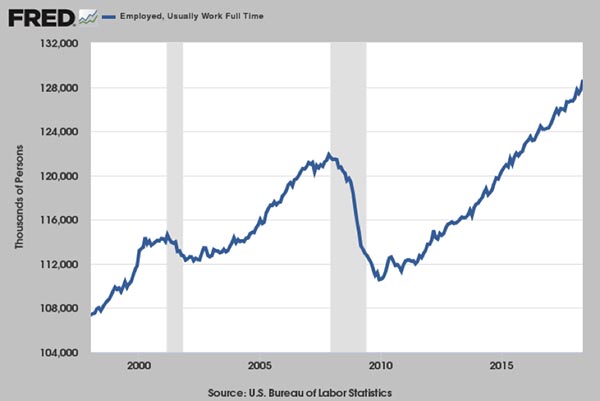
The May employment report was regarded as good, but when you dig past the top-level numbers, it was better than it looked. However, while the 3.8% unemployment rate looks good on the surface, it really can’t be compared to when it was last attained nearly 20 years ago. So many workers left the workforce that this figure implies a tighter labor than it really is. We will really know we have a strong economy when the active labor force starts increasing. Read More

Good News Could Be a Full-Time Job, but for Most Economists It’s Only Part-Time

Some people say that the news is always bad, and they wish someone would report good news now and then. There is good news but no one seems to report it. You’d think that would be a full time job for someone. The economy has set a record for full time employment, and all we hear are crickets. The economy has been doing better lately in some key measures of employment, but the Fed is scaring markets by preparing to raise rates. TINA, meet TAMA, the result of the Fed’s actions; don’t worry, we’ll explain it. The statisticians at the Commerce Department revised printing shipments data. Revising data seems to be a full time job in the Beltway. Dr. Joe clarifies it all for one nearly last time. Read More
Consumer Durable Goods Orders Moving at Almost 2X GDP Rate

Consumer Durable Goods Orders Moving at Almost 2X GDP Rate

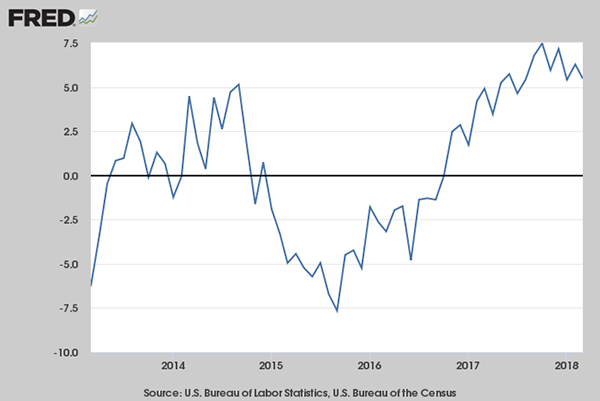
Durable goods orders for consumers (less transportation) are growing at a rate almost two times faster than Real GDP. This data series remains -14% below where it was at the start of the recession in December 2017, and is a critical one to monitor for indications of an improved economy. Read More