Perhaps we should start thinking of 2011 as the year of the "second transition." I've strongly suggested that printers and all those concerned about the success of printing businesses consider this as our second chance at 1994.
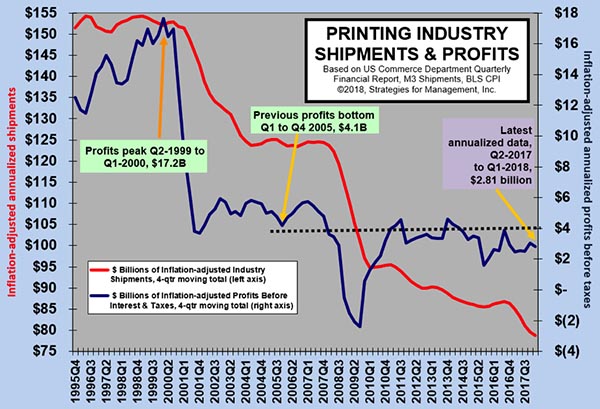
Back then we were worried about multimedia, digital printing, whether or not direct-to-plate would work, and how much of an impact waterless offset would have on improving the quality of offset printing. That all played out well, didn't it? The Internet started to cascade in 1995, and our industry was able to ride along for a little while, but it started to spin and careen so quickly, it got the better of us. Someone asked me what the effect of digital media was on printing. I asked, "What is it about $40+ billion a year of lost print that is so hard to understand?"
This year, 2011, is our chance to get 1994 right again, and have our eyes wide open for it.
There is some room for optimism. I find more print business owners are aware of the changes ahead than there were in 1994. Economist Thomas Schelling, in writing about Pearl Harbor, said the infamous attack was such a surprise because military planners and strategists "confused the unfamiliar with the improbable." That is, we usually construct our business plans based on our experiences and what we know. Those things that are not in our experience are unfamiliar and tend to be discounted. In the 1990s, it would have been something like: "Computers are slow, especially that dial-up stuff." Or: "Color is unreliable on monitors; digital media don't have the color rendering fidelity that print can have."
We all know what has happened since; and print business owners, especially the ones who lived through that period, have a practical and personal sense of what technological upheaval can be like. Many of them started from behind and got ahead, changing their businesses and offerings, finding different ways of competing.
We're still surely missing something, just like we did in 1994. But if we're wary and observant, we'll see it a lot earlier this time. I have seen quite a difference at the meetings where I have been speaking. More printers have iPhones; many have iPads. Last year, virtually no one had either, and most wondered why they should even have one.
Trends are forming around social media and mobile computing that indicate something radical may be happening. Some of the things I have been reading lately tell me that it's time to prepare to move with some urgency. Here are some of those trends.
Remember back when the Internet was was just beginning to gain strength, and the publishing business was relying on those aged 55+ to stick with their media choices and remain a vibrant, lucrative audience? Now those people are 70+. A Wall Street Journal article, "OMG! My Grandparents R My BFF!" explains how seniors are now a significant part of the digital media market. (If you can't decipher the title, you have some homework to do).
The author was about to discipline her children for being online too much when she realized, "My 9-year-old in our Philadelphia home was playing an online Scrabble game with his grandmother on her iPad two time zones away in Denver. My 11-year-old was video-chatting with his grandfather in Florida on Skype, a program I didn't even know we had. And my 14-year-old was checking in with his 'friends' on Facebook. And whom does he count among his 300-plus friends? His great-grandmother in Minneapolis." We've all seen teens texting in restaurants when they are out for a meal with their parents, but the author related a story from a grandmother: "A group of us was having dinner, and one woman had to tell her husband to put his iPod Touch away. He was emailing his grandchildren."
While high-speed communications were first seen in business organizations because they had the earliest and biggest financial benefit, the author quotes a professor and college housing administrator as saying that things are quite different now. "When the Baby Boomers went to college and moved away, we lost an entire generation of connection between grandparents and grandchildren. They saw each other once or twice a year, and there was a real disconnect... People say technology is so impersonal, but we are watching it being used to reconnect one of the most personal and important relationships of the species."
We've known this day has been coming for quite some time: paper Social Security checks are finally disappearing. The quote from the director of the Electronic Funds Transfer Division of the Treasury Department was quite interesting. He said, "...the government has been moving toward electronic deposits for years, but the changing senior demographic makes now an ideal time to go paperless." Why is that? He explains: "You have a demographic reaching retirement age who most likely used direct deposit in their work lives." It's not just direct deposit. This group that is retiring was about 50 years old in 1995 when Netscape went public. They may not have been the first users of the Internet, but they caught on when it started to be bundled with cable television service. They learned that they could research car purchases, arrange vacations and travel, and make retail purchases with great ease. Retirees have until March 1, 2013, to switch to direct deposit; it will pass with little notice because direct deposit and electronic banking are so ingrained.
This article from the Sacramento Business Journal underscores that use of the Internet has become virtually constant. The article states that as many as 35 percent of Android and iPhone users in the U.S. use non-voice applications on their smartphones while still in bed. And, among those users, most - 18 percent - opt to sign in to social networking sites such as Facebook or Twitter. In terms of demographics, the article states that about "...72.5 million people in the U.S. owned smartphones during the three months ending in March 2011, up 15 percent from the preceding three-month period." These and many other data are found in the 2011 Ericsson Consumer Lab Research study, which can be downloaded for free.
Finally, these data about consumers may not reflect where the action is for printers. We know that much of the printing industry, especially the sheetfed business, has relied on business-to-business printing for its much of its volume. Another Wall Street Journal article, "Drug Makers Use Digital Tools," relates how pharmaceutical companies are changing the size of their sales forces and the nature of their work, because of digital media.
Before I get to the details of the article, a little perspective might be helpful. In 2000, there were 13,506,880 jobs in sales or sales management, and numerous other sales positions, according to the Bureau of Labor Statistics. By May 2009, the number increased to 13,715,050. That was an increase of only +1.5% in that timeframe. That's compared to GDP growth of +13.8% for the period, and about 9% in population. Why did this happen? We're long past the time of calling a manufacturer or retailer for product information and having them mail something to us. We go to search engines and websites instead; no more sales call-backs or waiting for that promised brochure.
The travel agent line in that report showed a decline of about 50,000, a 40% drop in those workers. I mention that because we all know what has happened with e-commerce and the purchase of travel. Is that what's next for other sales channels? I don't know. But it should serve as a warning, because we know how printing-intensive travel marketing was. Did our industry get involved in the transformation of travel marketing? Not particularly; some print businesses have done some intriguing things with variable printing for travel marketers, but except for those, not much has happened. We now have a chance to involve ourelves in the transformation of other businesses. Back to the WSJ article, just look at what is happening in pharmaceuticals.
"Tens of thousands of pharmaceutical sales reps have been eliminated in the U.S., creating a void that drug makers are now increasingly filling with websites, iPad apps and other digital tools to interact with doctors who prescribe their treatments." That gets right to the point, doesn't it? The article continues, "Doctors can use the tools to ask questions about drugs, order free samples and find out which insurers cover certain treatments. Sometimes drug-company representatives will engage them in live chat or phone them back if they have more questions."
Doctors have always been a hard sell. They have little time, and though they have interest in professional development and learning about the latest technologies in therapies and treatments, they have to deal directly with patients and as well as manage their practices. The article says that these new approaches "...are designed to cut costs and to reach doctors in ways other than the traditional office visit [by a sales rep], which many busy physicians say they find intrusive and annoying." According to the report, 20% of physicians refused to meet with representatives in 2009, and that increased to 25% in 2010. A digital marketing agency with pharmaceutical clients says that 75% of industry visits fail to result in a face-to-face meeting. According to the article, "...widespread layoffs in the sector suggest that technology is replacing, not just supplementing, human reps."
According to research cited in the article, "72% of U.S. doctors own a smartphone, and 95% of them use it to download medical applications." The pharmaceutical companies are developing numerous iPhone and iPad applications, even some that are designed be used while delivering patient evaluations, treatments, and services.
Urgency... Again
The Apple iPad is selling about 3 million units per month, worldwide. At the end of this year, analysts expect that iPads and competitor sales of the many tablet PCs that will come to market later this year will hit 5 million per month. Already, tablet PCs are affecting sales of desktops and laptops. Netbook sales as a computing category are being relegated to "other" in reports. In addition, by the end of this year, smartphones will be even smarter and more capable, with growing sales.
The technology is running away from small and mid-sized businesses. They do not have the capability of keeping up with the kinds of customer, prospect, product, and marketing communications technologies that they need to stay current in a dynamically changing environment.
This summer, business will be slow for many printing businesses, as it usually is. Many will close for a week or two in July as they always have. What should we do with that time? I believe that years from now, 2011 will be viewed as a pivotal year for communications of all kinds. Knowing what you know now, what would you have done differently in 1994? This is our second chance. How will you spend your summer?
Continue reading your article
with a WhatTheyThink membership.