WhatTheyThink

Premium Commentary & Analysis

Wolfgang Pfizenmaier, Heidelberg

There were heavy hints at the recent Heidelberg Digital Imaging Association&

Wednesday, September 26, 2001

There were heavy hints at the recent Heidelberg Digital Imaging Association’s event to what Heidelberg would do for a remote proofing solution. Would the giant acquire one of the leading companies in this space, develop their on solution or continue to wait and watch adoption rates? The answer: RealTimeImage.

At PRINT 01, Heidelberg and RealTimeImage announced a joint development and distribution partnership that will result in Heidelberg's delivery of online proofing solutions to its partners, distributors and customers worldwide. The technology is called and branded as HDPROOF.

According to a statement from the show, “The combination of Heidelberg's renowned Color Management and RIP technologies, and RealTimeImage's patents-pending image streaming, online collaboration and proofing technologies, signals a great productivity leap for printers worldwide. The ability to review, measure, and collaborate over color and details in full resolution -- accurately, over the Internet -- and then produce precision inkjet hard-copies at any location, substantially accelerates the production cycle. Printers benefit with better control, less errors, and greatly reduced costs.

As their first “eService” to the industry, the alliance will be Heidelberg’s launching pad for more products and services for printers going forward.

Wolfgang Pfizenmaier, Heidelberg's Management Board Member responsible for digital solutions recently spoke to us about the implications of this partnership. While Mr. Pfizenmaier would not elaborate on financial details of the transaction, it is very clear that this arrangement is not a “soft announcement” with little impact to come. Pfizenmaier sees this deal as crucial and it will be aggressively marketed and deployed.


Interview Archive

Wolfgang, why did Heidelberg select RealTimeImage(RTI) and what other companies did you consider?

We looked at all possible partners and evaluated a variety of interesting concepts. We did a lot of customer surveys to shape our vision of how the "perfect" remote proofing solution should look like. RTI offered us the most mature technology together with a business model which fits best for our market.

From your research, what do users mean by "reliable on-line proofing?" What are they looking for here?

Our customers have sophisticated expectations when they talk about remote proofing. They expect more than just exchanging PDFs or using low resolution compression. The Pixel Streaming technology of RTI seems to fit best to our requirements for a high quality complete remote proofing solution. A customer can double-check even the smallest details; and due to the fact that he sees the final interpreted files, he can be sure to obtain the same result on the plate.

Tell us how this really works.

Usually, print providers upload files to the ASP. Here we are using SSL standards, so we can offer the same security level as that used for online banking. Once the file is uploaded, everyone who is invited to access can view the file, zoom in to see details, check separations and/or overprints.

Supertrap and Prinergy users can even check the traps. All annotations are made on the same "master file." And they are visible to all invited users, right after a new annotation has been made. Of course, people who are offline are informed with an email notification. Users can have different roles and rights in accordance with the whole approval process. All of this information is tracked and can be exported. For comparing changes, we offer a versioning tool as well. If requested, users can connect a remote hardcopy proofing device and download the pages or images they prefer to proof out on their site.

Tell us about calibration from the end user's equipment to get the needed results from HDPROOF.

There are two points our customers are usually concerned about when it comes to proofing: a true color match and a very high level of consistency between proof and press sheet. For the color match, the fact that we'll use the Heidelberg Color Management technology will allow us to add ICC profiles to the files. A possible scenario: the print provider embeds his press ICC profile in the upload file together with his actual image data and the print buyer will just choose his preferred proofing device, which could be also a monitor (graphic arts standard) and add the requested proof ICC profile.

For data consistency, the print provider can upload data which have already passed the RIP process and thus have the highest degree of consistency with the final output to press, because these final data will go through the very same process of ripping, with the very same set of parameters. Thus, inconsistency due to different flavors of PostScript interpreters can be excluded.

From speaking with contacts from both sides, the arrangement with RTI is much more than a simple, surface marketing agreement. Tell us about your specific plans to integrate this solution as a solid product in the Heidelberg suite of services and products.

Heidelberg will combine the Streaming technology from RTI with Heidelberg's RIP and CMM technology. This will allow us, for example, to add ICC-profiles for the viewing and of course for the Remote Hardcopy proofing. And when you imagine even more Ripping functionality on an ASP, it allows you to think about new ways of production and the way printers will work together with their clients.

Remote proofing will not be the only eService we offer. Heidelberg plans to launch an ePortal for Printers next year, which will provide an array of further services for our customers.

Is the product already integrated and ready to be sold?

Even before we actually signed the partnership with RTI our engineers started to share ideas. We plan to have the first version ready to be sold within the next several months.

How easy will it be for Delta, Prinergy and other users to switch to this solution?

We are using a sophisticated hot folder technology: for example, Prinergy users just address the hot folder for the file upload within a standard process plan. We see Remote Proofing as an addition to Delta, MetaDimension and Prinergy. It can be connected to all workflow and RIP solutions Heidelberg is selling.


Continue reading your article
with a WhatTheyThink membership.

WhatTheyThink Annual Membership

Less than $4/week.

Get unlimited access to in-depth commentary and analysis covering the latest trends, emerging technologies, operational strategies, and key events across every segment of today's printing industry.

Stay informed. Stay competitive. Stay ahead.
WhatTheyThink Day Pass

$5 for 24 hours

Unlimited access to all of WhatTheyThink. Get your Day Pass

Already a member?
Sign In

About WhatTheyThink

WhatTheyThink is the global printing industry's go-to information source with both print and digital offerings, including WhatTheyThink.com, WhatTheyThink Email Newsletters, and the WhatTheyThink magazine. Our mission is to inform, educate, and inspire the industry. We provide cogent news and analysis about trends, technologies, operations, and events in all the markets that comprise today's printing and sign industries including commercial, in-plant, mailing, finishing, sign, display, textile, industrial, finishing, labels, packaging, marketing technology, software and workflow.

Recent Articles from WhatTheyThink

Around the Web: Of Books and Bots

Around the Web: Of Books and Bots

New book “Empire of Ink” is a look at the history and mythology of the American newspaper. A hacked smart lightbulb provides access to banned books. A digital archive reassembles Leonardo da Vinci’s long-cut-apart notebooks. Michelangelo’s secret underground hiding place—complete with the artist’s graffiti. Marie Antoinette may have been history’s first influencer. A worn copy of a 1912 pulp magazine featuring Tarzan sold at auction for $58,560. New book, “The Graphene Handbook - Making Sense of Graphene at Its Inflection Point.” Visa is integrating its payment network into ChatGPT, which should be fun. A humanoid robot plans to climb Everest. A designer who specializes in chairs without legs. Did a flying monk see Halley’s Comet…twice? The British geologist whose goal was to eat as many different animals as he possibly could. Welcome to WhatTheyThink’s weekly miscellany. Read More
Publishing Establishments—2010–2023

Publishing Establishments—2010–2023

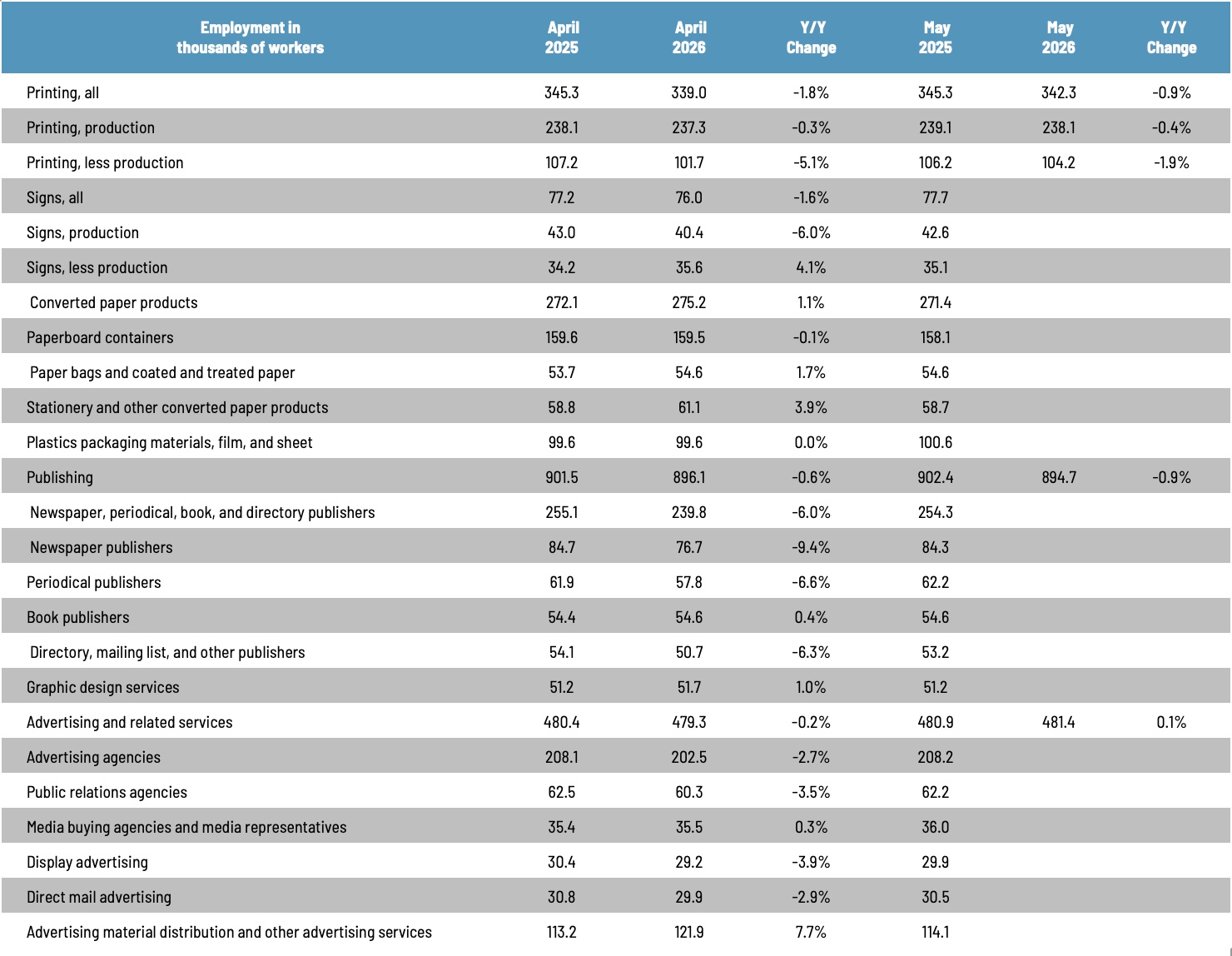
According to the latest, recently released edition of County Business Patterns, in 2023 there were 32,332 establishments in NAICS 511 (Publishing Industries [except Internet]). This represents an increase of 15% since 2010. In macro news, the University of Michigan’s Consumer Sentiment Index is at record lows. Read More

Finishing: Production Inkjet's Next Frontier

Finishing: Production Inkjet's Next Frontier

As production inkjet has advanced, a new primary factor limiting productivity has emerged: finishing. How are PSPs adapting their investment and automation strategies? New research shows many can gain a competitive advantage by focusing on finishing. Read More

HanGlobal Launches New LabStar 330mini at Flexo & Labels Expo 2026

HanGlobal Launches New LabStar 330mini at Flexo & Labels Expo 2026

Discover HanGlobal's newly launched LabStar 330mini digital label press! Get the full show roundup to see how this ultra-integrated, high-performance inkjet solution captured the crowd's attention and redefined narrow-web printing. Read More

Around the Web: Of Food and Feynman

Around the Web: Of Food and Feynman

A book designer who specializes in spine design. The Chinese postal service is using humanoid robots to sort packages. An amusingly overproduced Day Display. Allen Ginsberg’s spoken-word poetry recitation album is being reissued. The winners of this year’s World Food Photography Awards. A retired geneticist launched the online Museum of Plugs & Sockets. A viral warning about a new gas station scam is actually a hoax. What is the world’s longest domestic flight? Aw, et tu, graphene: Skeleton Technologies launches graphene-based GrapheneUPS for AI data centers. What is the quietest spot in the U.S.? Researchers finally cracked Richard Feynman’s “Restaurant Problem.” Malaysia’s kek lapis Sarawak is perhaps the world’s most complex cake. Welcome to WhatTheyThink’s weekly miscellany. Read More