WhatTheyThink

Premium Commentary & Analysis

Darlene Sobers, The Reliable Corporation

Darlene Sobers has been in the production area of the print business for over 20 years.

Saturday, August 25, 2001

Darlene Sobers has been in the production area of the print business for over 20 years. Previous to her 6 years with Reliable, she was with a privately-owned collectible company for 12 years handling the production of their catalogs. Previous to the collectible company Darlene spent 5 years at an industrial manufacturer purchasing catalogs, sell sheets and binders for the sales staff.

The year was 1917 - a sign reading "Reliable Stationery Co." was first raised above a Monroe Street entrance in downtown Chicago, and Reliable was born as a small contract stationer with a dedicated sales force. In 1937, the company was purchased by the Zenner family and renamed "The Reliable Corporation." In the 1960s, Reliable continued as a contract stationer but began looking into new ways to serve its customers better. They decided to dabble in direct response by creating catalogs to be mailed to current and new customers.

In May 1994, Reliable was sold to Boise Cascade Corporation and the following year became a subsidiary of Boise Cascade Office Products. The sale allowed Reliable and its customers to enjoy the resources of a larger company--one that now has 12,000 employees and sales of over $3.4 billion. Today, Reliable is proud to be one of America's largest direct marketer of office products.

Darlene Sobers is the Catalog Production Manager for Reliable.


Interview Archive

Darlene, tell us about the scope of Reliable’s reach.

We have approximately 500,000 active customers and ship out of 11 distribution centers across the country. We process and ship 3 million orders a year. We print over 10 catalog titles, such as, General, Customer, Furniture, Computer, etc. Our in-house advertising department will process thousands of pages a year for our catalog titles. The Catalog Production department is responsible for negotiating contractual agreements with our vendors, purchasing paper for our catalogs, monitoring the workflow of catalog pages from inception to mail and preparation and maintenance of our catalog costs.

How do you track all the pages and details needed to produce your catalogs?

We recently created a new position "Media Coordinator" who is responsible for scheduling and tracking the flow of our thousands of catalog pages each year. At present, this is a semi-automatic process. Even with this process, we have been able to conduct a time study to determine the length of time and cost involved in each step of this process to complete a catalog page. We are investigating new software/systems to automate this process in order to plan our catalog page flow more evenly, provide more detailed time study analysis and cost per page analysis. The addition of this new job function has helped us focus how to improve the process and work as a team to complete each catalog.

What about remote proofing, will that become part of your workflow?

Investigating remote proofing at our location with our pre-press vendor. We would send all information via a secured internet site and the completed proof would be sent to us immediately upon completion. This would save time for both companies and reduce our production cycle.

What is your proofing process now?

We have a Advertising department which will create copy and place images on the catalog page. We than send a laser proof with our digital file to the pre-press vendor who will rip, trap and furnish a Kodak Approval for a color OK. We also proof our pages on the type of stock we use to print our catalogs. This gives us a better understanding of how products will look on the printed page. The Kodak Approval, digital file and blueline in page sequence are sent to the printer who will create plates or roto cylinders to print our catalogs. We either photograph new products or the vendor will furnish a transparency or digital file for our use. We will have the pre-press vendor scan and supply a random for approval. They will furnish a JPEG which is what we use to place on our catalog page.

Being a large paper and print customer, how important is it for these vendors to be on the “same page?”

A knowledgeable customer service rep is the most valuable asset a printer or paper merchant can offer a customer. The Reliable Corporation has long standing partnerships with our current printers and paper merchant. Our customer service reps at both printers are very knowledgeable and flexible in scheduling a last minute change. Our paper merchant is always there for us when we need additional paper or want to select another type of paper. We have been able to project our estimated production information - catalog quantity, page count, mail date - to our current suppliers so they can plan paper usage, press time and bindery time to meet our mail date. Both parties need to be aware they are a team (at different companies) working towards a mutual goal.

The demise of mass printed catalogs - Do you see it happening?

Even though you are mailing catalogs to thousands of people, you need to speak one-to-one with each customer whether that is in the business to business or consumer world. There will be more focus to reduce the cost of one-to-one personalization for catalogs now and in the future.

What value does the Internet bring to the process of producing the catalog?

Computers and the internet are wonderful to research information, however I don't believe you can totally eliminate the human factor in communication. That's what we are talking about, communicating with our customers. I view the internet as an enhancement to our printed catalog. It is another tool for customers to communicate with their supplier. At this point, I don't see my company using this tool to place orders for print or paper.

Your catalog is your business - Tell us about the trust factor with your printers.

Create and maintain a long term partnership with your vendors. Building this trust factor takes time and diligence from both parties. But also be open with them when you are quoting another source on a project. They will understand and respect your decision. Business is business.


Continue reading your article
with a WhatTheyThink membership.

WhatTheyThink Annual Membership

Less than $4/week.

Get unlimited access to in-depth commentary and analysis covering the latest trends, emerging technologies, operational strategies, and key events across every segment of today's printing industry.

Stay informed. Stay competitive. Stay ahead.
WhatTheyThink Day Pass

$5 for 24 hours

Unlimited access to all of WhatTheyThink. Get your Day Pass

Already a member?
Sign In

About WhatTheyThink

WhatTheyThink is the global printing industry's go-to information source with both print and digital offerings, including WhatTheyThink.com, WhatTheyThink Email Newsletters, and the WhatTheyThink magazine. Our mission is to inform, educate, and inspire the industry. We provide cogent news and analysis about trends, technologies, operations, and events in all the markets that comprise today's printing and sign industries including commercial, in-plant, mailing, finishing, sign, display, textile, industrial, finishing, labels, packaging, marketing technology, software and workflow.

Recent Articles from WhatTheyThink

Around the Web: Of Books and Bots

Around the Web: Of Books and Bots

New book “Empire of Ink” is a look at the history and mythology of the American newspaper. A hacked smart lightbulb provides access to banned books. A digital archive reassembles Leonardo da Vinci’s long-cut-apart notebooks. Michelangelo’s secret underground hiding place—complete with the artist’s graffiti. Marie Antoinette may have been history’s first influencer. A worn copy of a 1912 pulp magazine featuring Tarzan sold at auction for $58,560. New book, “The Graphene Handbook - Making Sense of Graphene at Its Inflection Point.” Visa is integrating its payment network into ChatGPT, which should be fun. A humanoid robot plans to climb Everest. A designer who specializes in chairs without legs. Did a flying monk see Halley’s Comet…twice? The British geologist whose goal was to eat as many different animals as he possibly could. Welcome to WhatTheyThink’s weekly miscellany. Read More
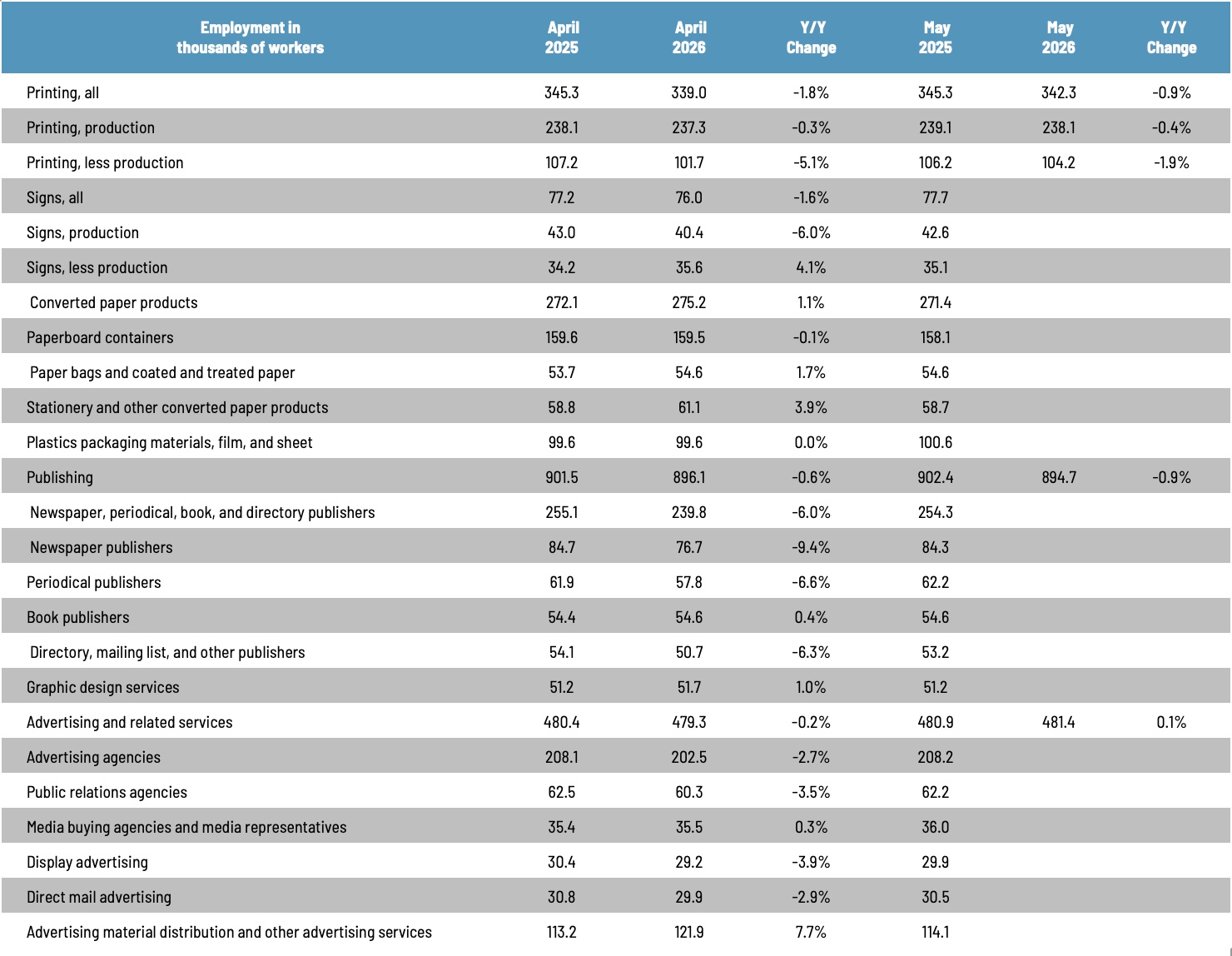
Publishing Establishments—2010–2023

Publishing Establishments—2010–2023

According to the latest, recently released edition of County Business Patterns, in 2023 there were 32,332 establishments in NAICS 511 (Publishing Industries [except Internet]). This represents an increase of 15% since 2010. In macro news, the University of Michigan’s Consumer Sentiment Index is at record lows. Read More

Finishing: Production Inkjet's Next Frontier

Finishing: Production Inkjet's Next Frontier

As production inkjet has advanced, a new primary factor limiting productivity has emerged: finishing. How are PSPs adapting their investment and automation strategies? New research shows many can gain a competitive advantage by focusing on finishing. Read More

HanGlobal Launches New LabStar 330mini at Flexo & Labels Expo 2026

HanGlobal Launches New LabStar 330mini at Flexo & Labels Expo 2026

Discover HanGlobal's newly launched LabStar 330mini digital label press! Get the full show roundup to see how this ultra-integrated, high-performance inkjet solution captured the crowd's attention and redefined narrow-web printing. Read More

Around the Web: Of Food and Feynman

Around the Web: Of Food and Feynman

A book designer who specializes in spine design. The Chinese postal service is using humanoid robots to sort packages. An amusingly overproduced Day Display. Allen Ginsberg’s spoken-word poetry recitation album is being reissued. The winners of this year’s World Food Photography Awards. A retired geneticist launched the online Museum of Plugs & Sockets. A viral warning about a new gas station scam is actually a hoax. What is the world’s longest domestic flight? Aw, et tu, graphene: Skeleton Technologies launches graphene-based GrapheneUPS for AI data centers. What is the quietest spot in the U.S.? Researchers finally cracked Richard Feynman’s “Restaurant Problem.” Malaysia’s kek lapis Sarawak is perhaps the world’s most complex cake. Welcome to WhatTheyThink’s weekly miscellany. Read More