WhatTheyThink

Premium Commentary & Analysis

Elaine Wilde, XEROX

Elaine Wilde is the senior vice president and general manager of the Worldwide Graphic Arts Business at Xerox.

Wednesday, July 18, 2001

Elaine Wilde is the senior vice president and general manager of the Worldwide Graphic Arts Business at Xerox. She has been with Xerox for 25 years, and has worked a variety of sales, marketing, and general management positions, many of which touched on the graphic arts industry. Most recently, Elaine was vice president of marketing and strategy for Public Sector Operations, which markets to government and educational institutions. Other positions she has held include:

Vice president of U.S. Industry Marketing, where Elaine created a graphic arts customer council and a new marketing position to address graphic arts customers.

Vice president of the Solutions and Services Business, where she led the development and deployment of document management and production print solutions.

Vice president and general manager for Baltimore-Washington Operations, where she created and managed two dedicated Graphic Arts teams that integrated sales and support also as Vice president of quality for Xerox Engineering Systems.


Interview Archive

Describe Xerox's services in terms of a corporate focus versus print provider focus.

Many of Xerox’s solutions and services are relevant to both corporations and print providers. So, while our print provider offerings are geared specifically to boosting the profitability of graphic arts firms, many also find useful lives inside corporations. The digital book production solutions that commercial printers and publishers use to produce paperback books can be tied into an enterprise resource planning system at a manufacturing company to produce just-in-time product manuals, for example.

Part of what differentiates our corporate and print provider services is the way they are tailored by our sales and analyst staffs, which have expertise in the various industries they serve.


The graphic arts business is a major portion of Xerox’s business. As their new worldwide leader, what are your immediate plans?

The graphic arts business is one of the great recent successes for Xerox and Xerox customers, and my goal is to make it even more successful moving forward. What’s at stake for our customers is the ongoing transformation of what we call the new business of printing - the influx of digital technologies that enable just-in-time, one-to-one marketing and e-services. Xerox is a leader in helping graphic arts providers to profit and grow by making this transition, and my goal is to make our offerings even more valuable to them.

We will accomplish this by continuing to work through our current five market segments which address creative services, commercial printers and prepress, quick and franchise printers, data center service bureaus and publishers. We will continue to develop partnerships modeled after those we have with Imation for digital color proofing and Presstek for digital offset presses, to meet specialized needs in these markets and to broaden our offerings. And, naturally, we will make the most of the Xerox product and solutions portfolio, which will soon break new ground with the FutureColor offering.

I also would like to stress that Xerox is totally committed to the graphic arts marketplace. Our graphic arts operation is a $3 billion business — which would make it the world’s second largest graphic arts firm if it were a separate company — and it is one of the key strategic organizations for delivering the major planks of the New Xerox, including color output capabilities and solutions and services. It’s definitely an exciting time to lead this business unit.

Explain the process of selling office equipment and offering print services to corporate clients and the partnering or selling similar solutions to print providers. Is there a conflict and how does Xerox deal with this?

Most businesses have conflicts of one kind or another, and yes, there are some potential conflicts in our corporate and graphic arts relationships. However, as we have increased our commitment to the graphic arts market in recent years, we have been working with out customers to address the issue. Specifically, we are reducing our deployment of Document Technology Centers (DTCs), which we established several years ago in response to market demand for off-site outsourcing of printing and, more recently, entire business processes.


Continue reading your article
with a WhatTheyThink membership.

WhatTheyThink Annual Membership

Less than $4/week.

Get unlimited access to in-depth commentary and analysis covering the latest trends, emerging technologies, operational strategies, and key events across every segment of today's printing industry.

Stay informed. Stay competitive. Stay ahead.
WhatTheyThink Day Pass

$5 for 24 hours

Unlimited access to all of WhatTheyThink. Get your Day Pass

Already a member?
Sign In

About WhatTheyThink

WhatTheyThink is the global printing industry's go-to information source with both print and digital offerings, including WhatTheyThink.com, WhatTheyThink Email Newsletters, and the WhatTheyThink magazine. Our mission is to inform, educate, and inspire the industry. We provide cogent news and analysis about trends, technologies, operations, and events in all the markets that comprise today's printing and sign industries including commercial, in-plant, mailing, finishing, sign, display, textile, industrial, finishing, labels, packaging, marketing technology, software and workflow.

Recent Articles from WhatTheyThink

Around the Web: Of Books and Bots

Around the Web: Of Books and Bots

New book “Empire of Ink” is a look at the history and mythology of the American newspaper. A hacked smart lightbulb provides access to banned books. A digital archive reassembles Leonardo da Vinci’s long-cut-apart notebooks. Michelangelo’s secret underground hiding place—complete with the artist’s graffiti. Marie Antoinette may have been history’s first influencer. A worn copy of a 1912 pulp magazine featuring Tarzan sold at auction for $58,560. New book, “The Graphene Handbook - Making Sense of Graphene at Its Inflection Point.” Visa is integrating its payment network into ChatGPT, which should be fun. A humanoid robot plans to climb Everest. A designer who specializes in chairs without legs. Did a flying monk see Halley’s Comet…twice? The British geologist whose goal was to eat as many different animals as he possibly could. Welcome to WhatTheyThink’s weekly miscellany. Read More
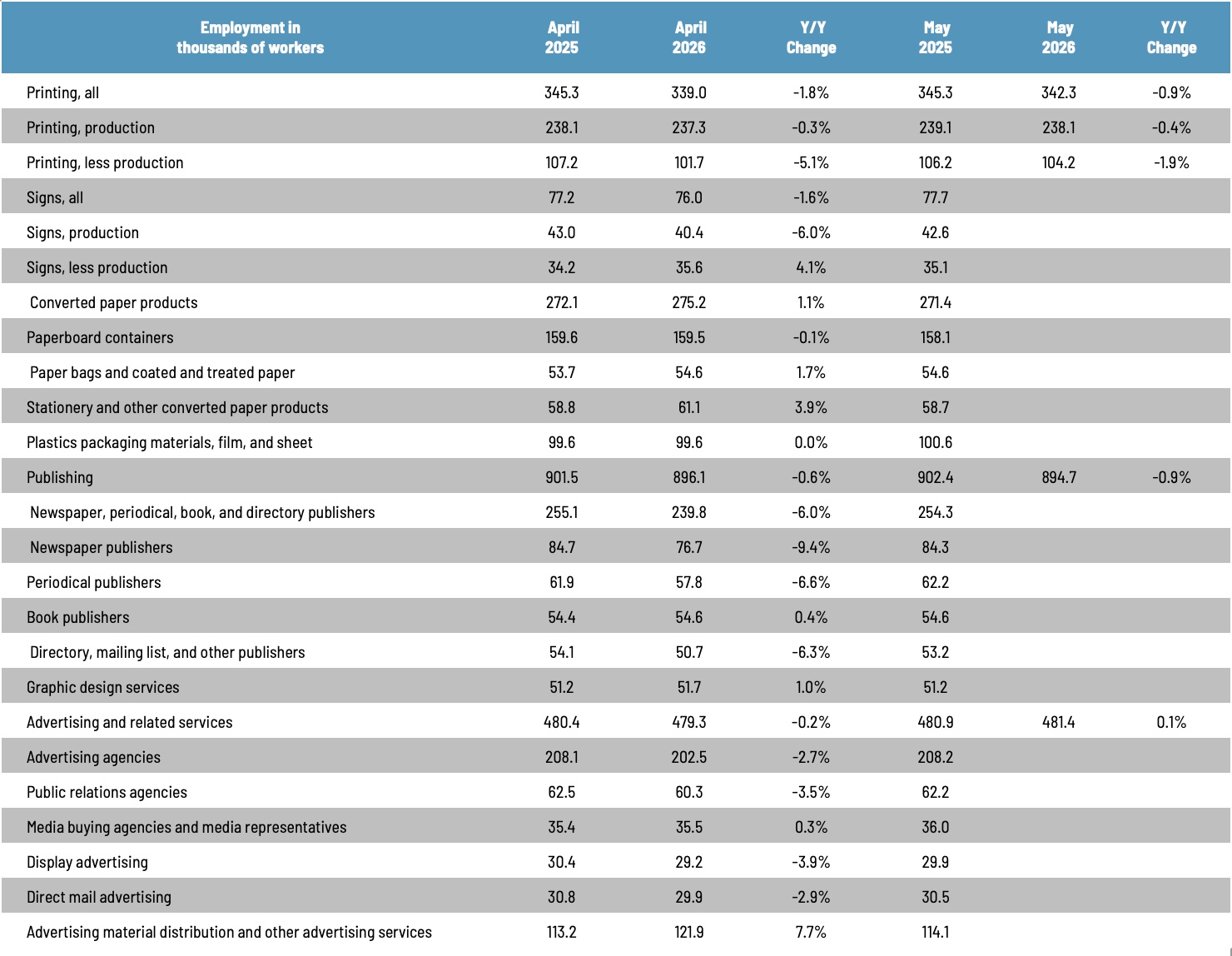
Publishing Establishments—2010–2023

Publishing Establishments—2010–2023

According to the latest, recently released edition of County Business Patterns, in 2023 there were 32,332 establishments in NAICS 511 (Publishing Industries [except Internet]). This represents an increase of 15% since 2010. In macro news, the University of Michigan’s Consumer Sentiment Index is at record lows. Read More

Finishing: Production Inkjet's Next Frontier

Finishing: Production Inkjet's Next Frontier

As production inkjet has advanced, a new primary factor limiting productivity has emerged: finishing. How are PSPs adapting their investment and automation strategies? New research shows many can gain a competitive advantage by focusing on finishing. Read More

HanGlobal Launches New LabStar 330mini at Flexo & Labels Expo 2026

HanGlobal Launches New LabStar 330mini at Flexo & Labels Expo 2026

Discover HanGlobal's newly launched LabStar 330mini digital label press! Get the full show roundup to see how this ultra-integrated, high-performance inkjet solution captured the crowd's attention and redefined narrow-web printing. Read More

Around the Web: Of Food and Feynman

Around the Web: Of Food and Feynman

A book designer who specializes in spine design. The Chinese postal service is using humanoid robots to sort packages. An amusingly overproduced Day Display. Allen Ginsberg’s spoken-word poetry recitation album is being reissued. The winners of this year’s World Food Photography Awards. A retired geneticist launched the online Museum of Plugs & Sockets. A viral warning about a new gas station scam is actually a hoax. What is the world’s longest domestic flight? Aw, et tu, graphene: Skeleton Technologies launches graphene-based GrapheneUPS for AI data centers. What is the quietest spot in the U.S.? Researchers finally cracked Richard Feynman’s “Restaurant Problem.” Malaysia’s kek lapis Sarawak is perhaps the world’s most complex cake. Welcome to WhatTheyThink’s weekly miscellany. Read More