WhatTheyThink

Premium Commentary & Analysis

Marc Gudema, President of Business Card Express

Business Card Express (

Wednesday, April 11, 2001

Business Card Express (BCE) is the largest trade printer of business cards and stationery in New England. A few years ago, the company decided that Internet ordering of these items offered so many advantages that it would be the preferred way to order these items for large corporations. BCE developed an E-PrintOrder system that is the premium application for ordering corporate business cards and stationery via the Internet. The firm continues to add features to the application and equipment to increase the types of printing they can offer.

After earning a BA and MBA degrees at the University of Michigan, Marc Gudema began his career in business. Prior to owning Business Card Express, he owned a distribution business for 15 years.


Interview Archive

Marc, tells us about your revenue and physical size of your company.

Our revenues are projected at $3 million this year. We employ 35 people. We process over 1,000 Internet based orders per month. Although our Internet ordering system is generating the majority of our growth, we also have a significant amount of business generated by conventional methods. We have focused on selling through distributors because we recognize that their relationship with the corporate customer is a key element in our obtaining the business.

Did you actually build your E-PrintOrder system or is it part of another ASP?

We developed our E-PrintOrder application, rather than use an ASP, because it allowed us to develop an application that is tightly integrated with our production process. This offered benefits to our users and us. For example, we offer UPS tracking information and masters inventory status. ASPs typically do not offer this because it requires an integration with the printer that they do not have.

Have you invested more in your on-line software or production ability?

We continue to invest in software development to enhance our E-PrintOrder application. This has paid off in an increase in sales plus a reduction in our costs. We have been direct-to-plate for several years in our pre-press department and recently upgraded our computers. We are on a high-speed DSL connection and are completely networked internally.

In addition to continuing to add features to the E-PrintOrder system, we plan to increase our ability to accept electronic orders from other Internet ordering systems. We are also going to add equipment, software, and more employees to increase our process color printing capabilities.

Our Internet-based orders are proofed before they are submitted. When a customer wants a proof of a conventional order, we use faxes. We would like to implement an Internet-based proofing system and are looking at options in this area.

Are you satisfied with the overall relationship you have with your suppliers?

We have excellent relationships with our vendors and service technicians and have used the same sources for several years.

With electronic communication on the rise, is the demand for corporate identity products decreasing?

Stationery (printing) is declining due to the increased use of e-mail. We have not seen any drop in business card orders due to any electronic substitute.

As a print firm who has examined e-production technology, what advice would you offer a printer?

There are substantial differences in the applications I have seen and many customers are not knowledgeable about the features they need. The leading print E-commerce application is ordering business cards. Our application is an easy, cost-effective solution. Many end-users are not looking for more than this. Before buying into an expensive system that will allow your customer to order many items, be sure that they want it and will use it. Don't assume that the companies with the biggest PR efforts have the best systems. Try the systems out. Ease of use is very important.

Does BCE's system work with other platforms that a printer may be using?

We have XML capabilities in our software that allows us to communicate electronically with a customer's accounting software.

For a company selling mostly to printers, what is the best way to reach them?

We have found regional trade shows to be an effective way to reach new customers. I find that they are most effective if you do the pre-selling as well as follow-up. We also use national trade shows, advertising, and direct sales contacts.

Do you have tips for print buyers ordering business cards?

Yes, put the design efforts into the master and keep the imprint simple - preferably black. Black imprints show off the design of the master better, are printed quickly, and are inexpensive. A fancy design can be done at a reasonable cost if it is mastered in large quantities.

Marc, thank you for detailing your business.


Continue reading your article
with a WhatTheyThink membership.

WhatTheyThink Annual Membership

Less than $4/week.

Get unlimited access to in-depth commentary and analysis covering the latest trends, emerging technologies, operational strategies, and key events across every segment of today's printing industry.

Stay informed. Stay competitive. Stay ahead.
WhatTheyThink Day Pass

$5 for 24 hours

Unlimited access to all of WhatTheyThink. Get your Day Pass

Already a member?
Sign In

About WhatTheyThink

WhatTheyThink is the global printing industry's go-to information source with both print and digital offerings, including WhatTheyThink.com, WhatTheyThink Email Newsletters, and the WhatTheyThink magazine. Our mission is to inform, educate, and inspire the industry. We provide cogent news and analysis about trends, technologies, operations, and events in all the markets that comprise today's printing and sign industries including commercial, in-plant, mailing, finishing, sign, display, textile, industrial, finishing, labels, packaging, marketing technology, software and workflow.

Recent Articles from WhatTheyThink

Around the Web: Of Books and Bots

Around the Web: Of Books and Bots

New book “Empire of Ink” is a look at the history and mythology of the American newspaper. A hacked smart lightbulb provides access to banned books. A digital archive reassembles Leonardo da Vinci’s long-cut-apart notebooks. Michelangelo’s secret underground hiding place—complete with the artist’s graffiti. Marie Antoinette may have been history’s first influencer. A worn copy of a 1912 pulp magazine featuring Tarzan sold at auction for $58,560. New book, “The Graphene Handbook - Making Sense of Graphene at Its Inflection Point.” Visa is integrating its payment network into ChatGPT, which should be fun. A humanoid robot plans to climb Everest. A designer who specializes in chairs without legs. Did a flying monk see Halley’s Comet…twice? The British geologist whose goal was to eat as many different animals as he possibly could. Welcome to WhatTheyThink’s weekly miscellany. Read More
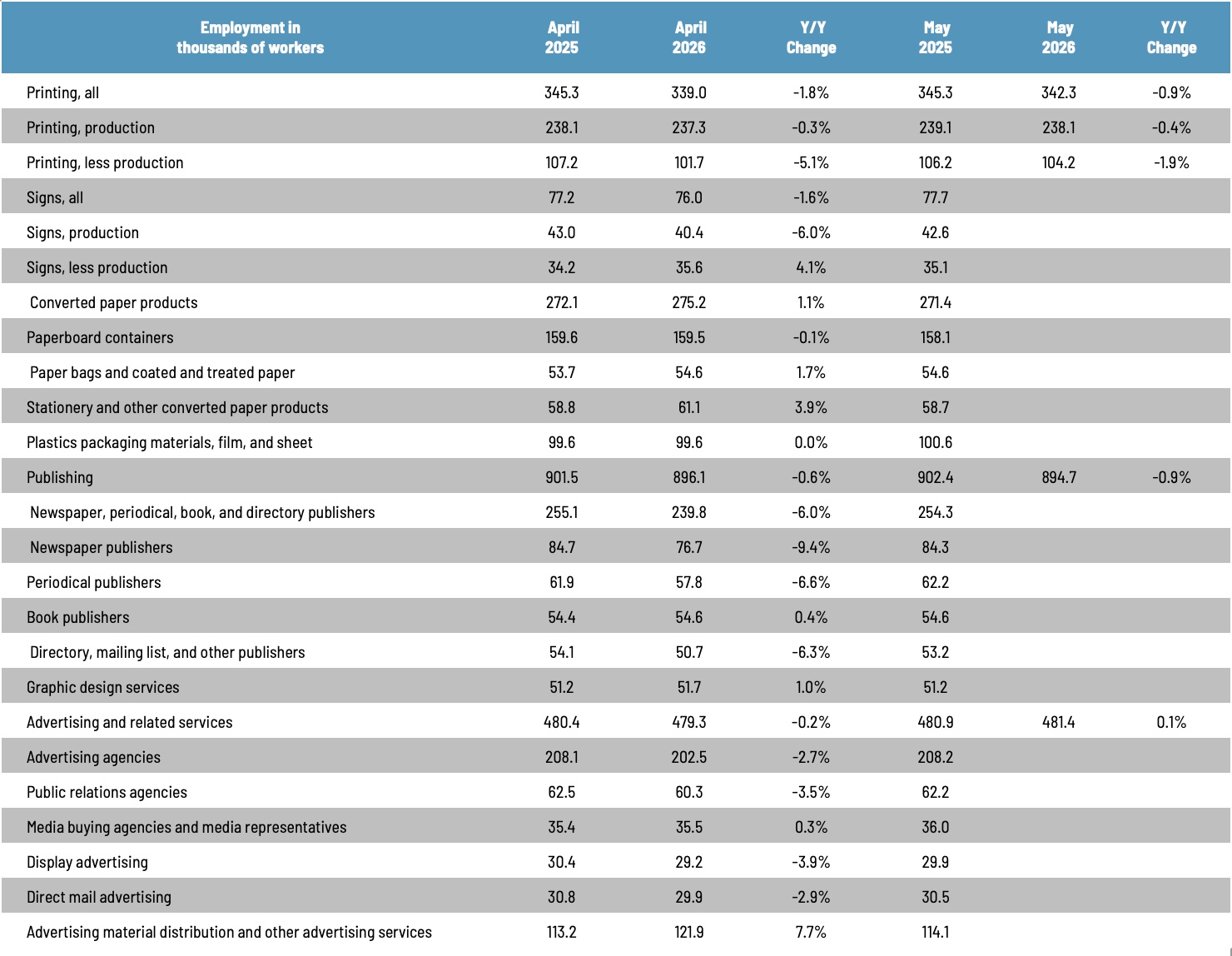
Publishing Establishments—2010–2023

Publishing Establishments—2010–2023

According to the latest, recently released edition of County Business Patterns, in 2023 there were 32,332 establishments in NAICS 511 (Publishing Industries [except Internet]). This represents an increase of 15% since 2010. In macro news, the University of Michigan’s Consumer Sentiment Index is at record lows. Read More

Finishing: Production Inkjet's Next Frontier

Finishing: Production Inkjet's Next Frontier

As production inkjet has advanced, a new primary factor limiting productivity has emerged: finishing. How are PSPs adapting their investment and automation strategies? New research shows many can gain a competitive advantage by focusing on finishing. Read More

HanGlobal Launches New LabStar 330mini at Flexo & Labels Expo 2026

HanGlobal Launches New LabStar 330mini at Flexo & Labels Expo 2026

Discover HanGlobal's newly launched LabStar 330mini digital label press! Get the full show roundup to see how this ultra-integrated, high-performance inkjet solution captured the crowd's attention and redefined narrow-web printing. Read More

Around the Web: Of Food and Feynman

Around the Web: Of Food and Feynman

A book designer who specializes in spine design. The Chinese postal service is using humanoid robots to sort packages. An amusingly overproduced Day Display. Allen Ginsberg’s spoken-word poetry recitation album is being reissued. The winners of this year’s World Food Photography Awards. A retired geneticist launched the online Museum of Plugs & Sockets. A viral warning about a new gas station scam is actually a hoax. What is the world’s longest domestic flight? Aw, et tu, graphene: Skeleton Technologies launches graphene-based GrapheneUPS for AI data centers. What is the quietest spot in the U.S.? Researchers finally cracked Richard Feynman’s “Restaurant Problem.” Malaysia’s kek lapis Sarawak is perhaps the world’s most complex cake. Welcome to WhatTheyThink’s weekly miscellany. Read More