WhatTheyThink

Premium Commentary & Analysis

Don’t Do It All at Once: Build Digital Workflow One Step at a Time

Companies are taking their documents and the processes that produce them far more seriously.

Friday, March 08, 2002

Companies are taking their documents and the processes that produce them far more seriously. "It's not just 'print, mail and insert' anymore. Now documents are seen as a moment of contact with customers," notes UPS Mail Innovations COO John Kuiper. To create the personalized communication essential to customer relationship building, document professionals must build applications to drive customization. Then they must reach customers with a quality product and fast time to market. Companies are automating all this because it is the only way to manage it, according to Kuiper. The good news is you don't have to tackle this all at once. In fact, it may be best not to.

Companies can go as deeply and quickly into digital workflow as they wish, but many start small and build as they grow. This works because most links in the chain of turning digits into documents are modular, allowing companies to build on their workflow as they acquire the ability and knowledge. A staged implementation provides a smooth way to transition to a new process and get buy-in from the organization as users see a more streamlined workflow, suggests Ann Jurczyk, vice president of Group 1 Software (g1.com).

Many companies are doing partial implementation because they can't afford to throw away all their processes and start from scratch. "They may apply digital workflow to pieces of the process, rather than creating a full uninterrupted on demand system right away," explains Jerry DeRome, manager of on demand technologies for Bell & Howell Mail and Messaging Technologies (BellHowell.com). "Many are transmitting their most volatile products to digital workflow, and starting with these short runs lets operations get processes nailed down as they work towards true on demand digital workflow."

"Organizations should focus on finding their 'pain points' in their current document workflow by looking for the areas where the greatest inefficiencies lie, then attack them on a business case-driven basis." says Dave Squires, vice president of Sefas Innovation, Inc. (sefas.com).

Standards Keep It Compatible
"You want to invest in something that is structured in building block mode so you can add as you grow or need, but it all has to be compatible, and this is where open architecture and standards for systems, file types, networks etc. must be considered," explains Robert Raus, director of solutions marketing for Océ Printing Systems (oceprinting.com).

"If you start wherever the expertise is, you can then expand your scope into other areas and be relatively sure you will have connectivity, that files will transfer, and you can ship things around or output to web or CD, and it is open standards that allow you to do this," Raus adds. "In publishing environments especially, things are already pretty compatible. Even with Macs, in this market users are able to cross platforms, connect different devices, share image files, and address different PDLs like PostScript level 2 or 3, TIFF, JPEG and HTML."

Remember the People in the Workflow
"Any time you change business processes, the technology is one thing but the biggest hurdle with change is people," declares Allan Sullivan, IBM Printing Systems Division manager of consulting and integration services (ibm.com). "Although the company may want everything right away, people cannot absorb it. Operators don't know what to do with it.

"Digital workflow should be implemented in stages. This lets operations people gain experience in an evolutionary process, not a revolutionary one. The complete production process as well as the production staff must be considered. The approach of a workflow 'backbone' with modular capabilities -- even from multiple vendors -- that can be snapped on and off results in a single interface that is easier for staff to learn and use."

Outsourcing Is One Way to Start
Operations can also start their digital workflow implementation by outsourcing individual stages, such as back up. "For one client, we now do half their volume, and they do half. The application already exists at our site, and as a result they have built-in backup for their workflow," notes Kuiper.

Kuiper says it's smart to outsource, and not just because outsourcing is his business. "Digital workflow is becoming more and more complex, making it almost impossible to do it yourself." UPS Mail Innovations (mail2000.com) has been building their digital workflow system over the last six years. They started with just physical mail, and over time added other parts of the workflow process. If you do choose to implement a digital workflow system in house, Kuiper recommends investing the energy upfront, based on his company's experience. "We have to be precise in our requirements, but on the other hand, testing and working with the evolving process gives you such enormous knowledge."

Your company may have already started down the digital path and not realized it. "Any organization that leverages information technology to make even a modest improvement in one area of the document process has implemented a digital workflow system," says Dave Squires.


Continue reading your article
with a WhatTheyThink membership.

WhatTheyThink Annual Membership

Less than $4/week.

Get unlimited access to in-depth commentary and analysis covering the latest trends, emerging technologies, operational strategies, and key events across every segment of today's printing industry.

Stay informed. Stay competitive. Stay ahead.
WhatTheyThink Day Pass

$5 for 24 hours

Unlimited access to all of WhatTheyThink. Get your Day Pass

Already a member?
Sign In

About WhatTheyThink

WhatTheyThink is the global printing industry's go-to information source with both print and digital offerings, including WhatTheyThink.com, WhatTheyThink Email Newsletters, and the WhatTheyThink magazine. Our mission is to inform, educate, and inspire the industry. We provide cogent news and analysis about trends, technologies, operations, and events in all the markets that comprise today's printing and sign industries including commercial, in-plant, mailing, finishing, sign, display, textile, industrial, finishing, labels, packaging, marketing technology, software and workflow.

Recent Articles from WhatTheyThink

Around the Web: Of Books and Bots

Around the Web: Of Books and Bots

New book “Empire of Ink” is a look at the history and mythology of the American newspaper. A hacked smart lightbulb provides access to banned books. A digital archive reassembles Leonardo da Vinci’s long-cut-apart notebooks. Michelangelo’s secret underground hiding place—complete with the artist’s graffiti. Marie Antoinette may have been history’s first influencer. A worn copy of a 1912 pulp magazine featuring Tarzan sold at auction for $58,560. New book, “The Graphene Handbook - Making Sense of Graphene at Its Inflection Point.” Visa is integrating its payment network into ChatGPT, which should be fun. A humanoid robot plans to climb Everest. A designer who specializes in chairs without legs. Did a flying monk see Halley’s Comet…twice? The British geologist whose goal was to eat as many different animals as he possibly could. Welcome to WhatTheyThink’s weekly miscellany. Read More
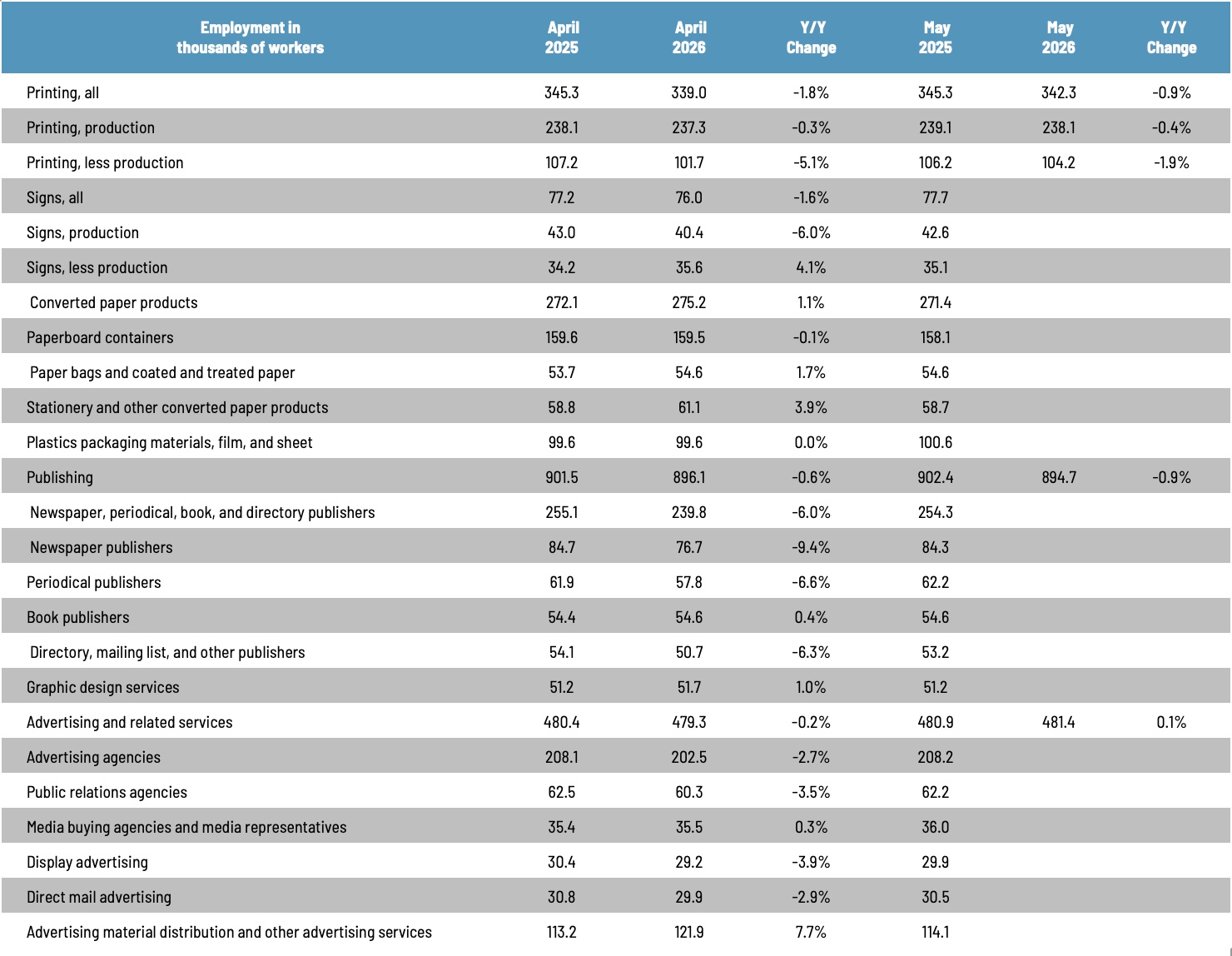
Publishing Establishments—2010–2023

Publishing Establishments—2010–2023

According to the latest, recently released edition of County Business Patterns, in 2023 there were 32,332 establishments in NAICS 511 (Publishing Industries [except Internet]). This represents an increase of 15% since 2010. In macro news, the University of Michigan’s Consumer Sentiment Index is at record lows. Read More

Finishing: Production Inkjet's Next Frontier

Finishing: Production Inkjet's Next Frontier

As production inkjet has advanced, a new primary factor limiting productivity has emerged: finishing. How are PSPs adapting their investment and automation strategies? New research shows many can gain a competitive advantage by focusing on finishing. Read More

HanGlobal Launches New LabStar 330mini at Flexo & Labels Expo 2026

HanGlobal Launches New LabStar 330mini at Flexo & Labels Expo 2026

Discover HanGlobal's newly launched LabStar 330mini digital label press! Get the full show roundup to see how this ultra-integrated, high-performance inkjet solution captured the crowd's attention and redefined narrow-web printing. Read More

Around the Web: Of Food and Feynman

Around the Web: Of Food and Feynman

A book designer who specializes in spine design. The Chinese postal service is using humanoid robots to sort packages. An amusingly overproduced Day Display. Allen Ginsberg’s spoken-word poetry recitation album is being reissued. The winners of this year’s World Food Photography Awards. A retired geneticist launched the online Museum of Plugs & Sockets. A viral warning about a new gas station scam is actually a hoax. What is the world’s longest domestic flight? Aw, et tu, graphene: Skeleton Technologies launches graphene-based GrapheneUPS for AI data centers. What is the quietest spot in the U.S.? Researchers finally cracked Richard Feynman’s “Restaurant Problem.” Malaysia’s kek lapis Sarawak is perhaps the world’s most complex cake. Welcome to WhatTheyThink’s weekly miscellany. Read More