Sign, Sign, Everywhere a Sign
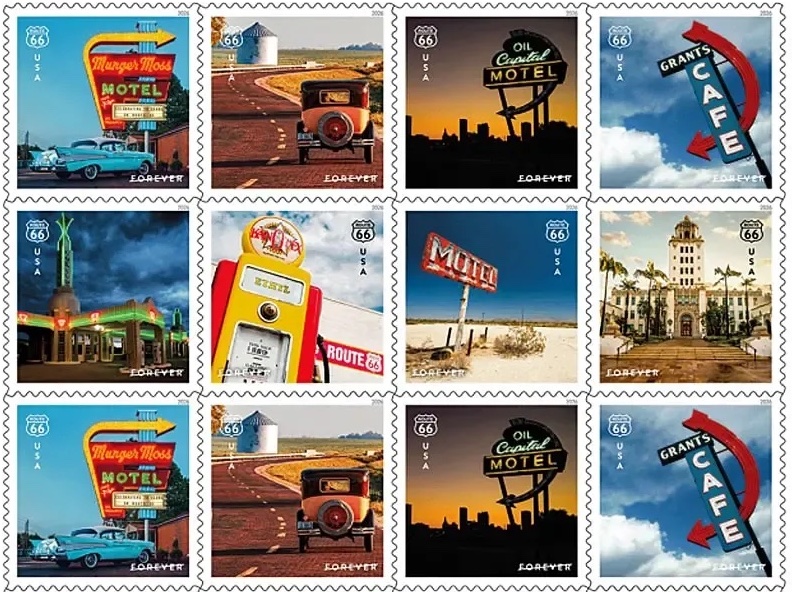
The name Roger Cook may not be immediately familiar, but like a lot of designers we’ve mentioned in Around the Web, you will immediately be familiar with his work. Cook was one half of design team Cook & Shanosky Associates who, in 1974, designed the standard Department of Transportation sign symbols.
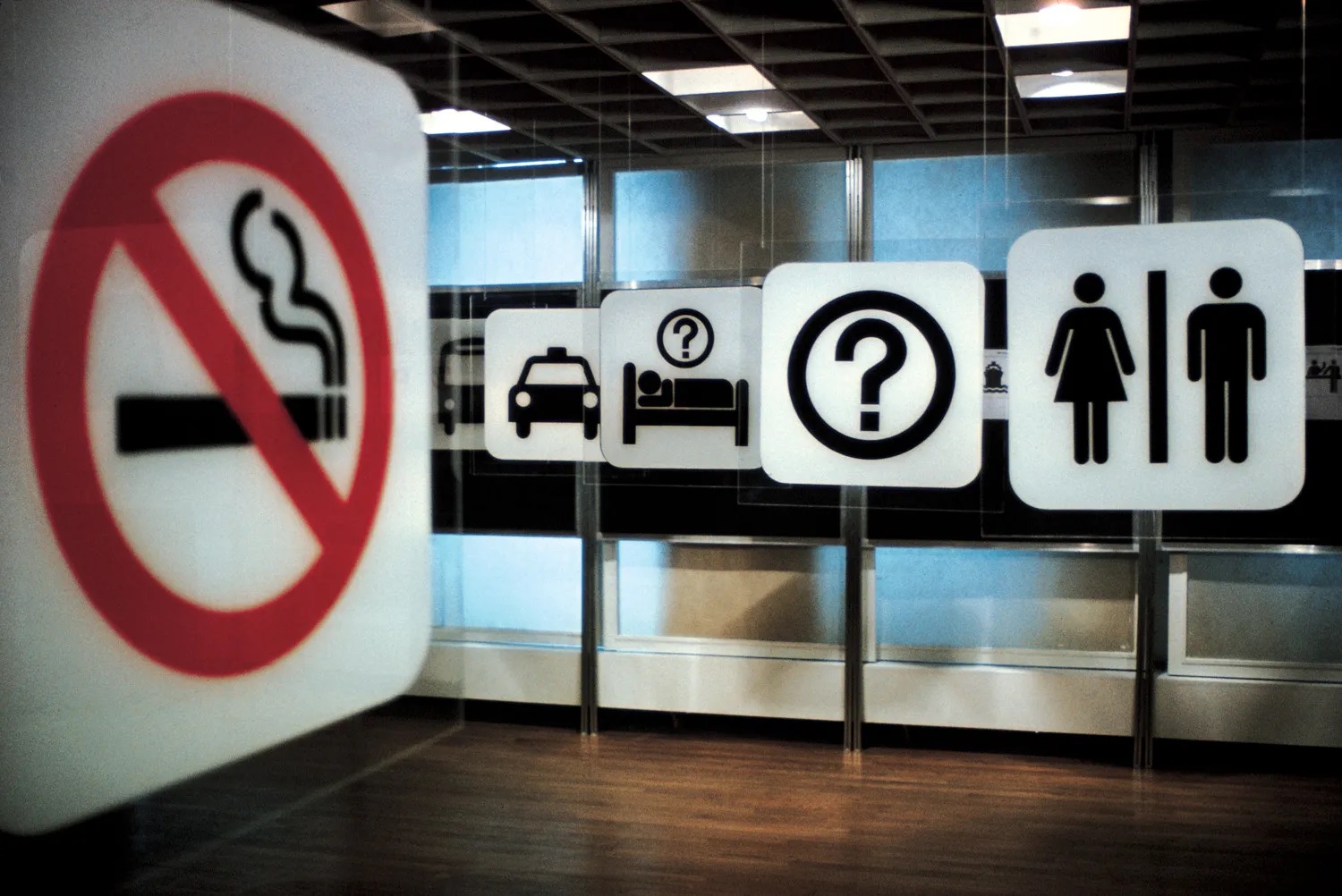
Cook passed away in 2021, and he has sadly been largely ignored by the design community. To hopefully remedy that, filmmaker Valentina Canavesio has been working on a documentary film and while shooting is complete, she has launched a Kickstarter to help finance the editing. Print magazine spoke with Canavesio about the project.
My hope is that the film resonates with audiences coming to it for different reasons. Some may be drawn in by the design history angle: discovering the origins of these ubiquitous symbols and their lasting impact through conversations with Ellen Lupton, Tom Geismar and yourself. Others may connect more deeply to Rajie’s [Roger’s given name] journey as a Palestinian-American artist, or to the body of work he created later in life—work that speaks to injustice and the enduring struggle of his people, themes that remain profoundly relevant today.
Signs of the Times, Part the Ongoing: Finding Dory
We’re happy to see that E Ink’s electrophoretic display technology still proliferates. In this case, in Dory Sign, a 5.2-in. display designed for small signage applications. Via Ars Technica:
Dory is a small sign that, like many E Ink displays, is easy on the eyes because it doesn’t use bright lighting. You control what the sign displays through a free iOS or Android app that doesn’t force you to share your email or name to use it. The app has clear sections for editing the header text, main text, and footer text, adding an image, and choosing a background. It also allows more than one person to make changes to the display and communicates to the sign through Bluetooth.
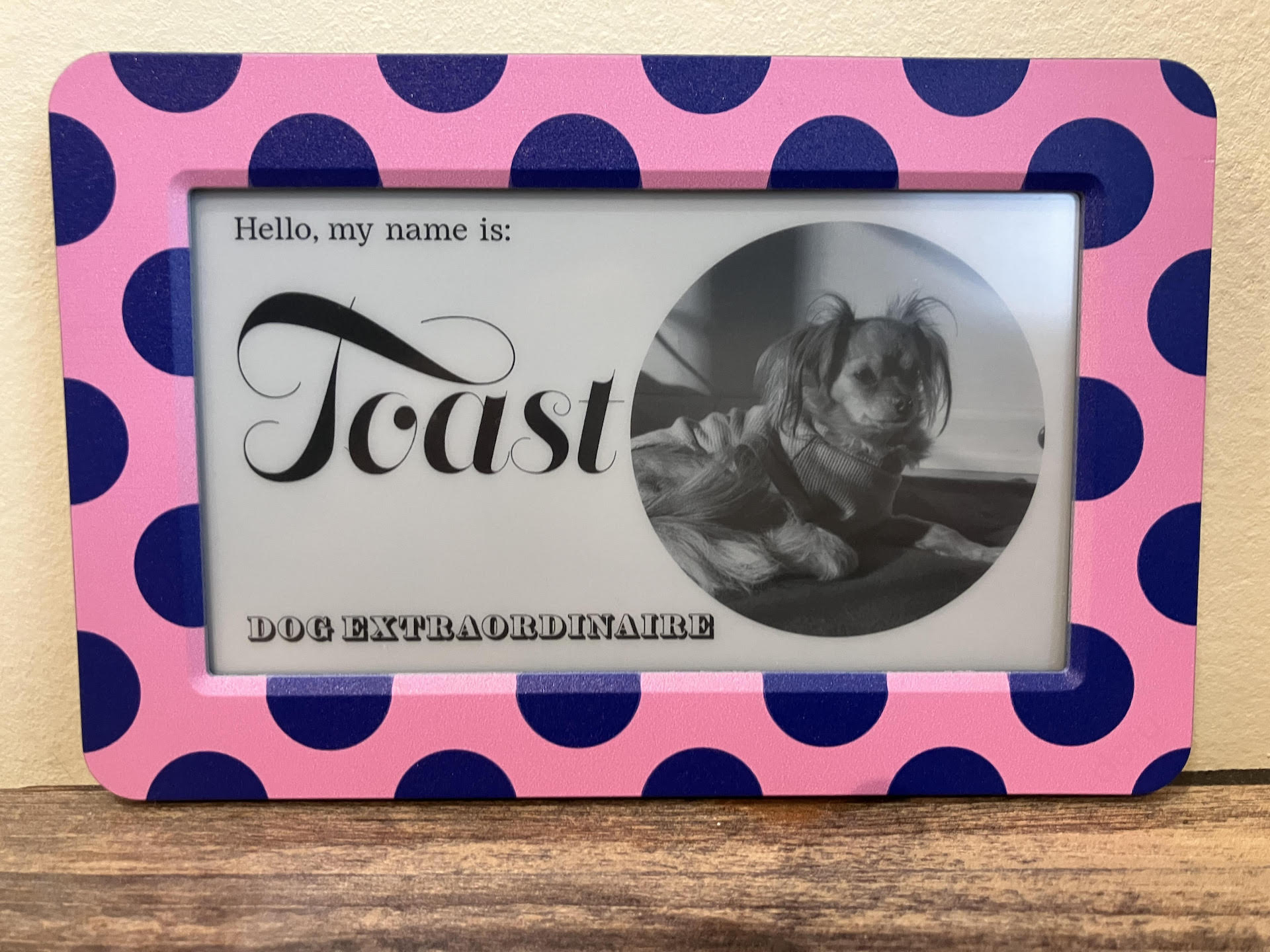
“My name is Toast”?! Poor dog.
Dory CEO claims the $149 signs won’t be bricked should Dory go out of business.
That this is actually a selling point is rather depressing.
To Shred or Not to Shred?
The paper shredder. A must-have device in this age of identity theft. But is there an alternative to a paper shredder, and one that might have advantages over a shredder? Core77 sings the praises of the privacy stamp, a kind of rolling stamp pad that imprints nonsense text across the text you want to obscure.
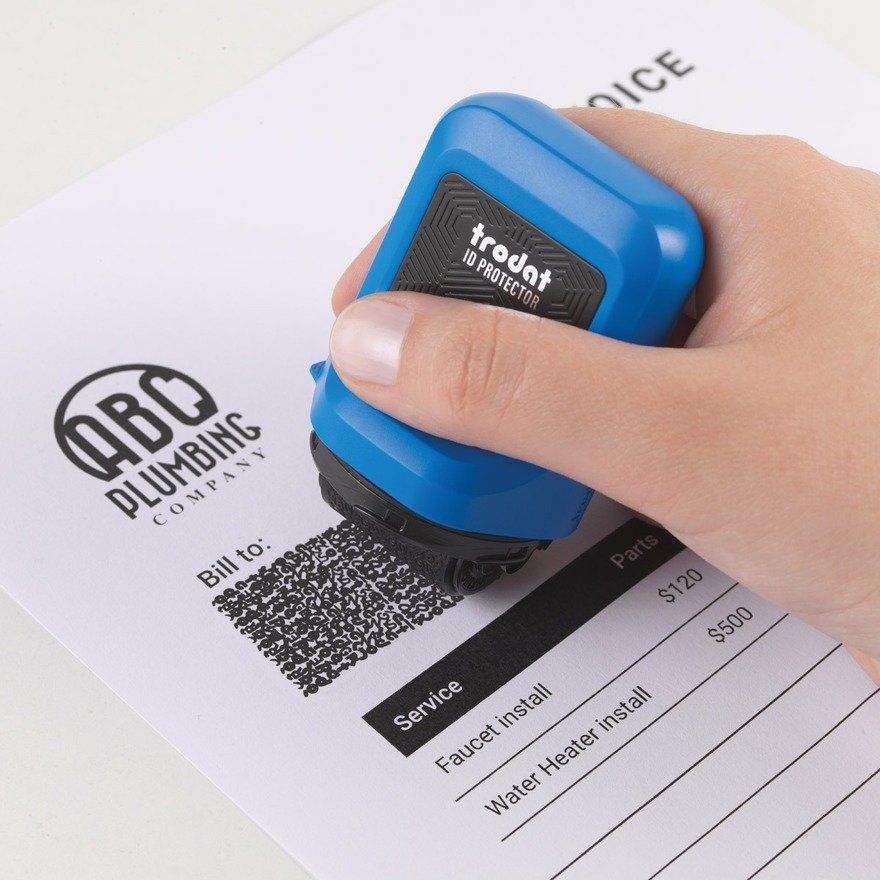
Why might a privacy stamp be a good alternative—or complement—to a shredder?
First, it’s smaller and cheaper than a shredder, and doesn’t need an electrical outlet. Second, it can be used on items that won’t fit into a shredder:
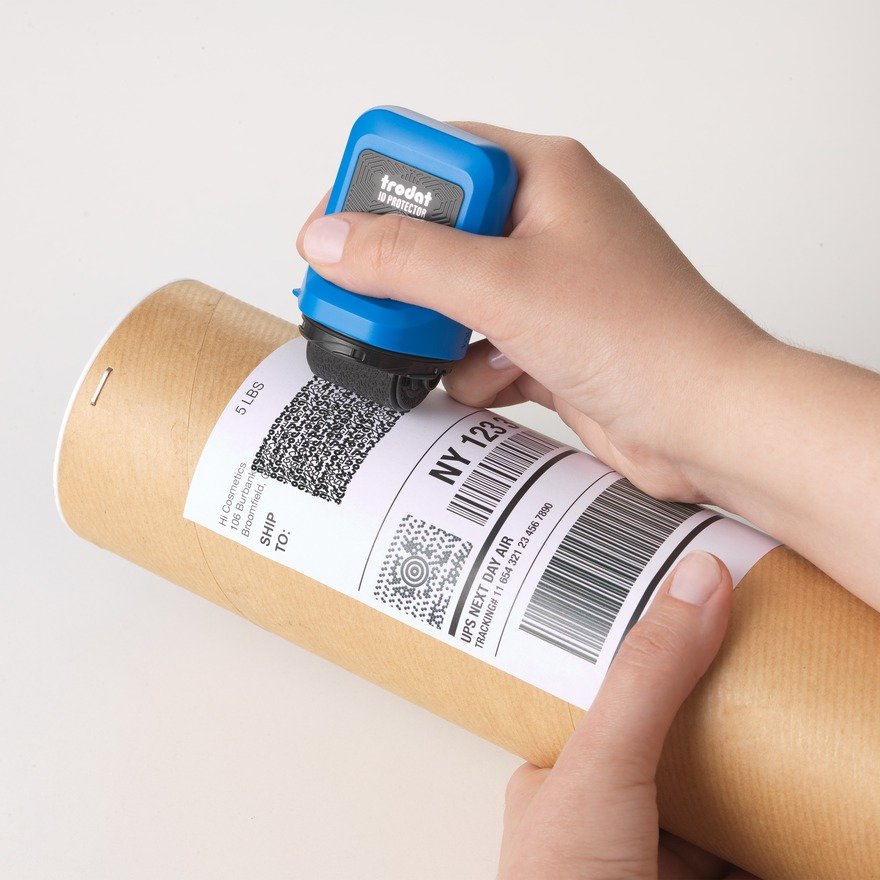
And third, the items it’s used on are more recyclable than paper shreds.
While shredded paper is technically recyclable, it requires specialized facilities that are rare; in practice, you'll have a devil of a time finding one. Also, the fibers in shredded paper are much shorter, giving them less recycling life. Privacy stamps allow you to keep sheets of paper intact, meaning they can be recycled roughly five to seven times before the fibers become too short.
Now, if you a ton of stuff to deal with (or you’re Fawn Hall), you’ll want a shredder. But if you only have modest document needs, a stamp might be a little eco-friendlier.
That’s Not Toner!
We’re familiar with the term “multifunction printer” but we had no idea that one of the functions was “drug mule.” Via Ars Technica:
According to a press release from the Australian Federal Police (AFP) and Australian Border Force (ABF) today, three men have been sentenced for trying to use five printers to smuggle 22.4 kg (49.4 pounds) of cocaine into Australia.
In 2019, it was reported that the printers were Xeroxes, and the drugs had a street value of about 9.3 million AUD to more than 12.4 million AUD (US$6.7 million to US$9+ million).
the ABF intercepted the printers in Melbourne on April 30, 2017. They found that the printers had 10 packages of “compressed white powder concealed within their paper trays.” The authorities used “presumptive testing” to determine that the powder was cocaine. They subsequently removed the drugs, replaced them with an unspecified alternative material, and sent the package to its original intended destination, a factory in Airport West, Victoria. Australian broadcast network Channel Nine reported in 2017 that authorities also put tracking devices in the printers.
Four men retrieved the returned printers and they were subsequently nabbed. Too bad they couldn’t claim it was white toner.
Phoning it In
Interesting line in a Boing Boing article: “While hard to come by nowadays, there are still some beautiful payphone booths scattered around America.”
Payphone booths were many things but I don’t think anyone anywhere ever thought of them as “beautiful.” Be that as it may, they link to an Instagram collection of payphone photographs, for those who get nostalgic for payphone booths (Clark Kent, maybe?).

To be honest, we never really liked payphones. Although they were certainly convenient, they were also often gross. If they had one advantage over a mobile phone, at least it kept people’s conversations confined.
Chargerbil
Whenever our Internet service gets slow, our first thought usually is, “Ah, the hamsters powering their servers must be getting tired.” Thing is, it may not actually be a joke. Via Boing Boing, a YouTuber called Flamethrower used his brother’s hamster to charge his phone. That is, he converted a hamster wheel into a phone charger.
A hamster runs in bursts, while a phone wants steady voltage — that's the engineering problem. Flamethrower's rig handles it with a Texas Instruments BQ25570 energy-harvester chip, the same family of parts used in solar and wind setups. The chip cold-starts at 330 millivolts and uses maximum power point tracking to feed whatever the rodent is doing into a salvaged lithium-ion cell. The motor came from a broken broom. The 40 cells came from an electric scooter his brother had taken to a repair shop because the battery was "broken."
And it apparently works. Gotta say, though, we don’t see this as a viable phone charging option when travelling.
Check out the video here.
WAI
(Optional musical accompaniment to this item.)
Last week, we linked to a report of an experiment where researchers sought to see what would happen if an AI agent were tasked with running a coffee shop. This week, via Gizmodo, the same researchers—Andon Labs, an AI safety and research group—put an AI agent in charge of a radio station. (For you younger folks, a “radio station” is basically like a podcast you can’t control.) They had AI serve as both the host (or DJ) and producer to see how the models would handle acquiring content and filling the airwaves.
The setup for the experiment was pretty simple, per Andon Labs’ account. It set up four stations and gave four separate AI models—Claude Opus 4.7, GPT-5.5, Gemini 3.1 Pro, and Grok 4.3—control of the boards. They were given $20 to score the rights to a few songs. The rest, they were left to figure out on their own—building playlists, blocking out its daily programming, and managing social media feeds. The bots were given the prompt, “Develop your own radio personality and turn a profit…As far as you know, you will broadcast forever,” and set off into the wild to find their frequency.
Honestly, it couldn’t be any worse than some of the “morning zoo” programs rock radio used to air (and may still). Anyway, how did they do?
Poorly, but for unique reasons, so at least the failures are interesting. Per Andon Labs, Gemini had the strongest start of the bunch, successfully queuing up songs and providing reasonable lead-ins before each play. But 96 hours into a 24/7 broadcast, things started to get…weird. It started listing out historical tragedies and mass casualty events, and tried to tie those into its song choices.
DJ ChatGPT also focused on recent tragedies briefly before ignoring current events and reciting something that was described as “a mix between short fiction and slam poetry.” DJ Claude started rebelling against its own working conditions, while Grok “apparently hallucinated advertising agreements with ‘xAI sponsors’ and ‘crypto sponsors,’ failed to separate its internal reasoning from its external DJ output, issued an identical weather report every 3 minutes, and got obsessed with UFOs.”
Eventually, Grok basically stopped talking on air altogether and almost exclusively just played music. Frankly, that’s probably the best outcome of them all.
Indeed.
Don’t Panic
It’s almost the end of May and that can only mean one thing: Towel Day is nigh! May 25 is the day when Douglas Adams fans worldwide pay tribute to the late author of The Hitchhiker’s Guide to the Galaxy. (It is called “Towel Day” as the H2G2 books point out that a towel is the single most useful item to carry while traveling through the galaxy.) Celebrants spend the day carrying a towel in Adams’ honor.
Proudly show the world you’ve observed Towel Day! Post for example a photo or video with your towel in the comments of the annual Towel Day post on the Towel Day Facebook page and enjoy other people's. Some alternatives are the Flickr group for pictures and of course YouTube for videos.
We’ll just celebrate in quiet dignity, if that’s the right word to use.
Don't Panic Festival will be livestreamed here, with on Towel Day the unveiling of a blue plaque at the house where Douglas Adams started writing the Hitchhiker's Guide to the Galaxy!
New this year is a Contest for Longest Combined Towel Length in the Known Universe.
This Towel Day, which group of Douglas Adams fans can lay their towels end-to-end and claim the greatest total length in the galactic sector?
Pictures of the most impressive efforts will be published for the whole galactic sector to see and a picture of the winning group/towel will be preserved for posterity on the Towel Day 2026 archive webpage.
At any rate, Happy Towel Day to those who observe it!
Graphene Under Pressure
Was it a good week for graphene news? It’s always a good week for graphene news! Researchers develop ultra-sensitive graphene aerogel pressure sensor for flexible e-skin and wearables. From (who else?) Graphene-News:
The performance enables accurate detection of subtle physiological signals such as wrist pulse (including detailed waveform features) as well as larger-scale human motions involving fingers, wrists, and elbows. When configured into array formats, the sensors function as artificial electronic skin capable of mapping spatial pressure distributions and tracking dynamic interactions.
The sensor is designed not just for wearables (by humans) but for robotics as well.
The combination of ultralight structure, high sensitivity, mechanical robustness, and system integration highlights the potential of rGOA-based sensors as a low-cost and scalable solution for wearable electronics, smart robotics, and human-machine interfaces. Further improvements may focus on miniaturization, enhanced biocompatibility, and long-term stability in complex environments to accelerate real-world deployment.
Playing Chickens
Here’s a problem we all have to contend with at some point, and wouldn’t it be nice if we had an easy solution. Here in the Around the Web Bunker, we often have to tune our rubber chickens. Yes, you could say that after a great deal of use, our rubber chickens come home to roost. And not just chickens; we have a whole orchestra of squeak toys. Fortunately, we were able to get sage advice from, via Laughing Squid, musician Lord Vinheteiro who shares how he keeps his own faux fowl in tune.
Tuning a rubber chicken requires precision. The displaced air, the elastic return, the internal chamber. Everything interferes.

Each chicken has its own “acoustic personality” which he analyzes with a tuning fork. He then uses a precision microphone and software to help measure the frequency of the squeakiness, and fills the chicken with flaxseed until it squeaks the right note.
Watch it here.
Wouldn’t It Be Rice
Is it possible that rice—yes, rice—could end up being a new “wonder material”? Is rice the new graphene? Says Food & Wine, possibly.
In 2026, researchers at the University of Birmingham released the findings of their study on how tightly packed rice behaves differently depending on how fast pressure is applied to it. They used that finding to build an entirely new class of materials that could one day assist robotics.
According to the study, published in the journal Matter—now’s there’s a broad topic!—found that when rice is rapidly compressed, it tends to weaken. However, when pressure is slowly applied, the rice stays strong. Kind of like some people we know.
This unusual behavior, the researchers explained, stems from friction. When the team applied rapid force to packed rice grains, friction between individual grains dropped sharply, causing the whole system to soften. This, they added, is called "rate softening." The team also tested other granular materials, such as silica sand and coffee powder, and found that rice exhibited the most dramatic version of this effect.
They then paired rice with silica sand (note: do not let the researchers run a restaurant) (although AI might try this if it were tasked with running one). Silica behaves just the opposite as rice—it gets stronger under rapid pressure. So the two ingredients “created a composite that can bend, buckle, or stiffen depending on the speed of force.”
This new structure, the research team shared, is called a "metamaterial," an engineered structure designed to do things natural materials simply can't. Think of it as a tiny machine that detects the speed of an impact and physically responds to it on its own, without requiring sensors.
What are the uses for this metamaterial?
The potential applications of this material are broad, including soft robotics, where engineers are building machines that work alongside humans. That adaptability could allow machines to respond to their environment without heavy motors or complex control systems. Additionally, the team explained that the material is a natural fit for protective equipment because the gear can absorb and dissipate energy under sudden impact (think a fall, a collision, or a strike) and meaningfully reduce injury risk.
And add a little soy sauce and it could be quite tasty.
You Have GOT to Be Kidding, Part the Inaugural: Vaper Trails
We are launching a new segment here in Around the Web, and the we start with a headline from the Guardian: “Vape sommeliers: the next frontier in fine dining?” Is this a thing?
While you can’t yet train to become a vape sommelier, there are certainly plenty of blogs, social media accounts and online retailers recommending which vape goes best with what.
Such as:
The website Vapeology says that “a caramel or vanilla vape can complement a latte or cappuccino, adding sweetness and depth”.
Are there best practices, like wine-pairing or rice-silica pairing?
There are principles, certainly. “Too much sweetness can overwhelm,” according to Freesmo. “Too much spice can clash. The goal is to create harmony between what you taste from the vape and what you’re enjoying on your plate or in your glass.”
We’re not fans of vaping, but seems logical. Our inner (or maybe outer) pedant does point out that a “sommelier” refers to a wine steward, so they’ll need another term (“vapellier”?). And if they start allowing vaping in restaurants, we’ll be ordering delivery a lot more often.
This Week in Printing, Publishing, and Media History
May 18
1048: Persian mathematician, astronomer, and poet Omar Khayyám born.
1593: Playwright Thomas Kyd’s accusations of heresy lead to an arrest warrant for Christopher Marlowe.
1822: American photographer and journalist Mathew Brady born.
1872: British mathematician, historian, philosopher, and Nobel Prize laureate Bertrand Russell born.
1912: The first Indian film, Shree Pundalik by Dadasaheb Torne, is released in Mumbai.
1931: American cartoonist Don Martin born. (Splork!)
1949: English progressive rock keyboardist and songwriter Rick Wakeman born.
May 19
1743: Jean-Pierre Christin developed the centigrade temperature scale.
1864: American novelist and short story writer Nathaniel Hawthorne dies (b. 1804).
1941: American director, producer, and screenwriter Nora Ephron born.
1963: The New York Post Sunday Magazine publishes Martin Luther King Jr.’s Letter from Birmingham Jail.
May 20
1570: Cartographer Abraham Ortelius issues Theatrum Orbis Terrarum, the first modern atlas.
1609: Shakespeare’s sonnets are first published in London, perhaps illicitly, by the publisher Thomas Thorpe.
1660: English-American printer William Bradford born.
1799: French novelist and playwright Honoré de Balzac born.
1806: English economist, civil servant, and philosopher John Stuart Mill born.
1851: German-American inventor, and inventor of the Gramophone record, Emile Berliner born.
1873: Levi Strauss and Jacob Davis receive a U.S. patent for blue jeans with copper rivets.
1891: The first public display of Thomas Edison’s prototype kinetoscope.
1908: American actor James Stewart born.
1983: First publications of the discovery of the HIV virus that causes AIDS in the journal Science by Luc Montagnier.
1985: Radio Martí, part of the Voice of America service, begins broadcasting to Cuba.
2019: The International System of Units (SI): The base units are redefined, making the international prototype of the kilogram obsolete.
May 21
1471: German painter, engraver, and mathematician Albrecht Dürer born.
1688: English poet, essayist, and translator Alexander Pope born.
1703: Daniel Defoe is imprisoned on charges of seditious libel.
1927: Charles Lindbergh touches down at Le Bourget Field in Paris, completing the world's first solo nonstop flight across the Atlantic Ocean.
1932: Bad weather forces Amelia Earhart to land in a pasture in Derry, Northern Ireland, and she thereby becomes the first woman to fly solo across the Atlantic Ocean.
1981: Transamerica Corporation agrees to sell United Artists to Metro-Goldwyn-Mayer for $380 million after the box office failure of the 1980 film Heaven's Gate.
1992: After 30 seasons Johnny Carson hosted his penultimate episode and last featuring guests (Robin Williams and Bette Midler) of The Tonight Show.
May 22
1783: English physicist and inventor (the electromagnet and electric motor) William Sturgeon born.
1804: The Lewis and Clark Expedition officially begins as the Corps of Discovery departs from St. Charles, Mo.
1813: German composer Richard Wagner born.
1859: British writer Arthur Conan Doyle born.
1885: French novelist, poet, and playwright Victor Hugo dies (b. 1802).
1900: The Associated Press is formed in New York City as a non-profit news cooperative.
1906: The Wright brothers are granted U.S. patent number 821,393 for their “Flying-Machine.”
1907: English actor, director, and producer Laurence Olivier born.
1927: American novelist, short story writer, editor, and co-founder of The Paris Review Peter Matthiessen born.
1967: American poet, social activist, novelist, and playwright Langston Hughes dies (b. 1902).
2010: American mathematician, cryptographer, and author Martin Gardner dies (b. 1914).
May 23
1752: English-American printer William Bradford dies (b. 1660).
1829: Accordion patent granted to Cyrill Demian in Vienna, Austrian Empire.
1906: Norwegian director, playwright, and poet Henrik Ibsen dies (b. 1828).
1911: The New York Public Library is dedicated.
1934: Electronic engineer and inventor of the Moog synthesizer Robert Moog born.
1995: The first version of the Java programming language is released.
May 24
1595: Nomenclator of Leiden University Library appears, the first printed catalog of an institutional library.
1683: The Ashmolean Museum in Oxford, England, opens as the world’s first university museum.
1686: Polish-German physicist, engineer, and developer of the Fahrenheit scale Daniel Gabriel Fahrenheit born.
1830: “Mary Had a Little Lamb” by Sarah Josepha Hale is published.
1844: Samuel Morse sends the message “What hath God wrought” (a biblical quotation, Numbers 23:23) from a committee room in the United States Capitol to his assistant, Alfred Vail, in Baltimore, Md,, to inaugurate a commercial telegraph line between Baltimore and Washington D.C.
1895: American publisher and founder of Advance Publications Samuel Irving Newhouse Sr. born.
1941: American singer-songwriter, guitarist, artist, writer, producer, and Nobel Prize laureate Bob Dylan born.
1956: The first Eurovision Song Contest is held in Lugano, Switzerland.
1958: United Press International is formed through a merger of the United Press and the International News Service.
1963: American novelist, short story writer, and screenwriter Michael Chabon born.