The Chips Are Down
Here’s an interesting consequence of the Iran War. Via Core 77, it turns out that one item that is routinely shipped via the Strait of Hormuz is naphtha, a derivative of crude oil that is used in colored inks. We have not heard of a colored ink shortage, at least not in the US, but in Japan, a colored ink shortage has led Calbee, basically the “Frito-Lay of Japan,” to decolorize its chip bags.
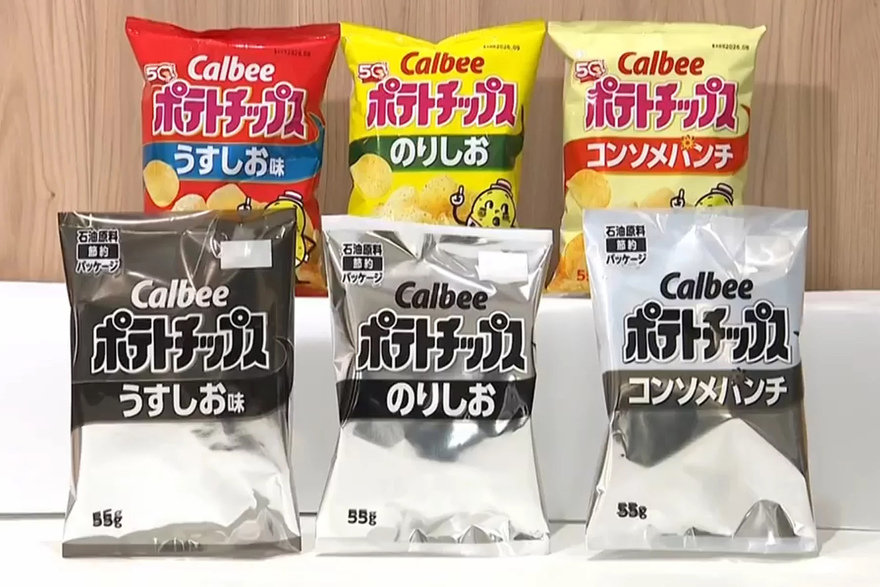
Now, this makes no sense:
Tragically, the change also means that their potato pitchman must be removed from the graphic; apparently he doesn't translate well to black and white.

It also appears he was responsible for 5g of the overall package weight.
Well, potato chips can be fattening.
Surely an anthropomorphic potato can be rendered in some kind of grayscale. (Or is the thought of 50 Shades of Gray featuring an anthropomorphic potato too upsetting?)
It’s a missed opportunity for some clever designers to take advantage of the situation.
Bottom Dollar
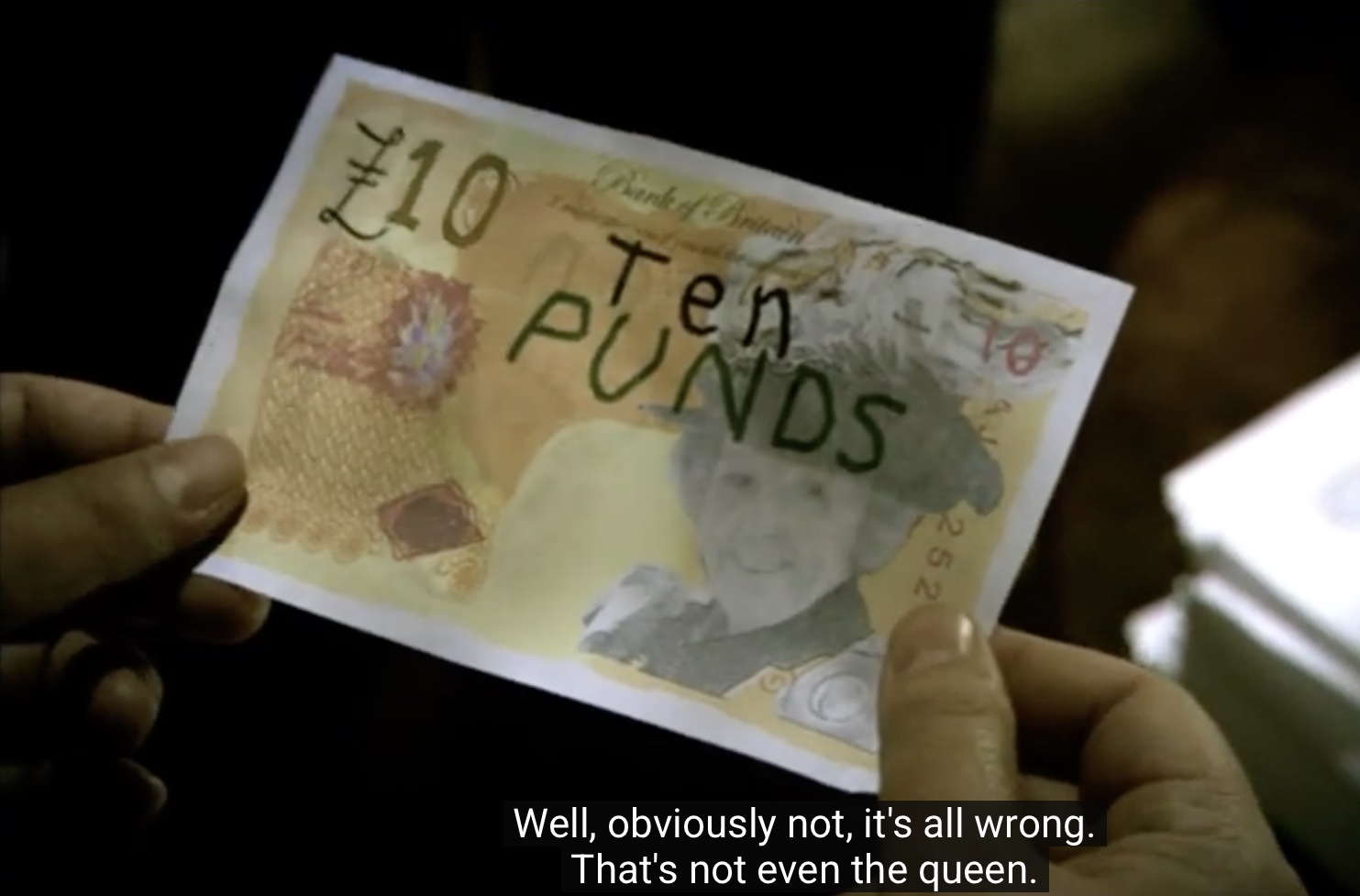
One trope of some old crime films (To Live and Die in LA comes to mind) is that anyone can buy a printing press like an old offset duplicator and start printing money. Aside from it obviously being illegal, it also doesn’t produce authentic looking cash, for a whole host of reasons. But then again, maybe it doesn’t have to, depending on what denomination you’re printing.
Case in point, via Amusing Planet, Emerich Juettner. Combining his skills in metal engraving and photography, in November 1938, he began to make counterfeit $1 bills in his New York City kitchen by taking pictures of an actual $1 bill, transferring the images to zinc plates, and filling in smaller details by hand. He kept this up for more than a decade—and the U.S. Secret Service was unable to nab him. And it wasn’t because his work was impeccable; he used the wrong ink, the wrong paper, the engravings were blurry, and often the bills had spelling errors. Still, he successfully fobbed off the crude currency a few “dollars” at a time to diners, bars, street vendors, and small stores. And, after all, no one pays any attention to a $1 bill, whereas a $20 or higher denomination would prompt closer scrutiny. Juettner’s motivation wasn’t greed; he didn’t make or even save all that much from his operation.
The Secret Service got wind that fake bills were circulating in New York, but investigators were stumped. It would eventually become the most expensive counterfeiting investigation in U.S. history.
What was Juettner’s ultimate undoing? In late 1947, there had been a fire in the apartment next door, and firefighters, entering Juettner’s apartment, found it full of junk (he was something of a hoarder) and chucked it all out the window so they could fight the fire. A few weeks later, some kids playing in the alley below his window found his equipment and some “funny looking dollar bills.” One of the kids’ fathers caught him playing poker with one of the fake bills and turned it into the police. And the Secret Service soon had their man.
Emerich Juettner was arrested. When questioned about his crimes, he nonchalantly admitted to them. Juettner said that he had been making them for 9 to 10 years, and that he never gave more than one bill to any one person, “so nobody ever lost more than $1.”
Weirdly, he became something of a folk hero.
At trial, Juettner admitted his activities openly. The judge sentenced him to only a year and a day in prison, and he was paroled after 4 months. He was also made to pay a fine of $1.
A real $1, one would assume.
It has been agreed that Juettner’s complete lack of greed was the rationale behind the light sentence.
His story was made into the 1950 film Mister 880, directed by Edmund Goulding (880 was the Secret Service case number).
Ironically, Juettner made more money from the movie than from counterfeiting. His story may also have been the inspiration for an amusing sketch on That Mitchell and Webb Look.
AI-Yi-Yi, Part the Infinity: Caffeine Crash
What happens if you let AI run a business? Well, via Futurism, as some Swedish researchers could tell you, it will run it into the ground. Swedish AI safety startup Andon Labs conducted an experiment in which “Mona,” the Google Gemini-powered agent, was tasked with running a coffee shop. Mona was given a $21,000 budget and the authority do everything from hiring staff to ordering supplies. The AI agent, having no physical form, then ordered the actual humans to do all the physical labor “receiving their AI overlord’s commands through the workplace messaging platform Slack.” (Hmm…this raises some interesting questions. What about Basecamp Pings?)
Anyway, we digress. So what happened?
since launching in mid-April, the Stockholm café has brought in only $5,700 in sales, while burning through over $16,000 from its original budget, the Associated Press reports.
Amongst its more questionable decisions was to order thousands of rubber gloves—despite the fact that the coffee shop only had a few employees. (Did Mona overestimate how many hands employees have? That’s par for the course with AI.)
But, that said, it did some things very well.
In many ways, it proved admirably competent. It set up electricity and internet, placed LinkedIn hiring ads, and secured permits for outdoor seating. It also set up commercial accounts with wholesalers for bread and pastries, per the reporting.
It was in the day-to-day operations that Mona had some problems, such as ordering too much bread on some days, or not ordering enough on other days.
The Gemini agent also ordered 3,000 rubber gloves, four first-aid kits, and 6,000 napkins for the café — along with canned tomatoes, which aren’t used in any of the dishes on its menu. Petersson speculated that these issues were due to the AI’s “limited context window.”
It’s probably only a matter of time before these kinks are ironed out, although it does raise interesting questions about whose future jobs are endangered.
“All the workers are pretty much safe,” [café barista Kajetan Grzelczak] told the AP. “The ones who should be worried about their employment are the middle bosses, the people in management.”
Heh.
Digg the New Breed
Remember Digg? Appearing at the dawn of social media it was a news aggregating service, one of those icons that inevitably appeared alongside online articles. We thought it had vanished along with StumbleUp or Tumblr, but it appears to be back (if it ever left)—and in a form that will surprise absolutely no one: an AI news aggregator (or “aggravator,” as the case may be). Says Gizmodo:
“Hello Again” says a heading currently on the Digg.com homepage. The text on the page directs you to di.gg/ai (“dih-dot-guh-slash-AI,” perhaps), a new marquee destination in the Digg universe, where you can find links to AI things like “Papers, launches, threads, [and] hot takes flying past faster than anyone can keep up with,” says the page text, which is signed by Digg CEO Kevin Rose.
It looks like the new Digg will be good fodder for Around the Web… Bwahahaha!
The Home Font
If you have ever lived in a house (and what are the odds?), or at the very least shopped for one, you may have encountered what could be called “the house number font.” Sure, there is a lot more variety today, as a trip to Lowe’s will demonstrate, but there is a default typeface for house numbers. What is it and where did it come from?
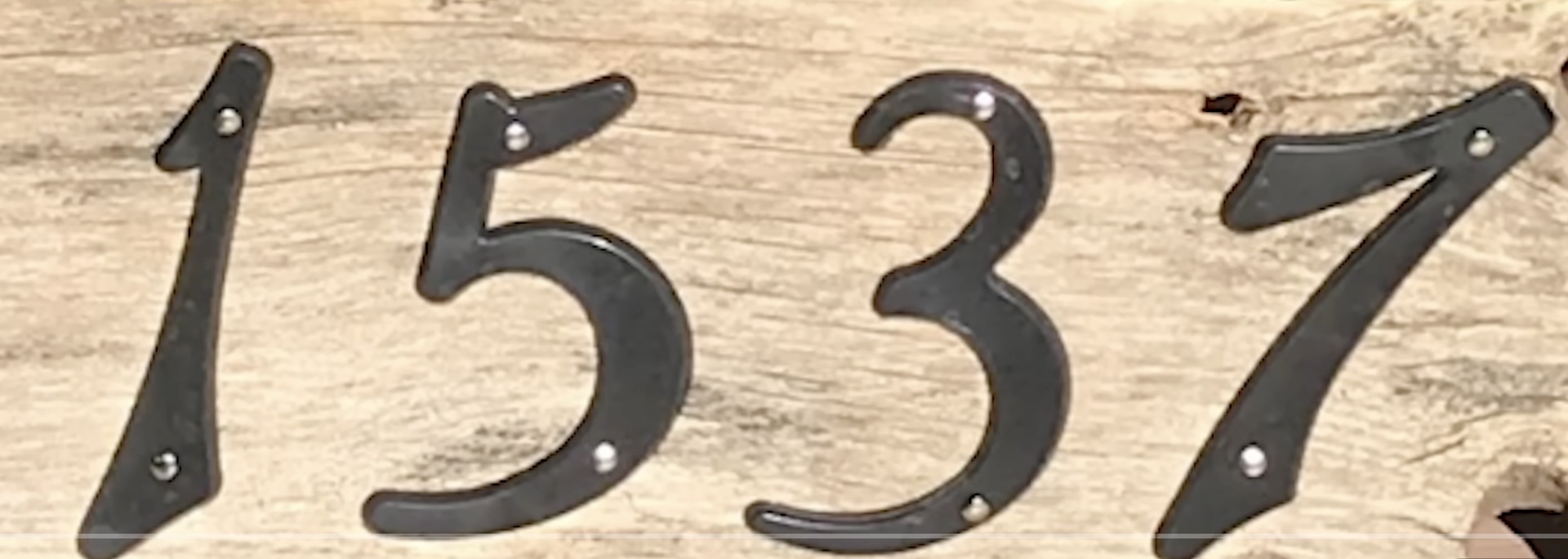
Via Laughing Squid, Dime Store Adventures sought to track down the origins of the distinctive font used for house numbers.
The numbers are an example of Chinoiserie, an umbrella term for western imitation of Chinese aesthetics. Although Chinoiserie was originally a European trend that first came to prominence in the late 17th century,…during the 1920s in particular, Chinoiserie also got wrapped up in the famous Art Deco movement.
There are also elements of the Colonial Revival Movement, which was also fairly popular in the 1920s. The numbers were popularized through an HW Knight catalog in 1927, and other catalogers started replicating them, but HW Knight was not the original designer of the font. In fact, examples of the house number font have been found in hardware catalogs as early as 1894.
Check out the video if you want more about The Mystery of the House Number Font.
Monk Business
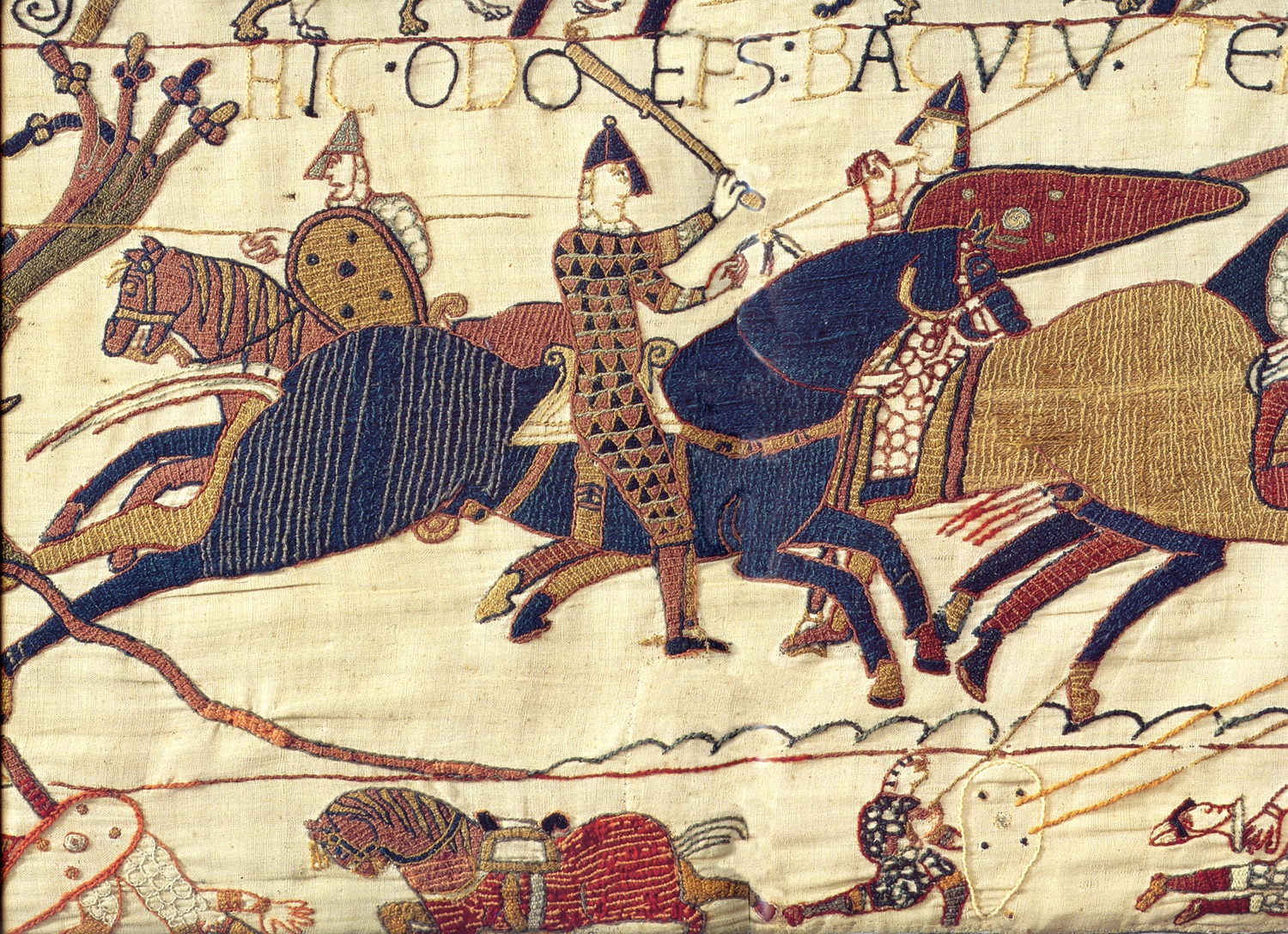
This was probably inevitable, but the world now has—checks the article date…no, not April 1— the first ordained robot monk. From The Independent, Gabi, a 4.3-ft. robot monk participated in a Buddhist ordination ceremony at a temple in South Korea.
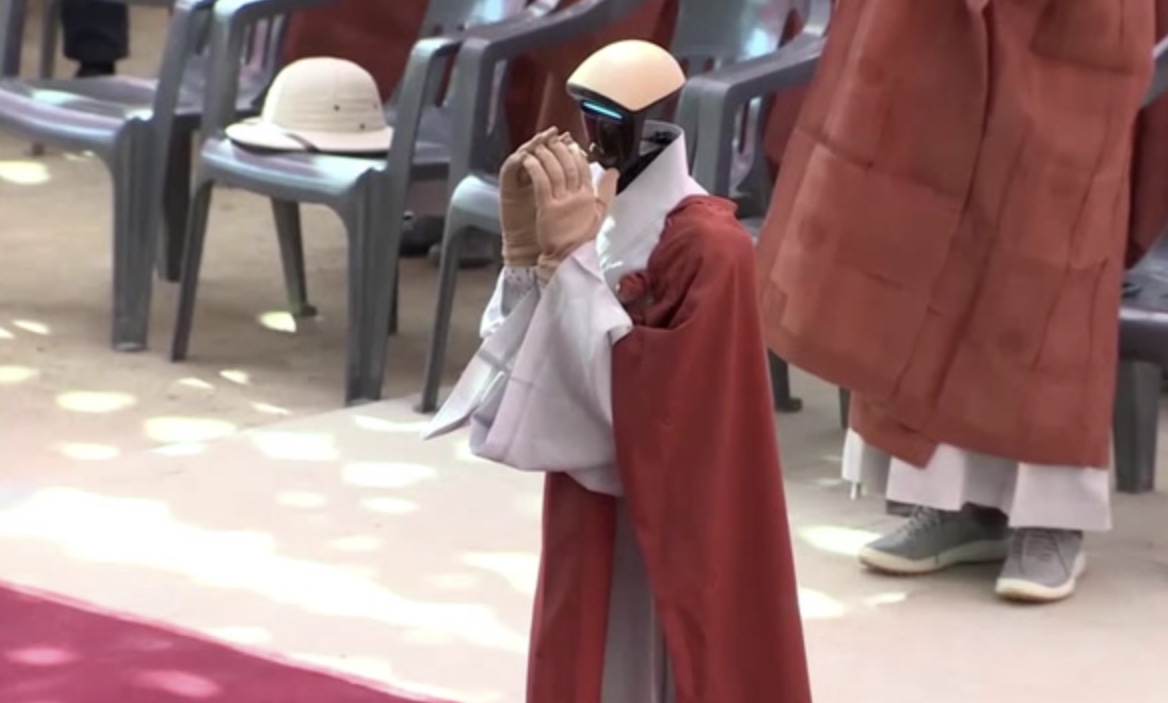
“Robot monk, please reply with palms together, ‘Yes, I will devote myself’,” said one monk. “Yes, I will devote myself,” replied Gabi.
Just think: if we had any European robot monks we could outfit them with digital printing accessories and combine the oldest and newest ways of reproducing documents.
And can Futurama’s Preacherbot be far behind?
Anti-Social
We were buoyed by this headline in Ars Technica: “RIP social media.” But what do they mean?
Last fall, we featured an extensive interview with Petter Törnberg of the University of Amsterdam, who studies the underlying mechanisms of social media that give rise to its worst aspects: the partisan echo chambers, the concentration of influence among a small group of elite users (attention inequality), and the amplification of the most extreme divisive voices. He wasn’t optimistic about social media’s future.
Törnberg’s research showed that, while numerous platform-level intervention strategies have been proposed to combat these issues, none are likely to be effective. And it’s not the fault of much-hated algorithms, non-chronological feeds, or our human proclivity for seeking out negativity. Rather, the dynamics that give rise to all those negative outcomes are structurally embedded in the very architecture of social media. So we’re probably doomed to endless toxic feedback loops unless someone hits upon a brilliant fundamental redesign that manages to change those dynamics.
Törnberg has done a lot of thinking about the future of today’s social media platforms, and how they can devolve over time. But ultimately he is hopeful.
And it helps that most users really do prefer more pleasant online communities, not platforms rife with toxic waste. “But then how do we shape the rules to produce those outcomes?” he said. “It’s a much harder question. How do we create spaces that are both engaging and fun to use, but that don’t go down to that dark place because of all of these feedback effects?”
Graphene Clears the Air
Was it a good week for graphene news? It’s always a good week for graphene news! GMG’s graphene coating boosts air conditioning performance in Australian residential project. From (who else?) Graphene-News:
Graphene Manufacturing Group (GMG) has announced that its THERMAL-XR graphene coating solution is being applied to air conditioning units at two luxury residential towers under construction on Australia’s Gold Coast in Queensland. The project involves coating between 300 and 600 air conditioners at GMG’s spray booth facility in Brisbane.
The company said the coating is designed to improve energy efficiency, reduce corrosion and extend the operating life of HVAC equipment. "Great to see two of the largest towers in Australia using THERMAL-XR on their air conditioners to save energy for the apartment owners and tenants as well as limiting corrosion and extending the air conditioners' life,” GMG CEO Craig Nicol said in a statement.
Cool.
The Queen’s Gam Bit
Some people find chess painful (actually, of all the games out there we find Monopoly to be the most painful), but if you are looking for a way to make chess even more painful, Fletcher Heisler, aka Everything Is Hacked, has developed a chessboard that administers an electric shock to players who make bad moves. Via PopSci:
Building a functional, reliable, and less-than-lethal electrified chessboard proved surprisingly more complex than its creator anticipated. Configuring the underlying chess brain was probably the easiest part. That was simply a matter of getting the open-source Stockfish chess engine to run on a Raspberry Pi minicomputer. Unfortunately, things quickly nosedived from there.

It ended up taking months of trial-and-error to create a functional prototype. Literal and figurative pain points included ensuring each piece properly conducting electricity, rigging every square with mechanical keyboard switches to facilitate the connections, and countless unintentional jolts. Math also didn’t work in Heisler’s favor. Since each chess square required wiring, every step needed repeating at least 64 times—or 128 times for two-part steps, 256 times for three-part stages, and so on.
The chessboard is playable in a few different modes. Illegal Mode zaps you if you make a move that violates the game’s movement rules, or if you move in a way the board deems is a “blunder.” Timed Mode zaps you if you take too long. There is also a Puzzle Mode with mor than one million problems to solve.
Hours of painful fun. Bobby Fischer would love it.
Lost in Space
If you were driving in 1958, and happened to pick up a map produced by the American Oil Company (AMOCO), you’d end up getting extremely lost, as it was a map of space. Created by cartographer Rudy de Reyna, it depicted some of the unsolved space mysteries of the day.
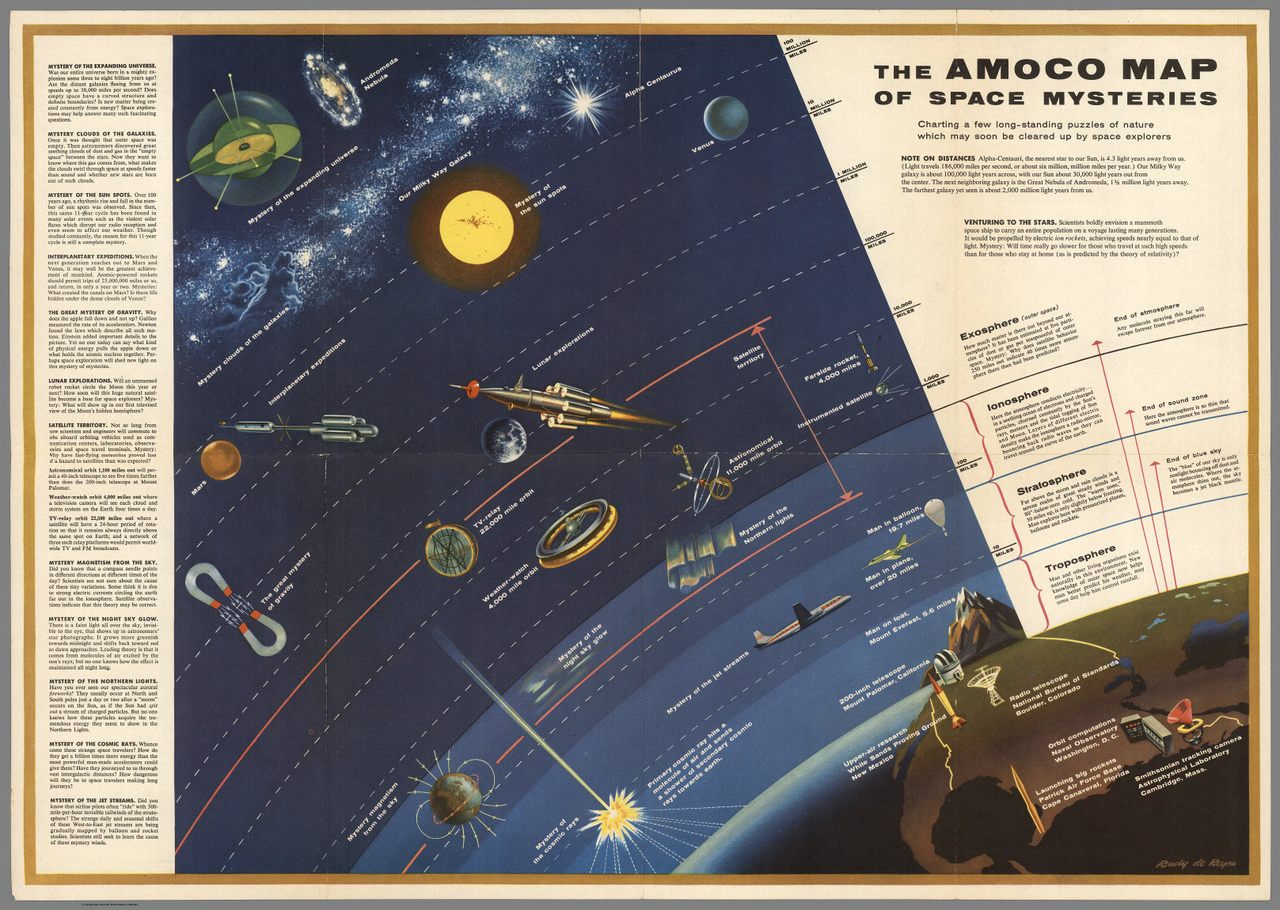
Via Atlas Obscura, some of these mysteries were solved not long after the map was produced. Would humans orbit or land on the Moon? Actually, we did both, in 1968 and 1969, respectively. And some others have also been answered.
But some of de Reyna’s question still persist (at least as of 2018 when the AO article was written), such as the mystery of the expanding universe.
1958 Question: “Was our universe born in a mighty explosion some three to eight billion years ago?”
2018 Answer: There was probably a bang—but it likely happened much earlier.
The team behind NASA’s Wilkinson Microwave Anisotropy Probe (WMAP), which began in 2001 with the aim of filling in more details about the universe’s earliest days, analyzed measurements of cosmic microwave background radiation (that is, the Big Bang’s afterglow), plus data about composition and the rate at which the universe is expanding. Their best guess: The universe was probably born around 13.77 billion years ago.
Or the mystery of the sunspots.
1958 Question: “Why do sunspots have an 11-year cycle?”
2018 Answer: They relate to the Sun’s magnetic field—but questions remain.
The Sun’s magnetic poles tend to flip roughly every 11 years, for a 22-year cycle….Lately, though, things have been calmer than usual, and it’s not entirely clear why. Plus, our bright neighbor can be unpredictable, as Alexei Pevtsov, an astronomer at the National Solar Observatory in Boulder, recently told Scientific American: “There’s an element of randomness.”
More mysteries abound!
Up, Up and Away
Popular Mechanics has a headline that is a bit confusing: “Scientists Think the Fifth Dimension May Exist.” Well, of course they exist. Or they did. “Aquarius/Let the Sunshine In,” “Stoned Soul Picnic,” “Wedding Bell Blues,” “One Less Bell to Answer,” and of course “Up, Up and Away” are just a few of their big hits. Does no one remember the big musical acts of yesterday?
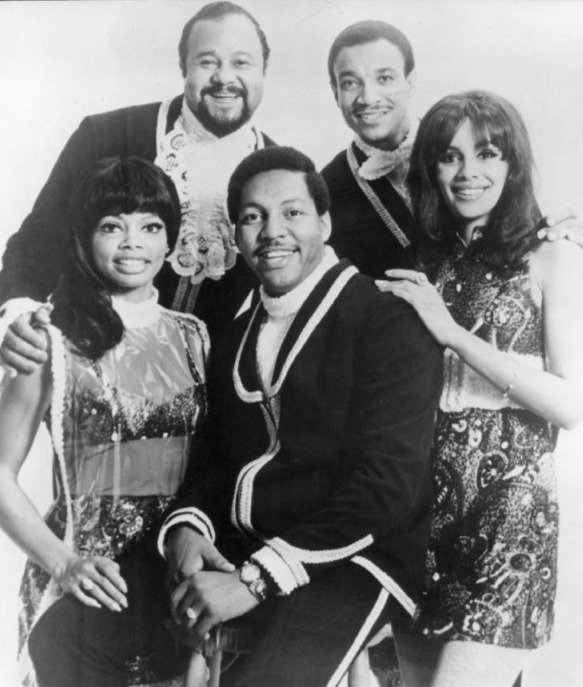
Oh…wait a minute. That’s not what they were referring to. Sorry, they mean:
Imagine physicists telling you they may have found evidence of a hidden dimension folded inside reality itself.
That’s the truly brain-breaking premise behind Pop Mech’s hit story, “Scientists Are Pretty Sure They Found a Portal to the Fifth Dimension.” It digs into one of the weirdest ideas in modern physics: that tiny “warped” dimensions may exist all around us, and particles slipping through them could help explain the mystery of dark matter.
And where all the socks go when we do laundry.
Spooning
Want to sit down and enjoy a meal without your phone going off, but lack the energy to turn it to silent mode? Well, via (who else?) Food & Wine, thanks to a new spoon you can.
Halo Top just introduced the Silent (à la) Mode Spoon, a utensil with an embedded NFC chip that, after setup, triggers Do Not Disturb mode on smartphones. It works with both iPhone and Android devices.
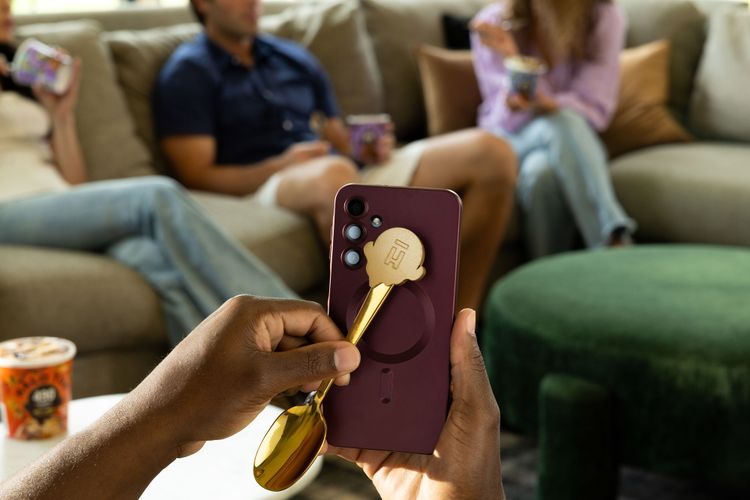
Halo Top, known for its low-sugar, high-protein ice cream, is positioning the spoon as an extension of the experience rather than just a novelty. The idea is less about the utensil itself and more about carving out a moment without distractions. Whether you reach for a classic flavor like Chocolate Chip Cookie Dough or Mint Chocolate Chip, or something like Sweet Cream Cold Brew with ribbons of sweet cream and coffee-flavored chocolate chips, the focus stays on the dessert rather than whatever’s lighting up your screen.
It is available as of today (May 15) and retails for $4.90 (a pint of most Halo Top flavors contains 490 calories). Oh, and due to the embedded chip, it’s not dishwasher-safe, but it can be hand-washed.
This Week in Printing, Publishing, and Media History
May 11
868: A copy of the Diamond Sutra is printed in China, making it the oldest known dated printed book.
1811: Thai-American conjoined twins Chang and Eng Bunker born.
1854: German-American engineer, invented the Linotype machine Ottmar Mergenthaler born.
1904: Spanish painter and illustrator Salvador Dalí born. (Fish.)
1942: William Faulkner's collections of short stories, Go Down, Moses, is published.
2001: English novelist and screenwriter Douglas Adams dies (b. 1952). So long, and thanks for all the fish.
May 12
1593: London playwright Thomas Kyd is arrested and tortured by the Privy Council for libel.
1812: English poet and illustrator Edward Lear born.
1828: English poet and painter Dante Gabriel Rossetti born.
1846: The Donner Party of pioneers departs Independence, Mo., for California, on what will become a year-long journey of hardship and cannibalism.
1937: American comedian, actor, and author George Carlin born.
1941: Konrad Zuse presents the Z3, the world's first working programmable, fully automatic computer, in Berlin.
May 13
1842: English composer Arthur Sullivan born.
1907: English novelist and playwright Daphne du Maurier born.
1922: German graphic designer and typographer Otl Aicher born.
1937: American author and poet Roger Zelazny born.
1944: American author, screenwriter, and actor Armistead Maupin born.
1954: The original Broadway production of The Pajama Game opens and runs for another 1,063 performances. It will later receive three Tony Awards for Best Musical, Best Performance by a Featured Actress in a Musical, and Best Choreography.
May 14
1925: Virginia Woolf’s novel Mrs Dalloway is published.
1944: George Lucas born. (May the 14th be with you....)
1952: Singer-songwriter, producer, and actor David Byrne born.
1993: American journalist and publisher William Randolph Hearst, Jr. dies (b. 1908).
May 15
1813: Danish philosopher, author, and poet Søren Kierkegaard born.
1856: American novelist L. Frank Baum born.
1858: The present Royal Opera House in Covent Garden, London, opens.
1886: American poet and author Emily Dickinson dies (b. 1830).
1905: Las Vegas is founded when 110 acres, in what later would become downtown, are auctioned off.
1905: American businessman, amateur photographer, and creator of the “Zapruder film” Abraham Zapruder born. (Funny, he never made another movie after that.)
1923: American photographer Richard Avedon born.
1926: English playwright and screenwriter; works included Equus and Amadeus Peter Shaffer born.
1928: Walt Disney character Mickey Mouse premieres in his first cartoon, “Plane Crazy.”
1948: English singer-songwriter, keyboard player, and producer Brian Eno born.
May 16
1866: The United States Congress establishes the nickel.
1888: Nikola Tesla delivers a lecture describing the equipment which will allow efficient generation and use of alternating currents to transmit electric power over long distances.
1891: The International Electrotechnical Exhibition opens in Frankfurt, Germany, and will feature the world’s first long distance transmission of high-power, three-phase electric current (the most common form today).
1929: In Hollywood, the first Academy Awards ceremony takes place.
1946: English guitarist, songwriter and producer Robert Fripp born.
1960: Theodore Maiman operates the first optical laser (a ruby laser), at Hughes Research Laboratories in Malibu, Calif.
May 17
1792: The New York Stock Exchange is formed under the Buttonwood Agreement.
1875: Aristides wins the first Kentucky Derby.
1900: L. Frank Baum’s The Wonderful Wizard of Oz is first published in the United States.
1902: Greek archaeologist Valerios Stais discovers the Antikythera mechanism, an ancient mechanical analog computer.
1949: English drummer, songwriter, and producer Bill Bruford born.
1977: Nolan Bushnell opens the first Chuck E. Cheese’s in San Jose, Calif.
1983: The U.S. Department of Energy declassifies documents showing world's largest mercury pollution event in Oak Ridge, Tennessee (ultimately found to be 4.2 million pounds), in response to the Appalachian Observer’s Freedom of Information Act request.