There was a time when label software meant a desktop design application, a folder of shared templates, and a thermal printer near the shipping dock. That model still exists, and for simple operations, it still works. But across retail, pharmaceutical, industrial, food, and manufacturing environments, the label has become something more demanding and more consequential. It is a compliance record, a traceability trigger, a consumer engagement point, a production control document, and often the last line of defense before the wrong product moves into the supply chain.
The pressures are converging from every direction at once. Retail is moving toward 2D barcodes and GS1 Digital Link, which fundamentally rearchitects the product identifier, turning a barcode into a web-enabled connection that carries consumer information, recall data, sourcing, and traceability. GS1's Sunrise 2027 initiative signals that retail point-of-sale infrastructure will be expected to read 2D symbols alongside traditional UPC barcodes, making the downstream implications for label design, data management, and pressroom workflow significant and immediate. In food, the FDA's Food Traceability Rule has shifted the industry conversation toward Key Data Elements, Critical Tracking Events, and supply chain data sharing. While the FDA indicates it will not enforce the rule before July 2028, the operational preparation cannot wait until 2027. In the pharmaceutical industry, the Drug Supply Chain Security Act (DSCSA) requires interoperable, electronic, package-level tracing for prescription drugs. For medical devices, Unique Device Identification (UDI) requirements place human- and machine-readable identifiers squarely in the labeling discipline.
The lesson is clear: label automation is not a print-room project. It is an enterprise data, workflow, and quality project that just happens to end with ink, toner, thermal transfer, or digital press imaging. The companies that succeed are not necessarily those that buy the most software. They are the ones that eliminate the most manual decisions.
Think In Layers, Not Applications
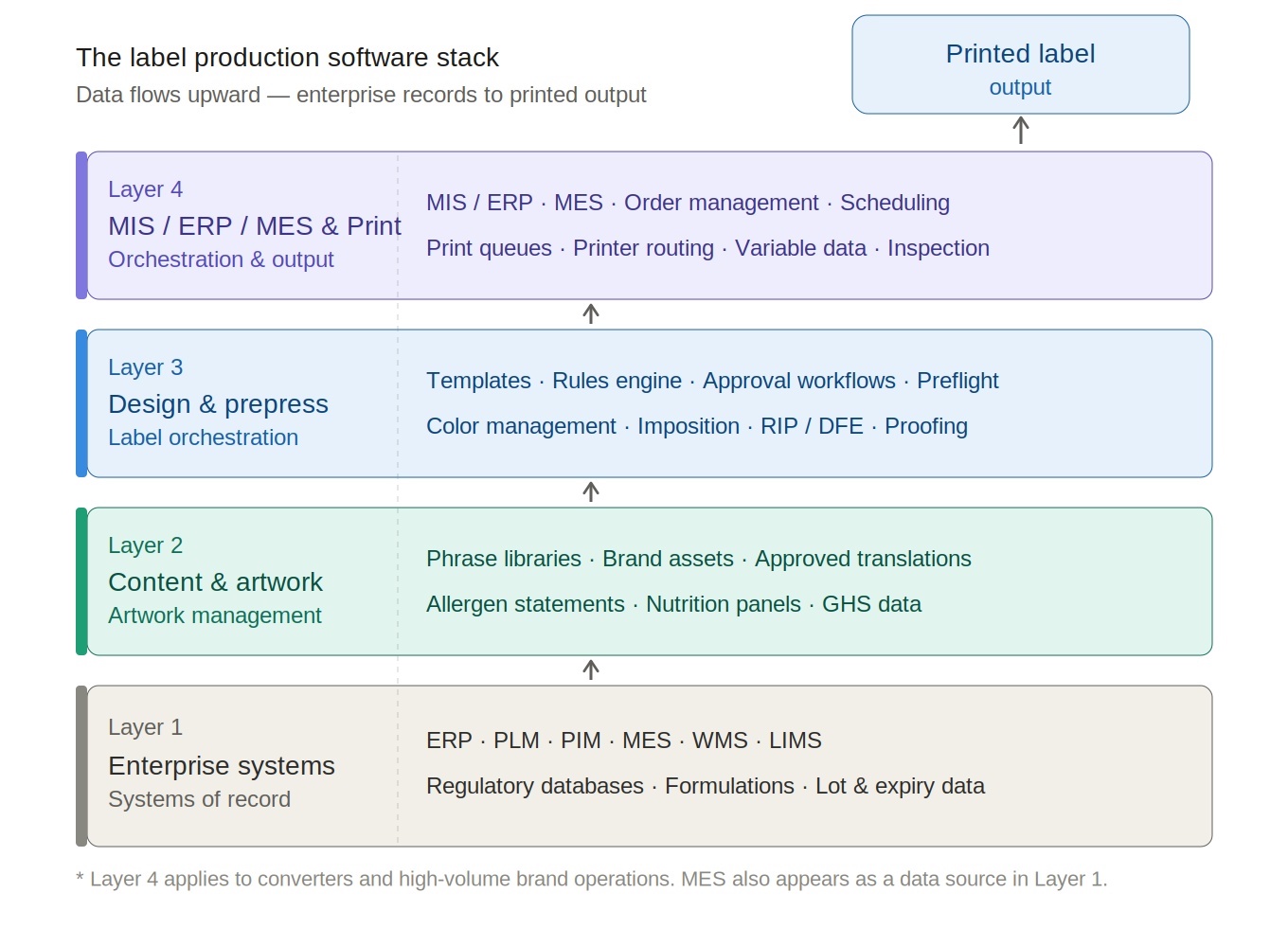
Understanding label automation requires disaggregating the term “label software” because no single application does everything. A mature, automated label production environment is a connected stack of four distinct layers.
At the foundation are the alphabet soup of enterprise systems of record: ERP, PLM, PIM, MES, WMS, LIMS, and regulatory databases. These are the authoritative sources for product descriptions, formulations, lot numbers, expiration dates, destinations, approved claims, and compliance data. The second layer is content and artwork management: phrase libraries, approved translations, brand assets, allergen statements, GHS hazard data, nutrition panels, country-specific claims, and version-controlled artwork files. The third layer is label design and print orchestration: templates, rules engines, database integrations, printer routing, print queues, user permissions, and approval workflows. For converters and higher-volume brand operations, a fourth layer handles prepress automation, MIS/ERP, color management, RIP/DFE workflows, inspection, and finishing data.
The principle that governs all four layers is the same: no operator should type information that already exists in a trusted system. The product description comes from the ERP or PIM. The lot number and expiration date come from the MES or LIMS. The ship-to address comes from the WMS or order management. The regulatory phrase comes from an approved content library. The label template is selected by business rules, not memory. When that discipline holds, errors do not just decrease. An entire category of failure disappears.
The practical outcome of template-driven, data-sourced label production is fewer files, not more. Companies that make this transition routinely discover that hundreds or thousands of individual label files can be consolidated into a fraction of that number with master templates driven by product data, regional rules, language logic, and packaging hierarchy. The return on investment appears not in printing speed but in reduced revision cycles, fewer obsolete files, fewer approval loops, fewer reworks and reprints, and fewer recalls due to labeling errors.
Governance Is the Automation Nobody Sees
A label operation without governance is simply a faster way to produce errors. The software must enforce who can design, edit, approve, publish, print, and retire a label. It should maintain a complete version history. It should support distinct development, QA, and production environments with appropriate access controls at each stage. It should immutably record who printed what, when, where, on which device, and with which data.
This governance layer is not optional overhead in regulated industries; it is the mechanism that guarantees the printed label matches the approved label. But the principle applies equally to industrial manufacturers producing GHS chemical labels, food companies managing allergen statements across multiple markets, and retail suppliers navigating retailer-specific compliance requirements. A supplier that prints the wrong carton label may not face the same regulatory exposure as a pharmaceutical company, but it can miss a shipment, trigger chargebacks, or lose preferred-supplier status. The business consequences are real.
For pharmaceutical, medical device, and chemical companies, the record of what was approved and what was printed is a quality document in its own right. The printed label and the audit trail that produced it are inseparable in a well-governed operation.
Cloud, On-Premise, and Hybrid: Choose By Risk, Not Fashion
The label software market has moved rapidly toward cloud and SaaS deployments because the benefits are genuine: centralized templates, easier access to suppliers and co-packers, browser-based printing, faster deployment, simpler updates, and improved visibility across sites. But the cloud-first reflex can create real operational risk if it is not paired with a practical understanding of production-floor realities.
Plants that print labels at weigh scales, packaging lines, cold-chain operations, receiving docks, cleanrooms, or automated palletizers need labels when the network is slow and when the internet is down. The right architecture is often hybrid: cloud governs templates, approvals, security, reporting, and supplier access; local print agents, cached templates, and site-level failover keep production moving. The architecture decision should be driven by risk and operational continuity requirements, not by what is fashionable in software procurement circles.
Smaller or simpler operations may still be well served by desktop or device-specific tools. But as soon as a company has multiple sites, regulated content, co-packer relationships, customer-specific requirements, or frequent revisions, the question shifts from “Can we design this label?” to “Can we control this label across its entire lifecycle?”
The same considerations apply to industrial label producers. Centralizing templates, managing corporate assets, and automating handoffs from the custom order through to production are essential to keeping equipment running and meeting deadlines.
Automate Verification, Not Just Production
Automation without inspection is fragile. A closed-loop label operation requires automated checks before, during, and after printing because each stage catches a different category of failure.
At the file and prepress stage, software should compare approved copy against artwork, verify barcodes and QR codes to ISO/IEC 15415 and 15416 grade standards, validate symbols and pictograms, confirm that regulatory phrases match approved library versions, and flag missing or altered content before a job enters the production queue. At the press and finishing stage, camera-based inspection systems verify variable data integrity, barcode readability, print defects, registration, die-cut accuracy, and sequence integrity at press speeds.
The barcode verification point deserves special emphasis. A barcode that renders correctly in a PDF is not the same as a barcode that will scan reliably on a retail shelf, a hospital dispensing system, or a warehouse conveyor. Grade verification should be embedded in the automated workflow, not delegated to a handheld verifier wielded by a press operator as a spot check.
A fully closed-loop system knows the approved label version, the specific data printed on each label, the device used, the inspection result, any rejected labels, and the disposition of reprints. In regulated and high-liability applications, that record is as important as the label itself.
For Converters: Automation Extends Into Prepress and MIS
For label converters, the software conversation is considerably broader than design and print. A converter's job may span estimating, customer service, artwork upload, proofing, substrate selection, tooling, scheduling, color management, die-cutting, finishing, inspection, shipping, and invoicing. Automation in this environment means passing clean data from estimate to job ticket to proof to press to inspection to invoice without rekeying, reinterpreting, or rechecking the same information at every departmental handoff.
Prepress automation is where many converters stand to gain the most. Esko Automation Engine is designed to standardize prepress processes, automate proof and print-ready file preparation, and reduce pre-production errors at scale. Esko WebCenter supports artwork and packaging management across brands, converters, and print service providers. Hybrid Software’s CLOUDFLOW is a modular, web-based workflow suite built specifically for packaging graphics, covering automation, soft proofing, RIPping, and asset management; PACKZ, its companion PDF editor, handles VDP, trapping, step-and-repeat, color management, and 3D inspection for labels and flexible packaging.
The MIS/ERP layer is equally critical. Label Traxx, now part of Amtech Software, is purpose-built for label and flexible packaging converters, covering order-to-cash, plan-to-produce, and procure-to-pay processes with scheduling, customer self-service, artwork approval, cloud API, and prepress integrations via JDF. CERM, ePS Radius/CommandCore, and printIQ are also important options depending on estimating complexity, shop-floor data capture requirements, API strategy, and business reporting needs.
Vendor Recommendations By Use Case
The best software choice is rarely a single product. In mature operations, the winning architecture is a connected stack: ERP or PLM as the data source, artwork management as the approval system, label management as the print orchestration layer, prepress automation as the production engine, and inspection as the quality record. With that context in mind, the following recommendations offer a practical starting framework.
For large enterprises with regulated or global operations, Loftware Cloud should be on the shortlist wherever SAP or Oracle integration, product compliance, multi-site governance, supplier labeling, and validation requirements are in scope. Its support for Development, QA, and Production environments, mass label-change workflows, and approval-process digitization make it particularly relevant to pharmaceuticals, medical devices, chemicals, and complex industrial supply chains.
For broad label design and printing across SMB, midmarket, and enterprise environments, BarTender by Seagull Scientific remains a practical and widely proven choice. BarTender Cloud is especially relevant where organizations want browser-based design and printing, data-driven templates, REST API or file-drop integration, and centralized label management without heavy infrastructure investment.
For industrial barcode labeling, manufacturing, warehouse, and compliance environments, TEKLYNX is a strong candidate, particularly for organizations managing a mix of label design, print automation, traceability, approval workflows, browser printing, and third-party supplier access. SENTINEL, LABEL ARCHIVE, and TEKLYNX CENTRAL are worth evaluating according to scale and governance requirements.
For regulated artwork and labeling content management, Kallik deserves serious consideration in pharmaceutical, medical device, chemical, cosmetics, and food and beverage environments where approved phrases, audit trails, and artwork governance are as important as printing. Its architecture is built around secure, auditable, cloud-based content and phrase management with structured approval flows.
For automated quality inspection, GlobalVision provides automated proofreading and QA inspection for text, graphics, braille, spelling, barcodes, and color across digital files and final proofs. Lake Image Systems delivers in-line label inspection including barcode grading, OCR, 1D and 2D verification, base stock verification, and reporting.
For label and flexible packaging converters, MIS/ERP evaluation should include Label Traxx, CERM, ePS Radius/CommandCore, and printIQ, with the selection driven by estimating complexity, scheduling requirements, shop-floor data capture, and prepress integration strategy. Esko Automation Engine and Hybrid CLOUDFLOW/PACKZ are the dominant prepress automation platforms and should be evaluated in parallel.
Where to Begin
For operations that are earlier in the automation journey, the priority sequence matters. Start with template-driven label design connected to a structured data source. This single change eliminates more errors than any other intervention. Add automated preflight and barcode verification as the second step. Then address approval workflow governance. MIS integration, inspection systems, and serialization can follow as organizational capability matures.
The converters and brand operations winning new business are not necessarily those with the newest presses or the largest software budgets. They are the ones who can onboard a new SKU in hours rather than days, guarantee barcode compliance across a full production run, provide a pharmaceutical client with a complete electronic audit trail on demand, and manage thousands of active label templates without a single version control failure. Those capabilities only exist in a connected label ecosystem by design.
The future of label production is not about making operators click faster. It is about making the correct label the only label that can be printed.
Five Questions to Ask Any Label Software Vendor
Before signing a contract or committing to a platform, press any label software vendor for specific, demonstrable answers to these five questions; not marketing language, not a reference to a roadmap.
- How does your platform handle template version control and change history? You should be able to see who changed what, when, and why, as well as roll back to any prior version on demand. If the vendor cannot demonstrate this in a live system, treat it as a red flag.
- What is the documented integration path to our ERP and to common label MIS platforms? Ask specifically about the systems you use. If the vendor hesitates or describes integration as a custom services engagement, factor in those costs and risks in your evaluation.
- Can you demonstrate automated barcode grade verification within the workflow versus as a standalone bolt-on tool? Integration is what matters here. A separate verification step outside the workflow is a governance gap, not a solution.
- What does your compliance documentation look like for regulated environments, and has it been validated in production? Ask for customer references in the pharmaceutical, medical device, or food manufacturing industries. Validation documentation should be available, not promised.
- What is your approach to data portability if we need to migrate to a different platform? Template formats, approval records, audit trails, and version histories should be exportable in open or documented formats. Data portability is a strategic issue, not a technical footnote. The time to ask is before signing, not after.
The Regulatory Clock Is Already Running
Compliance mandates are converging on the label faster than most operations realize. Each of the following developments carries direct implications for label software selection, data management infrastructure, and workflow design. None of them can be addressed by purchasing a better design application alone.
GS1 Digital Link / Sunrise 2027 — Retail
GS1's Sunrise 2027 initiative signals that retail point-of-sale infrastructure will be expected to read 2D barcodes like QR codes and DataMatrix symbols that encode a GS1 Digital Link URL. This transforms the product identifier into a dynamic web connection carrying consumer information, recall notices, sourcing data, and traceability records. For label operations, this means revisiting barcode placement, data structure, label real estate, and the back-end systems that populate the linked content. The time to plan is now.
FDA Food Traceability Rule — Food & Beverage
The rule introduces Key Data Elements (KDEs) and Critical Tracking Events (CTEs) for foods on the Food Traceability List. While the FDA has indicated enforcement will not begin before July 20, 2028, the data collection, supply chain communication, and labeling infrastructure required cannot be built in the final months before a deadline. Label software that connects to traceability databases and supports KDE-aligned data fields will be a practical requirement.
DSCSA Serialization — Pharmaceutical
The Drug Supply Chain Security Act requires interoperable, electronic, package-level tracing for prescription drugs in the US supply chain. Label platforms serving pharmaceutical manufacturers and their contract packaging organizations must support serialized data encoding, system-to-system data exchange, and audit trail maintenance as baseline capabilities.
UDI Requirements — Medical Devices
FDA's Unique Device Identification system requires human-readable and machine-readable identifiers on device labels and packaging. UDI data must also be submitted to the Global Unique Device Identification Database (GUDID). Label software in the medical device sector must support UDI-compliant data structures, barcode symbology requirements, and data submission workflows.
GHS / HazCom — Chemical & Industrial
The Globally Harmonized System of Classification and Labelling of Chemicals require specific pictograms, signal words, hazard statements, and precautionary statements that vary by jurisdiction. For any company producing labels for chemicals or hazardous materials, an approved phrase library with jurisdiction-specific content, connected to the label template, is a compliance requirement, not an efficiency option.