- A robotics solution can extend automation into the physical environment by linking digital workflow directly with material movement and execution.
- Instead of working to instantly implement fully autonomous production lines, businesses are focusing on specific operational bottlenecks and deploying robotics solutions where they can deliver immediate results.
- Proven use cases, peer experiences, and real-world outcomes will play a critical role in moving organizations forward on their robotics journeys.
By Eve Padula
Introduction
The concept of robotics in business has long been viewed as a futuristic “someday solution.” Sure, there were a few robotics demonstrations at trade shows and some early adopters cautiously experimented with basic solutions, but adoption and use were by no means widespread. We still have a long way to go, but new global research from Keypoint Intelligence suggests that robotics use is beginning to shift from experimental to strategic and maybe even necessary.
Modern businesses are struggling to accomplish more with less due to rising costs, an aging workforce, and ongoing labor challenges. Workflow automation is more important than ever, and robotic solutions (even if they are simple at first) are becoming an attractive way to automate. Companies are working to determine how robotics might fit into their existing workflows to increase efficiency, improve safety, and reduce strain on human employees. This article cites recent robotics survey findings to help determine how robots are being used today and how they might be deployed in the future.
About the Survey
In early 2026, Keypoint Intelligence conducted a global survey of 179 total respondents to gain a better understanding of the current state of robotics adoption as well as near-term plans. Almost all respondents were based in North America or Western Europe. Here are some top-level findings from the survey:
- The greatest share of respondents (46%) were commercial printers, followed by book printers/publishers (16%), in-house production printers (9%), and direct mailers (8%).
- Respondents reported an average of 203 total employees, but over a quarter had fewer than 50. The average number of employees was higher in Europe (234) than it was in North America (169).
- Common job titles included Print Services Manager/Supervisor/Director (24%), Print Production Manager/Director (21%), and Owner/CEO/President (19%).
- Roughly three-quarters of total respondents described themselves as decision-makers when it came to adopting new hardware, software, or robotics solutions. The remaining quarter were influencers. Influencers were slightly more common in North America than they were in Europe (28% vs. 21%).
- The most significant business concerns among total survey participants were rising costs (29%), keeping up with technological advancements (24%), shrinking print volumes (18%), and an aging workforce (18%).
The Next Step in Automation?
Over the past decade, many organizations have already invested in various workflow automation solutions to streamline decision-making and reduce inefficiencies. Some of the more common solutions include Management Information System (MIS) platforms, production analytics, and automated job routing. Unfortunately, physical execution within production facilities still frequently relies on manual intervention. As a result, software-driven workflows slow down at human handoff points.
A robotics solution can extend automation into the physical environment by linking digital workflow directly with material movement and execution. Rather than serving as a standalone technology, robotics may represent the next phase of automation in the production workflow environment. At this point, however, robotics implementation is low with less than 10% of total respondents having already deployed it. A more promising statistic is that nearly three-quarters of respondents were actively seeking a robotics solution or considering one for the future.
Figure 1: Deploying Robotics
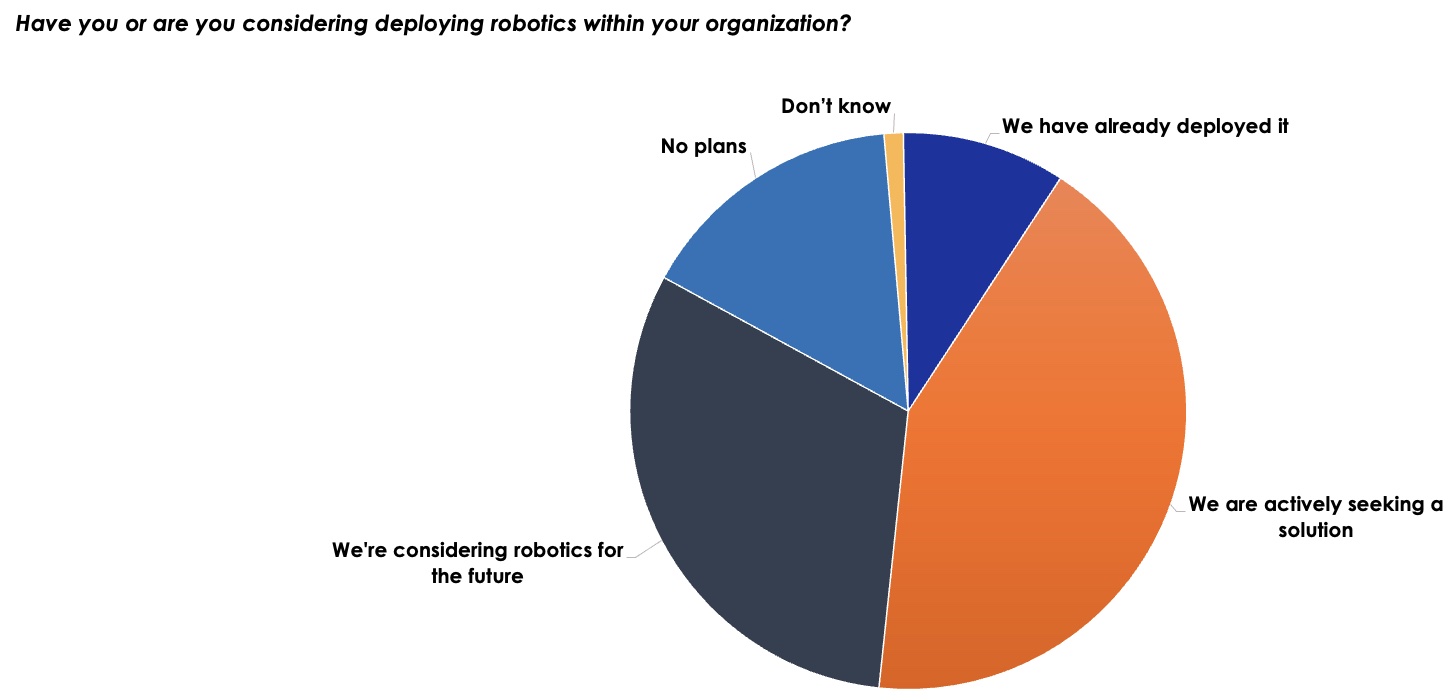
N = 179 Total Respondents
Source: Robotics Survey; Keypoint Intelligence 2026
It is interesting to note that while only 9% of respondents in Europe had no plans to deploy robotics, the same was true for 23% of respondents in North America.
Recognizing the Need
Ongoing labor issues continue to drive automation decisions across production environments. Companies are having difficulty recruiting and retaining employees for physically repetitive tasks, and there’s also the issue of worker safety since monotonous or taxing jobs can cause injuries. By assigning repetitive or physically demanding tasks to robots, businesses can free their employees to focus on higher-value activities like quality assurance, workflow oversight, and exception management.
A Slow, Steady Approach
Keypoint Intelligence’s survey data indicates that today’s organizations are taking a steady and pragmatic approach to robotics adoption. Instead of working to instantly implement fully autonomous production lines, businesses are focusing on specific operational bottlenecks and deploying robotics solutions where they can deliver immediate results.
The most commonly used (or planned) implementations occur on the production floor rather than in warehouses, bindery/finishing areas, or shipping areas. When respondents were asked specifically what their robots were or would be doing, the most popular uses were moving media/substrates to or from the press/production floor.
Figure 2: Functions of Robots (Top Responses Only)
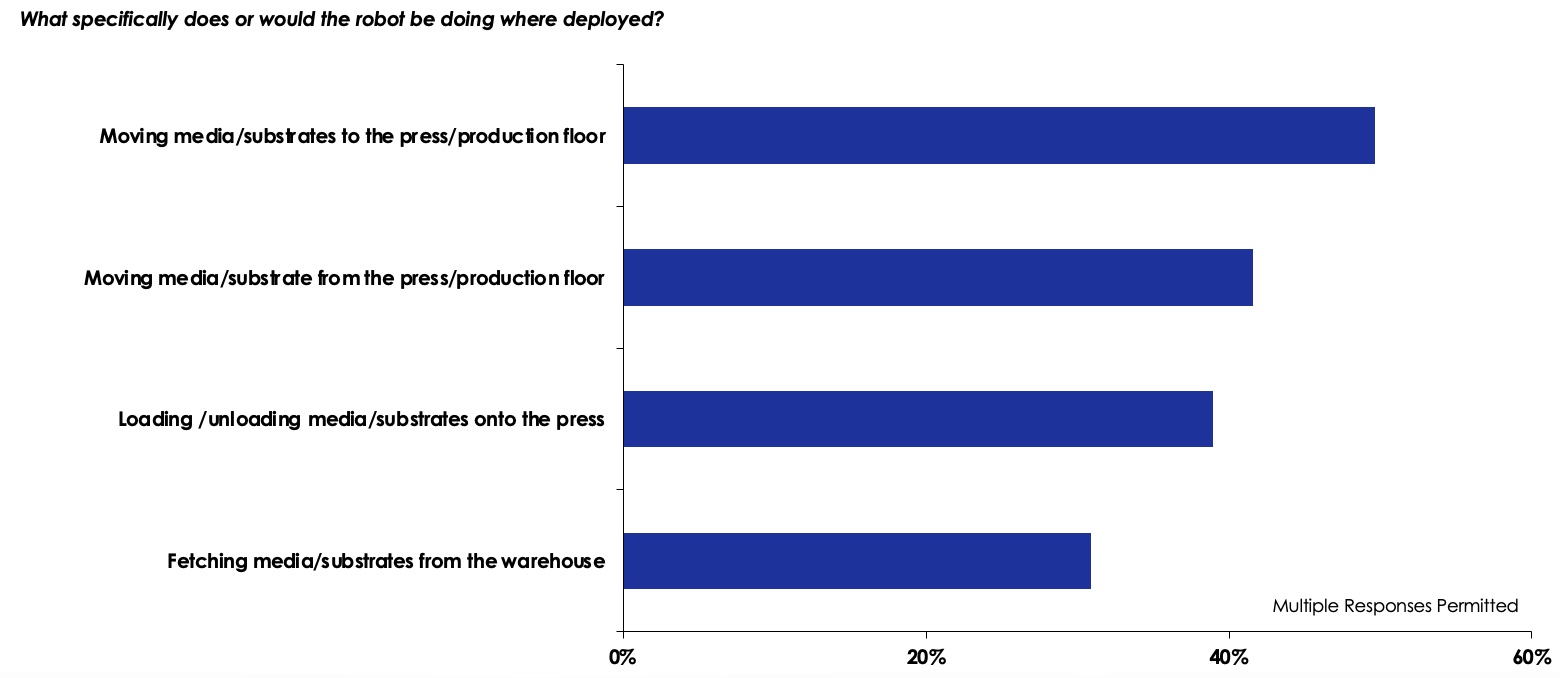
N = 149 Respondents that have deployed or are considering robotics
Source: Robotics Survey; Keypoint Intelligence 2026
All of the tasks in the Figure above share a common characteristic, and that’s repetition. These tasks can be labor-intensive but are performed over and over in a consistent manner, making them ideal candidates for robotics. In these situations, robots can deliver marked performance improvements while minimizing implementation risks.
By taking an incremental approach to robotics, businesses can build confidence in the technology without causing major disruptions to the existing workflow.
A Focus on Specialization…For Now
Our survey results also show a preference for task-specific robots. Multifunctional robotic solutions might attract a lot of attention at trade shows, but many firms currently favor solutions that are designed to reliably perform a single, simple job over and over. Especially when deploying robotics for the first time, businesses are more likely to start with solutions that deliver clear, expected results.
Instead of pursuing fully autonomous production, modern businesses are implementing robotics to solve immediate operational challenges. Of course, this may change over time as organizations become more comfortable with robotics and deploy more solutions. The industry is still in the early adopter phase, so it makes sense that people want to test the waters first.
When investigating robotics, survey respondents report consulting a wide range of sources, but the most common include robotics manufacturers, press/printer manufacturers, and robot system integrators.
Figure 3: Guidance for Robotics Purchase (Top Responses Only)
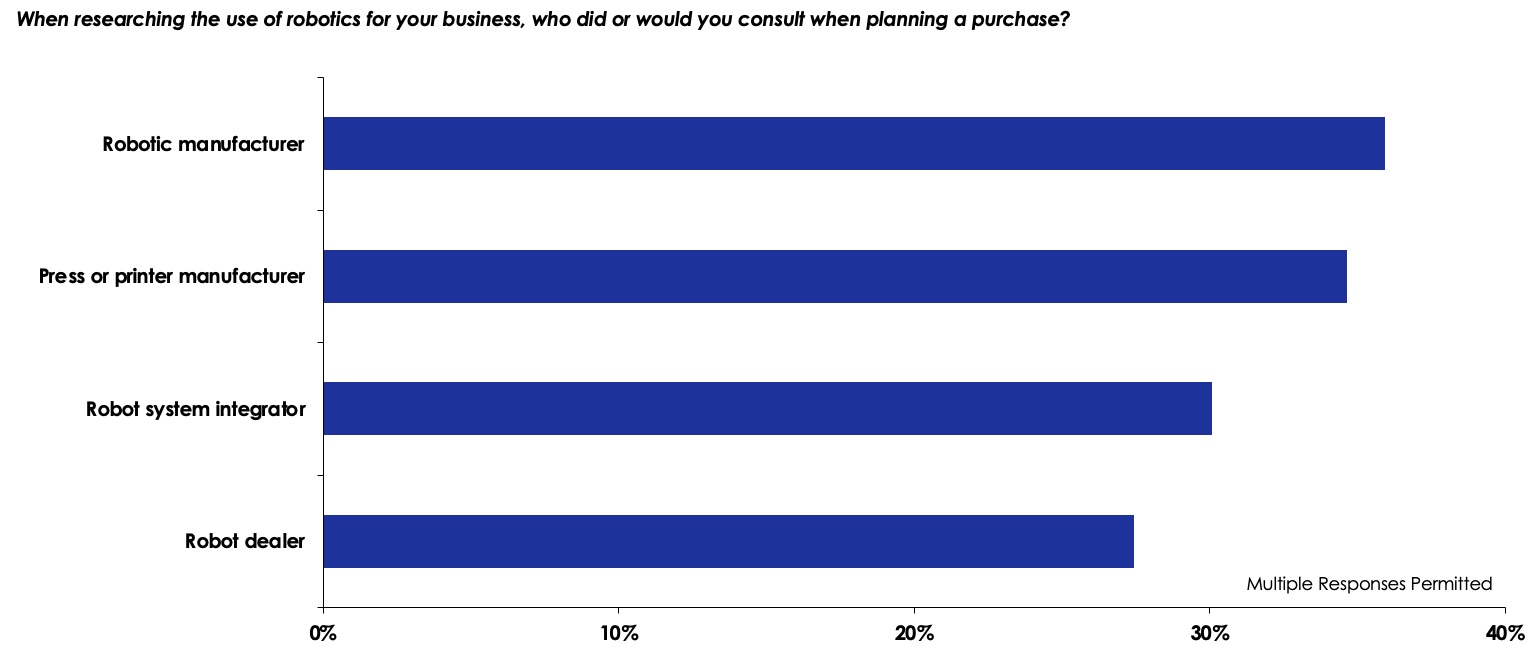
N = 153 Respondents who have already deployed or are planning to deploy robotics, or have explored the use of robotics
Source: Robotics Survey; Keypoint Intelligence 2026
A Path Forward
Among firms that are considering robotics but have not yet implemented them, some common barriers remain. Not surprisingly, survey participants most frequently cite budget/cost constraints, a high capital expenditure, and uncertainty about ROI or benefits.
Figure 4: Reasons for Delaying Robotics Purchase (Top Responses Only)
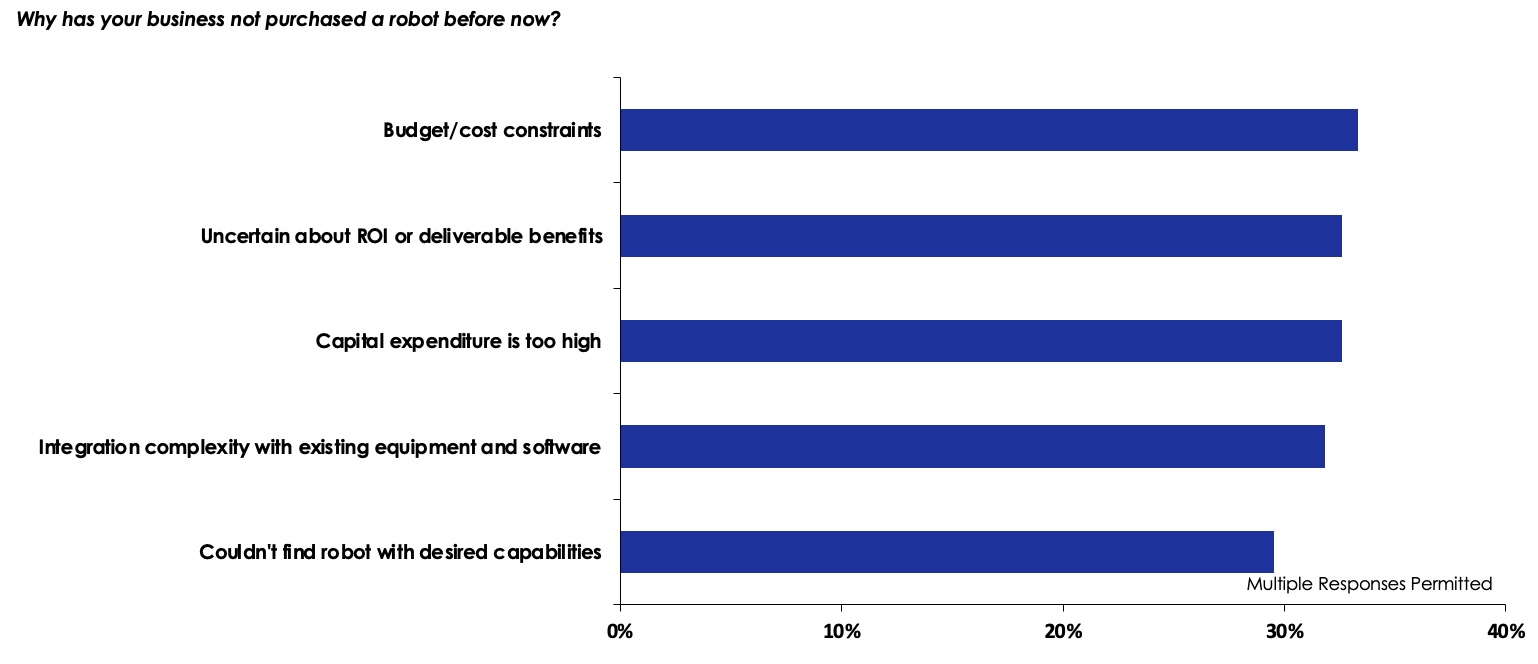
N = 132 Respondents who are planning to deploy robotics, or have explored the use of robotics, but haven’t yet made an investment
Source: Robotics Survey; Keypoint Intelligence 2026
Production businesses want evidence that robots can increase profitability and ultimately succeed in environments very similar to their own. Proven use cases, peer experiences, and real-world outcomes will play a critical role in moving organizations forward on their robotics journeys.
The Bottom Line
It might still seem futuristic, but robotics is no longer a distant and experimental concept. In today’s production environments, it is poised to become a practical extension of workflow automation. Although we’re still in the early stages of actual adoption, the message is clear: most organizations are actively exploring how robotics can help them address labor shortages, rising costs, and operational inefficiencies in the future. Rather than attempting sweeping transformations, modern businesses are taking a measured approach by deploying or considering task-specific robots that target repetitive, high-impact bottlenecks. In addition to delivering immediate results, this approach can also build confidence in robotics as it becomes a reliable part of the production ecosystem.
Before they move forward with broader robotics adoption, organizations will demand clearer proof of ROI as well as successful real-world implementations from peers and industry leaders. As confidence grows and technology continues to mature, robotics has the potential to become a strategic necessity. The companies that start small, stay flexible, and scale thoughtfully will be in the best position to achieve long-term efficiency gains and improved workplace safety in an increasingly automated industry.
Keypoint Intelligence’s recently released in-depth survey results cover the emergence of robotics on a global scale. Robotics is the key to true hands-free production, but it’s important to think strategically and start small. To learn more about robotics or to purchase our research, click here.
Eve Padula is a Senior Consultant for Keypoint Intelligence's Production Printing Consulting Services with a focus on Business Development Strategies, Customer Communications, and Wide Format. She is responsible for creating, analyzing, and formatting many types of content, including forecasts, blogs, industry analyses, and research/multi-client studies. She also manages editing and client distribution for many types of deliverables.