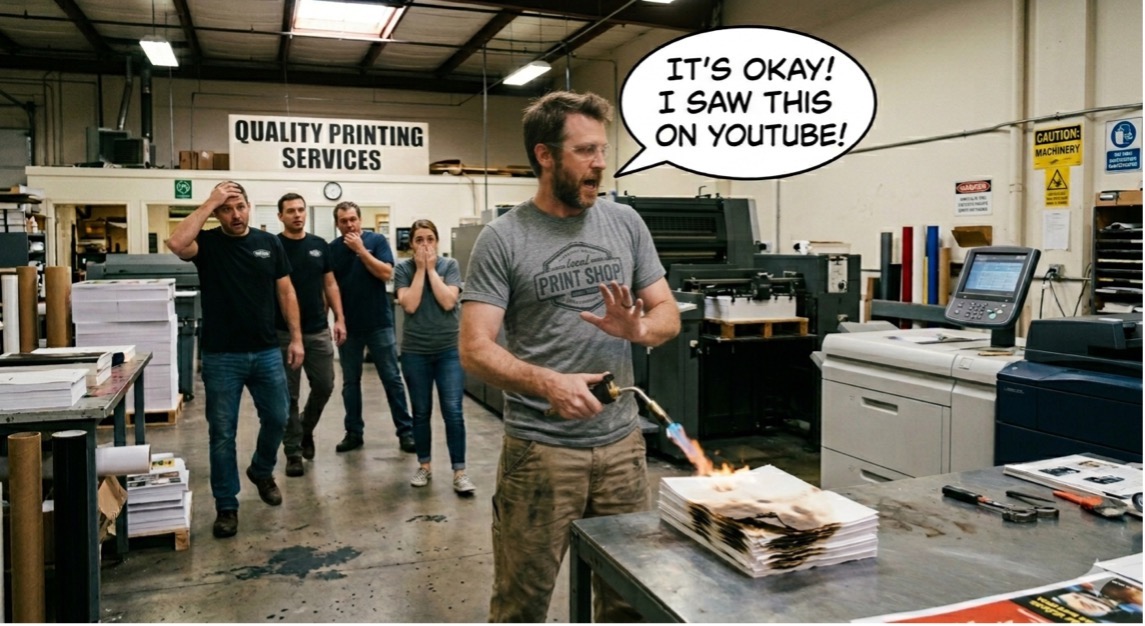
Have you ever heard someone say they knew “just enough to be dangerous”? That’s the lure of false confidence. Think of a teenager with a shiny new driver’s permit or someone who buys a blowtorch and thinks they can weld their own campfire grill because they watched a TikTok video. The same thing is happening in AI search.
Everywhere you look, new tools are popping up promising to help you gain visibility in AI search (increasingly called AEO, or answer engine optimization), and to tell you how visible you are in AI engines like ChatGPT, Gemini, and Perplexity. But there’s a big difference between a clean-looking score and a reliable diagnosis.
Can Data Cause Panic?
Recently, a Clutch survey reinforced why businesses are paying attention. Among its findings:
- Nearly three in four AI assistant users say they use one daily or multiple times a day.
- 32% say they turn to an AI assistant first when they need information, compared with 28% who still go to Google first.
- 69% say they use Google less because of AI assistants.
Understandably, printers see numbers like these and feel the chill of panic: “Yikes. Am I going to lose business? How do I deal with this?” Those are fair questions, but be careful where you get your answers.
Beware of Shaky Foundations
Many AI visibility tools make it easy to enter your website and location into the text boxes and get a score showing how you rank in AI visibility. The problem is that the underlying assumptions are often shaky. If a print shop specializes in fundraising materials for nonprofits, for example, but the tool compares it to a local franchise print shop (or to companies that no longer exist), the result may look precise while being practically useless.
That’s why competitor matching matters so much. A credible competitive analysis tool should let you define your own business based on the customers you serve, the work you want, and the markets that matter to you. Otherwise, the score may be more theater than insight.
Beware, too, of tools that use 100% AI to generate the content they say you need for visibility. The problem of AI slop is real. If your site already sounds generic (“We offer high-quality print, great customer service, and affordable prices!”), then AI will produce more of the same. That doesn’t create differentiation. It just creates more sameness.
Before creating any content (with or without AI-assist), know your true differentiators, how the market perceives you, how you want to be perceived, and incorporate precise, AI-citable details into your content so that your content is actually unique to you.
It’s All Still Messy
AI can be a powerful tool for improving visibility in the age of AI search, but it should not be treated as a magic wand. AI search is still messy, and the quality of the tools varies widely. It’s easy to end up with false confidence if you don’t know how the tool is working.
Before trusting any analysis from an AI tool:
- Ask what queries it is running and whether they match the products and services you actually offer.
- Look at the companies it lists as your competitors and make sure they are real, relevant, and comparable.
- Run the analysis in more than one tool, then compare the results. Different systems can use different prompts, retrieval methods, and scoring logic.
Don’t confuse visibility with value. A brand may be mentioned in an AI answer without being cited, cited without being recommended, or recommended in one tool but not another. That’s why a single score should be treated as directional, not definitive.
Special Note for Printers
A few things make this particularly important for printers. Many print businesses are vertically specialized, but their websites still look generic on the surface, which makes it easier for AI tools to misclassify them. Strong positioning, specific service pages, proof points, and clear market focus matter more than ever because they help both people and AI systems understand what makes you different.
Right now, we’re in the Wild West phase of AEO. Everyone claims to offer help, but the quality of that help varies widely. The smart move is not chasing the prettiest dashboard. It’s understanding the tools well enough that you can use them…safely.