The objection comes up in nearly every discussion about AI search: “Optimizing is complicated and expensive. Is it really worth the time and effort when there are easier ways to get in front of customers?”
It's a fair question. AI search optimization isn't like SEO, where you fill in the boxes and move on. It's contextual, considering the entire universe of content, from webpages to backlink quality to social media mentions to Google reviews. It demands intentionality, time, and financial investment. And the algorithms keep shifting.
Why bother when most businesses still just Google "commercial printer near me" or call someone they know?
From Product to Problem-Solving
Because simple searches work fine…until they don’t.
A business finds a printer through SEO. The printer misses the in-home window. Half the mailing arrives after the promotion ends. Money wasted, trust broken.
Suddenly, the search changes. It’s no longer “direct mail printer near me.” Now it’s “direct mail printer that won’t miss my in-home window and waste my doggone money.” The buyer is hunting for trust signals because proximity and price aren't enough anymore.
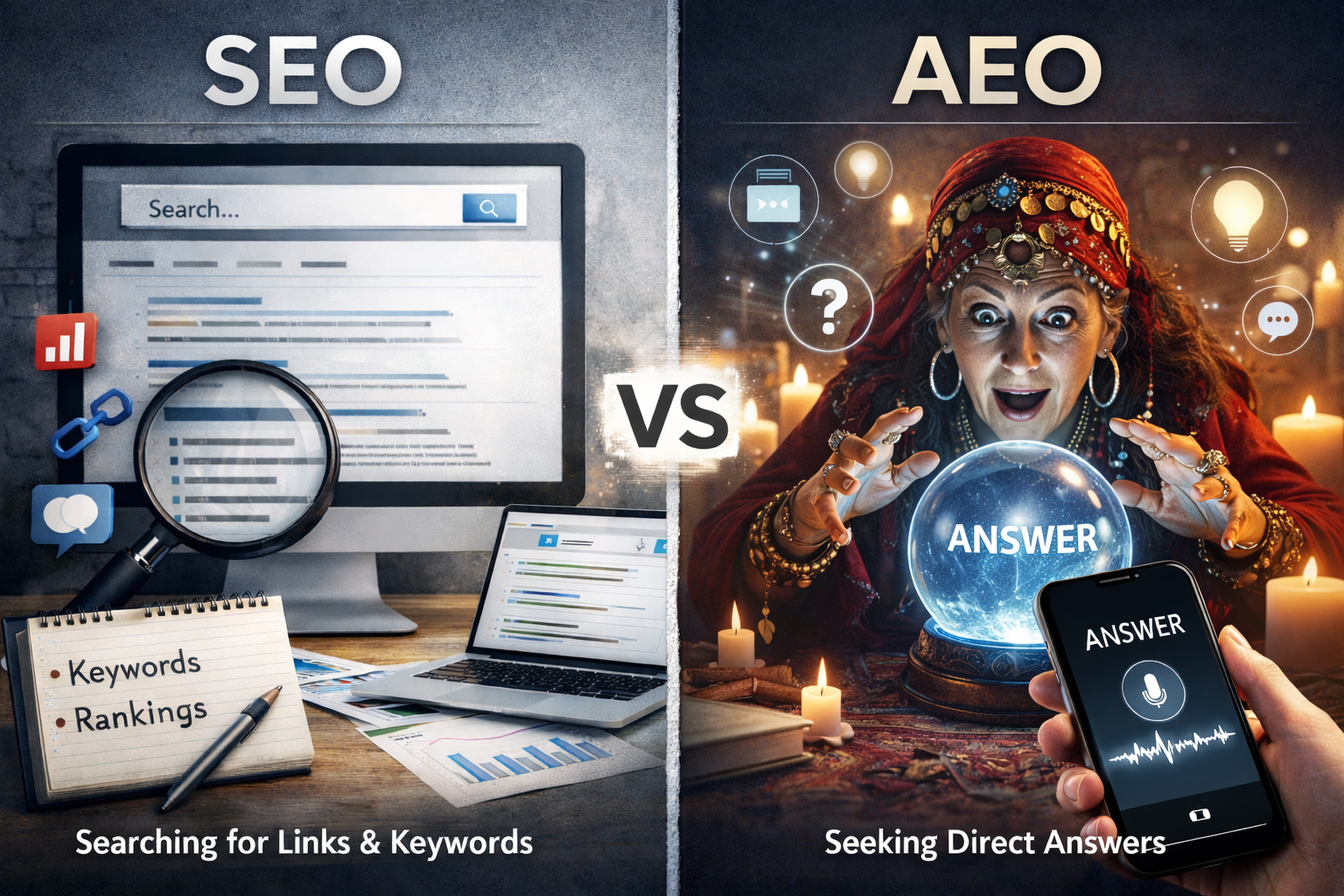
These are called “long-tail queries.” When someone has a long-tail question, they’re not looking at Google. They’re looking at ChatGPT. The search has moved from product to problem-solving, from simple to complex. SEO can’t answer these questions. But Answer Engine Optimization (AEO) can.
“I just had a call from a reseller like that today,” says Bob Saunders, VP of sales for Wise, a trade manufacturer of prime and durable labels as well as traditional business forms (Alpharetta, Ga.). “They were looking for very specialized paper for business forms inserted into packaging for lab samples. It requires a very precise match between the paper and the application. There are so many variables, especially in healthcare applications, and there’s a lot riding on getting it right.”
When SEO-Generated Lists Won’t Cut It
A list of SEO-generated printer options won’t solve a problem like that. When the query is essentially, “Help! I don’t know where to go!” or “Here are all the things that went wrong—now find me someone who can fix it,” traditional search results fall short.
Which explains why Wise is investing in AEO. “It makes sense that jobs coming in from AEO are not only complex, but higher margin,” Saunders says. “Plus, they’re sticky. If you can solve someone’s big problem, there’s a lot of value-add there and a lot of loyalty.”
For a company whose business is built on problem-solving, the strategy tracks. But it does require different content, or recreating what's already there.
“We’re starting that process now," notes Patrick Whelan, president of Great Reach Communications, which has offered content marketing solutions for printers for more than two decades and recently launched an AEO program specifically for the print industry. “From this point forward, we’re creating custom content that is AI-optimized. Plus, for our AEO clients, we’re working with them to update the content that’s already been posted.”
The ROI Question
Whelan recently spoke with a printer using an overseas provider for AEO services. While many printers balk at outsourcing marketing, this $5 million operation considers it one of the best investments they’ve ever made. The company generates 15–20 leads per month and has landed three new clients from AEO efforts, including one that became one of their largest accounts.
“I think of investing in AEO as like fishing,” Whelan says. “When you start catching fish, not all of them will be big. Even the small fish will feed you. But some of them will be big—really big.”
That’s the economics behind AEO. At least right now, it may not replace other marketing efforts or serve every type of job. It may be particularly effective for complex projects with higher margins, better profitability, and stronger client retention. Projects that might come from markets where a printer has no existing relationships.
So don’t think of AEO as intended to fill the basket with fish, although you might. It's to land the fish that matter…and never knowing what monster might end up in the net.
Update: This article reflects anecdotal observations based on the author’s conversations within the industry, and results may vary. The headline and select language have been updated slightly for clarity.