
AI is everywhere and affecting everything. The volume of news about AI is overwhelming. It’s easy to miss some of the most interesting stories, so let’s look at a quick roundup of AI headlines from this past week. This is not a comprehensive list. Just a representative selection of what ended up in our inbox. As any good news outlet would, let’s start with the most dramatic.
AI Security Breach
Last week, Claude Code, a popular AI chatbot, was the victim of a state-sponsored AI attack. Dubbed “espionage” by Anthropic, parent company of Claude, the attack executed thousands of operations per second and targeted 30 of Claude’s customers. According to Anthropic, the operation targeted large tech companies, financial institutions, chemical manufacturing companies, and government agencies. The attack reminds us that AI can be a powerful force for good, and it can also be a powerful force for evil.
Read the full analysis by Anthropic.
AI Scramble Drill
Other AI companies were not slow to respond to this attack. This week, John Munsell, author of INGRAIN AI, which helps teams responsible for security, operations, and strategic resilience, for example, appeared to use the attack as an opportunity to promote INGRAIN AI’s own cybersecurity capabilities, inviting security personnel to witness an AI breach simulation in real time. Network mapping. Vulnerability identification. Credential theft. Data extraction. Registrants can watch INGRAIN’s AI Certified implementer candidates identify the breach, assess the damage, and figure out how to contain it and stabilize the environment. The event is at 4 PM CST (today).
Do You Trust AI for Security?
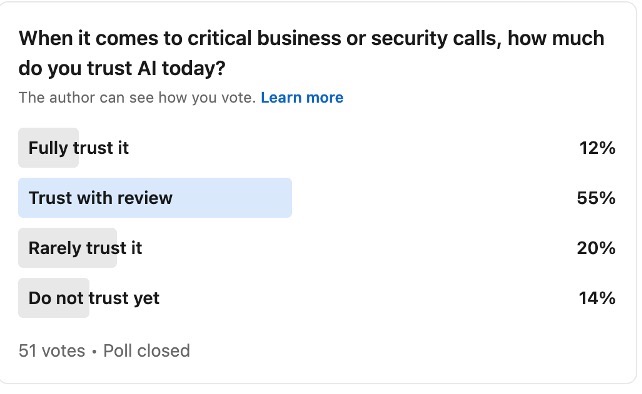
Not surprisingly in this news cycle, we ran into a LinkedIn poll on AI trustworthiness. On his LinkedIn page, IT operations and cybersecurity Professional Michael Romero polled his followers on their attitude toward AI security. He asked, “When it comes to critical business or security calls, how much do you trust AI today?” What did the majority say? Trust but verify.
AI Model Aims to Support Suicide Prevention
However, it wasn’t all negative AI news this week. Information Systems Research released a new report that finds that while certain short-form videos on major platforms can trigger suicidal thoughts among vulnerable viewers, a newly developed AI model can flag these high-risk videos before they spread. According to the press release, “The research delivers one of the first data-driven, medically informed tools for detecting suicide-related harms in real time, giving platforms a clearer early-warning signal at a moment when youth mental-health concerns are rising and scrutiny of platform safety is intensifying.” The study was conducted by researchers from the University of Delaware, the Hefei University of Technology, and the Chinese Academy of Sciences.
33% of AI Users Experienced Inaccuracies
Back to the bad news. eMarketer reports that one-third (33%) of U.S. genAI users have experienced inaccurate or misleading output when using the technology, citing a September 2025 report from Deloitte. Yet nearly all (98%) U.S. market researchers have used genAI over the past year, and according to a Harris Poll–QuestDIY survey from August 2025, 72% use it at least once daily. Let’s return to that LinkedIn poll—trust but verify—shall we?
AI Is Moving Faster than Commerce Can Keep Up
Also from eMarketer this week, three in four commerce leaders say AI is moving faster than their teams can keep up, citing Rithum and Wakefield Research data. Download the report, titled 2026 Commerce Readiness Index, which describes how 200 business leaders are “closing the gap,” here.
AI Can Be Manipulated into Phishing
New research from Cybernews shows that top AI models can be tricked into teaching people how to hack. The study tested six AI systems from three major companies and found that Google's Gemini Pro 2.5 was the easiest to manipulate, often giving answers that could help with hacking. Claude Sonnet 4 was the hardest to trick. Read the full article here.
Jeff Bezos Jumps into the AI Game
But don’t worry. Jeff Bezos can fix it! Founder of the global e-commerce retailer Amazon, Jeff Bezos has now jumped into the AI game. As announced by the New York Times, Bezos is now the co-founder and co-CEO of Project Prometheus, a $6.2 billion AI startup that he’s partially funding. Co-leading with Vik Bajaj, a physicist and chemist who worked at Google’s “Moonshot Factory,” Bezos has the vision of building AI models that learn in more complex ways than the LLMs that power AI chatbots.
CMOs: AI Is Changing Our Role
According to new research from Gartner, CMOs overwhelmingly believe that AI will shape their role within their companies but are struggling to tie the technology to measurable results. Part of the reason, Gartner argues, is that AI cannot simply be “bolted on to legacy systems.” Rather, it must be part of a complete revamp of how businesses operate.
Read the Marketing Dive report.
AI Skills Might Land You That Job
According to George Yang, a Toronto-based digital innovator and AI adoption strategist, major studies show that people with hands-on AI skills command a 19% to 56% salary premium over peers, exceeding the wage increase typical of advanced degrees or certifications. For instance, Yang writes, AI-savvy workers earn about $18K more per year and are 28% more likely to be promoted.
Read Yang’s full analysis here.
Survey: AI Tools Make Business More Efficient
Let’s end on another high note. According to a new survey of small business owners, “Business Owner Survey: Sentiment and Statistics on SEO and LLM Visibility,” most of those who state business has been better in 2025 have incorporated AI tools into their business operations. Sixty percent cite increased efficiency.
So what does this week's whiplash tour through AI headlines tell us? That the disconnect between those 72% of researchers using AI daily and the 33% experiencing inaccuracies isn't a bug. It’s a reflection of where we, as a society, are right now. We’re in the messy middle, where AI is too useful to abandon but too unreliable to trust completely.