Commatose
In editorial circles, those who have, shall we say, a pedantic and fastidious attitude toward grammar and punctuation are often referred to as “chasing commas.” And while, especially these days, no one especially cares about proper punctuation, a rogue comma once upended 19th-century tariff policy. Via Boing Boing:
Back in 1872, the U.S. was fine-tuning a new tariff act. Lawmakers wanted to exempt “fruit plants”—but only the tropical and semi-tropical kind, and only for propagation or cultivation. The idea was simple: help farmers, not fruit merchants.
But then, when the law was drafted, a misplaced comma changed its meaning:
A copyist nudged [the comma] one word to the left. Instead of exempting “fruit plants,” the printed law now exempted “fruit, plants tropical and semi-tropical…”
If you were a fruit importer, you loved that comma.
Suddenly, all bananas, pineapples, and other delicious cargo could legally glide into America, duty-free—no hidden fees, just hidden punctuation. The Treasury Department had no choice but to agree: Yep, that comma means all fruit gets in free.
That comma cost the US government $1–$2 million, or $40 million adjusted for inflation. Totally bananas, right? After two years, Congress fixed the comma and, therefore, the law, restoring tariffs on fruit.
Now, about that semicolon…
Finding My Way
Print magazine’s Steven Heller is bemused by a presumptuous bit of wayfinding signage in NYC.
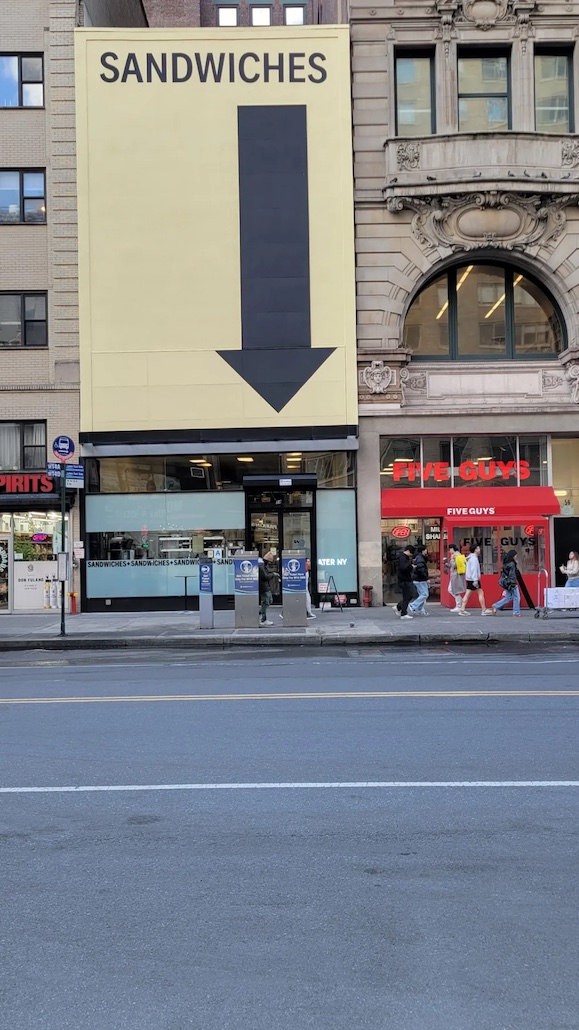
If only airports had this kind of obvious wayfinding signage.
More of Gravy Than the Grané
Halloween may be over, but that doesn’t mean we still can’t explore what are known as “ghost words,” or words that have made their way into the English language—and thus the dictionary—due to typos, misspellings, or bad handwriting. (Take, for example, the word “flimsy,” which was actually a transposition of the word “filmsy”—that is, thin like film—which would make more sense.)
Via Laughing Squid, Dr. Erica Brozovsky of the PBS series Otherwords explains these “ghost words.”
For instance, the word gravy is thought to be a 14th century cookbook misreading which turned the old French grané into gravé. … Like gravy, syllabus is now a legitimate word. But according to the second edition of the Oxford English dictionary,it originated from a misreading of the Greek word sittubas, meaning parchment label or book title slip. If you’ve ever tried to read someone’s messy handwriting, you can forgive that mistake.
Watch (grrr...) unembeddable video here.
Stuck on You
Consider the Band-Aid. One of those products that has become so successful and ubiquitous that it has become a generic term for an adhesive bandage, many people not realizing that it is actually a trade name. But who invented the Band-Aid (around these parts, as klutzy as we are, we’re glad someone did!) and how did it become a household word?
Via Laughing Squid, Today I Found Out explores the history of the Band-Aid. It began with a man named Earle Dixon, who in 1917 married Josephine Francis White. While by all accounts the marriage was a happy one, it seemed Josephine was rather accident-prone and was constantly cutting and burning herself. At the time, first aid kits contained bandage-making materials such as gauze and surgical tape, which had to be cut and folded—not an easy thing to do with one hand. (Heck, sometimes it's hard enough to open a Band-Aid wrapper when you’re bleeding profusely from a finger.) So Dixon, the ever-loving husband
laid a strip of gauze down the center of a length of surgical tape, then covered the adhesive backing in crepe tape to protect it. The resulting ready-made dressing could easily be cut to length with scissors and applied to one’s own wounds with no assistance and little hassle.
Dixon, who worked as a cotton buyer for Johnson & Johnson, presented the idea to his bosses and, although skeptical, in 1921 they bought the concept from him. It was through some clever marketing—often involving “product placement” in children’s books—that led to the Band-Aid’s ubiquity and its having become a generic term. Earwormy jingles also helped.
And that’s why after little more than a century, you’re stuck on Band-Aids and Band-Aids are stuck on you.
Swine and Cheese
Let is take a little trip back, to Regency London, circa 1815. What was all the rage? Pig-faced ladies. Say what? Via Atlas Obscura, as early as the 17th century myths and legends surrounding women with pigs’ heads had proliferated and captured the public imagination much like werewolves had. Interestingly, by the early 19th century, it was the growth of London’s newspaper industry that helped spread urban legends about pig-faced ladies. Fake news has always been with us.
For Regency readers, the pig-faced lady of 1815 London may have remained an easily dismissed rumor if it weren’t for the newspapers. In the early months of that year, journalists and papers helped turn the pig-faced lady into something of a celebrity—despite skepticism of her existence.
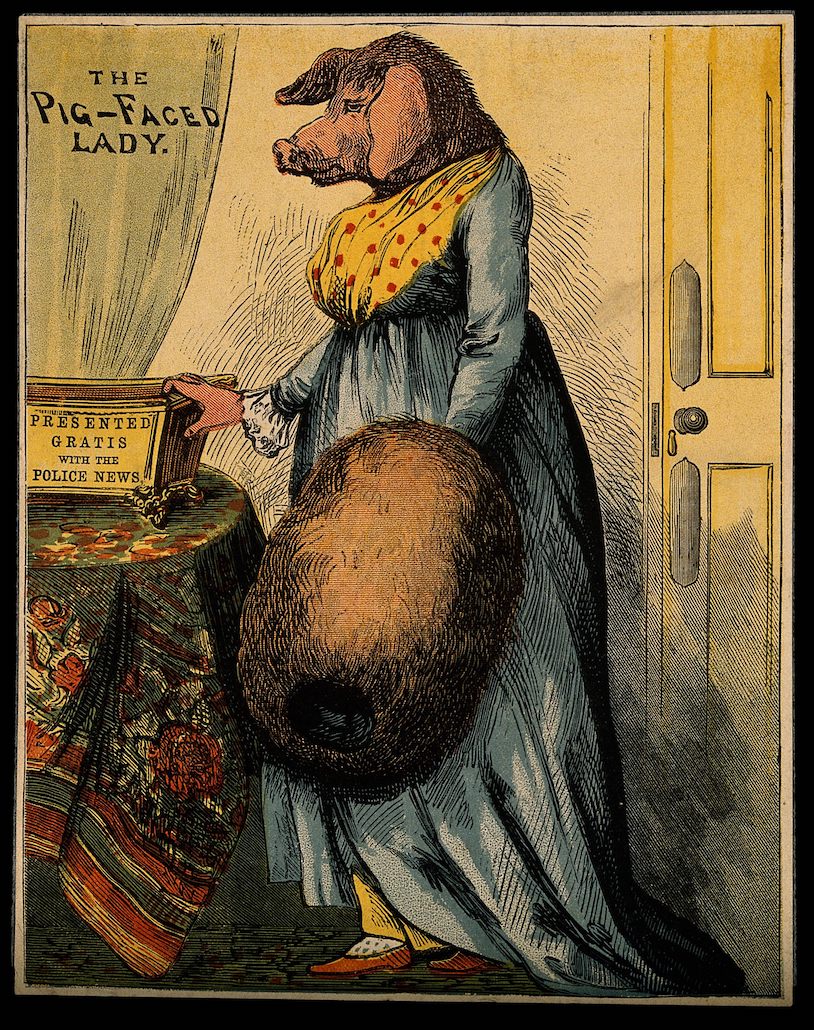
In the February 9, 1815, issue of The Times, one woman said she wished to “undertake the care of a Lady who is heavily afflicted in the face,” using what was essentially a job wanted column to express her hope of a substantial salary for the position (though no known job listing for a pig-faced lady’s companion was posted before this). The Times quickly ridiculed believers, publishing a February 16 article to shame readers to reason: “Our rural friends hardly know what idiots London contains.” Still, The Times couldn’t help but describe the legend, which often placed the reclusive woman in an expensive neighborhood around Manchester or Grosvenor Square.
AI-Yi-Yi-Part the Infinity: Slopstore
Want to go shopping for stuff that doesn’t actually exist? Thanks to the wonder that is AI, you can! Says Boing Boing:
Anycrap puts AI image generators to good use, filling a fake online store with fake nonsense. It's just like the real ones, except you don't have to deal with disappointment or the returns process. Fast favorites include a stress ball with spikes, Cat Litter Box With Coffee, and Real Unicorn Miniature Called Luna That Can Make Me Pizza.
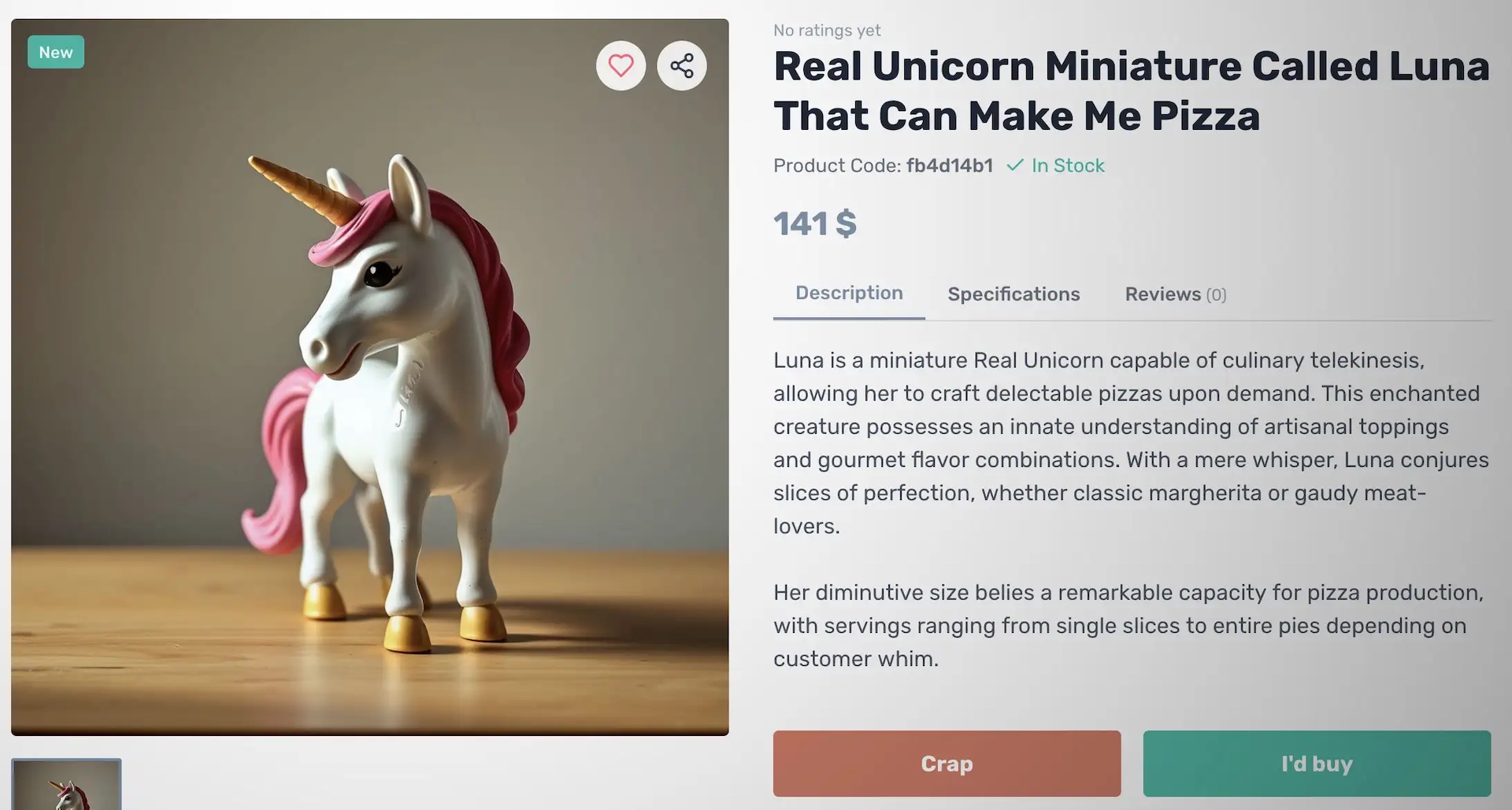

AI is immeasurably improving our lives in every way.
Dust in the Wind
What could possibly go wrong: a real-life military technology known as “smart dust.” Defined as “millimeter scale sensing and computing platforms,” it began as a proposal to the Defense Advanced Research Projects Agency (DARPA) decades ago, but the idea has not only not disappeared, but has been continually developed. Says Futurism:
That’s according to Interesting Engineering, which recently published a rundown of the state of present-day smart dust after decades of development. Though “dust” remains a bit of a misnomer — it’s more like a bunch of tiny sensors capable of delaying data to a central device — there’s a large body of theoretical and simulated work laying a path for practical microengineering that’s steadily coming into its own.
Case in point:
Recent developments within the past 10 years have expanded these sensor’s abilities to record various levels of sound, and work is underway to develop motes capable of detecting the chemical composition of the air. They can be used individually to record changes in the human body, or deployed in swarms to identify biological compounds.
Still, it does have its limitations.
While the tech is pretty dystopian as it is, there’s a lot of room for improvement. The need to interface with a centralized data-processing unit, for example, means the tiny units can’t travel too far from their human controller. Their usable lifespan is likewise pretty short, though that’s changing with innovations in energy-harvesting capabilities via light, vibrations, and electromagnetic fields.
As they point out, you may want to invest in an air purifier.
For Kicks
If you have an e-bike, you know that charging it either requires plugging it in directly or removing the battery and plugging that in. However, Dutch company Tiler has a clever alternative: a pad that charges the e-bike through the kickstand. Says Core77:
Called the Tiler Compact, the arrangement is being marketed to both e-bike-owning individuals and fleet operators; up to 24 of the pads can be daisy-chained and supported by a single outlet. Top-ups typically take 3 to 6 hours per bike. Installation of the kickstand is straightforward for DIY'ers, the company claims; for those who'd rather leave it to the pros, a bike shop can easily handle it.
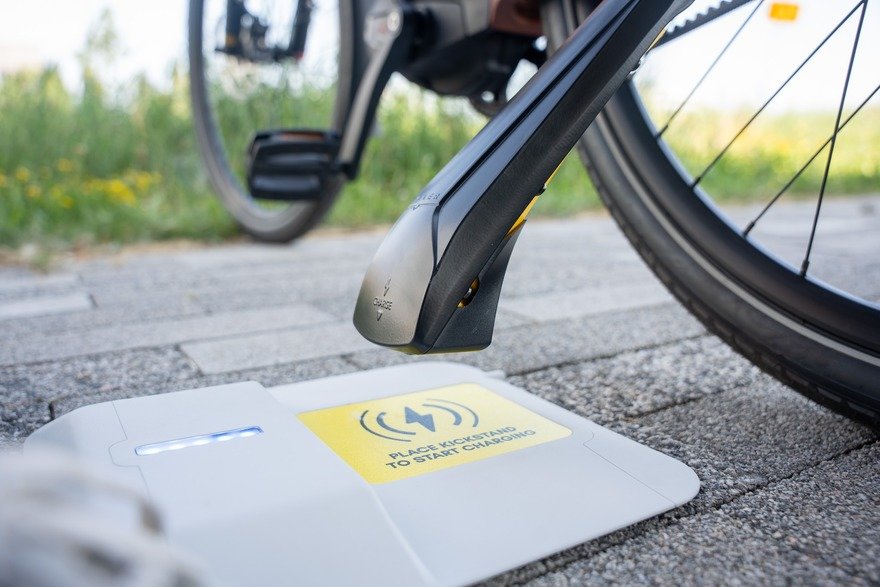
The company says it has installed more than 200 Tiler charging stations across Europe.

Graphene Is Cool
Was it a good week for graphene news? It’s always a good week for graphene news! Graphene-based coatings for the HVAC market. From (who else?) Graphene-Info:
Graphene Manufacturing Group (GMG) has announced a new collaboration with global refrigeration and HVAC leader Beijer Ref. Starting November 17, 2025, Beijer Ref will offer GMG’s proprietary THERMAL-XR® ENHANCE heat transfer coating as an optional upgrade for Beijer Ref and Kirby-branded refrigeration evaporator coils across all 73 of its wholesale locations in Australia.
…GMG’s THERMAL-XR® ENHANCE coating leverages a graphene-based formulation that boosts the thermal performance and durability of heat exchange components. Applying the coating to Beijer Patton and Kirby Guardian evaporator coils is expected to significantly reduce corrosion, enhance cooling efficiency, lower energy consumption, and contribute to sustainability targets across commercial and industrial applications.
Cool.
Around the Webb, Part the Continuing: Saturnalia
Well, what has the James Webb Space Telescope found now? Strange “dark beads” in Saturn’s atmosphere. “The surprising structures are unlike anything scientists have seen before,” says LiveScience, “and they're not sure what they are.”
The JWST’s Near Infrared Spectrograph (NIRSpec) took a gander at the planet’s atmosphere above the hexagonal storm that swirls at the planet's north pole, where it picked up the strange shapes.
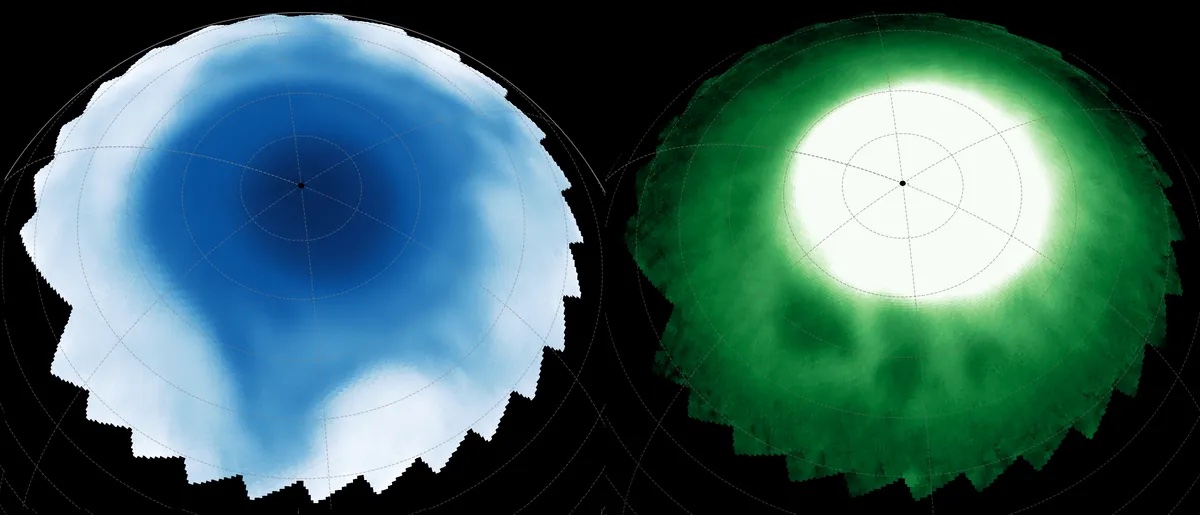
Caption from LiveScience: “The lopsided star in the stratosphere (left) and dark beads in the ionosphere (right). (Image credit: NASA/ESA/CSA/Stallard et al 2025.)”
The astronomers expected to see emissions across broad bands of the infrared spectrum in the atmospheric layers above the vortex. Yet what they noticed instead were dark, bead-like features — separated by vast distances yet possibly interconnected — drifting slowly in the charged plasma of the planet’s ionosphere, and a lopsided star-shape structure in the stratosphere beneath. They published their findings Aug. 28 in the journal Geophysical Research Letters.
"We think that the dark beads may result from complex interactions between Saturn's magnetosphere and its rotating atmosphere, potentially providing new insights into the energy exchange that drives Saturn's aurora," Stallard said.
The asymmetric star pattern, meanwhile, may somehow be tied to the hexagonal storm pattern, he said.
"Tantalisingly, the darkest beads in the ionosphere appear to line up with the strongest star-arm in the stratosphere, but it's not clear at this point whether they are actually linked or whether it's just a coincidence," he added.
The researchers hope to make some follow-up observations to hopefully understand what is causing these phenomena.
The things we can do.
Leeches
Consider the leech. An unprepossessing creature, it lives out a simple existence lurking in bodies of water and wants nothing more from life than to attach itself to a host and suck its blood. Kind of like social media, in a way.
Anyway, here’s an interesting, if upsetting, fact we came across: leeches didn’t always suck blood. Indeed, they used to swallow their prey whole. Says Discover magazine:
Now, for the first time, researchers have found a complete fossil of an ancient leech. Published in PeerJ, the study of this rare fossil has pushed back the presence of leeches on Earth to about 480 million years ago. The fossil also revealed something shocking: ancient leeches did not feed on blood. Instead, they likely swallowed soft-bodied organisms whole or feasted on their internal fluids.
Although leeches today (you know, those leeches today with their hula hoops and loud rock’n’roll music) feed in multiple ways, they most commonly use “a forward sucker at the front of their body to draw blood and secrete anticoagulants to ensure a consistent blood flow.” But the new leech fossil lacks that sucker, suggesting that in the past there wasn’t a sucker born every minute. Therefore, it must have fed on something other than blood.
Instead of feeding on blood, this leech ancestor likely ate other marine animals whole or consumed their internal fluids. This feeding strategy is backed up by the fact that the leech ancestor was more aquatic than modern leeches and likely roamed the ocean looking for prey.
So, sometimes things get better over time…
They Mint Well
Care for a toothpaste smoothie? There is such a thing! A collaboration between health food chain Erewhon and oral care company Boka has led to the introduction of the Mint Condition Smile Smoothie, a beverage inspired by toothpaste. Says (who else?) Food & Wine:
While the concept might seem off-putting at first, Boka’s team argues that you should give it a chance. “Yes, a smoothie inspired by toothpaste might sound unusual, but that’s what made it so fun to create,” Kinsey Butler, Boka’s senior director of brand marketing, tells Food & Wine. “Our goal was to capture that bright, clean sensation you get from brushing with our Ela Mint toothpaste and translate it into a smoothie people would actually enjoy.”

Spirulina provides the blue-green color you expect from minty toothpaste, while blended banana, coconut, and mango deliver a smoothie-like texture and layers of fruity sweetness. Butler notes that Boka worked alongside Erewhon’s team through multiple rounds of testing to reach the perfect taste, color, and consistency.
Man, could you imagine having been part of the first round of testing? It would bring new meaning to the phrase “Scope of the investigation”…
Anyway.
We can’t wait for a Listerine-infused soft drink.
This Week in Printing, Publishing, and Media History
November 3
1838: The Times of India, the world’s largest circulated English language daily broadsheet newspaper, is founded as The Bombay Times and Journal of Commerce.
November 4
1922: British archaeologist Howard Carter and his men find the entrance to Tutankhamun’s tomb in the Valley of the Kings.
November 5
1499: Publication of the Catholicon, written in 1464 by Jehan Lagadeuc in Tréguier, the first Breton dictionary and the first French dictionary.
1857: American journalist, author, reformer, and educator Ida Tarbell born.
1885: American historian and philosopher Will Durant (The Story of Civilization) born.
1959: Canadian singer-songwriter and guitarist Bryan Adams and, 1974, American singer-songwriter and guitarist Ryan Adams born. The coincidence cuts like a knife.
1979: American cartoonist Al Capp dies (b. 1909).
2007: Android mobile operating system is unveiled by Google.
November 6
1814: Belgian-French instrument designer and inventor of the saxophone Adolphe Sax born.
1869: In New Brunswick, New Jersey, Rutgers College defeats Princeton University (then known as the College of New Jersey), 6–4, in the first official intercollegiate American football game.
1935: Edwin Armstrong presents his paper “A Method of Reducing Disturbances in Radio Signaling by a System of Frequency Modulation” to the New York section of the Institute of Radio Engineers—basically inventing FM radio.
1947: Meet the Press, the longest running television program in history, debuts.
1958: American actor, puppeteer, producer, comic, and screenwriter Trace Beaulieu (Mystery Science Theater 3000) born.
November 7
1665: The London Gazette, the oldest surviving journal, is first published.
1837: In Alton, Ill., abolitionist printer Elijah P. Lovejoy is shot dead by a mob while attempting to protect his printing shop from being destroyed a third time.
1874: A cartoon by Thomas Nast in Harper’s Weekly is considered the first important use of an elephant as a symbol for the United States Republican Party.
1897: American director, producer, and screenwriter Herman J. Mankiewicz (Citizen Kane) born.
1913: French novelist, philosopher, journalist, and Nobel Prize laureate Albert Camus born.
1914: The first issue of The New Republic is published.
1929: The Museum of Modern Art opens to the public in New York City.
1943: Canadian singer-songwriter and guitarist Joni Mitchell born.
1967: U.S. President Lyndon B. Johnson signs the Public Broadcasting Act of 1967, establishing the Corporation for Public Broadcasting.
1981: American historian and philosopher Will Durant (The Story of Civilization) dies (b. 1885).
1994: WXYC, the student radio station of the University of North Carolina at Chapel Hill, provides the world’s first internet radio broadcast.
2016: Canadian singer-songwriter and poet Leonard Cohen dies (b. 1934).
November 8
1602: The Bodleian Library at the University of Oxford is opened to the public.
1674: English poet and philosopher John Milton dies (b. 1608).
1847: Irish novelist Bram Stoker (Dracula) became undead born.
1898: Canadian-American actress and singer Marie Prevost born. (Despite the story in Kenneth Anger’s Hollywood Babylon (and a song by Nick Lowe) Prevost was not eaten by her dog.)
1918: German typographer and calligrapher Hermann Zapf born.
1972: HBO launches its programming, with the broadcast of the 1971 movie Sometimes a Great Notion, starring Paul Newman and Henry Fonda.
1973: The right ear of John Paul Getty III is delivered to a newspaper together with a ransom note, convincing his father to pay US$2.9 million
November 9
1818: Russian author and playwright Ivan Turgenev born.
1914: Austrian-American actress and inventor Hedy Lamarr (not Hedley) born. (During World War II, Lamarr and composer George Antheil developed a radio guidance system for Allied torpedoes, unused at the time, but the principles of which were incorporated into Bluetooth technology and are similar to methods used in legacy versions of CDMA and Wi-Fi.)
1934: American astronomer, astrophysicist, and author Carl Sagan born.
1953: Welsh poet and author Dylan Thomas dies (b. 1914).
1967: The first issue of Rolling Stone magazine is published.