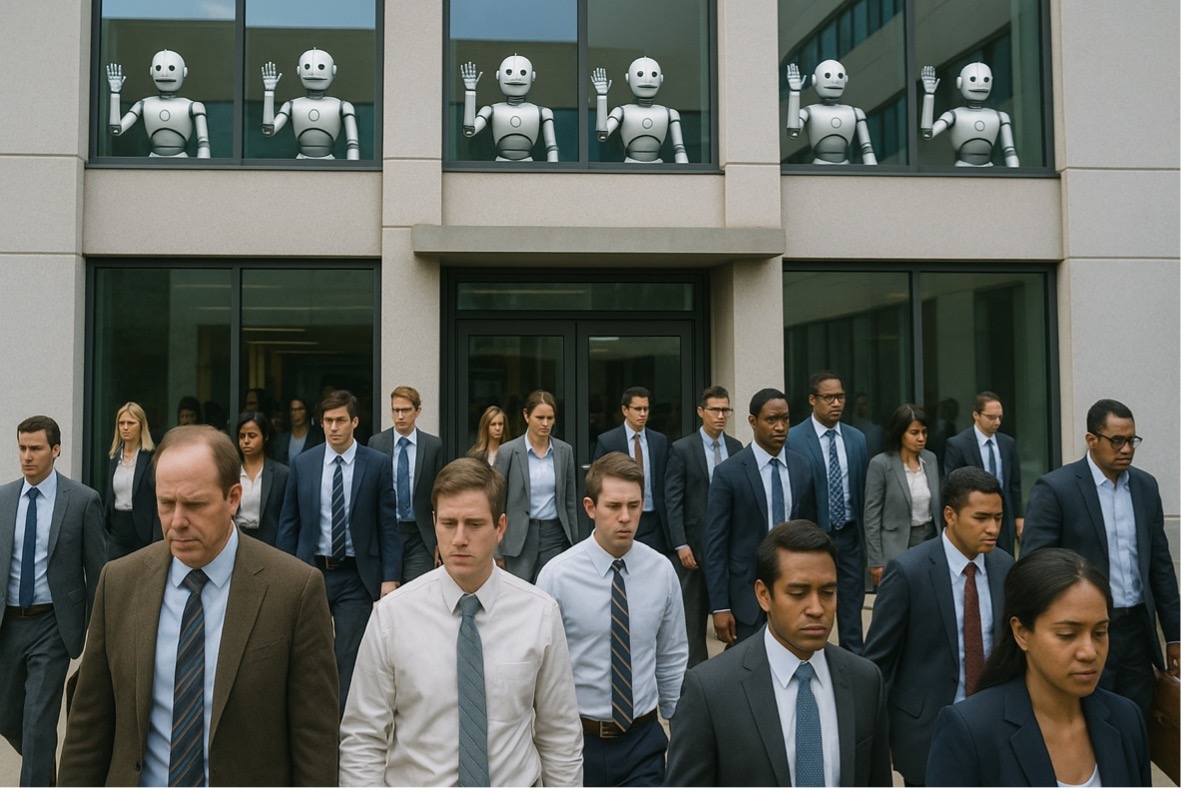
Yesterday, Amazon announced that it was cutting up to 30,000 corporate jobs as it “pares expenses.” This amounts to 10% of its 350,000 corporate workforce. Some of these cuts are the result of corporate bloat resulting from over-hiring during the peak of the pandemic, but others are enabled by the use of AI.
Amazon isn’t alone. Business Insider is reporting that, according to a World Economic Forum survey, 41% of companies plan to lay off employees thanks to gains in AI automation. This includes giants such as Oracle, CNN, Dropbox, and Block, who have previously announced AI-related job cuts.
But it’s not all doom and gloom. The same survey found that, even as AI takes away jobs, it is adding them, too. More than three-quarters (77%) of WEF survey respondents plan to “reskill” and “upskill” workers between 2025 and 2030 to enable them to work alongside AI. The WEF projects that tech jobs in big data, fintech, and AI are expected to double by 2030.
Coming for Your Job…Or ReShaping It?
So AI may not be coming for your job. But it might be reshaping it. Unless you’re in an administrative or graphic design role. Companies interviewed by WhatTheyThink are seeing their hiring needs in both marketing and graphic design roles shrinking.
The CEO of one highly successful multichannel marketing and printing company, for example, shared with WTT some of the tasks at the company now being done faster and more efficiently by AI: “We can get more done with our HR team,” she says. “Our safety team is able to drag projects (documentation and SOPs) over the finish line faster. Our sales team uses the LLM for doing deep research on companies and brands.”
But like many company leaders, this CEO is looking to reskill her teams, not replace them. “We are finding that we don’t need as many people in marketing or design,” she acknowledges. “So I am encouraging my designers to use the time saved to think strategically—do better creative analysis and use AI [the very same tool that is seen as a threat] to come up with a better collective strategy [which now becomes an opportunity].”
No Pressure, Right?
No pressure, right? Come up with better insights to justify staying on the payroll. But it’s true—if you’re so inclined to do so, the time saved by AI can be used to do things the chatbot cannot do (fully), such as how to optimize AI to benefit specific clients and specific projects, that makes graphic designers more valuable, not less.
The biggest risk to the printing industry? Jobs that involving repetitive, routine, and highly standardized tasks that can be automated: prepress technicians, quality control inspectors, binding and finishing operators, administrative and data entry staff, and customer service staff, as well as some creative teams like graphic designers.
(Microsoft has come up with its own list of jobs at most risk for AI replacement based on conversations between humans and AI chatbots. Check it out and see if you agree.)
What’s Your AI Replacement Strategy?
It is up to leaders to assess their AI replacement strategy in the coming months. Replace? Re-skill and re-assign? If so, which roles, where, and how? You can choose not to replace workers with AI, but then you’ll be at a competitive disadvantage to those who do. It’s a bit like trying to have a foot race with a passenger train.
But it’s not only up to company leaders. It’s also up to those whose jobs are at risk of being replaced. How can you use AI to do your job better and provide different, highly valuable deliverables that you couldn’t do before? (For example, using AI for marketing data analysis to uncover the most likely segments to respond to a client’s next campaign.)
AI is both threat and opportunity. Fortunately, we have a lot of choice in which one it becomes for us.