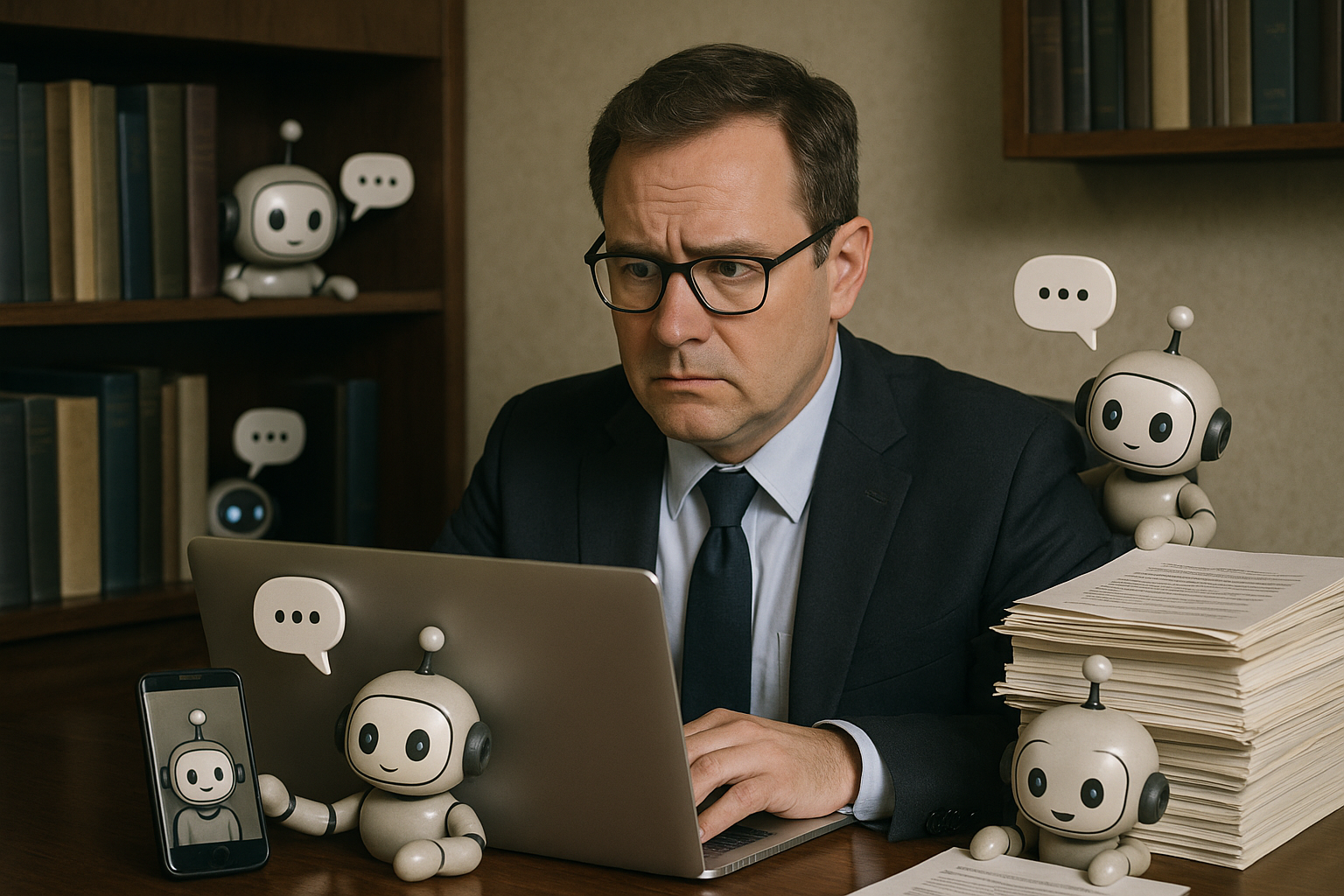
You can’t shake it. Everywhere you go, there it is. Of course, we’re talking about AI. It would not be unusual for nearly one-third or even one-half of the email in a print industry professional’s inbox to have at least some connection to the topic.
It used to be that most of the AI discussion revolved around content creation. But no more. Now we’re hearing about everything from chatbots to AI-facilitated affiliate marketing. What does it all mean?
Just for fun, we decided to take a single day’s worth of AI-related content from the inbox and distill it down and try to make sense of it. What we found was dozens of press releases, promotional emails, and editorial snippets from summary emails—all with wide ranging topics and perspectives—far more than any human being could quickly or easily distill.
So we asked the AI chatbot Claude to do it. We wanted to know, were there any trends that it could find? Do any threads tie them together? Within seconds, Claude had analyzed this mass of editorial and marketing information and provided the following analysis:
- AI is no longer a single story.
The sheer diversity of content—from career reinvention books to data breaches to shopping pilots—illustrates how AI isn't one technology anymore. It's the underlying fabric being woven into everything.
- The Anxiety-Opportunity paradox.
Content reflected messaging was both fear-based (jobs disappearing due to AI, the need to "future-proof" your career by using AI) and opportunity-focused (growth tools for small businesses, efficiency gains) coming in to the inbox side by side. “As a society, this reflects our collective ambivalence: AI as both threat and salvation.” Claude got that right.
- The trust gap is widening.
On October 13, Cybernews published the story that two AI companion apps, Chattee Chat and GiMe Chat, had exposed millions of intimate conversations from over 400,000 users. This story sat uncomfortably alongside pitches about using AI for highly personal tasks like allowing an AI chatbot to take your credit card information to pay for your holiday shopping. “We're being asked to trust AI with increasingly personal decisions while simultaneously learning it can't always be trusted with our data.”
- The "AI-Washing" gold rush.
Every vendor now, it seems, has an AI angle: TikTok ads, print training, translation services. Even nearly half of banks are adopting GenAI. But again, caution: “Many companies appear to be retrofitting AI into their pitch decks because they have to, not because the AI fundamentally changes their value proposition.” Certainly, that’s not new to AI!
- Human expertise is the counternarrative.
Smartcat, an AI-driven translation software, emphasizes “combining human expertise with AI” and the print training focuses on teaching people, not replacing them. The pushback against pure automation is already embedded in the sales pitches.
The Meta-Lesson
When you get more than a dozen AI press releases in one morning covering everything from chatbots for grocery shopping to social media analytics, it signals we've passed the "innovation" phase for this technology and entered the "integration chaos" phase. In the latter, everyone is simultaneously trying to adapt, profit from, and make sense of a technology that's bigger and more transformational for our industry than any of us likely expected this time one year ago.
The takeaway for you? If you’re not taking AI seriously and already investing in an AI strategy for the future, you’re way behind. This technology is moving so fast, and becoming so pervasive, that the time to start was long ago. So if you are among those taking the position that AI is a “nice to have” and not something you have to grapple with, think again—and don’t wait until you are too far behind to catch up.