If there is one trend in the AI world that you cannot ignore right now, it’s AI search. You can write your own emails, hire a copywriter for your marketing content, and pay a developer to create your apps. But you can’t stop the slow decline in your website traffic because of AI.
Here are some new stats from Accenture:
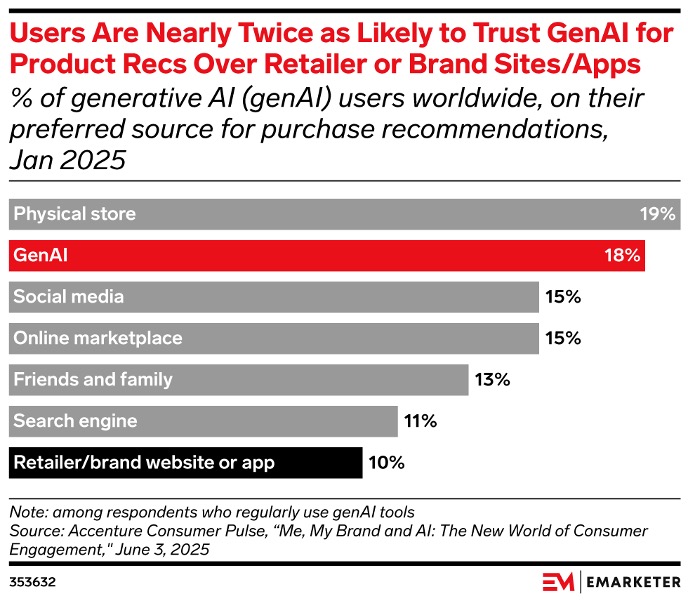
- 51% of US consumers trust generative AI (genAI) for shopping and product recommendations.
- Among genAI users, these platforms are the second most preferred source for purchase recommendations.
- Forty-one percent (41%) of GenZs trust AI more than humans.
AI is so trusted, in fact, that according to Bain & Co., traffic to companies’ websites is down 15% to 25%.
How is AI having such as impact on web traffic? There are two ways:
- AI Overviews. Starting in May 2024, Google added AI Overviews to its searches. Now, when you ask Google a question, the AI overview comes up first. These overviews can be from a short paragraph to multiple paragraphs or even a full page. These overviews can be so comprehensive that searchers often feel no need to go further. According to the study by Bain & Co., 60% of Google searches now result in no clicks at all.
Those Google AI Overviews often are the only source of information that people read.
- AI Search. The other impact, as we recently discussed, is AI-enabled search. In these cases, people are going to ChatGPT or other AI platform and conduct their searches from within them.
Instead of using Google to search for “commercial printer in Baltimore,” for example, they might go to ChatGPT and ask, “Who is the best commercial printer for four-color brochures on a fast turnaround?” ChatGPT will then scrub the Internet for everything from printers’ websites, to online reviews and social media posts, to articles from commercial printing trade publications. It will put together a curated list of recommended companies, often along with a comparison chart. These search results include links to those articles, reviews, and other content it is using to make its recommendations.
If you were doing a search, which approach would you prefer?
In the words of one Reddit user: “I just use Google far less [than I used to]. Maybe one in 10 searches now…The rest is Perplexity and CGPT. A specific habit is forming around asking questions differently. I start with the obvious question, then immediately follow up with asking for more context.”
Is Traditional SEO Still Relevant?
All of this means your effort put into traditional SEO is yielding you a lot less than it used to. No matter how good your SEO, you’ll likely never make it to the first page of the search results, if people even look at those search results at all. AI is the future of search.
How do you optimize your website for AI? This is leading to the rise of AI-optimization programs in the same way we saw the rise (and, potentially, the decline) of SEO optimization programs. The good news is that what you do to optimize your site for AI will also help with SEO, but as more and more people switch to AI search, will traditional SEO even be needed anymore?
Only time will tell. But in the meantime, how are you getting found in this changing search landscape?