Studies have historically found that consumers want their favorite brands to take a stand on issues they care about. But what happens when your customers are diverse and care about different things? Or when the priorities of different constituencies put them on opposite sides of an issue? You get a marketing minefield.
Recently, in its article “Brands and Politics,” Ipsos published multiple charts that illustrated the challenge.
Let’s take a look.
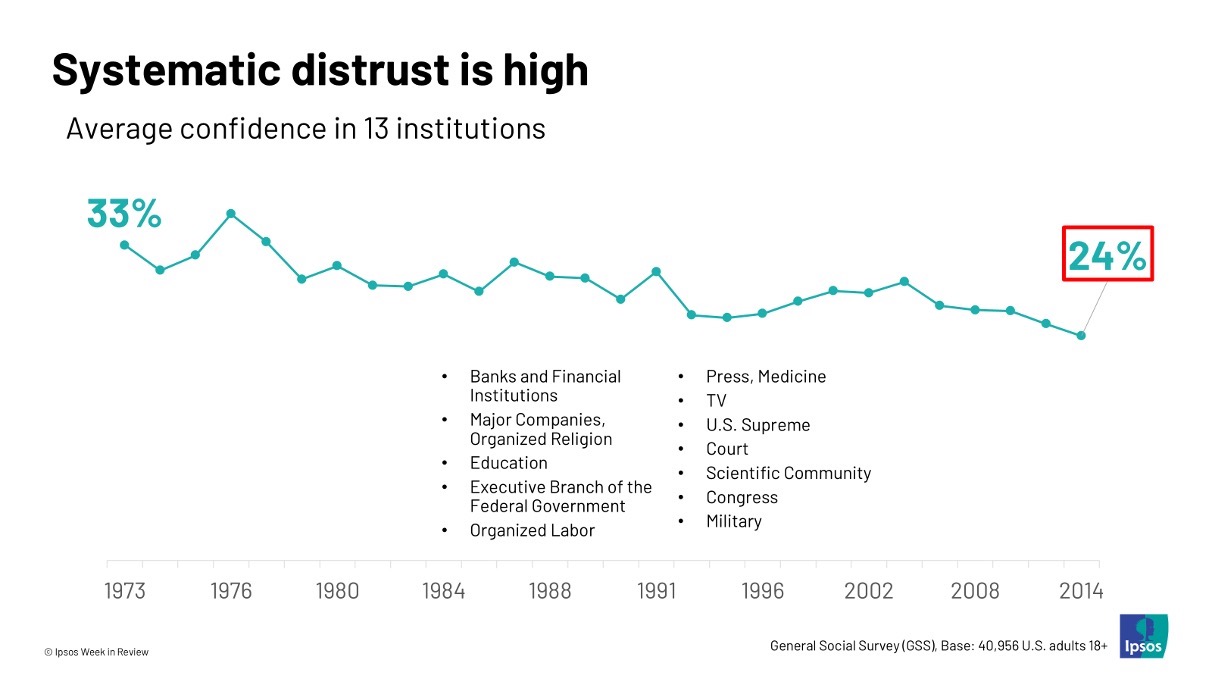
1. Systemic distrust is at an all-time high.
Between individuals and organizations behaving badly and the steady undermining of historically trusted organizations, Americans don’t know who to trust anymore. The average confidence in 13 well-known institutions tracked by Ipsos, ranging from banks and financial institutions to the U.S. military, has dropped from 33% of Americans feeling confident in these institutions in 1973 to 24% expressing this same confidence today.
2. Tread carefully in the War of the Words.
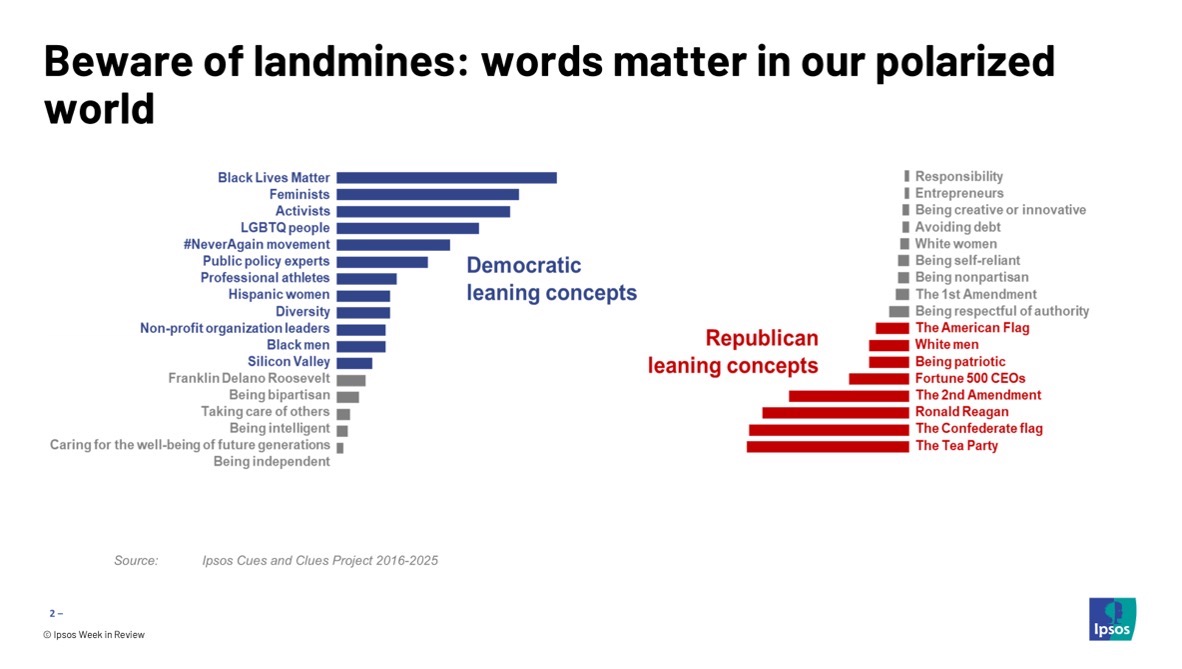
This drop in confidence is due, in part, to what we could call the War of the Words. In recent years, certain words and concepts—on both sides of the aisle—have been defined in ways that are highly polarizing. Americans who used to sit side by side in the church pew are now squared off in the boxing ring. Americans have not been this polarized in a long time.
3. Speaking up is risky.
This has created dilemmas for family dinners, as well as for office breakrooms. It has created dilemmas for brands, as well. Americans largely trust brands, which creates an opportunity for brands to speak into issues that they (and their customers) care about. Yet, this same opportunity creates substantial risk, as well. What happens when customers want them to take a stand, yet those customers are split on nearly every issue?
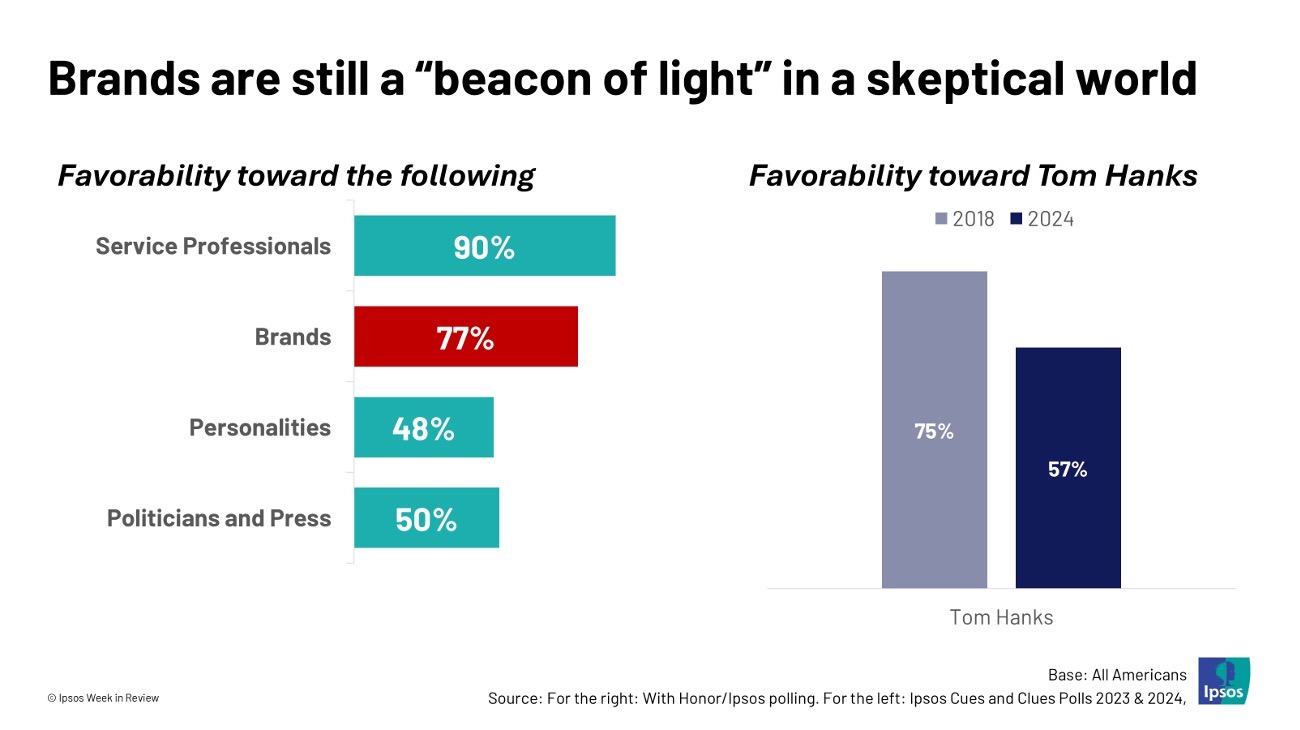
Even the venerable Tom Hanks has seen a tanking of his favorability after he chose to speak up on certain political topics. Hanks may weather such favorability erosion, but brands don’t always have the same luxury.
4. Brands walk a tightrope.
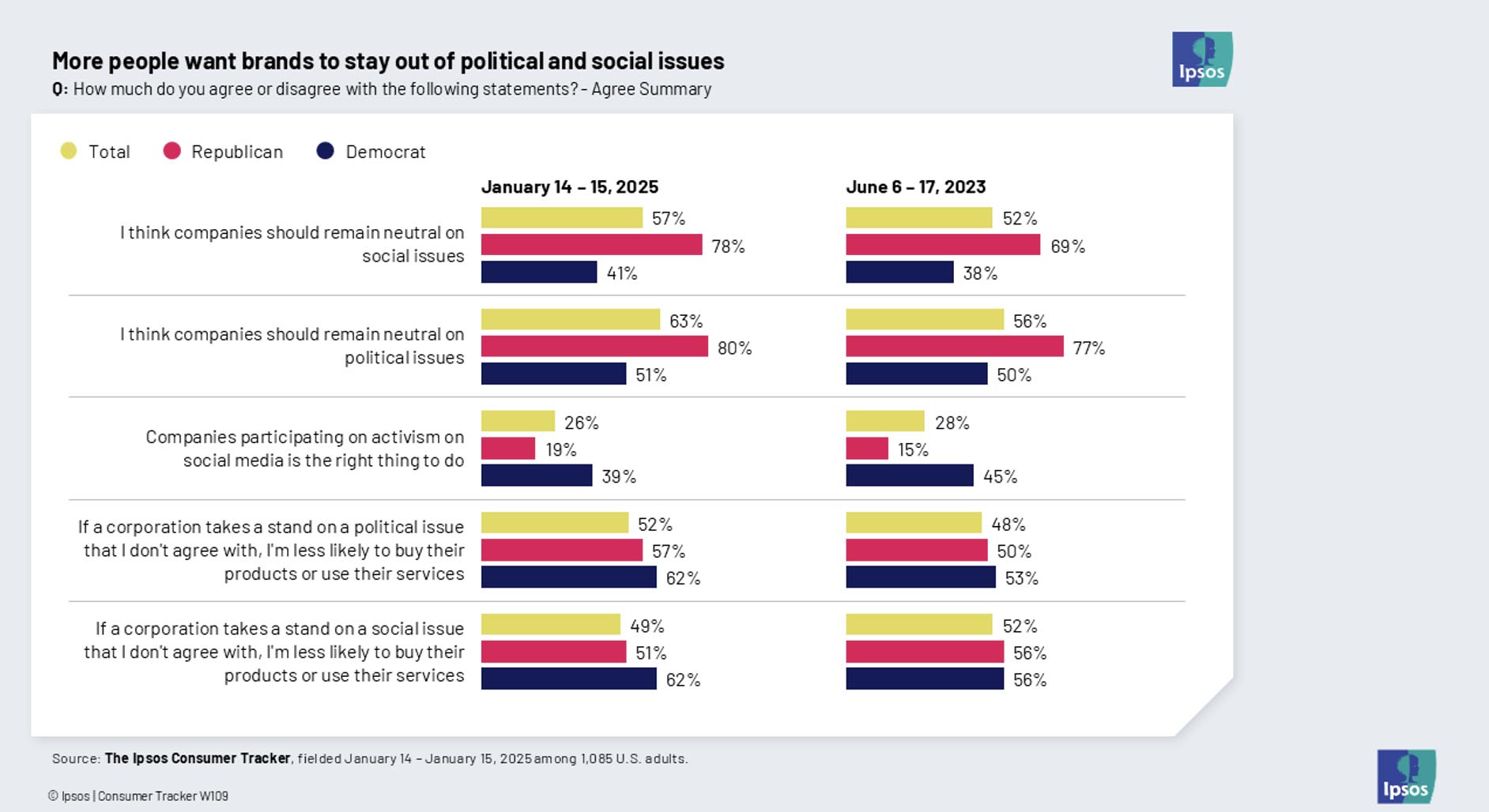
Indeed, a separate survey by Ipsos found that the percentage of consumers wanting brands to take a public stand on issues has actually decreased, from 57% thinking brands should stay neutral on political and societal issues, up from 52% two years ago.
5. Speaking up is riskier than ever.
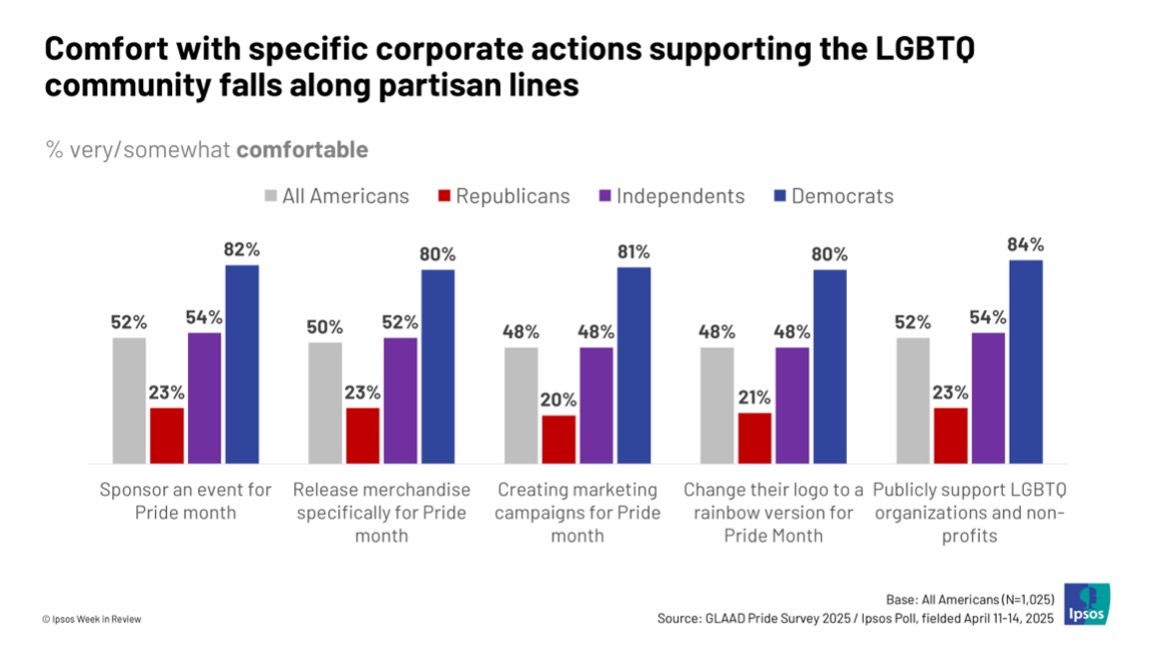
This makes speaking up far more risky than it used to be. To see just how much, consider Pride Month. When Ipsos asked about Americans’ level of support for corporations’ involvement in a variety of activities around this time, Americans were split along political fault lines. Less than one-quarter of Republicans were comfortable with any of the activities listed in the survey, while more than eight in 10 Democrats were. (Independents were square in the middle.) If you are a brand trying to publicly pick a side on an issue, unless 99.9% of your customers are on one side of the aisle or the other, you’re in trouble. Good luck finding that level of homogeneity!
A Shift in Landscape
So we’re seeing a shift in the landscape. While consumers may still want brands to take a stand, what they really mean is take a stand in ways that agree with them. How often does that happen for any constituency? So how brands take a stand (any stand) without alienating a large percentage of their customer base is becoming more of a challenge.
Thus, we may see brands embracing an old skill from the political world: Saying something without saying anything. In other words, instead of taking a clear stand on either side of an issue, they refine the skill of making general statements with near universal support instead.
In this, we might be reminded of the hilarious videos from YouTuber Jimmy Knowles when his characters Amygdala and Prefrontal Cortex lobby for two entirely different approaches to an apology, including “How to apologize without saying ‘I’m sorry.’” The concept applies here, as well: “How to take a stand on political and societal issues without picking a side.”
In other words, expect to see more brands focusing on universal values related to the issues, but keeping their responses non-polarizing. For example, a brand might say, “We believe in fairness, respect, and opportunity for all” rather than referencing DEI directly.
Will this tax the creativity of brands’ copywriting teams? Nah. That’s what ChatGPT is for!