Ever since Ross Cartwright was a little kid, he collected signs. “I always had interest in graphics and signage,” said Cartwright. “I had them hanging up in my room.” It seemed destiny that he would end up in the sign industry. After studying design at school, a chance meeting on a ski slope with the owner of Holthaus Signs in Cincinnati led to his being offered a job in Holthaus’s design department. “We did huge jobs with that company, including the Cincinnati Reds scoreboard,” he said. “We did a lot of really big projects for the biggest companies in Cincinnati and local universities as far as the University of Kentucky and University of Tennessee at Knoxville. We’d travel all over the country doing these big projects for these huge companies , schools, and organizations, and it really opened my eyes to how big this industry really was. Four days into it, I was hooked and knew that was something I wanted to do long term.”
This was 2008 and the Great Recession was just around the corner, and after two years with the company, he found himself laid off. Refusing to go on unemployment, he asked Holthaus if he could work for them one day a week. Combined with a couple other part-time jobs—including a fateful stint at the local FASTSIGNS franchise—he made it through the recession, and ultimately landed a full-time position with FASTSIGNS of Cincinnati overseeing production and installation.
“It was a whole different side of the signage industry, more of a smaller mom-and-pop type feel vs. a bigger manufacturing facility,” Cartwright said. “I didn’t think I’d like it at first, but I fell in love with the FASTSIGNS model and how it was set up.” What impressed him most was the ease of getting support, tech or otherwise. “If our printer went down, I had somebody at the touch of a button that I could call and get help,” he added. “What made it a lot easier to learn this business was being part of the FASTSIGNS network.” He stayed with FASTSIGNS Cincinnati for four years, ultimately co-running the business with owner Jeff Cline. “We really clicked and had a good vibe,” he said. “We had a great team, we really had a lot of fun, and we grew the center.”
Cartwright aspired to ultimately buy the business, but Cline wasn’t ready to sell or retire. “He had kids that were in college and still needed a decent income,” Cartwright said. “We didn’t get to that point for me to buy the location, and I wasn’t really willing to wait around for another few years to see what happened. So he recommended that I reach out to the corporate office and see what they had available.”
So, two weeks later, he packed up and moved to Dallas to join the FASTSIGNS training team, where he spent the next four years training new FASTSIGNS franchise owners, as well as the sales and graphic design employees that came through the training program with them.
I’ve interviewed enough sign franchise owners over the years—both FASTSIGNS and other networks—and a common denominator is that the majority of franchise owners come from outside the sign and graphics industry. Cartwright found that some new owners were quicker studies than others—and that, admittedly, most new owners don’t quite know what they’re getting themselves into. “So my goal in those two weeks was to give them a real-life feel for what the ‘day in the life’ of a FASTSIGNS center was,” said Cartwright. “How fast-paced it would be in creating orders, and the phones are ringing and you’re trying to create an estimate and you’ve got three more coming in. We created a kind of boot camp and gave them real-life scenarios where they had to work with their team to output these projects in a quick manner.”
After the two-week crash course was up, the FASTSIGNS training team remained on call to answer questions and solve whatever unanticipated problems arose. “Some people would get it pretty quickly and we wouldn’t hear from them much, and some people needed a lot more handholding,” he said. “But that’s the beautiful part about the FASTSIGNS corporate offices: they’ve got 140 or 150 employees that are a call away for support in any area, which makes it a lot easier for guys that don’t have any experience.”
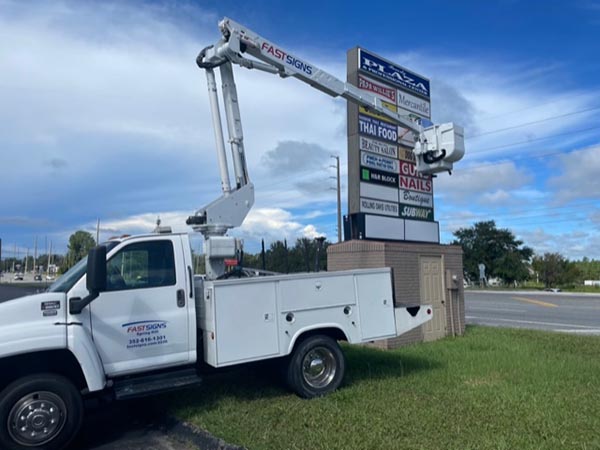
He spent four years in corporate training, and then five more in the operations department serving as a business consultant for 65 franchisees in the Midwest region. So after nine years in corporate, Cartwright’s wanderlust kicked in again and he returned to his original plan of buying a FASTSIGNS franchise. And, as it happened, one came available post-COVID, in Spring Hill, Fla. “The [previous] owner bought in 2019 , had to deal with COVID right away, and they were not able to make money quickly enough and wanted to find an exit,” said Cartwright. “Luckily, I was there pretty quickly and was able to be in a position to turn the franchise around.” And who better to save a distressed FASTSIGNS center than someone who spent the four years training new owners? “We had to come in and work on pricing, we had to work on how the point of sale system was set up—we had to make a lot of changes,” he said. “I’d probably put in 60 or 80 hours the first week just on the point of sale system alone.”
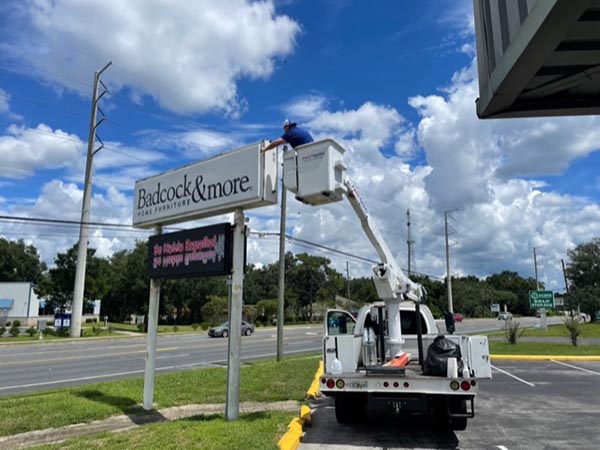
He also discovered that the center had no inventory, so he had to quickly stock up on supplies. You can probably see where this is going, but, in actuality, Cartwright said, “I hadn’t had any issues with the supply chain at all, surprisingly, and that was one thing that I was a little worried about.”
Cartwright took over the center in August 2022 and, when we spoke, he had been owner of FASTSIGNS of Spring Hill for fewer than 90 days. His goal, once he gets the center back up to speed, is to expand the number of verticals the center serves. His biggest client so far is Access Health, a local health care provider, but he is looking to expand his client base in local government, fire stations, and power and utility companies. “They are great customers for other FASTSIGNS locations, and we’ve got several property management companies that we do a lot of ongoing work for as well.
“We’re really excited to grow in this area,” he concluded. “Our goal is to double sales within the next year just based on the strategy of saying yes to everything that comes through the door and providing the best possible customer service we can. We’re definitely on the right track.”